A frayed rug edge can often be stabilized before the damage spreads, but the safest repair depends on how the rug is made. Minor fraying on a modern, machine-made bound edge may be trimmed and reinforced at home. Handmade, antique, silk, wool, collectible, or structurally damaged rugs need more caution because their edges and fringe may be part of the rug’s foundation.
Quick Answer
To fix a minor frayed rug edge, first identify whether the damaged area is applied binding or part of the rug’s woven structure. Trim only loose, nonstructural fuzz, then reinforce a suitable modern rug with compatible edge sealant, sewn binding tape, or careful stitching. Avoid cutting or gluing valuable, handmade, antique, silk, or structurally weak rugs.
Key Takeaways
- Do not pull loose yarns; pulling can extend the damage into sound material.
- Confirm that you are working on replaceable binding or a sturdy modern edge before cutting, gluing, or stitching.
- Adhesive or edge sealant is not a universal rug repair. Use it only when the product is compatible with the rug and the repair is appropriate for that construction.
- Handmade, antique, silk, heirloom, collectible, or structurally weak rugs are better assessed by an experienced rug or textile professional.
- Prevent repeat damage with gentle vacuuming, prompt spill care, and regular inspection of edges and backing.
At a Glance
| Time Required | About 15–45 minutes of active work for a small DIY repair, plus the full cure time specified by any adhesive or sealant used. |
| Difficulty | Easy to moderate for minor damage on a sturdy modern rug; professional skill is recommended for handmade, antique, fragile, or structurally damaged rugs. |
| Tools Needed | Sharp scissors, suitable needle, colorfast repair thread, and—only when appropriate—binding tape or a compatible rug-edge sealant. |
| Cost | Usually low for a small DIY repair. Professional cost varies with rug size, construction, fiber, condition, and the amount of reconstruction required. |
Identify the Rug Edge Before You Repair It
Before cutting or sealing anything, look closely at the construction. A repair that works on applied binding can damage a handwoven edge.
- Bound edge: A strip of fabric is folded around the perimeter and sewn to the rug. This is common on machine-made rugs and is often suitable for replacement or reinforcement.
- Serged edge: Dense yarn wraps around the edge in visible stitching. Loose surface yarn may sometimes be restitched, but widespread failure usually calls for re-serging.
- Handwoven selvage: The side edge is part of the original weave. Cutting or gluing structural yarns can accelerate loss.
- Fringe or warp ends: On many handmade rugs, the fringe extends from foundation yarns rather than being decorative trim. Do not assume it can simply be cut off.
- Tufted rug: The pile may be secured into backing with adhesive and a secondary backing layer. If the backing is brittle, separating, or shedding powder, edge repair alone may not solve the underlying failure.
Warning: Do not trim structural yarns, glue loose fringe to the rug, or apply household hot glue, super glue, or contact cement to an antique, handmade, silk, collectible, or valuable rug. If you cannot tell whether the loose yarn is structural, stop before cutting it.
Why Rug Edges Fray
Rug edges often fray because the perimeter receives repeated foot traffic, abrasion, flexing, and vacuum contact. Once binding or edge stitches loosen, unsupported fibers can begin separating.
Dirt also contributes to wear. The Canadian Conservation Institute notes that embedded dirt and dust can abrade rug fibers and that wear is a major source of damage.
Vacuuming technique matters as well. Power heads and rotating brushes can catch vulnerable fibers or fringe. The Carpet and Rug Institute recommends gentle suction around fringed area rugs and care not to catch the strands in a beater bar.
Moisture, unsuitable cleaning products, dragging furniture, pet scratching, and aging backing materials can also weaken an edge. When more than one problem is present—such as failing backing plus heavy traffic—the visible fraying may be only one part of the damage.
How to Fix a Frayed Rug Edge at Home
A minor frayed rug edge on a sturdy modern rug can often be stabilized at home. Work slowly and stop if the edge begins losing structural yarns or the backing starts separating.
- Inspect the construction. Confirm that the damaged material is applied binding, serging, or another repairable modern edge rather than structural warp, weft, or handmade selvage.
- Lay the rug flat. Work on a clean surface with the damaged edge fully supported.
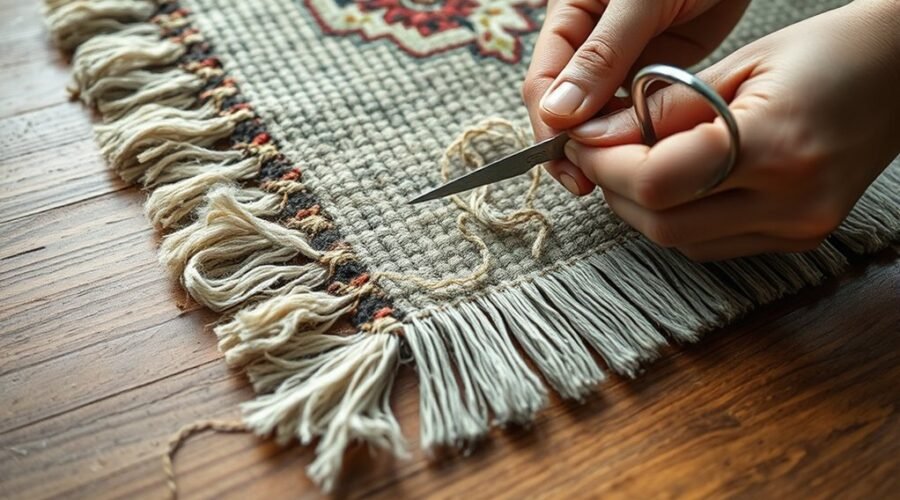
- Trim only loose, nonstructural fuzz. Use sharp scissors and cut close to the existing edge without pulling on yarns.
- Choose the least aggressive repair. A small loose section may need only stitching. Wider damage on a modern bound rug may need new binding tape. A compatible edge sealant may be used on an appropriate modern rug when its manufacturer directions allow it.
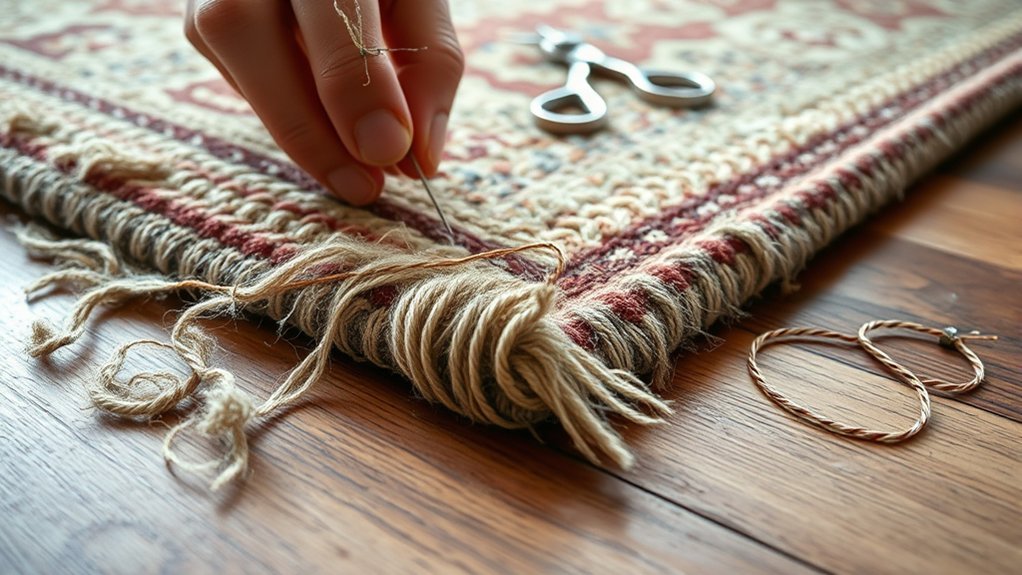
- Anchor stitches in sound material. Avoid repeatedly piercing already weakened fibers.
- Allow the repair to settle or cure. Follow the label of any adhesive or sealant rather than assuming a fixed drying time.
- Check the edge before returning the rug to normal use. The repaired area should lie flat without puckering, hard ridges, lifted tape, or continuing yarn loss.
Pro Tip: Photograph the damaged edge before beginning. If unraveling continues after the first repair, compare the new condition with the photo instead of repeatedly adding more glue or stitches.
Trim Loose Threads and Seal the Edge
Careful trimming can reduce snagging, but only clearly loose, nonstructural fibers should be cut. Never pull a loose yarn to see where it ends; that can extend the unraveling into sound material.
For a compatible modern rug, a purpose-made edge sealant or textile adhesive may help stabilize a small cut edge. Test the product in an inconspicuous area first and follow its application and cure instructions. Avoid saturating the fibers, because a stiff repair can concentrate stress where the hardened area meets the flexible rug.
| Action | Result |
|---|---|
| Trim only loose, nonstructural fuzz | Reduces snagging without intentionally cutting sound yarns |
| Use compatible sealant sparingly when appropriate | May stabilize a minor modern cut edge |
| Allow full cure per product label | Prevents premature flexing or traffic on the repair |
| Inspect regularly | Catches renewed unraveling before it spreads |
If the edge becomes unusually hard, changes color, remains tacky, or continues unraveling after treatment, stop adding product. That is a sign the material or repair method may not be suitable.
Use Binding Tape for Extra Support
Binding tape can reinforce a modern rug when the existing applied edge is worn but the surrounding backing remains sound. Choose tape with a width, weight, and flexibility appropriate for the rug, and extend it beyond the damaged area so the repair can anchor into intact material.
Position the tape evenly around the edge. If the product is sew-on binding, hold or pin it in place and sew through sound material rather than relying on glue. If it has an adhesive component, follow the manufacturer’s instructions and confirm that it is intended for the rug material involved.
A durable repair should transfer stress into sound material without creating a hard, rigid edge beside weakened fibers.
Use a needle and colorfast thread appropriate for the rug’s weight. The Canadian Conservation Institute’s textile-stitching guidance emphasizes choosing appropriate thread and support materials rather than simply using the strongest thread available.
When a Frayed Rug Edge Needs Professional Repair
Professional repair is appropriate when the problem involves the rug’s structure rather than only a small piece of applied binding. The length of the damaged area alone is not a reliable cutoff.
Seek an experienced rug repairer or textile conservator when:
- foundation yarns, warp, weft, knots, or handmade selvage are exposed or disappearing;
- fringe is pulling out of the body of a handmade rug;
- the rug is antique, collectible, handmade, silk, fragile, or has significant sentimental value;
- the backing is separating, crumbling, distorted, or tearing away from the pile;
- previous glue, tape, or stitching has hardened, discolored, or distorted the edge;
- the rug will not lie flat after repair;
- unraveling continues despite a careful minor repair.
The National Park Service guidance on textile conservation emphasizes selecting necessary treatments that minimize harm and preserve options for future care. That principle is especially important for rugs whose historical or material value exceeds the cost of a simple replacement.
How Pros Fix Frayed Rug Edges
Professionals choose a repair method after examining the rug’s fiber, weave, backing, condition, edge construction, previous repairs, and intended use.
- Hand-serging or edge stitching: Suitable stitching can secure vulnerable edges while placing stitches into sound material.
- Machine binding: Many sturdy modern rugs can receive new fabric binding by machine when their construction supports it.
- Support stitching: Fragile areas may be secured to an appropriate support rather than pulled tightly together.
- Selvage or structural repair: Handmade rugs may require reconstruction or stabilization of original edge structures.
- Fringe or warp-end treatment: A professional determines whether damaged ends should be stabilized, reconstructed, or left with minimal intervention.
- Blocking or alignment work: Distorted rugs may need controlled reshaping rather than a simple edge patch.
Conservation-grade repairs aim to stabilize the rug without placing unnecessary tension on weakened original fibers. For important textiles, preserving original material is often more important than making the repair visually invisible.
How to Prevent Rug Edge Fraying
Prevention starts by reducing abrasion and avoiding cleaning methods that pull on the perimeter.
- Vacuum gently near edges. Use low or appropriate suction and keep rotating brushes or power heads away from vulnerable fringe and loose fibers.
- Follow the rug manufacturer’s care instructions. Wool, washable synthetic rugs, handmade rugs, and tufted rugs can require different methods.
- Blot spills promptly. Do not scrub aggressively, which can distort or fray fibers.
- Do not drag furniture across the rug. Lift furniture when practical so the edge is not stretched or crushed.
- Rotate the rug when appropriate. This can distribute traffic and light exposure more evenly.
- Use a suitable rug pad when recommended. Reducing sliding and repeated edge movement can help limit abrasion.
- Inspect the perimeter regularly. A small loosened stitch or binding section is easier to address than a long area of lost structure.
The Canadian Conservation Institute recommends regular, careful vacuuming for rugs in sound condition and advises avoiding power heads on vulnerable carpets and rugs. Cleaning frequency should be based on the rug’s condition, soil level, construction, and manufacturer guidance rather than an automatic annual schedule.
Tools and Materials for Frayed Rug Edges
A small repair requires fewer tools than many people expect. The goal is controlled work, not maximum force.
- small, sharp scissors for clearly loose fibers;
- a needle sized for the rug and repair material;
- colorfast repair thread appropriate for the rug’s strength and fiber;
- sew-on binding tape for a compatible modern bound edge;
- a purpose-made edge sealant or textile adhesive only when appropriate for the material;
- a clean, flat work surface;
- good lighting so structural yarns can be distinguished from loose fuzz.
Essential Repair Tools
Sharp scissors allow precise trimming without tugging on the edge. A properly sized needle should pass through the material without forcing an oversized hole, while the thread should be strong enough for the repair without being dramatically stronger than fragile surrounding fibers.
A flat support under the damaged area keeps the rug steady during stitching. Foam board may be useful as a temporary work support in some situations, but it is not an essential repair material and should not be sewn into a floor rug unless it is part of a specialist conservation mounting system.
For valuable or fragile textiles, CCI conservation guidance recommends thoughtful matching of thread and support materials and relaxed stitching that does not introduce harmful tension.
Best Edge Materials
The best material depends on the rug rather than on one universal thread or brand.
For a sturdy modern bound rug, compatible woven binding tape and colorfast thread can provide a practical repair. For serged edges, matching repair yarn may be more appropriate. For fragile textiles, professional support stitching may use materials selected specifically for the existing fiber and condition.
A rug edge sealant can be useful on some modern synthetic or machine-made edges, but it should be tested first and used only when the product is suitable for that fiber and backing. Avoid assuming that general craft glue, crochet thread, carpet warp, or upholstery thread is automatically appropriate for every rug.
Note: If the rug’s backing is crumbling or separating, attaching stronger material only to the edge may move the stress inward instead of solving the underlying failure.
Repairing vs Rebinding a Frayed Rug Edge
Minor stabilization and complete rebinding solve different problems. A small repair preserves an edge that is still mostly sound. Rebinding replaces or covers a perimeter whose original applied binding can no longer support normal use.
Minor Fraying Repairs
Minor fraying is a good DIY candidate when the rug is modern and sturdy, the backing remains intact, structural yarns are not disappearing, and only a small section of applied binding or surface fiber is loose.
A controlled repair may involve:
- identifying which fibers are truly loose;
- trimming only nonstructural fuzz;
- restitching a loose section into sound material;
- using compatible sealant sparingly when the rug and product instructions support it;
- monitoring the repair for renewed movement.
If the repair immediately starts pulling on adjacent material, remove tension and reassess instead of adding tighter stitches.
When Rebinding Makes Sense
Rebinding makes sense when an applied fabric binding on a modern rug is worn through, detached in multiple areas, or no longer protecting the edge even though the rug’s underlying structure remains repairable.
Professional machine binding can provide a clean perimeter on rugs built for that method. Hand-serging may be more appropriate for other edges. Handmade and collectible rugs require a different evaluation because replacing an original edge indiscriminately can remove or conceal structural and historical material.
For sentimental or valuable rugs, a professional assessment can also determine whether stabilization is preferable to cosmetic reconstruction.
Choosing The Best Fix
Choose the repair by construction and condition rather than by appearance alone.
- Identify the edge: Determine whether it is applied binding, serging, handmade selvage, fringe, or part of a failing backing system.
- Check structural loss: If foundation yarns or backing are failing, a surface patch is unlikely to be enough.
- Consider value and fiber: Antique, handmade, silk, collectible, or otherwise valuable rugs warrant conservative treatment.
- Use the least aggressive effective repair: A few relaxed stitches may be preferable to saturating an edge with adhesive.
- Watch the repaired area: Puckering, stiffness, discoloration, lifted tape, or continued unraveling means the method should be reassessed.
Frequently Asked Questions
How Can I Fix a Fraying Rug Edge?
First identify the type of edge. On a sturdy modern bound rug, trim only loose nonstructural fibers, then restitch the binding, add suitable binding tape, or use a compatible edge sealant if its instructions allow it. Do not pull yarns. If structural fibers, handmade selvage, or valuable materials are involved, use a professional repairer.
How to Fix a Rug That Is Unraveling?
Stop traffic over the damaged edge and do not pull the unraveling yarn. Determine whether the loose material is binding, serging, fringe, or a structural yarn. Minor modern binding damage may be stitched or rebound. Continuing structural unraveling, backing separation, or damage to a handmade rug should be professionally assessed.
How Can I Repair a Frayed Carpet Edge?
For a removable rug or carpet remnant with a bound edge, loose applied binding can often be restitched or replaced with suitable binding material. Installed carpet has different edge and transition requirements, so damage near a doorway, seam, tack strip, or transition may be better handled by a carpet installer.
How to Fix the Edge of an Area Rug?
Check whether the area rug has fabric binding, serging, or a woven structural edge. Small binding failures on sturdy modern rugs may be sewn back into sound material or rebound. Handmade, antique, silk, or structurally damaged area rugs should not be trimmed or glued until their construction has been evaluated.
Can I Use Hot Glue on a Frayed Rug Edge?
Hot glue is not a good default repair for a valuable or structurally damaged rug. It can create a stiff area, complicate later treatment, and may not be compatible with the rug fiber or backing. If an adhesive repair is suitable for a low-value modern rug, use a product specifically intended for the material and follow its instructions.
When Can I Vacuum the Rug After an Edge Repair?
Wait until any adhesive or sealant has completely cured according to its product label. Afterward, use gentle suction near the repaired edge and keep a rotating brush or beater bar from catching loose yarns, fringe, or the new binding.
Conclusion
A frayed rug edge is easiest to manage before structural yarns begin disappearing. For a sturdy modern rug, small areas of loose binding may be trimmed carefully, restitched, rebound, or stabilized with a compatible product. The key is knowing what you are cutting or attaching before starting.
Do not treat handmade selvage, structural fringe, fragile fibers, failing backing, or a valuable rug as an ordinary craft repair. In those cases, conservative professional treatment can prevent a minor worn edge from becoming permanent structural loss. After any repair, reduce abrasion, vacuum gently, and inspect the edge periodically for renewed movement.
Sources
- Canadian Conservation Institute — Basic Care: Carpets and Rugs — rug wear, handling, vacuuming, moisture, cleaning, and preservation guidance.
- Canadian Conservation Institute — Stitches Used in Textile Conservation — appropriate threads, support materials, and stitching methods for weak and frayed textiles.
- The Carpet and Rug Institute — Cleaning and Maintenance — area-rug vacuuming, fringe care, spill treatment, and professional care for heirloom rugs.
- National Park Service — Curatorial Care of Textile Objects — principles for minimally harmful textile conservation and repair.