
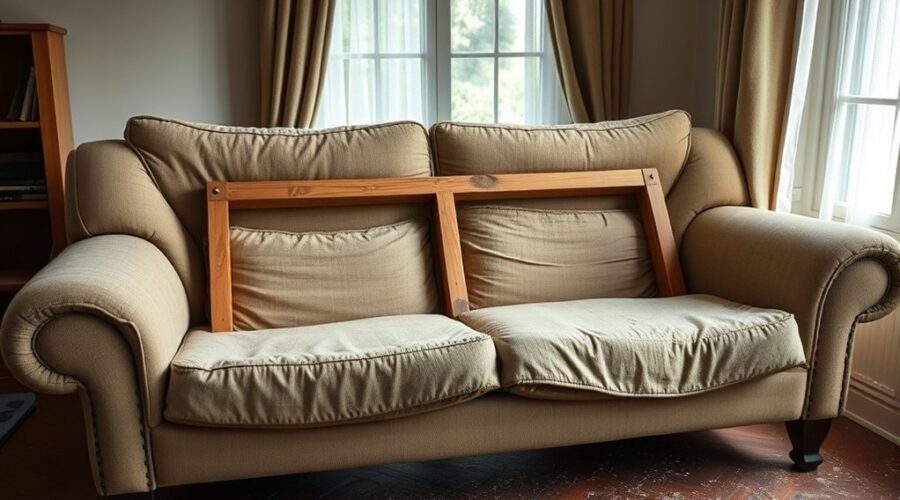
A sagging sofa can usually be narrowed down to one of four areas: the cushion filling, the seat suspension, the frame, or a combination of them. Start by removing the cushions and testing them separately from the sofa. If the cushions stay flat on their own, focus on the filling. If the bare seat deck still dips, inspect the webbing, springs, clips, and frame before buying new foam.
Quick Answer
To fix a sagging couch, first test the cushions on a flat surface. Replace or rebuild cushions that stay compressed. If the sofa still sags with the cushions removed, inspect the webbing, springs, clips, legs, and frame. A fitted support board can improve firmness in some sofas, but it will not repair broken structural parts.
Key Takeaways
- Test removable cushions away from the sofa before assuming the springs or frame are bad.
- A dip that remains with the cushions removed points toward webbing, springs, the seat deck, or the frame.
- Foam density affects durability and support, but density is not the same thing as firmness.
- Plywood can create a firmer platform, but it should not be used to hide broken springs, protruding hardware, or frame failure.
- Disconnect powered furniture before moving or servicing it, and get help when turning a heavy sofa over.
At a Glance
| Time Required | A few minutes for diagnosis; longer if foam, webbing, springs, or structural parts need repair. |
| Difficulty | Easy for cushion rotation or a pre-cut support board; moderate to advanced for suspension or frame repairs. |
| Tools Needed | Flashlight, tape measure, gloves, and a helper; optional plywood, sandpaper, screwdriver, staple puller, upholstery tools, or replacement parts. |
| Cost | Varies widely: rotating or redistributing filling may cost nothing, while new foam, suspension parts, structural repair, or professional upholstery work costs more. |
What’s Causing Your Sagging Couch?

A sagging couch usually loses support in one of four places: the cushion filling, the suspension beneath the cushions, the frame or legs, or several of these areas at once.
Compressed polyurethane foam can lose height, resilience, and support after repeated use. Loose fiber, feather, or down filling can also migrate away from the center of a cushion and make it look hollow even when the sofa underneath is sound.
When the cushion looks normal away from the sofa but the bare seat deck dips, the problem is more likely to be stretched webbing, a detached spring, a broken clip, a damaged deck, or another suspension component.
A sofa that leans, rocks, creaks heavily, or sits lower on one side may have a loose leg, failed center support, weakened joint, or damaged frame rail. The repair should match the failed layer instead of simply adding more padding.
| What You Notice | Likely Area to Check | Next Step |
|---|---|---|
| Cushion stays flat on the floor | Foam or loose filling | Inspect or rebuild the cushion |
| Seat still dips with cushions removed | Webbing, springs, clips, or seat deck | Inspect the suspension |
| One area suddenly drops or makes a metallic noise | Spring, spring clip, or local support | Stop loading the area and inspect underneath |
| Whole sofa rocks, leans, or twists | Legs, center supports, joints, or frame | Check structural parts before cushion repair |
How to Tell Whether Cushions or Support Are Failing
The simplest diagnosis is to separate the cushion from the sofa. Put each removable cushion on a firm, flat surface and compare its height, shape, and resistance with the other cushions. Then press the bare sofa deck in the same seating positions.
If the low spot follows one particular cushion when you move that cushion to another seat, the cushion is probably the main problem. If every cushion sinks in the same location on the sofa, inspect the support below.
Cushion Recovery Test
Press each cushion firmly and release it. A cushion that remains visibly dished, bottoms out easily, has a crumbling core, or feels much softer than a less-used cushion may need new foam or new filling.
Loose fiber, feather, and down cushions require a different test. Open the cover if it is designed to be opened and check whether filling has shifted into the corners or away from the center. Redistributing and fluffing that material can restore shape when the filling itself is still serviceable.
Foam selection should not be based on density alone. The Polyurethane Foam Association explains that density influences durability and support, while firmness is measured separately as indentation force deflection, or IFD. Support factor and fatigue performance also affect how a seat cushion behaves over time.
Pro Tip: Before ordering replacement foam, measure the existing core and the inside dimensions of the cushion cover. A thicker or firmer insert is not automatically better; an oversized core can distort seams and change how the cushion fits the sofa.
Check Suspension Support
If the cushions recover normally, remove them and press the bare seat deck by hand. Compare the center, front edge, rear edge, and each seating position. The deck should resist pressure consistently rather than dropping sharply in one spot.
Look for stretched or detached webbing, broken or displaced springs, loose spring clips, torn decking material, and gaps where one part of the suspension no longer matches the others.
Creaking alone does not prove that a spring is broken, but a new metallic pop, scraping sound, sudden local dip, or visible detached hardware deserves closer inspection.
- Remove all loose cushions.
- Press the bare seat deck in several locations.
- Compare resistance from seat to seat.
- Look underneath for visible gaps or detached parts.
- Check whether a spring or clip is protruding into fabric.
Spot Frame Damage
Check the legs, center supports, seat rails, corner joints, arms, and back for movement before assuming the cushion or suspension is responsible. A loose leg or failed support can make one end of an otherwise sound sofa sit lower.
Warning: Get help before lifting or turning over a heavy sofa. If the furniture has powered reclining, heating, massage, USB, or other electrical features, disconnect it from power before moving or servicing it and follow the manufacturer’s instructions. Keep hands away from moving mechanisms, exposed staples, and damaged springs.
| Checkpoint | What to Observe | What It May Mean |
|---|---|---|
| Underside and seat rails | Cracks, split wood, shifted joints | Structural repair may be needed |
| Arms and back | Excess movement or widening joints | Loose or damaged connections |
| Legs and center supports | Loose hardware, missing support, uneven contact | Sofa may lean or sag on one side |
| Seat deck | One local area drops much farther | Suspension or frame fault below that position |
Check the Cushions for Foam Failure
Foam failure is more likely when a cushion has permanently lost height, feels noticeably softer than comparable cushions, bottoms out easily, or shows crumbling or torn foam when the cover is opened.
Do not use age alone to decide whether foam needs replacement. Flexible polyurethane foam can be produced with different densities, firmness levels, support factors, and fatigue resistance, so two cushions of the same age can perform very differently.
- Remove a zippered cover only if the cushion is designed for access.
- Inspect the foam for permanent depressions, tears, crumbling, or uneven thickness.
- Compare heavily used cushions with lightly used cushions.
- Check whether loose fill has merely shifted before replacing it.
- Choose replacement foam by intended seating use, dimensions, density, firmness/IFD, and support characteristics rather than density alone.
- Add polyester batting when appropriate to smooth the cushion profile and soften the transition between the foam and cover.
Higher foam density generally improves durability and support, but density does not tell you how firm the cushion will feel. Firmness and support are separate performance characteristics.
Inspect Springs, Webbing, and the Frame
If the bare seat deck sags, inspect the suspension and frame before installing new cushion foam. Depending on the sofa, support may come from sinuous springs, coil springs, elastic webbing, jute webbing, a manufactured spring unit, or a combination of parts.
Check the owner’s manual and warranty terms before removing a stapled dust cover, especially on newer, powered, reclining, or specialty furniture. Opening the underside can expose moving mechanisms, electrical wiring, sharp staples, and tensioned suspension parts.
Spring And Webbing Check
With the sofa safely supported and disconnected from power when applicable, use a flashlight to inspect accessible suspension parts. Springs should remain attached at their intended mounting points, and webbing should not have obvious tears, detached ends, or large areas of slack compared with neighboring straps.
- Look for detached spring ends or damaged clips.
- Check whether a spring has shifted out of line with the others.
- Look for torn, frayed, or detached webbing.
- Compare tension across neighboring webbing straps.
- Inspect the wood where springs or webbing attach; replacement hardware will not hold well in badly damaged attachment points.
Reattaching webbing, replacing spring clips, or working with tensioned springs may require upholstery tools and experience. If a spring is broken, sharply deformed, or difficult to control safely, professional repair is the better option.
Frame Damage Inspection
Inspect the wooden or engineered frame members for cracks, separated joints, loose corner blocks, missing fasteners, and rails that have shifted out of position. Also check legs and center supports because an external support failure can mimic an internal frame problem.
| Component | Possible Fault | Typical Effect |
|---|---|---|
| Frame or seat rail | Crack, split, or loose joint | Seat may lean, move, or lose support |
| Sinuous spring | Detached clip, deformation, or break | Local dip or uneven support |
| Webbing | Stretching, tear, or detached end | Broad hammock-like sag |
| Leg or center support | Loose, bent, missing, or not contacting the floor correctly | One side or the center sits low |
Frame damage does not automatically mean the sofa must be discarded. Some loose joints, damaged rails, and support components can be repaired by an upholsterer or furniture-repair professional. Widespread cracking, repeated failures, severe water damage, or repair costs approaching replacement value make replacement less attractive.
Fix Sagging Couch Cushions
If testing confirms that the cushion is the problem and the sofa deck remains supportive, work on the cushion rather than reinforcing the entire sofa.
Sagging couch cushions may need redistributed filling, additional batting, or a new foam core depending on what has actually lost support.
For loose-fill cushions, unzip the cover when designed to open, redistribute the material, and break up compacted areas by hand. Feather, down, and fiber cushions may need regular fluffing because their filling naturally moves during use.
For a failed foam core, measure the existing core and cushion cover carefully and choose upholstery foam suited to seating. A foam supplier can help match firmness, density, support, and thickness to the original design and the feel you want.
Batting can smooth minor surface irregularities and add loft around an otherwise serviceable foam core, but it cannot restore a foam core that has permanently collapsed.
- Compare the suspect cushion with another cushion.
- Check whether the problem is foam or loose filling.
- Measure the existing core before ordering replacement material.
- Use batting only when it improves fit and surface feel.
- Rotate reversible cushions periodically to distribute wear.
Add Support Under a Drooping Seat
A fitted plywood support board can make a weak seat feel firmer by spreading load across a larger area. It is most useful when the supporting surface has become too flexible but the frame rails that will carry the board are still sound.
Measure the usable seating area from the internal support edges rather than simply copying the outside dimensions of the sofa. Cut the board so it rests flat without forcing the frame outward, then sand the edges and corners so they cannot snag fabric.
- Remove the cushions and inspect the seat for protruding springs, broken parts, or sharp hardware.
- Measure the area the board can safely span.
- Cut plywood to fit or have it cut at a hardware store.
- Sand every exposed edge and corner smooth.
- Set the board flat on sound support points and make sure it cannot rock or shift.
- Replace the cushions and test the seat gently.
Note: A board changes how the seat flexes and can make a sofa feel noticeably firmer. It should not be used to cover a broken spring, unstable frame, protruding hardware, or another defect that still needs repair.
For a practical overview of inspecting and reinforcing a sofa base, see Lowe’s sagging-sofa repair guide.
When to Repair or Replace Your Sofa
The decision to repair or replace a sofa should be based on the number and severity of failed components, the condition of the upholstery, the quality of the original construction, sentimental value, and the cost of restoring it correctly.
| Condition | Repair Often Makes Sense When | Replacement Becomes More Reasonable When |
|---|---|---|
| Cushions | Frame and suspension are sound and only filling has deteriorated | Cushion failure is combined with major structural and upholstery damage |
| Springs or webbing | Damage is localized and attachment points remain sound | Many parts have failed or frame attachment points are badly damaged |
| Frame | A repair professional considers the joints or rails practical to restore | Damage is widespread, repeated, or uneconomical to rebuild |
| Water or mold damage | Damage is limited and the piece can be properly dried and restored | Porous materials remain contaminated, damaged, or impractical to dry and clean |
A persistent musty odor, visible mold, or known water exposure deserves separate attention. The U.S. Environmental Protection Agency notes that upholstered furniture can be difficult to dry completely after water damage and that valuable pieces may require a furniture or water-damage restoration professional.
If the sofa has only one repairable problem, fixing it can be worthwhile. If the frame, suspension, cushions, upholstery, and moisture condition are all poor, repeated patches may cost more and deliver less reliable support than replacement.
Choose a Sofa That Won’t Sag Fast
Selecting a sofa that resists early sagging requires looking past surface softness and checking how the frame, suspension, and cushions are specified.
Properly dried frame material helps reduce unwanted dimensional change. The USDA Forest Products Laboratory explains that correct drying and moisture control help minimize dimensional changes in wood. Species, engineered components, joint design, fasteners, and overall frame construction also matter, so the label “hardwood” by itself is not enough to judge quality.
For the suspension, look for a clearly described system such as appropriately supported sinuous springs, coil units, or quality webbing, and check whether replacement parts or service are available.
For foam cushions, ask for more than the phrase “high density.” Useful specifications include foam density, firmness or IFD, cushion thickness, and whether the foam is designed for load-bearing seating. The Polyurethane Foam Association explains how these properties affect support, feel, and durability.
- Look for a rigid frame with well-supported joints.
- Check that legs and center supports are securely attached.
- Ask what type of suspension supports the seat.
- Ask for cushion specifications instead of relying on marketing terms alone.
- Prefer removable or serviceable cushions when long-term repairability matters.
- Check the warranty for frame, suspension, cushion, and mechanism coverage.
Country of origin, seat depth, or a soft showroom feel does not by itself establish long-term durability. Construction details and serviceability are better indicators.
Frequently Asked Questions
Can a Sagging Couch Be Fixed?
Yes. Many sagging couches can be repaired when the problem is limited to cushion filling, webbing, springs, clips, legs, or repairable frame joints. Diagnose the failed layer first. Extensive frame damage, widespread suspension failure, severe water damage, or several simultaneous problems can make replacement more practical.
How Do You Fix a Sagging Sofa Without Taking It Apart?
Start with removable parts. Rotate or redistribute reversible cushions, fluff loose fill, or replace a removable foam insert if the cushion is the cause. A properly fitted support board may firm up some seats without opening the sofa, but it cannot repair broken springs, damaged clips, or a cracked frame.
How Do You Stop a Sofa From Dipping?
Remove the cushions and determine whether the dip remains in the bare seat. Replace or rebuild a cushion that sags on its own. If the bare deck dips, inspect the webbing, springs, clips, legs, and frame. Repair the failed support component instead of adding padding over the problem.
What Causes a Couch to Sag?
Common causes include compressed foam, shifted loose filling, stretched or detached webbing, damaged springs or spring clips, weakened decking, loose legs or center supports, and cracked or separated frame joints. More than one problem can be present at the same time.
Does Plywood Permanently Fix a Sagging Couch?
Not always. A fitted board can create a firmer platform and spread load over a sound frame, but it does not restore a broken spring, damaged clip, torn webbing, or cracked rail. Inspect those parts first and use a board only when the structure underneath is suitable.
What Density Foam Should You Use for Sofa Cushions?
There is no single density that is correct for every sofa. Higher density generally improves durability and support, but firmness is a separate property. Choose upholstery foam based on density, firmness or IFD, support characteristics, cushion thickness, occupant needs, and the original cushion design.
Conclusion
A sagging sofa is best repaired by identifying which support layer has actually failed. Test removable cushions first, then the bare seat deck, suspension, legs, and frame. Replace or rebuild cushion filling when the sofa underneath remains sound; repair webbing, springs, clips, or structural parts when the dip remains without the cushions. A support board can improve firmness in the right situation, but it should not hide structural damage.
When several components have failed or water, mold, severe frame damage, or repeated repairs are involved, compare the cost and reliability of professional restoration with replacement. The most durable fix is the one that corrects the actual failure instead of covering the symptom.
Sources
- Polyurethane Foam Association — Foam Performance — explains foam density, firmness/IFD, support factor, resilience, and durability testing.
- USDA Forest Products Laboratory — Drying and Control of Moisture Content and Dimensional Changes — supports the discussion of wood drying, moisture, and dimensional stability.
- U.S. Environmental Protection Agency — Mold Course Chapter 4 — provides guidance for drying and handling water-damaged upholstered furniture.
- La-Z-Boy Operating Instructions — supports disconnecting powered furniture before moving or servicing and keeping clear of moving mechanisms.
- Lowe’s — How to Fix a Sagging Sofa — supports inspection, safe handling, and fitted plywood reinforcement as a DIY option.


