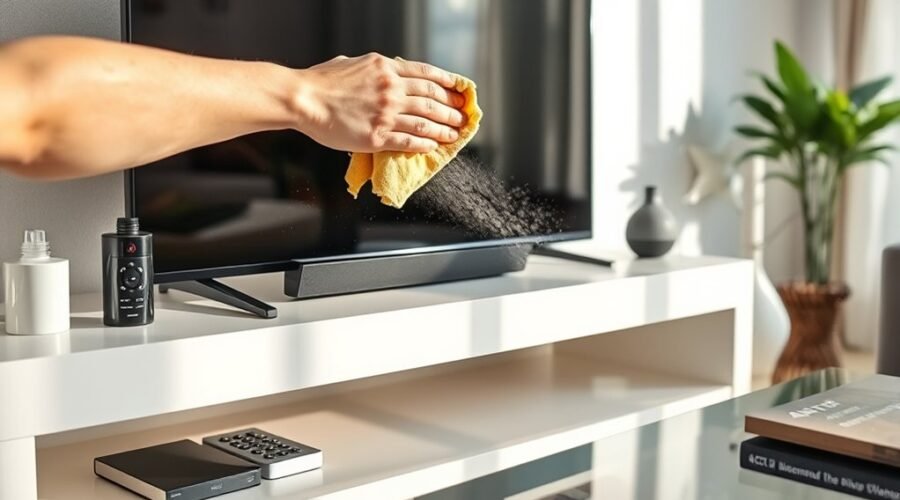
To dust electronics on a TV stand without static, power off and unplug each device first. Use a dry microfiber cloth to lift dust from surfaces, vents, and cables with light, sweeping motions. For stubborn spots, slightly dampen the cloth with water or a suitable cleaner, never spray directly on equipment. Avoid paper towels and compressed air, which can increase static or damage parts. Anti-static spray and low-humidity control help limit buildup, and more methods follow.
Why Static Builds Up on TV Stands
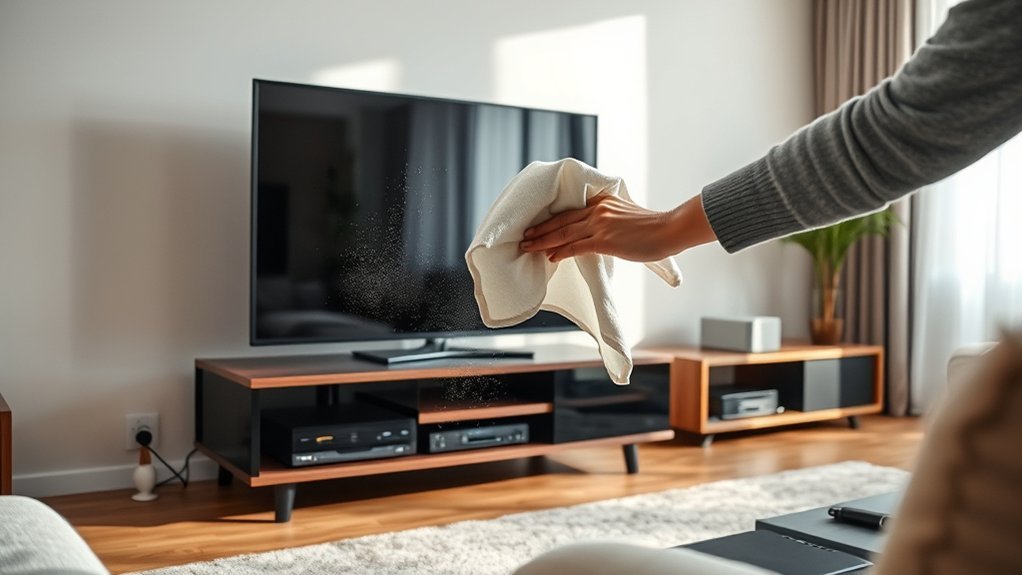
Static electricity on TV stands typically builds up through friction between surfaces, especially when dust, plastic, synthetic fabrics, and moving cables come into contact with electronics.
This charge is amplified by dust accumulation and by synthetic materials that resist dissipation. In dry indoor air, common in heated or air-conditioned rooms, moisture is insufficient to carry charge away, so static electricity persists longer on the stand.
Plastic housings, cable sheathing, and upholstery act as insulators, increasing charge retention. When devices are shifted or cables are adjusted, friction increases and more charge accumulates on nearby surfaces.
Regular cleaning reduces residue that can intensify this effect, while anti-static cleaning methods interrupt charge transfer and lower buildup.
For those seeking liberation from unnecessary maintenance hazards, understanding these mechanisms supports safer handling of electronics and more controlled dusting practices.
The result is a surface that is easier to clean and less likely to attract particles.
What You Need to Dust a TV Stand
A microfiber cloth is the primary tool for removing dust from a TV stand because it traps particles without adding static.
A static-free spray can be applied lightly to the cloth to reduce charge buildup on delicate surfaces.
Vacuum attachments may be used for seams and edges where dust collects, provided the electronics are unplugged first.
Microfiber Cloths
Microfiber cloths are a practical choice for dusting a TV stand because their fine fibers trap dust and dirt effectively without scratching delicate electronics or furniture surfaces.
A microfiber cloth serves as a soft cloth that can prevent damage during regular maintenance, helping maintain a clean is essential standard around exposed devices. Its static-free structure reduces attraction of new particles, supporting cleaner surfaces with less effort.
Compared with ordinary fabric, it can hold several times its weight in dust and moisture, improving collection efficiency.
For routine care, a dry cloth is suitable for loose debris, while a lightly dampened one addresses stubborn marks.
After use, washing in cold water without fabric softeners preserves performance and extends service life, keeping the tool effective for ongoing care.
Static-Free Spray
A static-free cleaning spray formulated for electronics helps reduce static electricity while dusting a TV stand, lowering the chance that dust will resettle on nearby surfaces.
The static-free spray should be paired with a microfiber cloth, since the cloth is non-abrasive and effective at lifting dust without promoting static discharge. For controlled use, the cloth should be lightly misted first; direct application to electronics or finished surfaces is avoided to prevent moisture damage.
This method supports precise dusting around cables, screens, and components without compromising sensitive equipment. Regular maintenance with static-free products preserves a cleaner environment and helps individuals maintain control over their space.
Used correctly, the spray enables efficient, low-risk cleaning that supports freedom from unnecessary buildup and static-related concerns.
Vacuum Attachments
Vacuum attachments designed for electronics make dusting a TV stand more controlled and less intrusive.
Use a soft brush attachment to gently remove dust from delicate surfaces without scratching or increasing static buildup. A crevice tool can reach narrow gaps between components and the stand, where debris often accumulates.
Operate the vacuum on a low suction setting to reduce the chance of dislodging cables, ports, or lightweight items. When available, an anti-static attachment adds another layer of protection for electronics by minimizing static electricity during contact.
It is also important to regularly clean vacuum attachments so trapped particles are not recirculated onto exposed equipment. Properly selected and maintained attachments support efficient, precise cleaning and preserve the freedom of a clutter-free setup.
Power Off and Unplug Your Electronics
Before dusting, electronics should be powered off and unplugged to reduce the risk of electrical shock and accidental damage. This procedure supports safe cleaning, limits static electricity transfer, and keeps sensitive circuits unexposed during dusting. Power off all devices first, then unplug each cord from the outlet or power strip. The pause in operation also reduces heat buildup, allowing safer handling of electronics and lowering the chance of display burn-in on TVs.
| Action | Purpose |
|---|---|
| Power off | Stops active circuitry |
| Unplug | Isolates from mains power |
| Wait briefly | Allows residual heat to dissipate |
| Handle carefully | Reduces accidental contact risks |
| Repeat habitually | Builds disciplined maintenance |
A consistent shutdown routine gives users greater control over their environment. It replaces improvisation with a method that is safe, precise, and compatible with responsible care of electronics.
How to Dust a TV With a Microfiber Cloth
A dry microfiber cloth should be used to gently wipe the TV screen, since its fibers lift and trap dust without creating static electricity. The microfiber cloth should move in a gentle circular motion across the screen, removing loose dust while reducing streaks and preserving the display surface.
For smudges that resist dry wiping, the cloth may be lightly dampened with water or a mild cleaning solution, but it must remain only slightly moist to avoid excess liquid. Paper towels and rough fabrics should be avoided because they can scratch the screen and increase static, which draws more dust.
Regular dusting supports ideal viewing quality, lowers allergen accumulation, and keeps the television ready for clear use. A weekly cleaning routine is generally sufficient for maintaining a liberated, uncluttered viewing environment without unnecessary wear.
How to Clean a TV Screen Safely
Before cleaning, the TV should be turned off and unplugged to reduce electrical risk and static buildup.
A microfiber cloth should then be used gently across the screen, preferably in light circular motions to remove dust without abrasion.
Harsh cleaners, paper towels, and other abrasive materials should be avoided, since they can damage the display surface and leave streaks.
Turn Off And Unplug
Power down the TV and disconnect it from the outlet before cleaning to eliminate the risk of electric shock and protect internal components. This turn off and unplug step gives the operator clear control over the electronics and reduces exposure to live power.
A microfiber cloth should be used because it lifts dust efficiently without scratching the screen. If cleaning solution is required, the cloth may be dampened lightly with water or a suitable screen cleaner, never saturated. The surface should be wiped in gentle circular motions to remove residue while limiting static electricity.
Excess liquid must be avoided to prevent seepage into ports or seams. After cleaning, the panel should dry completely before power is restored, preventing moisture-related damage and preserving safe, independent use.
Use Microfiber Gently
A dry microfiber cloth should be used to wipe the TV screen gently because it attracts dust efficiently without producing static that could damage sensitive components.
A microfiber cloth limits dust accumulation and preserves surface integrity better than paper towels or rough fabrics.
- Gently wipe the panel in circular motions.
- Keep pressure low to avoid streaks.
- For stubborn smudges, lightly moisten the microfiber cloth with distilled water, leaving it just moist.
- Keep the room adequately humidified to reduce static electricity.
This method maintains control, protects delicate coatings, and supports a clean display without unnecessary residue.
Avoid Harsh Cleaners
Harsh cleaning agents should be avoided when cleaning a TV screen because ammonia-based products can degrade the display coating and leave the surface vulnerable to damage.
For delicate surfaces, a microfibre cloth should be lightly dampened with distilled water or a pH-neutral solution; mild dish soap may be used in minimal dilution if residue is absent. The cloth should not drip, because excess liquid can migrate into the panel.
Circular strokes remove dust and grime while limiting streaking and static buildup. Power should remain disconnected during cleaning to reduce electrical risk and support cleaning to prevent faults.
A soft brush attachment may be used on surrounding vents, but not on the screen itself. These controlled methods help users avoid harsh cleaners and maintain an undisturbed display.
When to Use a Damp Cloth
Use a damp cloth when dust removal must be done without generating static electricity that could damage sensitive electronic components. For cleaning electronics, the cloth should be only slightly damp; excess moisture can enter openings and create short circuits or surface damage.
Before touching the device, users should unplug devices to reduce electrical hazard and protect personal autonomy through careful procedure. Distilled water is preferred, although a mild cleaning solution may be used if residue risk remains low.
Dust effectively is lifted by a gentle circular motion, which minimizes scratching and avoids forcing particles across the finish.
- Lightly moisten the cloth.
- Wring out all excess moisture.
- Wipe in gentle circular motion.
- Allow surfaces to dry fully.
This method suits situations where dry dusting is insufficient and static control is necessary. It supports precise maintenance while preserving components, finishes, and operational safety.
How to Dust Vents and Cables Safely
Dust should be removed from vents and cables with a microfiber cloth or electrostatic duster, since both materials help attract particles while limiting static buildup. Before any contact, users should unplug electronics to eliminate shock risk and protect internal components.
A gentle wipe across exposed cables can lift loose debris without abrasion, while a vacuum with soft brush attachment can clear vent openings where dust buildup restricts airflow. The brush should remain lightly positioned, never forced into grilles or seams, because deeper intrusion can drive particles farther inside.
Cable management also matters: organized routing reduces tangling, exposes less surface area, and limits places where dust can collect. Cloths should remain free of fabric softeners or dryer sheets, which can leave residue and increase static electricity.
Regular maintenance supports cleaner operation, safer access, and greater autonomy over the device environment.
How to Remove Fingerprints From Glossy Surfaces
A dry microfiber cloth should be used to gently buff glossy surfaces, since it lifts fingerprints without scratching the finish or generating static. For fingerprints and smudges that remain, a soft cloth may be slightly dampened with water or a mild soap solution, then wrung out so it is not dripping wet. This preserves control and reduces moisture risk on glossy surfaces while maintaining a clear finish.
- Wipe in a circular motion.
- Avoid harsh cleaners and abrasive pads.
- Use mild soap only when needed.
- Regularly cleaning limits oil buildup.
Cleaning around buttons, seams, and edges should be done with light pressure to prevent residue from settling in recesses. Paper towels are unsuitable because they can scratch and leave lint.
With disciplined technique, glossy surfaces can remain clean, liberated from visible marks, and ready for use without unnecessary wear.
How to Reduce Dust Buildup
An air purifier can reduce airborne particulates, lowering dust accumulation on electronics and improving room air quality.
Weekly vacuuming with a HEPA filter removes fine debris before it settles, especially around equipment and cable runs.
Dust-friendly materials such as wood or light-colored surfaces can make buildup less apparent than glass or black finishes.
Use An Air Purifier
Using an air purifier near a TV stand can effectively remove dirt and dust particles from the surrounding air, reducing buildup on electronics and helping preserve their appearance.
A properly selected air purifier can reduce dust accumulation in the environment and lessen the need for frequent cleaning. For best performance, the unit should include a HEPA filter, which captures fine particles that would otherwise settle on screens, speakers, and other components.
Continuous operation can maintain lower airborne debris levels, supporting a cleaner, more liberated living space for occupants.
- Place it near the stand.
- Use a HEPA filter.
- Run it continuously.
- Replace filters as directed.
Vacuum Weekly
Vacuuming the TV stand weekly with a vacuum cleaner equipped with a HEPA filter helps reduce dust accumulation on electronics and maintain better air quality.
Regular weekly dusting limits particles entering vents, where they can impair electronics performance and increase heat buildup. A soft brush attachment is recommended to clean delicate surfaces without abrasion or static-related damage.
The vacuum should pass over the stand, cables, and surrounding floor area to capture hidden debris that can resettle on equipment. Consistent removal of dust also helps prevent allergens, which is relevant for occupants with respiratory sensitivity.
This method supports a cleaner, more autonomous living space by reducing maintenance demands and preserving device function through controlled, routine care.
Choose Dust-Friendly Materials
Choosing dust-friendly materials can reduce visible buildup and make routine cleaning easier. For electronics on a TV stand, dust-friendly materials should prioritize low-contrast, smooth finishes that resist dust accumulation.
- Wooden TV stands and white finishes conceal dust better than black frames.
- Wood surfaces are easier to dust with a regular duster, supporting a lower cleaning frequency.
- Glass surfaces and glass cabinets reveal fingerprints and dust quickly, so they demand more labor.
- A smooth finish limits settling, while an air purifier reduces airborne dust particles before they land on electronics.
These choices support cleaner surfaces with less effort, helping maintain a practical, orderly environment without constant wiping.
Common Static-Dusting Mistakes to Avoid
Several common dusting practices can worsen static buildup on electronics rather than reduce it. Regular cloths and synthetic tools are frequent common mistakes because they can generate static electricity and draw dust back onto surfaces.
Dry dusters and feather dusters also perform poorly; they often spread particles instead of helping clean electronics. Aerosol sprays and harsh chemicals, including alcohol-based products, should be avoided because they can increase static on sensitive finishes.
Cleaning in low-humidity environments further amplifies the problem, since dry air supports stronger static charge; a humidifier can help maintain more stable conditions.
To reduce dust accumulation without unnecessary risk, anti-static microfiber cloths should be used, as they are designed for electronics and limit charge transfer.
Careful material selection and environmental control allow a cleaner, less constrained approach to maintenance, helping preserve equipment without encouraging buildup or residue.
Consistent restraint supports safer, more effective dust removal.
Frequently Asked Questions
What Is the Best Way to Dust Electronics?
The best way to dust electronics is with microfiber cloths, used with careful dusting techniques and regular maintenance.
Anti static spray may be applied sparingly to the cloth, never directly on devices.
Vacuum attachments can remove loose debris around vents and cables.
A consistent cleaning schedule reduces buildup.
Proper storage protects unused items from dust exposure.
These methods minimize static, preserve surfaces, and support clean, controlled, independent use.
What Is Grandma’s Simple Trick to Eliminate Dust?
Grandma’s simple trick to eliminate dust is equal parts water and vinegar, a steady shield against static, like a quiet current clearing a path.
Her grandma’s secrets rely on precise dusting techniques and natural remedies rather than harsh cleaning supplies. These household tips support allergy prevention and offer eco-friendly options.
Applied with a microfiber cloth, the solution captures dust, reduces buildup, and helps preserve surfaces without dependence on synthetic sprays.
Does Dust Damage Electronics?
Yes, dust accumulation can damage electronics by restricting airflow, trapping heat, and contaminating electronic components, which may shorten electronic lifespan.
Fine particles can also contribute to shorts and failures, especially when static electricity is present.
Effective cleaning techniques and dust prevention reduce risk and support reliability.
Recommended maintenance tips include regular inspection, gentle removal of debris, and keeping equipment in a low-dust environment to preserve performance and operational freedom.
Why Do TVS Collect so Much Dust?
TVs collect dust because charged surfaces, heat, and airflow act like a magnet, not because the room is inherently dirty. Dust accumulation causes include static attraction, gravity, and fan-driven circulation.
Electronic device maintenance benefits from effective cleaning techniques, furniture placement tips, humidity control methods, and improved indoor air quality. Seasonal cleaning habits further reduce buildup.
Liberation from clutter begins with disciplined care, allowing surfaces to remain functional, visible, and less burdened.
Conclusion
In the grand theater of TV-stand maintenance, static remains the uninvited critic, keen to attract dust after every overconfident swipe. The careful method is less dramatic: power down, unplug, use a dry microfiber cloth, and avoid sprays that transform electronics into minor weather systems. Vents, cables, and glossy surfaces all benefit from restraint, not enthusiasm. With disciplined dusting and a little anti-static humility, the screen stays cleaner, and the equipment stays less offended.