
You can dust a bookcase without unloading it by working from the top down and cleaning only the exposed surfaces first. Use a chemical-free dusting cloth or soft brush for light dust, and use a vacuum with a soft brush attachment at low suction when buildup is heavier. Shift small groups of books only enough to reach hidden shelf edges, rather than emptying every shelf.
Quick Answer
To dust a bookcase without removing all the books, start at the top, clean book tops with an untreated cloth, soft brush, or low-suction vacuum, then wipe exposed shelf edges and corners. Shift a few books at a time only when necessary. Keep liquids and spray cleaners away from books, and save full unloading for occasional deep cleaning.
Key Takeaways
- Work from the highest shelf downward so falling dust does not land on areas you already cleaned.
- For books, use an untreated, chemical-free cloth, a soft brush, or a soft vacuum attachment at reduced suction.
- Brush or vacuum outward from the spine rather than pushing debris into the binding.
- Clean shelf edges in place and shift only a few books when you need access behind them.
- Do not apply water, vinegar, furniture polish, anti-static spray, or household cleaner directly to books.
At a Glance
| Time Required | About 10–20 minutes for light dust on a small bookcase; longer for heavy buildup |
| Difficulty | Easy |
| Tools Needed | Untreated dusting cloth, soft brush, and optionally a vacuum with a soft brush attachment and adjustable suction |
| Cost | Usually $0 if suitable cleaning tools are already on hand; otherwise the cost depends on the tools purchased |
Gather Your Dusting Supplies
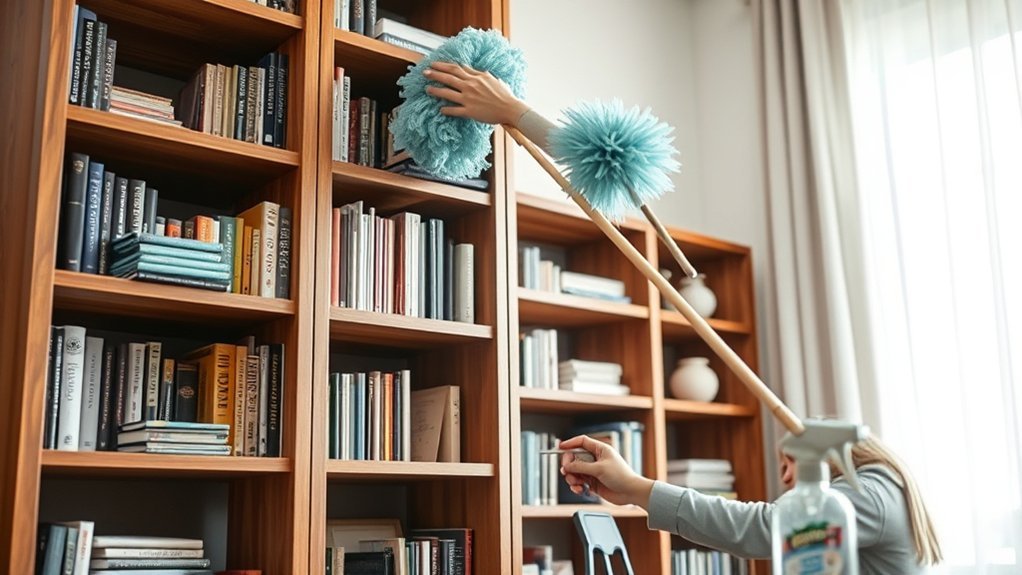
For routine bookcase dusting, gather an untreated, chemical-free dusting cloth, a soft-bristled brush, and a vacuum with a soft brush attachment if you have one. A narrow vacuum tool can also help along shelf joints, but suction should be kept low around books.
The Library of Congress recommends dusting books and shelves with dusting materials that contain no fragrances or other chemicals. It also notes that books can be vacuumed with a small, soft brush attachment when suction can be reduced.
For heavier accumulations, the Northeast Document Conservation Center recommends a HEPA vacuum with a soft brush attachment and, when possible, variable suction. For lightly soiled, stable books, it recommends untreated magnetic wiping cloths rather than chemically treated cleaning cloths.
Use the gentlest method that actually removes the dust: little pressure, little friction, and no unnecessary moisture on the books.
Warning: Do not routinely wipe brittle paper, flaking leather, powdery bindings, visibly moldy books, or valuable rare books like ordinary household books. Cleaning can cause permanent damage. If a book is fragile, historically important, or moldy, isolate it from routine cleaning and seek appropriate conservation guidance.
Plan the Dusting Without Unloading the Bookcase
Start by deciding whether the bookcase needs a quick maintenance dusting or a true deep clean. If you mainly see a light film on book tops, shelf edges, and corners, there is usually no reason to unload every shelf.
Begin at the highest shelf and work downward. This prevents loose dust from falling onto surfaces you have already cleaned. If possible, vacuum the floor around the bookcase first or immediately after finishing so disturbed particles do not remain nearby.
For the fastest routine, follow this sequence:
- Dust the top of the bookcase and upper trim.
- Clean the tops of the books while they remain upright.
- Wipe the exposed front edge of each shelf.
- Shift small groups of books only where dust is visible behind or beside them.
- Finish the corners, frame, base, and floor.
Pro Tip: Keep one cloth or brush for the books and another for shelf surfaces. This helps prevent grime or cleaner residue from a shelf from being transferred onto book covers and page edges.
Cleaning frequency does not need to follow a rigid calendar. Preservation guidance from NEDCC recommends basing it on how quickly dust accumulates in the actual room. A short maintenance pass whenever visible dust develops is easier than waiting for a heavy layer to form.
Know When Removing Books Is Actually Necessary
Routine dusting does not require the whole bookcase to be emptied. Full removal is better treated as an occasional deep-cleaning option for shelves with sticky grime, heavy debris, pest evidence, major reorganization needs, or dust that cannot be reached by shifting small groups.
If a deeper clean becomes necessary, work one shelf at a time. This keeps the arrangement manageable and reduces the chance of mixing up books or creating large unstable stacks.
Remove Shelf Contents for a Deep Clean
When a shelf truly needs to be emptied, create a clean landing area before moving anything. Remove books in shelf order so they can be returned easily.
Do not pull a book out by hooking a finger over the top of its spine. The Library of Congress handling guidance recommends making space beside the volume so it can be gripped securely around the middle instead of tugging on the head of the spine.
Once the shelf is clear, inspect the books for loose covers, brittle paper, stains, insect activity, or possible mold. Fragile items should be separated from ordinary cleaning rather than scrubbed or aggressively vacuumed.
Sort Keeper Books
If you are already doing a full deep clean, it is a convenient time to sort books by genre, author, subject, size, or another system that makes them easier to use.
Books that remain upright should be adequately supported. The Library of Congress storage guidance recommends shelving similar-size books together when practical and keeping upright books from leaning or slumping. Bookends can support rows that do not fill the shelf.
Frequently used books can stay at an easy-to-reach height, while less-used books can go above or below. Oversized volumes may need different support rather than being forced into a row that is too small.
Declutter Shelf Items
A deep-cleaning session can also be used to review books and decorative objects that no longer serve a purpose. A simple sorting system keeps the process manageable:
- Keep books that are used, valued, referenced, or intentionally collected.
- Donate or sell duplicates and books you no longer want.
- Discard only items that are genuinely unusable and cannot reasonably be donated or recycled.
- Reduce decorative objects if they make routine dusting unnecessarily difficult.
- Leave enough room to remove books without pulling on the tops of their spines.
This step is optional. If the goal is simply to dust the bookcase without unloading it, skip the decluttering process and continue with the in-place cleaning method.
Wipe Down an Empty Shelf Safely
If you have removed the books from a shelf for a deeper clean, start with dry dust removal. Vacuum or wipe loose debris before introducing any moisture.
For washable shelf surfaces with stuck-on grime, use only the amount of moisture needed. A slightly damp cloth may be enough. If a cleaner is necessary, choose one that is appropriate for the shelf’s finish and apply it to the cloth rather than spraying near books.
NEDCC notes that wooden shelving or heavily soiled metal shelving may require washing with a mild detergent, but the shelf should be allowed to dry completely before books return. It also warns that some cleaners can leave residues that are harmful around collections.
A universal 1:1 vinegar-and-water mixture is therefore unnecessary and may not suit every paint, veneer, laminate, sealed wood, or furniture finish. Follow the furniture manufacturer’s cleaning instructions when they are available.
Note: Never return books to a shelf that is still damp. Moisture trapped between books and shelving creates conditions that are far worse for a collection than ordinary household dust.
Dust Books Without Damaging Them
For stable everyday books, keep each volume closed while cleaning so loose debris does not fall between the pages. Start with the top edge, where dust usually collects most heavily.
Use a soft brush, suitable untreated cloth, or low-suction vacuum attachment. Work gently from the spine toward the fore edge. This moves dirt away from the binding rather than pushing debris into the spine.
- Keep the book firmly closed while cleaning its page edges.
- Use light strokes instead of rubbing back and forth.
- Work outward from the spine.
- Use reduced suction with a soft vacuum attachment.
- Do not apply household cleaner, furniture polish, vinegar, or water directly to a book.
- Stop if the cover, leather, paper, decoration, or binding begins to flake or lift.
The Smithsonian Libraries’ book-care guidance similarly advises holding a book firmly closed while removing dust and brushing along the text block away from the spine.
If books are packed tightly, do not force a cloth between them. Push neighboring volumes gently aside to create enough room to grip and shift a small group, clean the newly exposed area, and then return them to position.
Get Dust Out of Corners
Dust often survives along shelf joints, behind bookends, and in the narrow corners between a row of books and the bookcase frame.
Use a soft narrow brush to loosen debris while holding a vacuum nozzle nearby, or use a small vacuum attachment at low suction. Avoid improvised metal tools, sticky tape, or rigid objects that can scratch the shelf or catch a book cover.
When a corner cannot be reached safely, shift only the nearest few books rather than unloading the entire row. Clean the exposed corner, return the books, and move to the next section.
Finish by vacuuming the floor and baseboard around the bookcase. NEDCC specifically recommends regular floor cleaning because controlling room dust reduces the amount that later settles on books and shelving.
Put Books Back in a Tidy Order
If you shifted or removed books during cleaning, return them in a stable arrangement. Books can be grouped by subject, author, size, or another system that makes sense for the household.
For physical protection, stability matters more than decoration. Keep upright books reasonably supported and avoid letting them lean at sharp angles. Use bookends where necessary.
Frequently used titles can stay around eye or hand level. Less-used volumes can go higher or lower, provided the shelving can safely support them.
- Keep similar-size books together when practical.
- Use bookends to support partially filled rows.
- Do not cram books so tightly that they are difficult to remove.
- Do not leave them so loose that they slump heavily.
- Keep decorative objects from pressing against fragile covers or page edges.
If appearance matters, color or decorative grouping can still be used after these basic support needs are met.
Prevent Dust Buildup on Shelves
The easiest bookcase to clean is one that never develops a thick layer of dust. Routine housekeeping makes more difference than specialty sprays.
Vacuum or dust the surrounding floor regularly, maintain HVAC filters according to the system manufacturer’s instructions, and reduce obvious sources of airborne dust when practical. NEDCC also notes that keeping windows closed can help reduce incoming dust in collection areas.
A portable air cleaner may reduce airborne particles, but it is not a complete solution. The U.S. Environmental Protection Agency explains that portable air cleaners can filter particles when correctly sized for the room, while also emphasizing that no air cleaner removes every indoor pollutant.
If using an air cleaner, choose one with an appropriate Clean Air Delivery Rate for the room. HEPA filtration is commonly used for particle removal. Avoid treating shelves with anti-static sprays simply to control dust around books; chemical residues add an unnecessary variable when ordinary housekeeping can do the job.
Book placement matters too. The Library of Congress recommends limiting intense or direct light exposure, and good storage also means keeping books away from places with persistent moisture or extreme environmental conditions.
When to Do a Full Deep Clean
A no-unload routine is ideal for ordinary maintenance, but it cannot solve every problem. Consider cleaning one shelf at a time with the books removed when:
- Dust is thick behind the entire row.
- The shelf has sticky grime that dry methods cannot remove.
- You see insect debris or other possible pest activity.
- You need to inspect books for deterioration.
- The arrangement has become unstable or overcrowded.
- You are already reorganizing or decluttering the collection.
There is no universal requirement to do this once or twice every year. The right interval depends on how quickly dust accumulates, the environment, and the condition and importance of the collection.
When Not to Clean a Book Yourself
Ordinary household methods are not appropriate for every volume. Stop routine cleaning if a book has brittle pages, detached pieces, powdery or flaking leather, fragile decorative media, active mold, severe water damage, or significant monetary or historical value.
NEDCC cautions that cleaning actions themselves can damage fragile books and recommends professional conservation judgment for special collections and valuable bound materials. Mold also requires more careful handling than ordinary dust.
If you are unsure whether a mark is dust, mold, pigment, deteriorating leather, or another material, avoid rubbing it until it has been identified.
Frequently Asked Questions
What Is the Best Way to Dust a Bookshelf?
For routine cleaning, work from the top down and use an untreated chemical-free cloth, soft brush, or low-suction vacuum with a soft brush attachment. Keep books closed, clean their top edges gently, and brush or vacuum away from the spine. Wipe the exposed shelf edges separately and shift only a few books when needed.
What Is Grandma’s Simple Trick to Eliminate Dust?
There is no recognized preservation standard known as “Grandma’s trick” that eliminates dust. For books, the safer approach is simple: remove dust gently with a chemical-free dry cloth, soft brush, or low-suction vacuum attachment. A slightly damp cloth can be useful on some empty washable shelf surfaces, but moisture should not be applied directly to books.
Is It Better to Dust With a Wet or Dry Cloth?
Use a dry method on books. Moisture can stain covers, swell paper, affect adhesives, or create conditions favorable to mold. For an empty shelf with stuck-on grime, a slightly damp cloth or finish-appropriate mild cleaning method may be used when necessary, followed by complete drying before books are returned.
How Often Should You Dust a Bookshelf?
Dust when visible buildup begins rather than relying on one fixed schedule. For many homes, a light pass every few weeks may be convenient, while cleaner rooms may need attention less often. Homes with pets, open windows, nearby traffic, renovations, or other dust sources may require more frequent cleaning.
Conclusion
You do not need to unload an entire bookcase every time dust appears. For routine maintenance, work from the top down, gently clean the tops of closed books, wipe exposed shelf edges, and shift only small groups when a hidden area needs attention. Keep moisture and chemical sprays away from books, use reduced suction when vacuuming, and reserve full shelf removal for deeper cleaning when it is genuinely needed.
A short, careful routine also makes future cleaning easier. Keeping surrounding floors clean, maintaining filters, supporting books properly, and dealing with visible dust before it becomes heavy reduces both the work involved and the amount of handling your books receive.
Sources
- Northeast Document Conservation Center — Cleaning Books and Shelves — supports book-cleaning methods, low-suction vacuuming, shelf cleaning, dust prevention, and fragile-material precautions.
- Library of Congress — Books Preservation FAQ — supports chemical-free dusting materials and reduced-suction soft-brush vacuuming.
- Library of Congress — Handling Your Books — supports safer removal and handling techniques that avoid pulling on the top of the spine.
- Library of Congress — Storing Your Books — supports proper shelving, bookends, regular housekeeping, and protection from damaging environments.
- U.S. Environmental Protection Agency — Guide to Air Cleaners in the Home — supports qualified guidance on portable air cleaners, particle filtration, HEPA filters, and room-size selection.