At one showroom, you might notice a slim, open shelf holding a few ceramic bowls and a stack of art books, and suddenly the room feels larger. That’s the appeal of an étagère: you use it to display, not just store. Unlike a standard bookcase, it stays airy, elegant, and light on the eye, which makes you rethink what belongs on the wall—and what shouldn’t.
Key Takeaways
- An étagère is a decorative open shelving piece designed primarily for display, not heavy storage.
- Unlike a standard bookcase, an étagère has open sides and shelves that create a lighter, airier look.
- Bookcases focus on practical storage and usually hold heavier items, while étagères suit lighter decor and curated objects.
- Étagères work well in living rooms, entryways, bedrooms, and baths because they add style without visual bulk.
- Styling an étagère usually involves a few intentional objects, balanced spacing, and a cohesive color palette.
What Is an Étagère?
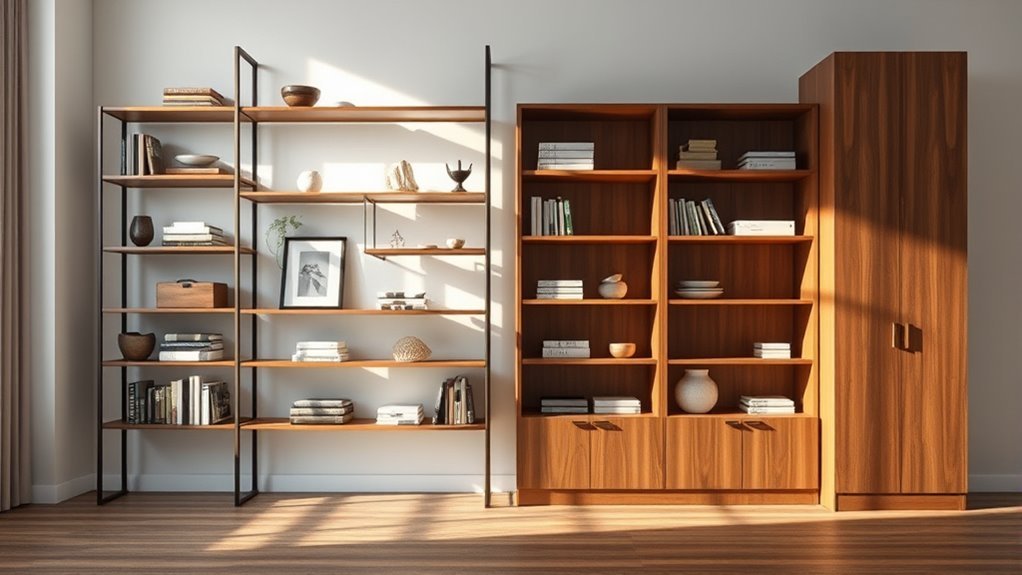
An étagère is a decorative shelving piece made to show off what you place on it. When you choose an étagère, you’re bringing in a display object with French roots, from 18th-century France, where the word suggested a stage for presentation.
Its open structure keeps your room feeling light and visually relaxed, letting artful objects breathe. You can style an étagère in a living room, bedroom, bath, or entry, and it adapts easily to your scheme.
Metal, wood, and glass frames each bring a different mood, from crisp modernity to warm texture. Because an étagère supports lighter pieces, you’ll want to arrange plants, ceramics, candles, and collectibles with intention.
Think of it as a curated backdrop that adds rhythm, height, and polish to your interior.
Étagère vs. Bookcase: Key Differences
If you’re deciding between the two, the biggest difference is purpose: an étagère is built to display, while a bookcase is built to store. In the étagère vs. bookcase debate, you’re choosing between a sculptural accent and a workhorse piece.
An étagère’s open shelves let your objects breathe, but a bookcase surrounds your collection with structure and support.
- Étagère: open, airy, display-first
- Bookcase: enclosed, organized, storage-first
- Étagère: lighter weight capacity for decor
- Bookcase: stronger for books and files
- Étagère: refined, modern presence; bookcase: practical, utilitarian feel
You’ll also notice where each belongs. Use an étagère to elevate a living room, hallway, or bedroom vignette.
Reach for a bookcase when you need dependable, everyday storage in an office or library.
Maintenance differs too: an étagère often asks for gentler care, while a bookcase usually handles routine use with less fuss.
Why Étagères Feel Light and Open
Étagères feel light and open because their open shelves let light pass through, so the piece never reads as visually heavy. You see the room breathe around it, and the étagère becomes part of the architecture rather than a block in it. Without a back panel, your displayed objects stay visible from every angle, which sharpens the airy design and keeps the silhouette relaxed.
| Feature | Effect | Visual Result |
|---|---|---|
| Open shelves | Light moves through | Less visual weight |
| No back panel | More visibility | Cleaner depth |
| Tiered structure | Uses height well | Small spaces feel bigger |
| Metal or glass | Lighter profile | Easier repositioning |
| Minimal form | Frames decor elegantly | Refined openness |
When you style it with a few sculptural pieces, the étagère stays graceful, never crowded. Its slim lines, transparent materials, and vertical rhythm create a polished sense of space that feels calm, deliberate, and distinctly open.
When a Bookcase Is the Better Choice
When you need storage that feels substantial and dependable, a bookcase is the better choice. You get a framed, enclosed silhouette that anchors a room and keeps heavy volumes neatly in place. With solid backs and sides, bookcases support weight confidently, so your books and documents won’t lean, sag, or tip.
- Sturdy construction for serious storage
- Wood or metal finishes to match your style
- Multiple sizes for tailored organization
- Ideal for home offices and studies
- A traditional look that reads polished
Choose bookcases when function matters more than display. They bring visual order, create clean vertical lines, and make dense collections feel curated instead of cluttered.
Compared with an étagère, a bookcase gives you more structure, more capacity, and a stronger architectural presence.
Best Rooms for an Étagère
You’ll get the most from an étagère in a living room, where its open shelves can frame books, plants, and sculptural accents without crowding the space.
In an entryway or hallway, it keeps keys, mail, and decor neatly arranged while making the first impression feel polished.
These rooms let you use the piece as both storage and a visual focal point.
Living Room Displays
In the living room, an étagère feels almost like a stage set for your favorite objects. You can use étagères to display books, plants, and art while keeping the room open and airy.
Its tiered design lifts pieces upward, so you create visual rhythm without crowding your seating area. The backless frame lets light pass through, which helps smaller rooms feel brighter and more spacious.
- Layered shelves create height
- Open sides keep sightlines clear
- Decorative objects stay curated
- Materials shift from sleek to classic
- The look suits modern or traditional decor
Entryway And Hallway
An étagère works beautifully beyond the living room, especially in an entryway or hallway where it can greet guests with style and order. You can place vases, picture frames, or a sculptural bowl on its open shelves, and the design keeps the space airy instead of heavy.
In a narrow hall, an étagère adds light and visual interest, so the corridor feels larger and more welcoming. It also gives you a smart spot for keys, mail, and other daily essentials, helping you stay organized without sacrificing style.
Because étagères come in many materials and finishes, they blend with modern, traditional, or eclectic decor. Compared with bulky bookcases, they create a curated display that feels polished, personal, and uncluttered.
How to Choose the Right Étagère
To choose the right étagère, start by considering how its size and scale will sit within your room, so it complements your furniture instead of crowding it.
Choose an étagère that fits your room’s scale, complementing your furniture without crowding the space.
When you’re learning how to choose the right étagère, think of it as a visual frame: it should feel airy, intentional, and balanced. Match the material to your decor, and choose details that echo the room’s architecture.
- Metal suits sleek, modern spaces
- Wood warms traditional or classic rooms
- Check weight capacity before you buy
- Choose adjustable shelves for flexibility
- Use tiered forms for a layered silhouette
A slim profile works well in tight areas, while a taller piece can draw the eye upward and add elegance.
Inspect the finish, too, because easy maintenance helps keep the piece looking crisp. Dust it regularly and don’t overload shelves, so your étagère stays both beautiful and structurally sound.
How to Style an Étagère Without Clutter
You can keep your étagère feeling airy by leaving a few shelves open, letting negative space frame each piece like part of the design.
Style small decorative groups in threes, mixing heights and textures so the eye moves naturally across the display.
Tuck smaller items into a sleek box or basket, and let a touch of greenery soften the arrangement without crowding it.
Balance With Negative Space
Even the most elegant étagère can feel heavy if every shelf is filled, so let negative space do some of the work. To balance with negative space, you’ll shape a calmer, more refined design and let the open design breathe.
- Group pieces in threes for rhythm.
- Mix heights to keep the eye moving.
- Leave one shelf section clear.
- Use boxes or baskets to hide small clutter.
- Keep colors cohesive for a polished look.
You don’t need to cover every inch; in fact, restraint makes each object feel intentional. A tall vase beside stacked books can read like sculpture, while a woven basket adds texture without visual noise.
When you edit carefully, your étagère feels airy, curated, and quietly luxurious, not crowded.
Curate Small Decorative Groups
Small decorative groups help an étagère feel styled, not stuffed, by giving each shelf a clear visual rhythm.
You can build each vignette around three pieces: a stack of books, a sculptural vessel, and a plant, for example. Vary the heights so the arrangement gains depth and movement. Choose decorative objects in a monochromatic palette to keep the étagère cohesive and polished.
Mix functional accents with display pieces, but don’t crowd one shelf; leave breathing room so every item reads distinctly. Let negative space frame the collection and sharpen the silhouette.
When the look starts to feel too familiar, swap in seasonal decor or a personal object. That small change keeps the composition fresh, layered, and intentionally curated.
Frequently Asked Questions
What Is the Difference Between an Étagère and a Bookcase?
An étagère gives you open, airy shelving for display functionality, letting decorative pieces shine from every angle.
A bookcase gives you enclosed, sturdier storage for books and documents, often with a back panel and higher weight capacity.
You’ll use an étagère to create a light, elegant focal point, while a bookcase supports organized, practical storage with a more traditional, substantial look in your room.
What Does an Étagère Look Like?
You’ll see an étagère as a tall, open display piece with tiered shelves and a decorative frame, not a closed cabinet.
If you think all shelving looks bulky, that theory isn’t true. Its airy design highlights plants, art, or collectibles, and Design Variations can include metal, wood, or glass.
You’ll often notice slim lines, no back panel, and a refined silhouette that keeps your room feeling open.
What Does “Étagère Shelf” Mean?
An “étagère shelf” means you’re looking at one tier of a decorative, open shelving unit.
You’ll see clean lines, airy Shelf Styles, and a display-minded form that lets objects breathe visually. Instead of hiding items away, you can use each shelf to showcase ceramics, books, plants, or art.
The look feels elegant and light, with a layered silhouette that adds height, texture, and polish to your room.
What Is a Fancy Word for a Bookshelf?
A fancy word for a bookshelf is bibliotheca. You can also call it an elegant bookcase or a librarium if you want a more refined, classical feel.
For a softer visual touch, you might choose an étagère, which turns Decorative Storage into a design statement.
You’ll create a polished display for books, art, and keepsakes, and your room won’t just hold stories—it’ll quietly showcase them.
Conclusion
In the end, you’ll choose an étagère when you want your space to feel airy, curated, and visually light, and a bookcase when you need sturdy, enclosed storage. For example, if you’re styling a living room corner with a few art books, a vase, and a framed photo, an étagère can make the arrangement feel intentional instead of crowded. Pick the piece that matches both your storage needs and the atmosphere you want.