
A living room can be safe for a crawling baby or curious toddler without looking like a temporary playroom. Start with the hazards that can cause the most serious injuries—unstable furniture and TVs, reachable electrical sources, cords, windows, batteries, sharp edges, heat, and small objects—then choose softer materials and discreet storage that still suit your style.
Quick Answer
To babyproof a living room without sacrificing style, anchor tip-prone furniture and TVs, protect accessible outlets, control electrical and window-covering cords, soften sharp edges, secure windows and stairs, remove choking and battery hazards, and use durable furniture, rugs, and storage that blend with the room.
Key Takeaways
- Anchor TVs and furniture that could tip, using the hardware and installation method specified by the manufacturer.
- Protect accessible outlets, contain electrical cords, and use cordless window coverings where young children are present.
- Replace or guard sharp, hard furniture with rounded pieces, soft ottomans, or securely attached edge protection.
- Keep button batteries, small objects, breakables, hazardous plants, and other tempting items out of reach.
- Choose easy-care upholstery, secure rugs, and attractive storage so safety measures blend naturally into the room.
- Recheck the room whenever your child begins crawling, pulling up, climbing, reaching higher, or opening new containers.
At a Glance
| Time Required | About 30–60 minutes for a first safety scan; installation time varies by anchors, gates, window coverings, and other devices. |
| Difficulty | Easy to moderate; structural anchoring may require drilling and the correct fasteners for your wall type. |
| Tools Needed | Room-specific safety devices plus the tools required by their manufacturers; furniture anchors may require a screwdriver, drill, stud finder, or suitable masonry/drywall hardware. |
| Cost | Varies widely. Simple outlet and cord solutions may cost little, while gates, cordless window coverings, fireplace barriers, or furniture changes can cost substantially more. |
Babyproof Living Room Basics
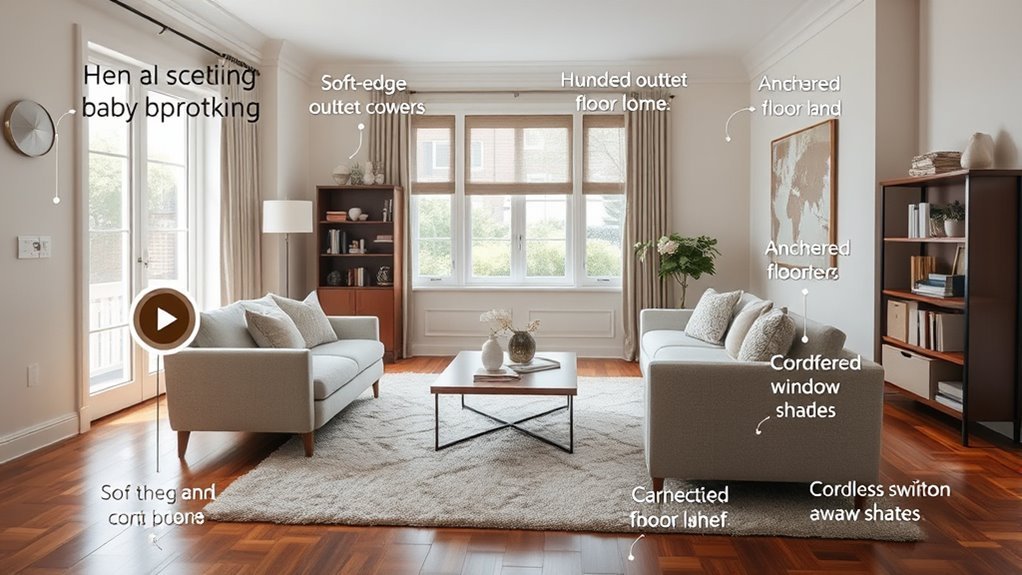
When you babyproof your living room, work from the highest-consequence hazards down. Secure furniture and TVs that could tip, protect accessible electrical outlets, contain reachable cords, check windows and stairs, remove small objects and batteries, and deal with sharp or hot surfaces.
Then soften the room with rounded-edge furniture, a padded ottoman, washable textiles, and storage that fits your decor. The goal is not to hide every safety device. It is to make the important ones reliable while choosing finishes that keep the space calm and cohesive.
Warning: No babyproofing product makes a room completely childproof. Install every device according to its manufacturer’s instructions, check it regularly, and continue active supervision as your child becomes more mobile.
Do a Floor-Level Safety Scan
Before buying products, get down to your child’s height and look around the entire room. A low viewpoint makes hazards easier to spot: a dangling charger behind the sofa, a loose remote on a low table, a sharp hearth corner, a climbable stool beside a window, or a small object under a cabinet.
- Look for anything a baby could pull, chew, climb, open, swallow, or knock over.
- Check underneath sofa cushions and furniture for coins, batteries, hardware, toy parts, and other small objects.
- Pull gently on lamps, consoles, shelves, and decorative objects to identify unstable pieces.
- Repeat the scan after rearranging the room or adding new furniture or electronics.
This simple check gives you a practical list of what actually needs attention instead of covering the room with safety products that do not address your real hazards.
Anchor Furniture and Cover Outlets
Furniture tip-overs and electrical access deserve early attention because they can cause serious injury. The U.S. Consumer Product Safety Commission recommends securing TVs and tip-prone furniture and using appropriate outlet protection in homes with young children.
Secure Heavy Furniture and TVs
Secure bookcases, cabinets, dressers, media units, televisions, and other pieces that could tip if a child climbs, pulls, or pushes on them. The CPSC’s Anchor It! guidance recommends anchoring TVs and furniture and following manufacturer instructions.
Avoid choosing what to anchor based on one height number alone. A shorter but top-heavy cabinet or a television on a stand can still present a tip-over hazard.
- Use the anti-tip hardware supplied or recommended for the furniture or TV.
- Use fasteners appropriate for the wall material and installation instructions.
- Place televisions only on furniture designed to support them, or mount them correctly.
- Keep toys, remotes, and other tempting objects off the top of furniture so children are less likely to climb for them.
- Recheck anchors after moving furniture, renovating, or noticing loosened hardware.
Discreet straps or brackets can usually sit behind the furniture, allowing the room’s clean lines to stay visually uncluttered.
Pro Tip: Do not substitute decorative adhesive strips for a structural furniture anchor when the product requires mechanical attachment. Use the installation method specified by the furniture, TV, or anchor manufacturer.
Cover Electrical Outlets
Protect accessible receptacles so little fingers cannot easily reach energized openings. The CPSC childproofing guide recommends outlet covers or outlet plates and says protectors should be difficult for children to remove and large enough not to become a choking hazard.
| Option | Best Use | What to Check |
|---|---|---|
| Tamper-resistant receptacle | When replacing an outlet | Use a properly installed, code-compliant receptacle |
| Sliding outlet plate | Frequently used outlets | Confirm the cover closes automatically and fits correctly |
| Plug-in outlet protector | Unused accessible outlets | It should resist child removal and not create a small-part hazard |
If you are replacing receptacles, CPSC specifically recommends considering tamper-resistant receptacles. Match plates to the wall finish if you want the protection to disappear visually into the room.
Control Electrical Cords Safely
Do more than make cords look tidy. Keep charging cables, lamp cords, power strips, and entertainment-system wires out of a child’s reach so they cannot be pulled, chewed, or wrapped around the body.
- Route cables behind secured furniture where a child cannot reach them.
- Use properly installed cord channels or organizers to contain excess cable.
- Keep power strips and adapters inaccessible rather than leaving them loose on the floor.
- Remove chargers when they are not needed instead of leaving long loose leads in the play area.
- Make sure cord management does not pinch, damage, overheat, or sharply bend electrical cables.
A TV stand with enclosed cable management can make these precautions nearly invisible while keeping the room visually cleaner.
Make Windows and Blinds Safer
Window-covering cords deserve their own safety check. The CPSC advises families with young children to use cordless window coverings because accessible cords can create a strangulation hazard.
- Choose cordless blinds, shades, or other window coverings where young children are present.
- If older corded coverings remain, follow current manufacturer and CPSC safety instructions for the specific system while planning replacement.
- Move sofas, stools, toy boxes, and other climbable furniture away from windows and window cords.
- Do not assume a window screen will prevent a fall.
- Where a fall hazard exists, use an appropriate window guard or opening-limiting device while preserving any required emergency-egress route.
For homes with young children, CPSC identifies cordless window coverings as the safest option for eliminating the strangulation hazard from accessible window-covering cords.
Swap Out Risky Living Room Furniture
Hard corners at a crawling or cruising child’s head height can turn an ordinary fall into a painful impact. You do not have to pad every surface, but the pieces in the main play path deserve attention.
Safer Coffee Table Swaps
If your coffee table has hard, sharp corners, consider replacing it temporarily with a soft ottoman or rounded pouf, choosing a rounded table, or using securely attached corner and edge protection.
- A low, rounded ottoman softens the main walking and crawling zone.
- Built-in storage can hold blocks, books, and toy rotation items.
- Easy-clean upholstery makes everyday spills simpler to manage.
- A stable, low-profile shape is preferable to a lightweight piece that can easily tip or slide.
The CPSC recommends securely attached corner and edge bumpers as one way to reduce injury from falls against sharp furniture and fireplace edges.
Replace Breakable Accent Pieces
Move reachable glass, ceramic pieces, candles, heavy sculptures, and other breakables to inaccessible locations. For low surfaces, use durable objects that do not shatter easily and that are too large to become choking hazards.
Woven trays, smooth wood objects, fabric accessories, and sturdy baskets can give you the same layered look without leaving fragile items at grabbing height.
Avoid assuming that “natural” automatically means safe. Check decorative pieces for loose parts, splinters, sharp hardware, unstable bases, and finishes that are not appropriate for a child-accessible area.
Check Small Objects and Button Batteries
Low shelves and coffee tables often collect exactly the objects a baby wants to mouth: coins, screws, game pieces, jewelry, pen caps, magnets, and loose batteries. Make a habit of clearing these items from the child’s reach.
Pay special attention to remotes, key fobs, small lights, flameless candles, thermometers, and other electronics that may contain button or coin batteries. The CPSC warns that swallowed button batteries can cause severe internal injury.
- Keep loose batteries completely out of reach.
- Check that battery compartments close securely.
- Keep devices away from children if the battery compartment is damaged or can be opened easily.
- Replace damaged remotes and electronic accessories rather than relying on temporary tape as a permanent fix.
Warning: A swallowed button or coin battery is an urgent medical hazard. If ingestion is suspected, seek immediate expert medical guidance rather than waiting for symptoms.
Choose Safer Decor for Low Surfaces
Treat every low surface as temporarily belonging to your child. Reserve coffee tables, low consoles, and bottom shelves for large, sturdy, non-breakable items that do not have loose pieces.
- A tightly woven basket beside the sofa
- A large wooden bowl with no removable hardware
- A soft ottoman replacing a sharp coffee table
- Large-format books that cannot easily be torn into small pieces
Keep fragile, sharp, heavy, or swallowable objects higher up—but remember that “higher” changes as a child learns to climb. Do not place tempting objects where a child may climb unstable furniture to reach them.
Check Houseplants Too
Plants can be pulled over, spilled, mouthed, or eaten. Some species can also cause poisoning or irritation. Identify the plants in your room and keep them inaccessible to young children. Poison Control provides guidance for identifying potentially harmful plants and recommends keeping indoor plants where children cannot reach them.
If a planter is large, make sure it is stable and cannot be easily pulled over. Avoid loose decorative stones, glass mulch, or other small pieces within reach.
Protect Fireplaces, Hearths, and Hot Zones
If the living room has a fireplace, stove, heater, or hard raised hearth, treat both heat and impact as hazards. Keep children away from hot surfaces and open flames, and soften or block hard hearth edges where appropriate.
- Use a barrier designed for the specific fireplace or heat source and install it according to its instructions.
- Do not place a standard baby gate dangerously close to a hot surface unless the gate manufacturer specifically permits that use and spacing.
- Securely attach edge protection where a stone or brick hearth creates a sharp impact point.
- Keep fireplace tools, matches, lighters, and ignition controls inaccessible.
After the fire is out, remember that glass doors, metal surrounds, and nearby surfaces can remain hot.
Use Baby Gates Correctly
A gate can keep a child away from stairs, an unsafe adjoining room, or another restricted area, but the gate type and installation location matter.
The CPSC recommends child safety gates that meet current safety standards and specifically states that a gate at the top of stairs should screw to the wall. Do not use a pet gate as a substitute for a child safety gate.
Pressure-mounted gates may be useful in some level-floor doorways when permitted by the product instructions, but they should not be treated as interchangeable with hardware-mounted top-of-stair gates.
Use Soft, Durable Fabrics and Rugs
Once the main hazards are controlled, choose materials that make everyday family life easier. Upholstery described by its manufacturer as stain-resistant, washable, or suitable for heavy use can reduce stress around spills without changing the room’s style.
For seating, rounded silhouettes can reduce hard collision points. Removable, washable slipcovers are useful when they fit securely and do not create long loose ties or hanging fabric within a child’s reach.
Choose rugs based on cleanability, construction, and how securely they sit on your floor rather than assuming one fiber is always safest. Keep corners and edges flat, and use an appropriate non-slip rug pad when needed so the rug does not bunch or slide in a busy walking area.
Patterns, heathered textures, and tonal designs can visually disguise everyday marks better than flat pale solids while still keeping the space refined.
Set Up Toy Storage That Blends In
A few well-chosen storage pieces can keep toys accessible without allowing them to take over the room. Choose woven bins, fabric baskets, or smooth open containers in colors that already appear in the room.
- A sturdy basket beside the sofa for plush toys
- An ottoman with manufacturer-designed storage and child-safe operation
- A low shelf with large bins for blocks and books
- A smooth vintage-look crate rather than a splintered or unknown old painted crate
For a toy chest or storage bench, pay attention to the lid. Avoid a heavy lid that can suddenly fall on fingers or trap a child. Follow the product’s safety instructions and keep hinges, closing mechanisms, and hardware in good condition.
The best toy storage works as part of the design, but safety comes before the container’s appearance.
Babyproof the Couch
A sofa is softer than a coffee table, but it still needs a quick safety check. Look behind and beneath cushions for coins, batteries, pens, toy parts, or other small objects. Secure loose slipcovers and remove hanging ties or cords that a child can pull.
Keep the sofa away from windows if it would give your child a climbing route to a sill or window-covering cord.
For infants, remember that a sofa is not a safe sleep surface. The CPSC safe-sleep guidance says babies who fall asleep somewhere other than a product intended for infant sleep should be moved to an appropriate crib, bassinet, play yard, or bedside sleeper.
Add Discreet Babyproofing Features
Once the major hazards are handled correctly, choose finishes that help the remaining safeguards blend into the room. Outlet plates can match the wall, cord channels can follow the baseboard, furniture anchors can sit behind cabinets, and corner protection can coordinate with furniture.
Adhesive child-safety products can be useful for some light-duty applications, but do not assume they are suitable everywhere or that they will always remove without damaging the finish. Check the product instructions and test surface compatibility where appropriate.
For structural hazards—especially furniture or TV tip-over protection—use the installation system required by the manufacturer rather than choosing a weaker method simply because it is less visible.
Check Smoke and Carbon Monoxide Alarms
Babyproofing is a good time to check the larger safety systems around the room and home. CPSC recommends properly placed smoke alarms and carbon-monoxide alarms and regular testing according to their instructions.
Do not cover, unplug, paint over, or move an alarm merely to improve the room’s appearance. Safety equipment should remain functional and properly located.
Update the Room as Your Baby Grows
Your living room should evolve as your child’s abilities change. A room that works for a baby who rolls may need a completely different setup once that child crawls, pulls to stand, climbs, reaches door handles, or begins opening containers.
Keep multi-functional pieces such as storage ottomans, washable slipcovers, large baskets, warm wood, and rounded furniture if they continue to work safely. The room does not need to become more “babyish” as your child becomes more mobile.
- Recheck reachable zones when crawling starts.
- Inspect furniture and window access when pulling up or climbing begins.
- Move objects again when your child can reach higher shelves.
- Reevaluate locks and gates when your child learns how they operate.
- Repeat the safety scan after moving furniture, decorating for holidays, or adding electronics.
Note: There is no single birthday when every babyproofing measure should disappear. Keep each safeguard for as long as the underlying hazard remains accessible, and follow any age, weight, or use limits provided by the safety product manufacturer.
Frequently Asked Questions
Does every piece of furniture need to be anchored when babyproofing?
No. Babyproofing is based on the furniture’s tip-over risk rather than a universal height cutoff. Pay particular attention to TVs, bookcases, dressers, cabinets, media furniture, and other pieces that could tip when climbed on or pulled. Follow the furniture and anchor manufacturers’ installation instructions.
How do you babyproof a couch?
Check under and between cushions for batteries and small objects, secure loose covers and dangling ties, and move the sofa away from windows or cords if it creates a climbing route. Keep breakable objects off nearby tables. For infants, do not use a couch as a sleep surface; move a sleeping baby to an appropriate infant sleep product.
How can I babyproof a living room?
Start at floor level and look for tip-over hazards, accessible outlets, electrical cords, window-covering cords, sharp corners, batteries, small objects, hot surfaces, climbable furniture, and unsafe window or stair access. Fix the highest-consequence hazards first, then choose soft furniture, easy-care fabrics, secure rugs, and attractive storage.
How long do I need to babyproof my house?
There is no universal age when every safeguard can be removed. Reassess as your child crawls, pulls up, climbs, reaches higher, and learns to open gates, drawers, or containers. Keep a safety measure in place while the underlying hazard remains accessible, subject to the product manufacturer’s age, size, or use limits.
Are outlet plug covers safe for babies?
Appropriate outlet covers can help reduce access to electrical receptacles, but they should fit securely, resist child removal, and not become a choking hazard. If receptacles are being replaced, CPSC recommends using tamper-resistant types. Follow the outlet-protection product’s installation instructions.
Should I use a pressure-mounted baby gate at the top of stairs?
No. CPSC guidance says a gate at the top of stairs should screw to the wall. Pressure-mounted gates may be appropriate for some level-floor doorways when allowed by the manufacturer, but they should not replace a properly installed top-of-stair gate.
Conclusion
When you childproof your living room with intention, safety and design do not have to compete. Secure what can tip, control cords and outlets, make windows and stairs safer, remove batteries and choking hazards, soften hard edges, and keep hot or fragile items inaccessible. Then use durable fabrics, secure rugs, thoughtful storage, and rounded forms to keep the room welcoming. Revisit the setup as your child gains new skills, because effective babyproofing changes right along with them.
Sources
- U.S. Consumer Product Safety Commission — Childproofing Your Home — furniture anchoring, outlets, gates, window safety, corner protection, smoke alarms, and carbon-monoxide alarms.
- U.S. Consumer Product Safety Commission — Anchor It! — TV and furniture tip-over prevention.
- U.S. Consumer Product Safety Commission — Window Covering Cords — cordless window-covering guidance and strangulation prevention.
- U.S. Consumer Product Safety Commission — Button Cell and Coin Batteries — battery-ingestion hazards and secure battery compartments.
- U.S. Consumer Product Safety Commission — Safe Sleep — appropriate infant sleep surfaces and transferring a baby who falls asleep elsewhere.
- Poison Control — Poisonous and Non-Poisonous Plants — identifying plants and keeping potentially harmful plants away from children.