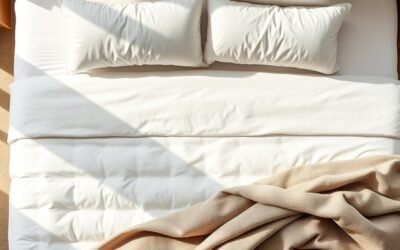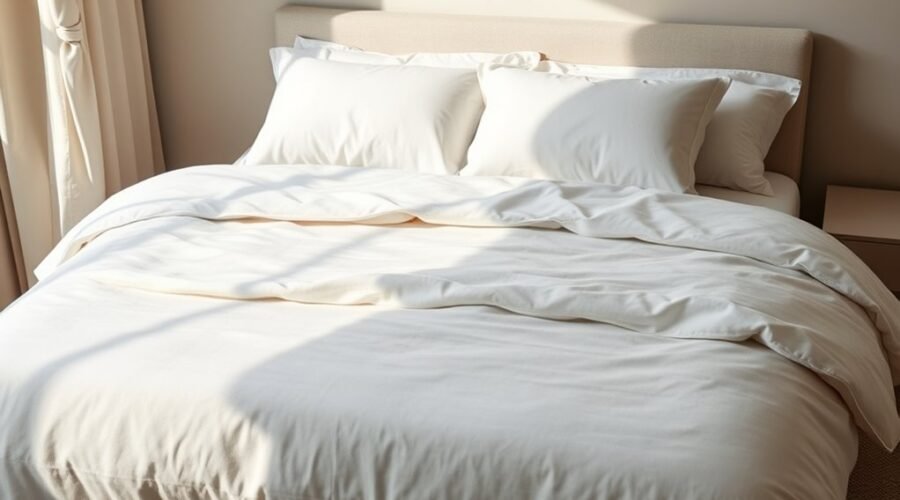
A coverlet is a relatively lightweight bed covering used for decoration, light warmth, or layering. It usually covers the mattress and hangs partway down the sides rather than reaching the floor like a traditional bedspread. Coverlets can be woven, matelassé, lightly quilted, or even lightly filled, so construction varies more than the name alone suggests.
Quick Answer
A coverlet is a thin, decorative bed covering that normally sits over sheets or other bedding and hangs partway down the mattress. It is typically lighter and shorter than a comforter or bedspread, making it useful as a warm-weather cover, a decorative top layer, or an extra layer in cooler seasons.
Key Takeaways
Key Takeaways
- A coverlet is a relatively lightweight bed covering used for light warmth, decoration, or layering.
- It normally covers the mattress and hangs partway down the sides instead of reaching the floor.
- Many woven and matelassé coverlets have no batting, but some modern quilted coverlets contain light fill.
- A coverlet is generally thinner and less insulating than a traditional quilt, comforter, or duvet insert.
- Always compare actual dimensions and care instructions because products labeled Full/Queen or King can vary significantly by brand.
What Is a Coverlet

A coverlet is a light top-of-bed layer that adds color, pattern, texture, and some warmth without the loft of a comforter. It is normally smaller than a traditional bedspread and is designed to cover the mattress rather than extend all the way to the floor.
Construction is not identical from one coverlet to another. Many classic versions are made from a single woven fabric or a matelassé weave. Matelassé creates a raised, quilted-looking texture without requiring traditional quilt batting. Peacock Alley describes its matelassé construction as producing dimensional texture without batting or fill.
Other modern products use light quilting or fill and are still marketed as coverlets. For example, some current quilted coverlets include polyester fiber fill. That means it is more accurate to identify a coverlet by its relatively slim profile, styling role, and typical shorter drop than to say that every coverlet is a single unfilled layer.
You can use a coverlet as your main top layer during warm weather, place it between a sheet and heavier bedding, spread it over a duvet for a smoother look, or fold it across the foot of the bed.
Coverlets are available in cotton, linen, polyester, blends, and other fabrics. The best choice depends on the feel, weight, texture, maintenance, and warmth level you want rather than the fiber name alone.
Where a Coverlet Sits on the Bed
A coverlet can sit directly over your top sheet, over another blanket, beneath a duvet, or on top of a duvet as a decorative layer. There is no single mandatory position; the arrangement depends on the season and how you use the bed.
When spread across the whole bed, it normally covers the mattress top and hangs partway down the sides. Unlike a traditional floor-length bedspread, a coverlet generally leaves at least part of the bed base, frame, or bed skirt visible.
Bed Edge Placement
For a classic fitted look, center the coverlet so the overhang is roughly even on the left and right sides. How far it should hang depends on your mattress depth, frame, and personal preference. A deep mattress may need a wider coverlet than a shallow mattress even when both beds use the same nominal mattress size.
| Detail | What to Aim For |
|---|---|
| Top surface | Full mattress coverage |
| Left and right sides | Similar overhang on both sides |
| Foot | Enough drop to cover the mattress without unwanted floor contact |
| Platform bed | A shorter drop can emphasize the frame |
| Bed with footboard | Check length so excess fabric does not bunch behind the footboard |
Drape and Coverage
A coverlet generally has a shorter, flatter drape than a comforter or traditional bedspread. You can use that shape in several ways:
- Spread it over a flat sheet as your main lightweight cover.
- Place it between the sheet and duvet when you want an extra adjustable layer.
- Lay it over a duvet to add texture and visually flatten a very puffy bed.
- Fold it in thirds across the foot of the bed for decoration and occasional extra warmth.
The coverlet does not have to stop at one exact point on every bed. Product dimensions, mattress thickness, and styling preference all affect the final drop.
Pro Tip: Measure the bed rather than relying only on a Twin, Full/Queen, or King label. Coverlets carrying the same size label can differ by several inches between manufacturers.
Coverlet vs Quilt vs Comforter
A coverlet, quilt, and comforter can all sit on top of a bed, but they usually differ in construction, loft, warmth, and coverage. The distinctions are useful even though manufacturers sometimes use bedding terms loosely.
| Bedding Type | Typical Construction | Typical Warmth | Typical Use |
|---|---|---|---|
| Coverlet | Woven, matelassé, or lightly quilted; may have no fill or light fill | Light | Warm-weather cover or decorative layer |
| Quilt | Top fabric, batting, and backing stitched together | Light to medium | Primary cover or layer |
| Comforter | Fabric shell containing substantial insulating fill | Medium to high | Primary warmth layer |
| Bedspread | Varies | Varies | Full-bed coverage, often extending close to the floor |
| Duvet | Filled insert used inside a removable duvet cover | Depends on insert | Primary warmth layer |
The Company Store’s current bedding guide similarly describes coverlets as thin, lightweight layers, quilts as stitched layers with batting, and comforters as fuller filled covers.
Coverlet Basics
A coverlet works especially well when you want flexibility. It can be easier to fold and store than a lofty comforter, and its slimmer profile makes it practical as an additional layer rather than an all-or-nothing bedding choice.
- Use it alone over a sheet when the room is warm enough.
- Fold it at the foot of the bed so it is available when temperatures change overnight.
- Layer it with a duvet, quilt, or blanket when you need more insulation.
A coverlet can provide light warmth, but it should not automatically be treated as equivalent to a winter comforter. Warmth varies substantially with fabric weight, construction, and fill.
Quilt Differences
A traditional quilt has three basic components: a decorative or functional top, an inner batting layer, and a backing, with stitching passing through the layers. That construction gives a quilt more built-in insulation than a typical unfilled coverlet.
Peacock Alley’s quilt-and-coverlet guide describes the same core distinction while noting that coverlets may be single-layer or lightly quilted.
Appearance is not enough to identify the construction. A matelassé coverlet can have a dimensional surface that resembles quilting even though it may contain no separate batting layer.
Comforter Comparison
A comforter normally has substantially more loft because insulating material is enclosed between outer fabric layers. Depending on the fill and weight, it may provide enough warmth to serve as the primary top layer in cool conditions.
- Coverlet: low-profile and useful for light coverage or decoration.
- Quilt: stitched construction with batting and moderate structure.
- Comforter: filled, loftier, and generally intended to provide more insulation.
A duvet differs slightly from a comforter because the insulating insert is normally placed inside a removable duvet cover. A coverlet can sit beneath the duvet for extra layering or over it as a decorative finishing layer.
Best Fabrics and Weaves for Coverlets
The best fabric depends on whether you prioritize softness, texture, easy care, durability, or low warmth. Fiber content matters, but weave, fabric weight, quilting, fill, and finishing also influence how a coverlet feels.
Cotton is common because it is soft, absorbent, washable in many constructions, and available in everything from smooth woven styles to waffle and matelassé textures. Cotton is naturally absorbent, although high-performance moisture wicking is not guaranteed simply because a fabric contains cotton. Cotton Incorporated explains that engineered treatments and fabric design are used when faster moisture movement and drying are required.
Linen can provide a relaxed texture and lightweight drape. It naturally develops creases, so shoppers who want a perfectly smooth bed should not assume a linen coverlet will remain wrinkle-free.
Polyester and polyester blends are often selected for durability, dimensional stability, color retention, or easier maintenance. Polyester is relatively hydrophobic compared with cotton, and comfort depends on the entire fabric structure rather than fiber content alone. Textile research has documented this difference in water interaction between polyester and cotton.
Matelassé is especially common in coverlets. It is a weaving technique that creates a raised or padded-looking pattern without requiring the separate batting construction of a traditional quilt.
For a warm room, look at the coverlet’s total weight and construction—not just whether the label says cotton, linen, or polyester.
How to Style a Coverlet
A coverlet can make a bed look more finished without requiring a thick top layer. The simplest approach is to spread it over your sheet and center it so the side drops are balanced.
- Use it full-length: Pull the coverlet toward the head of the bed and let it cover the mattress as the visible top layer.
- Fold it at the foot: Fold it in halves or thirds across the lower portion of the bed to expose a duvet, quilt, or sheet underneath.
- Pair it with shams: Matching shams create a coordinated look, while contrasting pillows add more texture.
- Layer it over a duvet: A thin coverlet can visually calm the loft of a thick duvet and add a different color or pattern.
- Tuck it in: On a platform bed, tucking the lower corners can create a cleaner, more structured appearance.
If you layer several pieces, vary their texture or weight rather than adding several items that look and behave exactly the same. For example, a smooth duvet under a textured matelassé coverlet gives each layer a visible role.
Why Coverlets Work in Warm Weather
Coverlets are often useful in warm weather because many have less loft and insulation than comforters or heavy quilts. A lightweight version can provide the feeling of sleeping under a cover without adding a large amount of bulk.
Material still matters, but construction matters too. A loose or lightweight woven fabric may feel cooler than a dense or filled construction made from the same general fiber category.
Lightweight Breathability
For summer use, look for a coverlet with relatively low weight, limited fill, and a fabric construction that allows comfortable air and moisture transfer.
- Check the fill: An unfilled woven coverlet will usually feel lighter than a padded one.
- Check fabric weight: Two cotton coverlets can feel very different if one is substantially thicker.
- Check the weave: Open or lightweight constructions can feel less enclosing than dense, heavy fabrics.
Cotton and linen are popular warm-weather choices, but neither guarantees a particular sleep temperature. Room conditions, humidity, mattress materials, sheets, and the rest of your bedding also affect comfort.
Easy Seasonal Layering
A coverlet makes seasonal changes simple because it can move between roles. In summer it can become the primary cover; during transitional weather it can stay folded at the foot; and in winter it can become one layer in a warmer bedding system.
Because it is generally less bulky than a comforter, storing a coverlet can also be easier. Fold it only after it is completely clean and dry, and store it in a dry place where moisture cannot become trapped in the fabric.
Low-Heat Comfort
If a heavy comforter feels excessive but sleeping with only a sheet feels too exposed, a lightweight coverlet fills the middle ground. It gives you another layer without requiring the loft associated with heavily filled bedding.
- Choose an unfilled or lightly constructed coverlet for the lowest warmth.
- Use it directly over the sheet when temperatures are high.
- Fold it toward the foot if you become warm during the night.
The important point is that “coverlet” does not describe one exact warmth rating. Compare the fabric, construction, weight, and fill of the particular product you are considering.
How to Layer a Coverlet for Winter
For colder weather, start with your fitted sheet and preferred top sheet, then add the layers you need for insulation. A coverlet can sit above a blanket and beneath a duvet, or it can sit on top of the duvet as the visible decorative layer.
If the coverlet has a distinct right and wrong side, keep the decorative or finished side facing outward. Do not automatically place the decorative side against the mattress. Some products are reversible, but others have clearly different faces.
- Make the bed with your fitted sheet and optional flat sheet.
- Add a blanket or coverlet if you want a light intermediate layer.
- Add a quilt, comforter, or duvet when more insulation is needed.
- Alternatively, put the duvet on first and spread or fold the coverlet over it for decoration and another light layer.
You do not need every layer at once. Using removable layers lets you adjust the bed more easily as temperatures change.
Note: A coverlet can add some warmth, but a thin decorative coverlet should not be expected to replace an adequately insulated blanket, comforter, or duvet in a cold room.
How to Choose the Right Coverlet Size
Do not choose a coverlet by the mattress-size label alone. Measure your mattress and compare those measurements with the finished dimensions listed by the manufacturer.
For the width, use this simple formula:
Mattress width + desired drop on the left + desired drop on the right = target coverlet width.
If you want the same drop on both sides, the formula becomes:
Mattress width + (2 × desired side drop) = target coverlet width.
For example, a 60-inch-wide queen mattress with an 18-inch desired drop on each side needs a coverlet about 96 inches wide. This matches some current queen coverlets. The Company Store, for example, lists a 96-inch-wide queen coverlet and explains that it gives an 18-inch drop on each side of a 60-inch queen mattress.
However, dimensions are not standardized across every brand. Current Full/Queen coverlets can measure around 88 × 92 inches, 92 × 88 inches, 96 × 98 inches, or other dimensions depending on the manufacturer and design.
- Measure mattress width and length: Do not rely on the bed-size name alone.
- Measure mattress depth: A deep mattress requires more side fabric if you want it fully covered.
- Choose your desired drop: Decide how much of the bed base or frame you want visible.
- Check the foot: Measure carefully if the bed has a footboard.
- Allow for product-specific shrinkage: Natural-fiber bedding can shrink, so check the manufacturer’s care and shrinkage information before selecting a borderline size.
Pro Tip: If you are choosing between two sizes, sketch the listed dimensions over your mattress measurements before buying. A size name such as “Full/Queen” does not tell you the actual drop.
How to Wash a Coverlet
Start with the manufacturer’s care instructions. Coverlets differ in fiber, dye, weave, quilting, fill, trim, and finishing, so one washing method is not correct for every product.
Many cotton and matelassé coverlets can be machine-washed, and cold or gentle cycles with low-heat drying are common instructions. For example, several current Pottery Barn matelassé coverlets specify gentle machine washing and low tumble drying. Other products may require different temperatures or even professional dry cleaning.
Before laundering:
- Read the sewn-in care label or manufacturer’s instructions.
- Check whether the coverlet fits loosely in your washer; forcing bulky bedding into a small machine can prevent proper cleaning and rinsing.
- Follow the specified water temperature, detergent, bleaching, and drying guidance.
- Remove the coverlet promptly if the instructions call for tumble drying.
- Make sure it is fully dry before folding or storing it.
How often you wash it depends on how you use it. A coverlet that touches your body every night generally needs cleaning more often than one used only as decoration at the foot of the bed. Spills, pets, allergies, visible soil, and household preferences also affect the schedule.
Warning: Do not assume a coverlet is safe for hot washing, bleach, high dryer heat, or ironing simply because another coverlet uses those instructions. Follow the care information for your specific product.
Common Questions About Coverlets
Coverlets are flexible because they can work as bedding, decoration, or both. The easiest way to decide whether one belongs on your bed is to consider three things: how much warmth you need, how much mattress coverage you want, and how often you want to change or wash the top layer.
- How do you use a coverlet? Spread it over a sheet, layer it beneath or above a duvet, or fold it across the foot of the bed.
- What sizes are available? Twin/Twin XL, Full, Full/Queen, Queen, King, and King/California King combinations are common, but actual measurements vary by manufacturer.
- What fabric works best? Cotton and linen are popular for natural-fiber texture, while polyester and blends can offer durability and easier care. Construction and weight matter as much as fiber.
- Can you sleep under one? Yes. A lightweight coverlet can serve as the main cover when it provides enough warmth for your room and sleeping preference.
- Is a coverlet the same as a bedspread? The terms sometimes overlap, but a traditional bedspread is generally larger and designed to extend much farther down the sides of the bed.
If you are shopping online, compare the product’s dimensions, fiber content, fill, finished weight when available, and care instructions rather than relying only on the word “coverlet.”
Frequently Asked Questions
What Is the Point of a Coverlet?
A coverlet adds a light layer of warmth, texture, color, and coverage without the bulk of heavily filled bedding. You can use it as a main cover in warm weather, combine it with heavier bedding when temperatures fall, or fold it across the foot of the bed as a decorative layer.
What Does a Coverlet Look Like on a Bed?
A coverlet usually lies relatively flat over the mattress and hangs partway down the sides. It normally has less loft than a comforter and a shorter drop than a traditional bedspread. It may also be folded across the foot of the bed rather than spread over the entire mattress.
What Do You Do With a Coverlet for a Bed?
Use it over a top sheet for lightweight coverage, place it between your sheet and duvet as an extra layer, spread it over a duvet for added texture, or fold it at the foot of the bed so it is available when you want more warmth.
What Is a Coverlet vs Bedspread?
A coverlet is generally shorter and lighter, covering the mattress and part of its sides. A traditional bedspread is usually sized for fuller coverage and often extends close to the floor. The terminology can overlap between manufacturers, so actual dimensions are the best way to confirm the fit.
Can You Sleep Under a Coverlet?
Yes. You can sleep under a coverlet if its warmth is comfortable for the room. Lightweight versions are particularly useful in warm weather or for people who prefer less insulation. In cold conditions, combine the coverlet with a blanket, quilt, comforter, or duvet.
Does a Coverlet Go Over or Under a Duvet?
Either arrangement works. Place a coverlet under the duvet when you want an easily removable intermediate layer, or put it over the duvet when you want its color and texture to remain visible. You can also fold the coverlet across the foot of the duvet.
Conclusion
A coverlet is best understood as a light, versatile bed covering rather than a product with one rigid construction. It usually covers the mattress and hangs partway down the sides, giving you less bulk and a shorter drop than many comforters or traditional bedspreads.
Use one by itself when light coverage is enough, layer it with a duvet or quilt when you need more warmth, or fold it at the foot for texture and easy access. When buying, pay closest attention to the actual dimensions, fabric weight, construction, fill, and care instructions. Those details tell you far more about how a coverlet will fit and feel than the size label alone.
Sources
- Peacock Alley — What Is a Coverlet? Style and Bedding Guide — coverlet definition, typical drop, layering, and construction.
- Peacock Alley — Quilt vs. Coverlet — quilt construction, batting, coverlet construction, and typical uses.
- The Company Store — Quilts, Coverlets, Comforters, and Duvets Guide — comparison of bedding types, warmth, thickness, and intended use.
- The Company Store — Hillcrest Matelassé Coverlet — real coverlet dimensions and queen-mattress drop example.
- Cotton Incorporated — TransDRY Moisture Management — cotton absorbency and engineered moisture-wicking performance.
- Microbiology Spectrum / PubMed Central — Textile Fiber Hydrophobicity Study — comparative water interaction of cotton and polyester textiles.