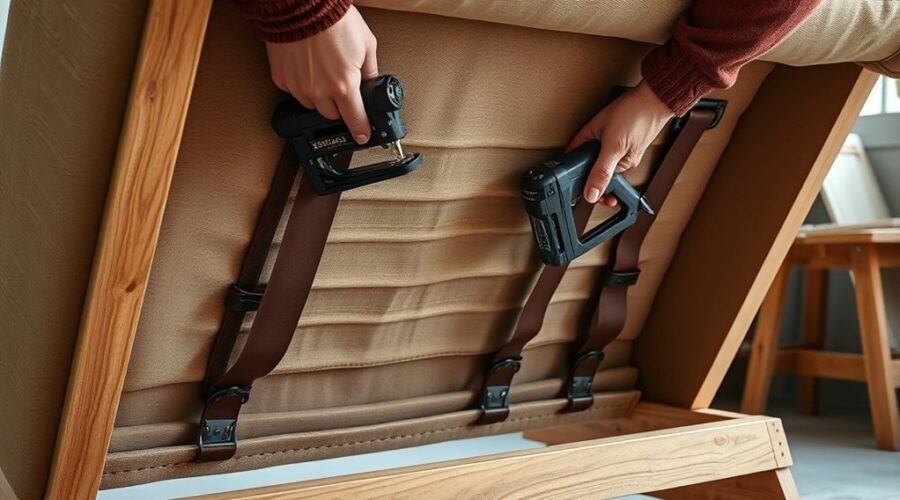
Repairing sofa webbing underneath the seat deck starts with identifying the support system before removing anything. Some sofas use woven jute or elastic webbing alone, while traditional seats may use webbing beneath coil springs and other sofas use sinuous or zig-zag springs. Once the construction is identified, inspect the frame, remove only the failed material, install matching seat-rated webbing with even tension, correct any spring problems that are part of the original system, test the seat, and reinstall the underside dust cover.
Quick Answer
To repair sofa webbing underneath the seat, remove the dust cover, identify the suspension type, inspect the wooden rails, and replace failed webbing with a matching seat-rated material. Stretch each strip evenly, secure both ends firmly, weave crossing strips over and under, repair springs only when the existing design requires it, and test the seat before closing the underside.
Key Takeaways
- Identify whether the sofa uses jute webbing, elastic webbing, coil springs, sinuous springs, or another platform before cutting anything.
- A traditional load-bearing seat needs seat-rated webbing; lighter jute intended for backs should not be substituted for seat webbing.
- Use a webbing stretcher on the webbing only. It is not a tool for stretching steel sofa springs.
- Match the original strip direction, spacing, spring locations, and attachment method whenever possible.
- Do not install new webbing over split, soft, loose, or badly damaged frame rails that cannot hold the fasteners securely.
At a Glance
| Time Required | Varies by construction; a webbing-only repair is considerably shorter than rebuilding a hand-tied coil-spring system or repairing damaged frame rails. |
| Difficulty | Intermediate for webbing replacement; advanced for hand-tied coil springs or structural frame repair. |
| Tools Needed | Staple or tack remover, pliers, tape measure, scissors, upholstery staple gun or tack hammer, webbing stretcher, gloves, and safety glasses. Coil-spring systems may also require spring twine and upholstery needles. |
| Cost | Depends on the webbing type and whether new spring clips, springs, twine, dust-cover fabric, or frame repairs are also required. |
Warning: Wear eye protection and gloves when working around old staples, tacks, webbing-stretcher teeth, and tensioned springs. Support the sofa securely before working underneath it. Stop if a main frame rail is cracked, badly split, soft, or unable to hold fasteners, or if a tensioned spring assembly must be substantially rebuilt and you are not experienced with upholstery spring work.
Identify the Sofa Support System
Before replacing the webbing, remove the cushions and press across the seat deck. A broad, soft dip can point to loose or failed webbing, while a sharp low spot, loose metal sound, or isolated collapse may indicate a spring or spring-clip problem. A creaking or twisting structure can indicate frame damage instead.
Next, carefully expose the underside. Most upholstered sofas have a lightweight dust cover, also called cambric or underlining, stapled around the bottom perimeter. Its job is mainly to conceal the internal construction and help control dust; it is not the structural support for the seat. A typical upholstery dust cover can be seen in Sailrite’s cambric dust-cover specifications.
Once the underside is open, identify what actually supports the seat:
- Webbing-only suspension: woven jute, elastic, rubber, polypropylene, or another upholstery webbing spans the frame.
- Traditional coil-spring suspension: coil springs sit on or are anchored to webbing and may be tied together with upholstery spring twine.
- Sinuous or zig-zag springs: S-shaped steel springs span between frame rails and are normally held by dedicated clips rather than supported like traditional coil springs.
- Other platform construction: some sofas use slats, engineered platforms, or proprietary suspension components.
Do not automatically convert one system into another. If the sofa originally used elastic webbing, for example, replacing it with rigid jute changes the way the seat flexes. Matching the original design is usually the safest repair approach.
Pro Tip: Take several clear photos before removing webbing, springs, clips, or twine. Measure strip width, spacing, direction, and spring locations. These references are much more reliable than trying to reconstruct the pattern from memory.
Inspect the Sofa Frame First
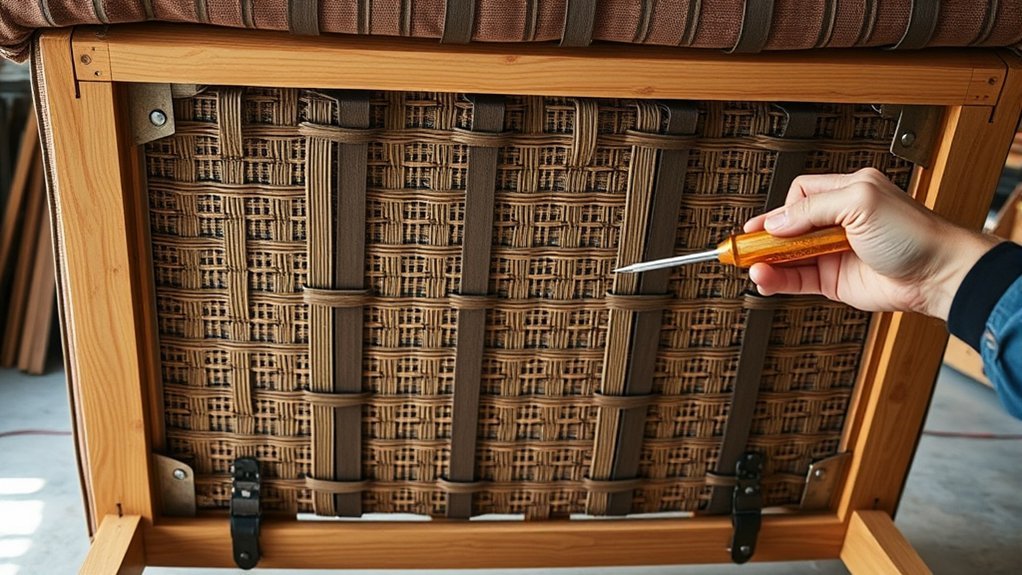
Before new webbing is installed, inspect the sofa frame carefully for structural defects that could undermine the repair. Look for soft or deteriorated wood, split grain, cracked rails, loose joints, pulled-out fasteners, and rails that move when moderate hand pressure is applied.
Old tack holes and staple scars also deserve attention because heavily damaged attachment areas may provide poor holding power. New staples or tacks need sound wood. If previous fasteners have enlarged the holes, use an undamaged area of the rail when the original construction gives enough room to do so rather than repeatedly fastening into weakened holes.
New webbing cannot compensate for a rail that is cracked, soft, loose, or unable to retain its fasteners.
Sagging strips, torn attachment points, or pulled staples indicate webbing failure, but they may also be symptoms of a damaged frame. Correct structural defects before tensioning new material across the rails.
A sound frame gives the webbing stable anchor points and distributes the seat load across the structure. If a primary rail is badly split, multiple joints are loose, or the wood is deteriorated, professional frame repair is preferable to covering the problem with new webbing.
Remove the Dust Cover and Failed Webbing Carefully
Flip or position the sofa securely so the underside is accessible without balancing the furniture in an unstable position. Use a staple lifter, tack puller, or flat tool carefully around the perimeter of the dust cover. Remove the fasteners without tearing the cover if it is still reusable, and set the cover aside.
Before disturbing the suspension, photograph the original pattern. Mark the front, back, left, and right sides if necessary. Record the direction and spacing of the webbing and note exactly how springs, clips, or twine connect to it.
A staple puller or flathead screwdriver can lift old webbing fasteners one at a time. Keep the prying angle shallow to reduce the risk of tearing wood or enlarging existing holes. Pliers are useful for pulling staples or tacks after their heads have been raised.
Remove webbing that is torn, badly stretched, frayed, or no longer securely anchored. Do not automatically remove every spring. If the sofa uses coil springs anchored to the webbing, support the spring assembly and document its connections before releasing the failed webbing. If the existing spring ties remain sound and the repair can be completed without cutting them, unnecessary disassembly should be avoided.
With the failed material out of the way, inspect the frame again. Damage hidden behind old webbing often becomes easier to see once the rails are exposed.
Choose the Correct Replacement Webbing
The best replacement is the webbing that suits the sofa’s original suspension design and load. Jute webbing is a traditional choice for upholstered furniture, but not every grade of jute is intended for a seat.
For traditional load-bearing seat construction, use a product specifically rated for seating. For example, Sailrite’s 3-1/2-inch 11-pound jute webbing is specified for chair and sofa seats and for supporting springs. By comparison, its lighter 9-pound jute webbing is intended mainly for furniture backs and lighter-load areas.
If the sofa was built with elastic upholstery webbing, replace it with compatible upholstery-grade elastic webbing of the appropriate width and stretch rather than assuming jute is an automatic upgrade. The suspension was designed around a particular amount of flexibility.
Also inspect the existing fasteners and rail thickness. Upholstery staples or tacks need enough penetration to hold the webbing securely, but they must not be so long that they emerge through another face of the frame.
Note: Do not select replacement webbing only by color or width. Seat webbing carries substantially more load than webbing used on an inside back or arm, so use material intended for the actual application.
Replace the Sofa Webbing With the Correct Material
Cut the new webbing long enough to span the frame and leave sufficient material at each end for secure fastening and any fold-back used by the original construction. Keep the new strip direction and spacing consistent with the layout documented during removal.
- Attach the first end. Position the webbing square to the rail and secure one end with multiple upholstery-grade staples or appropriate upholstery tacks driven into sound wood.
- Stretch the webbing across the frame. Use a proper webbing stretcher to pull the strip firmly and evenly. The stretcher is designed for upholstery webbing such as jute or polypropylene.
- Secure the stretched end. While maintaining tension, fasten the opposite end firmly to the rail. Where the original construction and available rail surface allow it, fold the loose tail back over the first row of fasteners and secure it again for reinforcement.
- Repeat the parallel strips. Install the remaining strips in the first direction with consistent spacing and similar tension. Avoid one strip being dramatically tighter than its neighbors.
- Weave the crossing strips. Run the second direction over and under the first set. Alternate the starting pattern on adjacent rows to create a basket-weave grid.
- Check every attachment point. Look for staples that have not seated correctly, splitting wood, crooked strips, or material beginning to pull out of the rail.
The webbing should feel firm and evenly tensioned across the seat opening without visibly distorting the wooden rails. It should not hang loosely between attachment points, but extreme tension is not a substitute for using the correct webbing or repairing weak wood.
Do not staple a webbing strip “every 4 to 5 inches” along its unsupported span. Each strip crosses from one structural rail to another; its critical attachment points are where its ends meet the frame.
Reattach or Re-tie Springs Only If the Sofa Uses Them
After the webbing is secured, restore the spring system only if springs are part of the sofa’s original construction. The correct method depends on the spring type.
Traditional Coil Springs
In a traditional coil-spring seat, the spring bottoms may be anchored to the webbing with upholstery twine, clips, or stitching according to the original design. Upholstery needles are specifically used for tasks such as tying and anchoring springs to webbing; see Sailrite’s upholstery needle guidance.
If the sofa originally uses an eight-way hand-tied coil-spring system, the springs are connected to neighboring springs and the frame with spring twine in multiple directions to control their position and movement. Preserve the original spring height, alignment, and tying pattern rather than inventing a new one.
A webbing stretcher should not be used to pull steel springs tight. Its job is to tension the webbing underneath them.
Sinuous or Zig-Zag Springs
Sinuous springs are a different system. They normally span between frame rails and attach through dedicated spring clips. They are not converted into an eight-way hand-tied coil-spring system simply because the seat sags.
If a sinuous spring has detached, inspect the spring, its clip, the fastener, and the wooden rail. Replace damaged suspension hardware with compatible upholstery components. A broken spring, badly damaged spring clip area, or cracked rail can require a more involved repair than webbing replacement.
Warning: Do not improvise spring repairs with lightweight household wire, random screws, or makeshift hooks. Spring components can be under significant tension. If the original attachment method is unclear or several springs require rebuilding, use a professional upholsterer.
Test the Seat Before Reupholstering or Closing the Underside
Perform a final seat test before reinstalling upholstery layers or the underside dust cover. Press across the seat from several positions and compare the resistance from one area to another.
- Inspect the new webbing for fraying, cuts, twists, or loose ends.
- Confirm that every fastener is fully seated and that no staple or tack is pulling out.
- Check the frame again for movement, fresh splitting, or distortion caused by tension.
- Check that woven strips remain aligned and that the seat does not contain one unusually tight ridge or soft section.
- If coil springs are present, verify that they remain upright, securely anchored, and evenly supported.
- If sinuous springs are present, confirm that their clips and attachment points remain secure.
If the surface gives too much, identify the actual cause before adding more tension. Common causes include a loose fastener, insufficient webbing tension, an incorrectly selected webbing material, uneven strip tension, a failed spring connection, or weak frame wood.
Once the internal support is secure, return the sofa upright and apply weight cautiously. The seat should feel consistent across comparable seating positions without a sudden dip, shifting sound, or moving frame joint.
Finally, reinstall the dust cover. Pull it smooth across the underside and staple it around the perimeter without treating it as a load-bearing support layer.
Troubleshooting Common Sofa Webbing Problems
New Webbing Still Sags
If new webbing sags immediately, check whether it was tensioned enough before fastening, whether a staple or tack is pulling free, and whether the material is actually rated for seat support. Also inspect the rails; a fastener cannot hold reliably in soft or badly damaged wood.
The Seat Feels Uneven After Repair
Compare the tension of neighboring strips. One excessively tight strip can create a ridge while looser strips create a dip. On spring seats, uneven spring anchoring or tying can produce the same symptom.
Staples Keep Pulling Out
Do not solve repeated pullout by simply adding more staples to the same damaged holes. Inspect the rail for split grain, enlarged holes, deterioration, or insufficient sound wood. The frame may need repair before the suspension can be restored reliably.
The Webbing Is Good but One Area Still Drops
An isolated low spot can indicate a detached or damaged spring, spring clip, spring-to-webbing connection, or local frame problem rather than general webbing failure. Inspect that section instead of automatically tightening the whole webbing grid.
The Sofa Creaks or Twists
Creaking combined with visible frame movement suggests a structural problem. Webbing replacement alone will not stabilize loose joints or a cracked rail. Repair the frame before putting the sofa back into regular service.
Frequently Asked Questions
What Is the Fabric on the Underside of a Couch Called?
The fabric stapled across the bottom of a couch is usually called a dust cover, cambric, or underlining. It conceals the internal frame, webbing, and springs and helps control dust. It is not the structural seat support. Modern versions are commonly made from lightweight nonwoven synthetic material, although older furniture may use other fabrics.
What Is the Best Type of Webbing for a Sofa?
The best webbing depends on the sofa’s construction. Traditional upholstered seats may use heavy seat-rated jute webbing, including 3-1/2-inch 11-pound jute designed for seating. Modern furniture may use elastic or synthetic upholstery webbing instead. Match the original system unless you are deliberately rebuilding the suspension to a professionally designed alternative.
How Do You Repair the Underside of a Couch?
Remove the underside dust cover carefully, photograph the existing support system, inspect the wooden frame, and identify whether the sofa uses webbing, coil springs, sinuous springs, or another support platform. Replace failed webbing with a matching upholstery-grade material, restore any spring connections that belong to the original construction, test the seat for even support, and reinstall the dust cover.
What Is the Difference Between Sofa Webbing and Sofa Springs?
Sofa webbing consists of flexible straps stretched across a frame to create or support the seat suspension. Sofa springs are steel suspension components that compress and rebound under load. Some furniture uses webbing alone, some uses sinuous springs, and traditional coil-spring furniture can use both webbing and springs together.
How Tight Should Sofa Webbing Be?
Sofa webbing should be firm and evenly tensioned so it supports the seat without hanging loose between the rails. Use a webbing stretcher for webbing designed to be mechanically tensioned, and keep neighboring strips consistent. Avoid excessive tension that begins to distort weak rails or makes one strip substantially tighter than the rest.
Can You Replace Elastic Sofa Webbing With Jute?
It is usually better to match the original suspension rather than automatically replace elastic webbing with jute. Elastic and jute webbing behave differently under load, so changing materials can change seat firmness and movement. Use upholstery webbing compatible with the sofa’s original design unless the entire suspension is being intentionally redesigned.
Conclusion
Repairing sofa webbing underneath the seat deck can restore support when the webbing itself has stretched, torn, or pulled away from the frame. The important first step is identifying the sofa’s actual suspension system instead of assuming every seat uses jute webbing and hand-tied springs.
Inspect the frame, preserve the original layout, choose webbing rated for the application, stretch and fasten each strip evenly, and handle coil or sinuous springs according to their own construction. After testing the seat for consistent support, reinstall the dust cover. Correcting the underlying failure instead of simply hiding the sag gives the repair the best chance of lasting.
Sources
- Sailrite — 3-1/2″ Red 11 lb Jute Webbing — specifications and intended use of heavy-duty jute webbing for furniture seats and spring support.
- Sailrite — 3-1/2″ Black 9 lb Jute Webbing — confirms that lighter jute is intended mainly for backs and lighter-load areas rather than load-bearing sofa seats.
- Sailrite — Webbing Stretcher — confirms that the tool is intended for stretching upholstery webbing such as jute or polypropylene.
- Sailrite — Upholstery Hand Sewing Needles — documents upholstery needles used for tying and anchoring springs to webbing.
- Sailrite — Cambric Dust Cover — describes the underside fabric as a cover that conceals springs and webbing and helps control dust.