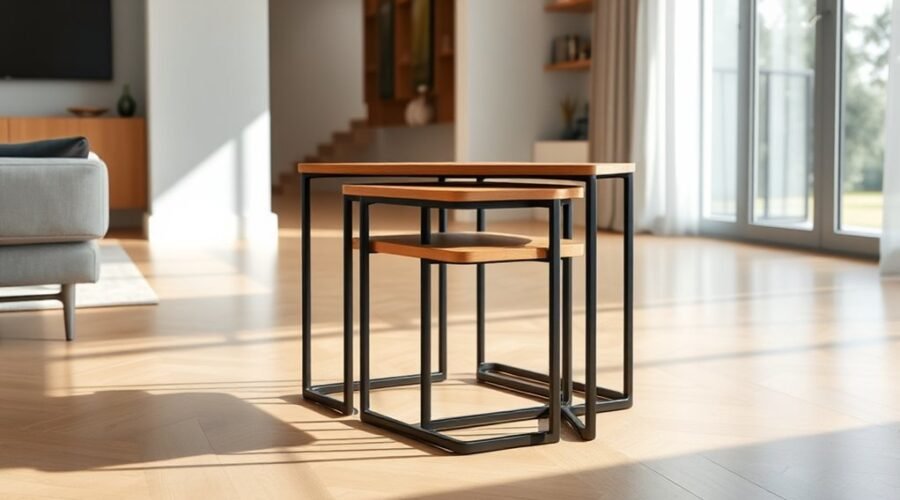
If you want extra tabletop space without permanently filling the room with furniture, nesting tables are one of the simplest options. The smaller tables slide beneath or partly beneath the larger one, then pull out when you need another place for drinks, books, a laptop, or décor. The best set depends on its actual dimensions, stability, materials, load limits, and how easily the pieces move in your room.
Quick Answer
Nesting tables are a set of two or more tables sized so smaller pieces fit beneath larger ones. They save floor space when nested, then separate to provide extra surfaces. Choose a set by checking its actual dimensions, nesting clearance, stability, load rating, material, and whether it is designed for indoor or outdoor use.
Key Takeaways
- Nesting tables use progressively sized pieces that can be grouped together or separated as needed.
- Their main advantage is flexible surface space without keeping several separate tables on the floor all the time.
- Two-piece sets are simple and compact, while larger sets provide more individual surfaces.
- Wood, metal, glass, acrylic, and mixed-material designs offer different looks, weights, care needs, and durability.
- Measure the complete nested footprint and each individual table rather than relying on a universal size or clearance rule.
- Check manufacturer load limits, care instructions, and indoor/outdoor ratings before use.
What Are Nesting Tables?
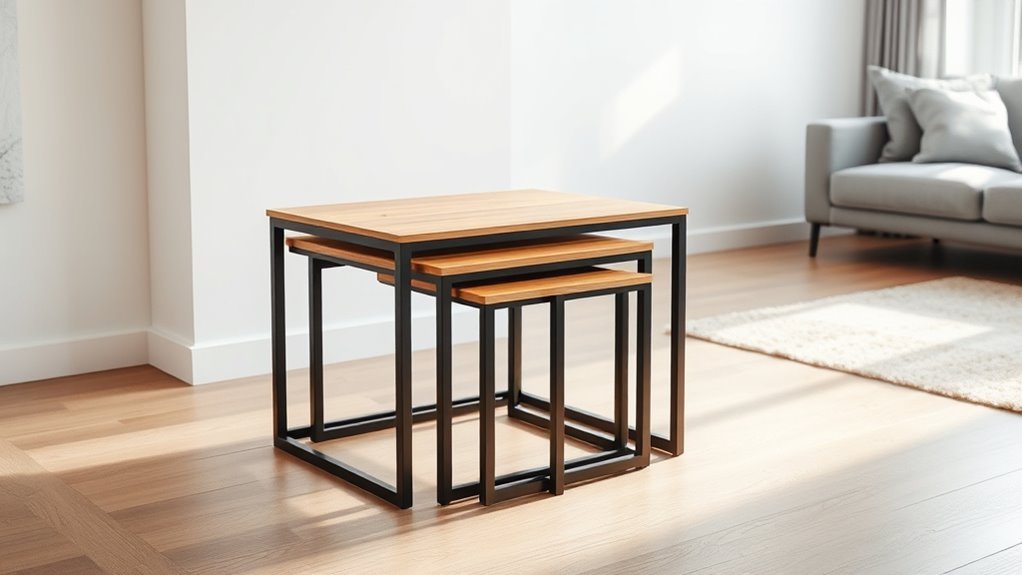
Nesting tables are a compact set of progressively sized tables designed so one or more smaller pieces can fit beneath a larger table. You can use the pieces together as a layered arrangement or separate them when you need more surface area.
The design has a long history. A surviving Sheraton-period nest of three tables is dated to around 1800, and Thomas Sheraton described nesting tables in his 1803 Cabinet Dictionary as tables that could be drawn out, used separately, and enclosed together again when not needed. An 1808 furniture reference also described their usefulness for refreshments. BADA documents this early history and a circa-1800 example.
Modern nesting tables use the same basic idea but come in far more materials and shapes. Current sets may use wood-based panels, solid or veneered wood, steel, tempered glass, acrylic, or combinations of these materials.
There is no universal rule that every nesting set must have a specific height difference between pieces. What matters is that the smaller table clears the larger table’s top, frame, legs, shelves, or crossbars well enough to slide into its intended nested position.
How Nesting Tables Save Space
Nesting tables save space because several usable surfaces can be stored within roughly the footprint of the largest piece when the set is pushed together.
When you need more surfaces, you can separate one or more tables. When you are finished, they can return to the nested arrangement instead of remaining spread around the room.
This makes them particularly useful in apartments, small living rooms, guest rooms, and multipurpose spaces where the furniture layout changes during the day.
Tuck-Away Footprint
A nesting set works best when the smaller pieces fit cleanly beneath the larger one without scraping the tabletop, catching on a brace, or forcing the frames together. Some sets nest almost completely; others overlap only partway by design.
| Feature | Benefit | What to Check |
|---|---|---|
| Nested layout | Reduces everyday floor use | Complete nested width and depth |
| Separate pieces | Adds temporary surfaces | Weight and ease of moving |
| Progressive sizing | Allows compact storage | Frame, leg, shelf, and tabletop clearance |
Before buying, compare the manufacturer’s complete measurements rather than assuming every smaller table will disappear fully underneath the largest one.
Flexible Surface Use
A nesting set can serve several jobs during the same day. One piece might stay beside a sofa, another can become a temporary laptop or snack table, and the set can be grouped again when you want more open floor space.
This is useful when you occasionally need extra surfaces but do not need several permanent side tables. Current retailers also describe nesting tables as furniture that can be used together or individually, especially in smaller rooms. IKEA’s current nesting-table range shows several examples of this format.
Small-Space Efficiency
In a compact room, the main benefit is not that nesting tables magically create more floor area. Instead, they let you choose when several tables occupy the room and when those pieces return to a smaller grouped footprint.
That can make it easier to adjust a living room for guests, move furniture for cleaning, open a play area, or create a temporary work surface without keeping another full-size table in place all day.
The real space-saving advantage is flexibility: several surfaces are available when needed but can return to one compact arrangement afterward.
Nesting Table Sizes and Set Options
You will commonly see nesting tables sold as two-piece sets, although three- and four-piece nests also exist. Historical examples often used three or four progressively sized tables, while many modern retail sets use two larger pieces.
The number of tables matters less than whether the complete set fits your room and provides the number of separate surfaces you will actually use.
Common Set Configurations
- 2-piece sets: Simple to move and useful when you only need one occasional extra surface.
- 3-piece sets: Add another independent surface for guests, décor, reading areas, or flexible layouts.
- 4-piece sets: Provide more individual tables but require more space when every piece is separated.
- Partially overlapping sets: Some modern designs slide together without one table fitting completely underneath another.
A larger set is not automatically better. If you rarely separate more than one table, a compact two-piece set may be easier to live with.
Choosing Table Dimensions
Start with the space where the set will sit most of the time. Measure the maximum width and depth available when the tables are nested. Then measure the positions where you expect to move the smaller pieces when they are in use.
Compare those measurements with the manufacturer’s published dimensions for each table. Pay attention to frames and legs as well as tabletops. A smaller tabletop can appear narrow enough to fit underneath while a lower crossbar, angled leg, shelf, or support prevents full nesting.
For use beside a sofa or chair, choose a height that makes items comfortable to reach from your normal seated position. There is no single ideal table height for every sofa because seat height, arm height, cushion depth, and the table’s intended use vary.
Also check the traffic path with the tables both nested and separated. Keep enough open room for the people in your household to move comfortably, including any extra clearance required for mobility aids, children, pets, or frequently used doorways.
Pro Tip: Mark the largest table’s footprint on the floor with painter’s tape, then mark where the smaller table will sit when pulled out. This gives you a much more useful fit check than relying on a generic recommended width or walkway number.
Best Materials For Nesting Tables
The best material depends on where the tables will be used, how often you move them, what you place on them, and how much maintenance you want.
Wood and Wood-Based Materials
Wood and wood-look nesting tables add warmth and work with traditional, Scandinavian, rustic, and contemporary interiors. Products may use solid wood, veneer, fiberboard, particleboard, or a combination, so do not assume every wood-looking surface is solid timber.
Check the care instructions before using strong cleaners or leaving wet glasses on the surface.
Metal Nesting Tables
Steel and other metal frames can create a slim profile while providing a rigid structure. Powder-coated finishes are common because they are easier to maintain than unfinished metal.
Metal tables can still scratch floors, so inspect the feet or glides and add suitable floor protection if the manufacturer does not provide it.
Glass and Acrylic
Glass can visually lighten a small room because it blocks less of the view through the furniture. Some current nesting tables use tempered glass with steel frames. For example, IKEA’s VITTSJÖ nesting tables use tempered-glass panels and a steel underframe. IKEA lists the VITTSJÖ materials, load limit, care instructions, and glass warning here.
Acrylic can create a similarly light visual effect, but it can scratch, so cleaning methods should match the manufacturer’s instructions.
Warning: Treat glass tables carefully. Damaged edges and scratched glass can weaken a panel. Follow the manufacturer’s care instructions, inspect damaged glass before continued use, and never exceed the stated load limit.
Common Shapes And Design Styles
Rectangular, round, square, oval, and irregular nesting tables all work, but their shapes affect both usable surface and how easily you can move around them.
Rectangular nesting tables often provide a long, uninterrupted surface for books, drinks, lamps, or décor. They can also fit naturally beside a sofa or along a wall.
Round nesting tables soften the look of a room and remove sharp tabletop corners. They can be convenient where people frequently move around the furniture, although the frame and leg design still determine how much clearance they need.
Square nesting tables create a compact, balanced footprint and often work well beside armchairs or at the end of a sofa.
Material combinations influence style as much as shape. Traditional wood finishes create a warmer look, while thin metal frames and glass tops tend to feel lighter and more contemporary. Mixed wood-and-metal sets can bridge both styles.
The most convincing set is one whose proportions relate to the surrounding sofa, chairs, lamps, and open floor area rather than one chosen only because a particular shape is fashionable.
Where Nesting Tables Work Best
Nesting tables are most useful in rooms where the amount of surface space you need changes during the day.
- Living rooms: Pull out an extra piece for drinks, snacks, books, or guests, then nest it afterward.
- Bedrooms: Use a compact piece for a book, phone, charging cable, or lamp if its size and load rating are appropriate.
- Home offices: Create temporary space for papers or accessories without adding another permanent desk.
- Reading corners: Keep one table beside a chair and store the remaining pieces underneath until needed.
- Guest rooms: Offer temporary bedside or luggage-adjacent surfaces without filling the room with permanent furniture.
- Patios and balconies: Use only sets specifically rated by the manufacturer for outdoor conditions.
Do not assume an indoor table is suitable outside simply because it has a metal frame. Moisture, UV exposure, coatings, fasteners, adhesives, and tabletop materials all affect outdoor durability.
How To Choose The Right Set
Choose nesting tables by matching their real dimensions and construction to what you expect them to do, not simply by choosing the smallest-looking set.
Measure Both Layouts
Check the set in two states: fully nested and fully separated. The nested measurements tell you how much permanent floor area it needs. The separated measurements tell you whether the tables can actually be used without blocking doors, walkways, seating, or other furniture.
Check Stability and Load Limit
Look for a stable frame, level feet, secure fasteners, and a published load limit when available. A table intended for a lamp and drink may not be designed for a heavy appliance, large planter, or a person sitting on it.
For example, IKEA currently lists a maximum tabletop load of 22 lb for the VITTSJÖ nesting-table set. That number applies to that product, not to nesting tables in general.
Consider How Often You Will Move Them
If you plan to separate the tables every day, weight and grip points matter. A very heavy table may look compact but still be awkward to move. Glass tops also deserve more careful handling than many wood-based tops.
Match the Material to the Location
Indoor and outdoor furniture should not be treated as interchangeable. IKEA, for example, recommends SONHULT for indoor use, while GRYTSHOLM is specifically designed for outdoor use. SONHULT’s product information identifies it as indoor furniture, while GRYTSHOLM is listed for outdoor use.
Think About Storage and Shelves
Some nesting tables are nothing more than tabletops and legs, while others include lower shelves or partially enclosed storage. A shelf can be useful, but it may also affect how completely the smaller table nests and how easily you can reach items when the pieces overlap.
How To Style Nesting Tables
To style nesting tables without making the room feel busy, treat the set as flexible furniture first and decoration second.
You can keep the largest table beside a sofa and pull out the smaller piece when someone needs a drink surface. If the set is large enough and specifically designed for the role, the largest piece may also work as a compact coffee table.
- Stagger the pieces slightly when you want a layered look.
- Keep at least one surface mostly clear so the table remains useful.
- Use small books, a plant, or a lightweight decorative object rather than covering every level.
- Repeat one material or finish already present in the room to help the set look intentional.
- Nest the pieces again when you need more open floor area.
If the tables are moved frequently, avoid tall or unstable décor that can easily tip as the furniture is repositioned.
Nesting Tables Vs. Side Tables
Nesting tables and conventional side tables solve slightly different problems.
| Feature | Nesting Tables | Fixed Side Table |
|---|---|---|
| Surface flexibility | Several surfaces can be separated as needed | One consistent surface |
| Floor footprint | Compact when nested | Constant |
| Mobility | Often designed to be rearranged | Often left in one position |
| Storage | Varies; nesting clearance can limit shelves or drawers | May offer drawers, cabinets, or larger shelves |
| Best fit | Rooms needing changing surface space | Rooms needing a permanent bedside or sofa-side station |
If you regularly need several temporary surfaces, nesting tables can be more flexible. If you want permanent storage, a charging station, a large lamp, or a table that rarely moves, a conventional side table may fit better.
Best Nesting Tables For Small Spaces
The best nesting table for a small room is not simply the narrowest one. Look at the full nested footprint, how far the set extends when separated, how much weight you need it to hold, and whether its material suits the room.
For a current price comparison, these IKEA US examples were checked on September 17, 2026. Retail prices and availability can change:
- SONHULT set of two: listed at $89.99. The yellow/birch-effect version was also marked “Last chance,” so availability may be limited. Its two tables can be positioned separately, partly together, or pushed together, and IKEA recommends it for indoor use.
- LACK set of two: listed at $26.98. IKEA describes the smaller piece as sliding underneath the larger table for compact use.
- VITTSJÖ set of two: the black-brown/glass version was listed at $149.99, while the light-beige/glass version was listed at $129.99. The tables use tempered glass and steel and can be used together or separately.
- GRYTSHOLM set of two: listed at $99.99 and designed for outdoor use. The pieces can be separated into two small tables or arranged together.
The LACK product page is useful if price and a simple two-piece indoor design are priorities. The VITTSJÖ product page provides an example of a glass-and-metal set with a published load limit and glass-care guidance.
Note: Furniture prices, finishes, ratings, and availability change. Use the examples above to compare design types, then confirm the current specifications on the manufacturer’s or retailer’s page before buying.
Nesting Table Safety And Care
Nesting tables are simple furniture, but the fact that they move and overlap creates a few practical checks that are easy to miss.
- Follow the load limit: Do not assume a compact table can support a heavy object just because the frame feels solid.
- Do not use it as a stool or step: Unless the manufacturer explicitly rates the product for sitting or standing, use it only as a table.
- Check fasteners: If the set is assembled with screws or bolts, inspect them periodically and retighten them as directed by the manufacturer.
- Protect glass: Avoid impacts to glass edges and stop using damaged glass until you have followed the manufacturer’s safety guidance.
- Check floor contact: Make sure feet or glides are intact so repeated movement does not scratch flooring.
- Watch pinch points: Keep fingers clear of tight frame gaps when sliding one table beneath another, especially when children are nearby.
- Use the right environment: Keep indoor-only furniture protected from rain and prolonged outdoor exposure.
Current VITTSJÖ instructions, for example, advise checking assembly fastenings regularly and warn that damaged edges or scratched glass may cause the glass to crack or break. That guidance applies specifically to that product, but it illustrates why the manufacturer’s instructions matter.
Frequently Asked Questions
What Is the Point of a Nesting Table?
A nesting table gives you several usable surfaces without requiring the permanent floor footprint of several separate tables. Pull the smaller pieces out when you need them, then slide them back into the grouped arrangement afterward.
What Are the Common Uses for Nested Tables?
Common uses include side tables for drinks and books, temporary snack tables, small laptop surfaces, display tables, bedside surfaces, and extra tables for guests. Use depends on the size, stability, and load rating of the specific set.
Can Nesting Tables Be Separated?
Yes. Separating the individual pieces is a core feature of most nesting-table designs. You can place them beside different seats or in different parts of the room, then group them together again when you want a smaller footprint.
Are Nests of Tables Old Fashioned?
No. The concept is centuries old, but current versions are sold in contemporary wood, metal, glass, and mixed-material designs. The nesting function remains useful in modern apartments and multipurpose rooms because the pieces can be rearranged without adding another permanent table.
How Do I Know What Size Nesting Table to Buy?
Measure the space for the complete nested set first, then measure where each smaller table will go when separated. Compare those measurements with the manufacturer’s dimensions and check frame, leg, shelf, and tabletop clearance rather than relying on one universal size rule.
Can Nesting Tables Be Used Outdoors?
Only if the manufacturer rates the set for outdoor use. Outdoor exposure can affect coatings, fasteners, wood products, adhesives, and other materials. Check the product specification instead of assuming that a metal frame automatically makes a table weather-resistant.
Conclusion
Nesting tables are useful because they give you a choice between a compact grouped footprint and several separate surfaces. Their value comes from that flexibility, not from any one material, shape, or fixed size formula.
Measure the nested and separated layouts, check that the frames clear each other properly, choose a comfortable height for your seating, and confirm the manufacturer’s load and care instructions. With the right dimensions and construction, a nesting set can add everyday function without making a compact room feel permanently crowded.
Sources
- BADA — George III Nest of Tables — documents a circa-1800 Sheraton-period nesting set and historical references from 1803 and 1808.
- IKEA US — Nesting Tables — current examples, configurations, materials, and small-space uses.
- IKEA — LACK Nesting Tables — current product configuration, materials, and price checked September 17, 2026.
- IKEA — SONHULT Nesting Tables — current price, dimensions, materials, and indoor-use guidance.
- IKEA — VITTSJÖ Nesting Tables — tempered-glass construction, 22-lb load limit, care instructions, glass warning, and current pricing.
- IKEA — GRYTSHOLM Nesting Tables — outdoor-use designation, materials, care guidance, and current pricing.