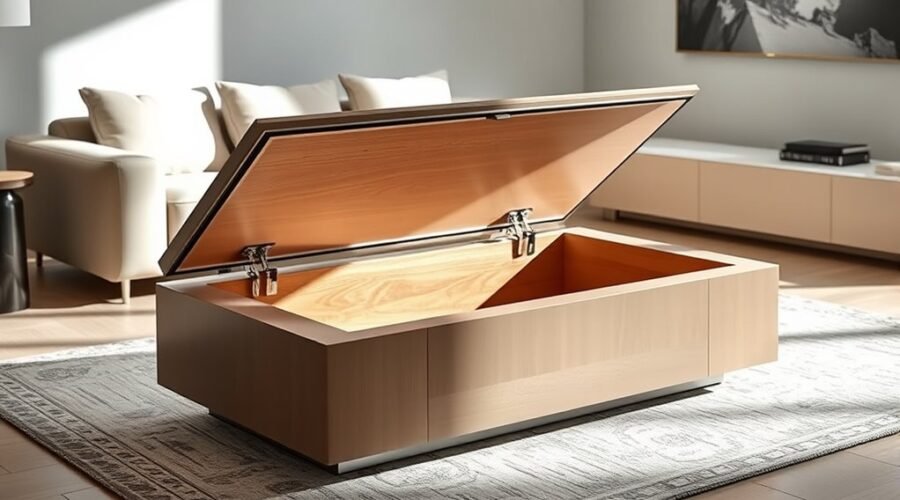
A storage coffee table combines an everyday tabletop with built-in space for blankets, books, remotes, games, chargers, and other living-room items. Lift-top versions add another function: part or all of the tabletop moves upward and often toward the sofa, creating a higher surface for a laptop, snack, or casual meal while revealing storage underneath.
Quick Answer
A storage coffee table hides everyday clutter inside drawers, shelves, or a compartment beneath the top. A lift-top model uses hinges, springs, gas-assisted hardware, or similar mechanisms to raise the tabletop. The best choice fits your sofa, provides enough opening clearance, has a stable mechanism, and carries a clearly stated manufacturer load rating.
Key Takeaways
- A storage coffee table combines a tabletop with hidden or open storage for everyday living-room items.
- Lift-top designs raise the surface for easier laptop use, reading, snacks, or casual meals while exposing storage below.
- Lift mechanisms vary by model, so check the hardware type, opening path, stability, and manufacturer-rated load before buying.
- Drawers, shelves, side doors, and divided compartments can make small items easier to organize.
- Correct sizing, safe operation, sturdy construction, and enough clearance around the sofa matter more than any single material or mechanism.
What Is a Lift-Top Storage Coffee Table?

A lift-top storage coffee table is a multifunctional table with a surface that can rise above its normal coffee-table position. Depending on the design, the top may move straight up or travel both upward and toward the sofa.
The space below the moving top is commonly used for blankets, magazines, remotes, board games, chargers, or a laptop. Other versions combine the lift-top compartment with drawers, open shelves, or doors.
When raised, the top can provide a more convenient surface for paperwork, laptop use, reading, snacks, or a casual meal. It does not automatically replace an ergonomically adjusted desk, but it can make a multi-use living room more flexible.
Storage coffee tables are available in solid wood, plywood, MDF, particleboard, metal, veneer, and mixed-material constructions. Build quality, joinery, hardware, finish, and proper use are at least as important as the material name printed on the product listing.
How Lift-Top Tables Work
A lift-top table connects its movable tabletop to the base with a hinged lifting assembly. Mechanical arms guide the top as it rises, while springs, gas-assisted supports, locks, or other hardware may help control the movement.
The exact mechanism is model-specific. For example, some current adjustable coffee tables use a gas spring and a locking feature to control closing. Other tables use spring-assisted scissor-style hinges or simpler mechanical assemblies.
As the surface rises, many designs also move it toward the seated user. That forward travel is useful for working or eating, but it also means the table needs enough clearance between the base, sofa, knees, and nearby furniture.
Warning: A moving lift top creates pinch and crush points around its hinges and closing edges. Keep fingers, children, pets, cords, and loose objects clear of the mechanism. Follow the table manufacturer’s instructions, and do not exceed its stated load limit.
Do not assume the raised surface can carry the same load as the closed tabletop. The manufacturer may specify different limits for different positions, and those limits should control how the table is used.
Lift-Top Hardware and Mechanisms
The lifting hardware determines how the tabletop moves, how much effort it takes to open, and how stable it feels when raised. Product listings sometimes use terms such as pneumatic, gas lift, hydraulic, and spring lift loosely, so look at the actual mechanism and instructions rather than relying on the marketing label.
| Hardware type | What to know |
|---|---|
| Mechanical or spring-assisted hinge | Uses hinged arms and may use springs to assist movement. Check for balanced movement, securely mounted fasteners, and a stable fully raised position. |
| Gas-assisted mechanism | A gas spring can assist lifting or help control closing. The force and travel are designed for a particular tabletop, so replacement parts should match the original specification. |
| Locking or controlled-close feature | Some tables add a lock or controlled-motion feature to reduce unintended movement. Its operation should be checked in the manufacturer’s instructions. |
Some tops rise farther than others, and some travel much farther toward the sofa. Before buying, compare the table’s closed height, raised height, forward travel, compartment depth, and load rating with the way you plan to use it.
Pro Tip: Test the lifting motion with the tabletop empty. A good mechanism should move evenly without the top twisting, rubbing the cabinet, or forcing you to put your fingers near the hinge arms.
Common Hidden Storage Features
The main attraction of a storage coffee table is the ability to organize items without adding another cabinet to the room.
A large compartment under a lift top works well for blankets, board games, books, headphones, controllers, and similar items. Drawers are better for small objects such as remotes, charging cables, coasters, pens, and batteries because you can reach them without opening the main top.
Open shelves keep books, baskets, or decorative objects visible and easy to reach. Side or front doors can provide access to storage even when something is sitting on the tabletop.
Dividers and small organizers can prevent one large compartment from becoming a mixed pile of cables, remotes, and papers. Before buying, compare the usable internal dimensions, not just the outside dimensions of the table.
Why People Choose Storage Coffee Tables
People choose storage coffee tables because the same footprint can provide a tabletop, organization, and—in a lift-top design—a temporary raised work or eating surface.
The main space-saving advantage is not that the table becomes smaller; it is that one piece of furniture can perform several jobs.
That can be useful in apartments, studios, family rooms, and other spaces where a separate desk or storage cabinet would consume valuable floor area.
A storage table can also reduce visible clutter by giving frequently used objects a defined place. However, a deep storage base may look visually heavier than an open-frame coffee table, so the best design depends on your room as well as your storage needs.
Prices vary widely by size, material, construction, hardware, and brand. Instead of choosing by a fixed price threshold, compare the mechanism, usable storage, stability, warranty, material specification, and load limits.
Best Ways to Use the Lift-Top Surface
A lift-top coffee table can create a more convenient temporary surface when the normal tabletop is too low for the task.
- Use it for a laptop or paperwork when you need a short work session from the sofa.
- Raise it for a snack or casual meal so you do not have to lean as far forward.
- Use the compartment below to keep remotes, chargers, books, and games off the visible tabletop.
- Use it for reading, puzzles, or hobbies when the raised position provides a more comfortable reach.
- Lower it completely when you want the proportions and appearance of a conventional coffee table.
A raised coffee-table surface is not automatically an ergonomic workstation. For extended computer use, you still need appropriate screen position, seating, and arm support.
If children use the room, treat the lift mechanism as moving furniture rather than a toy. Adults should supervise opening and closing, and small fingers should stay away from the hinges and closing edges.
Which Materials Last the Longest?
No single material guarantees the longest life. A well-built table depends on the quality of the wood or panel, the design of the joints, the way the lift hardware is attached, moisture exposure, surface finish, and how heavily the table is used.
Solid hardwood can provide excellent strength and repairability. Quality plywood can provide strong, dimensionally stable panels. Manufactured boards such as MDF and particleboard can also work well when correctly engineered for the table and protected from moisture.
Solid Wood Durability
Hardwoods such as oak, maple, and cherry are common choices for furniture because they can provide a strong frame and durable visible surfaces. Solid wood can also often be sanded or refinished after years of wear.
However, solid wood expands and contracts as its moisture content changes. The USDA Forest Products Laboratory explains that moisture and relative humidity affect the dimensions of wood in service. Good drying, joinery, design, and moisture control therefore matter as much as species choice.
A protective finish can slow moisture exchange and reduce staining or surface wear, but it does not make wood immune to dimensional movement.
Plywood and Veneer
Plywood is made from layers of wood veneer arranged with their grain directions crossed and bonded together. According to APA – The Engineered Wood Association, this cross-laminated construction provides good strength-to-weight performance and dimensional stability.
A furniture-grade veneer can give a plywood panel the appearance of a chosen wood species while the plywood core provides structural stability. Edge quality, veneer thickness, adhesive, finish, and construction still affect how well the finished piece holds up.
For furniture sold in the United States that contains regulated hardwood plywood, MDF, or particleboard, look for appropriate EPA TSCA Title VI compliance. This is more meaningful than relying on a vague unsupported claim that a product is simply “chemical-free” or “formaldehyde-free.”
Hardware Wear Resistance
The lift hardware can determine the service life of the table even when the cabinet itself is strong. Look for substantial metal arms, secure mounting points, appropriately sized fasteners, and a mechanism designed for the weight and dimensions of the tabletop.
Material alone does not tell you whether a hinge is good. Thickness, geometry, pivot design, fastener quality, mounting surface, corrosion protection, and rated load all matter.
- Inspect hinges and mounting plates before buying or assembling.
- Open and close the top several times and watch for twisting or binding.
- Check that screws and bolts remain tight.
- Keep dirt and debris out of moving joints.
- Do not add a heavier replacement tabletop unless the lift hardware is rated for it.
How to Build a Storage Coffee Table
A DIY storage coffee table should be designed around its lift hardware rather than treating the mechanism as an afterthought. The mechanism determines mounting locations, internal clearance, tabletop weight, travel, and the space needed for the arms to move.
At a Glance
| Time Required | Project-dependent; allow separate time for accurate cutting, dry-fitting the mechanism, assembly, sanding, finishing, and cure time. |
| Difficulty | Intermediate; accurate alignment of the moving hardware is more demanding than building a fixed coffee table. |
| Tools Needed | Measuring tools, square, clamps, drill/driver, appropriate saws, sanding equipment, bits and fasteners specified for the chosen design, plus eye and hearing protection. |
| Cost | Varies by lumber or sheet material, lift hardware, fasteners, finish, and whether you already own the necessary tools. |
Warning: Power saws and moving lift hardware can cause serious injuries. Wear appropriate eye and hearing protection, follow each tool manufacturer’s instructions, guard moving blades, disconnect power before adjustments, and keep hands out of the lift mechanism’s pinch zones.
1. Choose the Lift Hardware First
Select a lift mechanism with documented dimensions, mounting instructions, travel, and load limits. Do not design a heavy tabletop first and then assume a generic hinge will carry it.
2. Plan the Base and Storage Compartment
Lay out the cabinet so the hinge arms have enough room to move without striking dividers, drawers, stored objects, or the inside walls. Decide whether the table will use solid wood, plywood, or another furniture-grade material.
3. Cut and Assemble the Base
Cut the side panels, ends, bottom, rails, and other structural parts square. Edge-glued solid-wood panels or quality plywood can both work, depending on the design. Use joinery and fasteners appropriate for the material rather than relying on weak edge fastening into unsuitable sheet goods.
4. Build the Top and Internal Storage
Make the top flat and stiff while staying within the weight range intended for the hardware. Add dividers, shelves, or organizers only where they will not interfere with the mechanism.
5. Dry-Fit and Align the Lift Mechanism
Install the lift assembly according to its supplied dimensions. Mount both sides square and at matching positions so the top does not rack as it moves. Do not substitute different screws or mounting locations unless the hardware manufacturer permits it.
6. Test the Motion Before Loading the Table
Open and close the empty tabletop slowly. Check for binding, sudden movement, loose screws, uneven travel, contact with the cabinet, and adequate clearance around the hinges. Correct any problem before putting objects on the raised surface.
7. Sand and Finish the Table
Sand sharp edges and apply paint, stain, varnish, polyurethane, or another furniture finish compatible with the material. Keep finish buildup and debris out of pivots and moving hardware.
How to Choose the Right Size and Style
Start by measuring your sofa and the open floor area around it. Generic coffee-table dimensions are only starting points because sofas vary in height, length, depth, cushion compression, and layout.
Ethan Allen’s current sizing guidance recommends looking for a coffee table roughly two-thirds the length of the sofa and about 1–2 inches lower than the sofa-seat surface. It also suggests keeping roughly 12–18 inches between the table and surrounding furniture.
For a lift-top model, measure more than the closed dimensions. Check:
- Closed height: Does it work as a normal coffee table with your sofa?
- Raised height: Is the surface comfortable for the task you expect to perform?
- Forward travel: Will the moving top hit your knees or sofa?
- Walking clearance: Can people still move through the room while the top is raised?
- Storage dimensions: Will the compartment actually hold the items you plan to store?
- Table length and width: Do they suit the seating arrangement without dominating the room?
Style matters too. Solid or veneered wood can suit traditional, rustic, Scandinavian, and contemporary rooms, while combinations of metal and engineered wood often create a more industrial or modern look.
Lift-Top Coffee Table Buying Tips
When shopping for a lift-top coffee table, start with the moving parts rather than the finish. A beautiful tabletop will not compensate for a mechanism that twists, binds, slams, or feels unstable.
Check the manufacturer’s load limits, assembly instructions, warranty, replacement-part availability, storage dimensions, and both raised and lowered measurements.
Lift Mechanism Types
Lift-top tables may use mechanical spring-assisted hinges, gas-assisted supports, scissor-style arms, locking hardware, or combinations of these systems.
- Choose based on documented operation rather than a marketing term such as “hydraulic.”
- Check whether the top rises evenly from both sides.
- Confirm the maximum load stated by the manufacturer.
- Check whether the raised position is stable enough for your intended task.
- Look for controlled closing or locking features if they are important to your household.
- Make sure replacement gas springs or hardware are available if the design depends on specialized parts.
One current IKEA adjustable coffee table, for example, uses a gas spring and a lock intended to control the top’s movement. IKEA also advises clearing the tabletop before raising or lowering it. That is useful model-specific guidance, but another table may use completely different hardware.
Storage and Size Considerations
Choose the storage style based on what you actually plan to put inside. Blankets and games need a larger compartment, while remotes and cables are easier to organize in drawers or smaller divided spaces.
Compare external dimensions with the usable internal space because mechanisms, rails, and thick panels can reduce storage capacity.
For the overall size, use your sofa rather than a generic 36-inch or 48-inch table as the main reference. A table around two-thirds of the sofa length and near the seat height can be a useful starting point, but the available walkway and the table’s raised position still need to be checked.
Check Safety, Loads, and Clearance
Before using a lift-top table, read its assembly and operating instructions. Confirm that all supplied fasteners are installed and properly tightened.
Do not place more weight on the raised top than the manufacturer permits. A table may have a sturdy cabinet yet a much lower allowable load on the moving surface because the lifted top transfers forces through hinges, arms, and mounting screws.
Leave enough room for the entire opening path. A top that moves toward the sofa may need significantly more usable space than its closed footprint suggests.
Care and Troubleshooting
Regular inspection can prevent small hardware problems from turning into a loose or uneven top. Some furniture manufacturers specifically recommend checking assembly fasteners periodically and retightening them when necessary.
- Top lifts unevenly: Stop using it and check that left and right mounting points are aligned and that no fastener has loosened.
- Top rubs or binds: Inspect for a shifted hinge, loose cabinet joint, obstruction inside the compartment, or incorrect assembly.
- Top drops faster than before: Stop loading the raised surface and inspect the assist hardware. A worn or failed gas spring or other support should be replaced only with a compatible part.
- Table wobbles: Check leg, frame, and cabinet fasteners before blaming the lift mechanism.
- Wood top changes slightly with the seasons: Humidity-related wood movement is normal, but severe cupping, splitting, or binding deserves inspection.
Keep the tabletop dry, wipe spills promptly, and use cleaning products compatible with the finish. Do not spray lubricant blindly into a mechanism unless its manufacturer recommends a specific lubricant and application point.
Frequently Asked Questions
What are the benefits of a storage coffee table?
A storage coffee table combines a useful surface with space for items such as remotes, books, blankets, games, and chargers. Lift-top versions can also raise the surface for temporary laptop use, reading, snacks, or casual meals, which can be helpful when a room has to serve several purposes.
What is the 2/3 rule for coffee tables?
The 2/3 rule is a proportional design guideline that suggests choosing a coffee table around two-thirds the length of the sofa. For example, a 72-inch sofa would point you toward a table around 48 inches long. It is a starting point rather than a requirement; room clearance and the sofa’s actual proportions still matter.
What do you call a coffee table that opens?
A coffee table with a surface that rises is commonly called a lift-top coffee table. Many lift-top designs reveal a hidden storage compartment when opened, although some storage tables instead use hinged lids, drawers, doors, or removable panels.
What are the coffee-table design trends in 2026?
Current designs continue to emphasize multifunctional furniture, hidden storage, adjustable surfaces, cleaner profiles, mixed materials, and ways to manage electronic devices and cables. Individual products may add charging or other technology, but those features should be evaluated model by model rather than treated as standard across all 2026 coffee tables.
Are lift-top coffee tables safe around children?
They can be used safely when assembled and operated according to the manufacturer’s instructions, but the moving top and hinges create pinch points. Children should not play with the mechanism, and an adult should keep fingers, toys, cords, and other objects away from the closing path.
How much weight can a lift-top coffee table hold?
There is no universal load limit. Capacity depends on the table, hardware, mounting method, and whether the top is raised or closed. Use the manufacturer’s stated limits for your exact model and do not assume the moving top has the same capacity as the stationary base.
Sources
- Ethan Allen — Coffee Tables — coffee-table height, proportion, and spacing guidance.
- IKEA — VITTERYD Adjustable Coffee Table — example of lift-top gas-spring, locking, load, maintenance, and operating guidance.
- APA – The Engineered Wood Association — Plywood — plywood construction and dimensional-stability information.
- U.S. Environmental Protection Agency — Formaldehyde Emission Standards for Composite Wood Products — U.S. requirements covering hardwood plywood, MDF, particleboard, and finished goods containing them.
- USDA Forest Products Laboratory — Drying and Control of Moisture Content and Dimensional Changes — moisture-related movement of wood.
- Occupational Safety and Health Administration — Saw Safety — hazards and protective measures relevant to woodworking.
Conclusion
A storage coffee table earns its floor space by combining a normal tabletop with organization underneath. A lift-top version adds another useful feature, but the mechanism deserves as much attention as the finish: check how it moves, how far it travels, what it can safely carry, and whether there is enough room to operate it.
Choose the table around your sofa and actual storage needs rather than a universal size, price, or material rule. With sound construction, appropriate hardware, regular fastener checks, and safe operation, a storage coffee table can keep everyday clutter close at hand while helping a living room stay more flexible and organized.