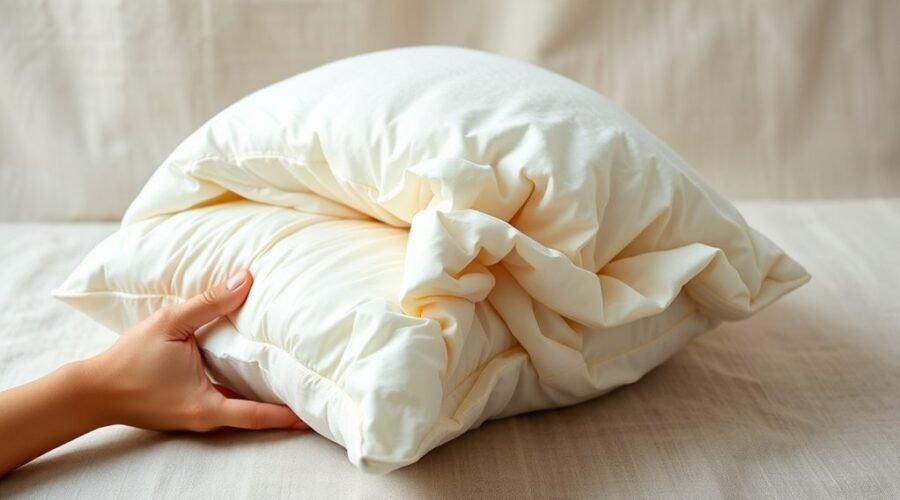
A down blend cushion combines natural down and feathers—and, in many sofa designs, those materials wrap around a supportive foam core. The result is a softer, more relaxed seat than firm foam alone, but the exact feel depends on the blend ratio, fill amount, core construction, and upholstery. Down blend can be an excellent choice if you like a plush seat and do not mind routine fluffing and reshaping.
Quick Answer
Down blend cushion fill combines down and feathers to create a soft, moldable feel with more structure than a high-down fill. Many sofa cushions also use a foam core wrapped in feather, down, and fiber. Ratios and construction vary by manufacturer, and regular fluffing and rotation help the cushion maintain its loft and shape.
Key Takeaways
- Down blend cushion fill combines feathers and down, but there is no universal feather-to-down ratio.
- Down adds loft and softness, while feathers generally add more body and structure.
- Many sofa seat cushions pair the natural fill with a foam core for stronger support and shape recovery.
- Down-proof ticking helps contain the fill, while baffles or channels can reduce shifting inside the cushion.
- Expect a relaxed look and routine maintenance: fluffing, rotating, and reshaping are normal parts of owning feather/down cushions.
- Choose the cushion by feel, construction, maintenance needs, and manufacturer specifications rather than assuming every “down blend” is built the same way.
What Is Down Blend Cushion Fill?
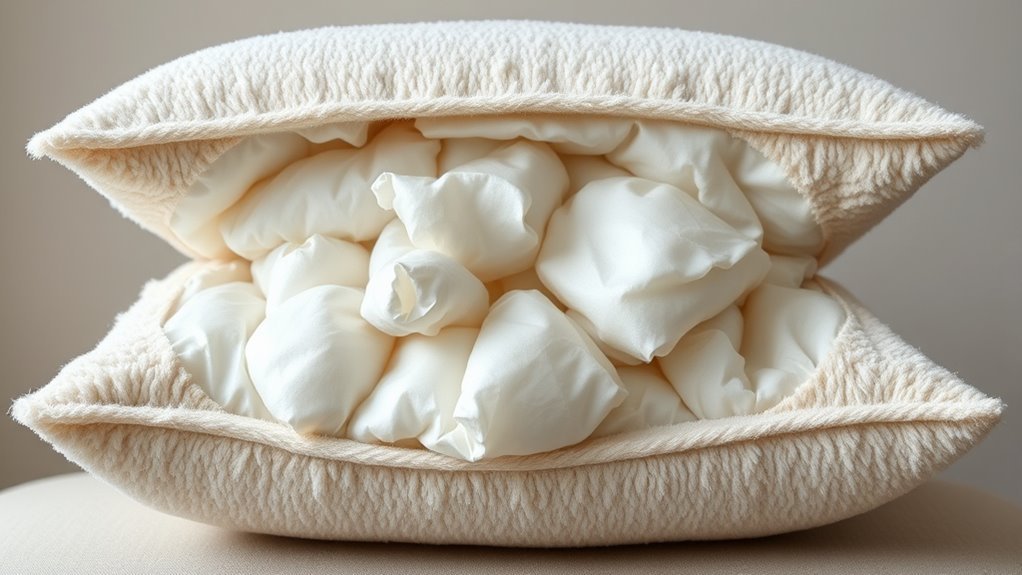
Down blend cushion fill is a mixture of natural down and feathers used in sofa seats, back cushions, chairs, and decorative cushions. Down and feathers are not the same material. According to the American Down and Feather Council, down is the soft undercoating of waterfowl and does not contain a quill, while feathers have quills and provide more structure.
That difference helps explain the feel of a blend. Down contributes loft, softness, and a moldable surface. Feathers give the cushion more body. Manufacturers can then adjust the ratio, add polyester fiber, or build the blend around foam to create anything from a very relaxed back cushion to a more supportive seat cushion.
Note: “Down blend” is a construction category, not a standardized recipe. One product may use a feather-heavy blend, another may use a different ratio, and another may combine feather, down, fiber, and a foam core. Check the actual product specifications instead of assuming a 90/10 mix.
For example, some current furniture uses a foam-centered construction rather than loose natural fill alone. Room & Board describes its blend-down cushion as a high-resiliency foam core wrapped in fiber, feather, and down and covered with down-proof ticking.
How Soft Does Down Blend Feel?
Down blend generally feels soft, moldable, and relaxed. When you sit down, the natural fill compresses around your body instead of holding a rigid surface. The more down and loose fill a cushion contains, the softer and more sink-in it may feel, although the complete construction matters as much as the percentage printed on a tag.
A feather-heavy blend usually has more body than a high-down fill. A foam-core down blend can feel plush on the surface while remaining supportive underneath. This is why two sofas both advertised as “down blend” can feel noticeably different in a showroom.
Loose down and feathers should not be expected to rebound like springy foam on their own. Natural fill regains loft through movement and fluffing. The American Down and Feather Council describes loft as the fluffiness of down and notes that compressed down products can have their loft restored by plumping or shaking.
A down blend cushion is best thought of as a soft, shapeable cushion—not a maintenance-free cushion that instantly returns to a factory-perfect profile after every use.
What’s Inside a Down Blend Cushion?
There is no single construction used for every down blend cushion. Depending on the manufacturer and whether the cushion is used for a seat or backrest, you may find loose feather/down fill, polyester fiber, a foam core, internal channels or baffles, and tightly woven ticking.
Foam Core Support
Many sofa seat cushions use a foam core as the main structural element. The foam carries much of your weight and helps the cushion regain its basic profile after you stand. Feather, down, and sometimes fiber surround the core to soften the surface.
This construction is useful when you want the comfort of natural fill without the extremely loose feel of an all-feather or high-down insert. It can also make a seat easier to live with because the core provides a defined shape even when the outer fill needs fluffing.
| Feature | Benefit |
|---|---|
| Foam core | Provides the main support and helps maintain the cushion profile |
| Feather/down wrap | Adds a softer, more moldable surface feel |
| Baffles or channels | Help limit large-scale fill migration |
Down Feather Blend
The natural-fill portion can contain many different feather/down ratios. A feather-heavy mix generally feels more structured, while increasing the proportion of down can create a softer, lighter, loftier feel. The actual experience also depends on how much fill is used and whether a foam or fiber core sits underneath it.
Do not assume that every cushion contains 90% feathers and 10% down. As one example of ratio variation, Ethan Allen currently lists a 95/5 feather-down-blend insert on one of its custom pillow products. Furniture specifications vary by collection, so the product tag or manufacturer specification is the best source for the actual blend.
Baffle Box Construction
Baffle-box construction divides the interior into compartments. The American Down and Feather Council defines a baffle box as a construction with internal fabric walls between boxes; those walls help keep down from shifting freely from one area to another.
Not every sofa cushion uses a true baffle-box design. Manufacturers may instead use channels, pockets, quilting, or other compartment systems. The goal is similar: keep a large amount of fill from migrating to one side and leaving another area flat.
Down-Proof Ticking
The natural fill is commonly enclosed in tightly woven down-proof ticking. Its main job is containment: it reduces the amount of feather and down working through the cushion casing.
Ticking should not be confused with internal baffles. Ticking surrounds the fill; baffles or channels organize it inside the cushion. Even with quality ticking, an occasional feather working its way out can occur. Both Room & Board and Crate & Barrel note that some feather migration or loss is normal with feather/down cushions.
What Are the Pros and Cons of Down Blend?
Down blend appeals to people who prioritize a soft, relaxed sitting experience, but that comfort comes with more reshaping than a firm foam cushion normally requires.
Softness and Comfort Benefits
- Soft surface feel: Natural fill conforms readily around your body.
- Relaxed appearance: The cushion develops a casual, lived-in look rather than staying perfectly squared at all times.
- Adjustable construction: Manufacturers can combine foam, fiber, feathers, and down to create different firmness levels.
- Good pressure distribution: The loose outer fill moves instead of creating one rigid contact surface.
- Restorable loft: Fluffing and kneading redistribute compressed fill and restore fullness.
Maintenance and Cost Drawbacks
- Regular fluffing: Natural fill settles and compresses with use.
- More visible body impressions: A relaxed cushion will not always look freshly arranged after someone gets up.
- Possible feather migration: An occasional feather can work through the ticking or seams.
- Variable construction: The words “down blend” alone do not tell you the exact ratio, foam quality, or amount of fill.
- Potentially higher price: Natural-fill and multi-layer cushion constructions can cost more than basic polyester fiber or simple foam cushions.
If you have a known allergy to feathers or bird proteins, a synthetic-fill cushion may be the more appropriate choice. However, it is too broad to assume that feather/down furniture is inherently an allergy problem for everyone. Research on feather versus synthetic bedding has produced a more complicated picture, and bedding studies do not directly establish the effect of sofa cushions.
How Do You Care for Down Blend Cushions?
Routine care keeps down blend cushions looking fuller and reduces uneven compression. The exact cleaning method should always follow the upholstery manufacturer’s care label, because the outer fabric may require different treatment from the cushion insert.
- Fluff compressed areas. Lift, shake, knead, and pat the cushion so the feather/down layer spreads back through the casing.
- Rotate loose seat cushions. Move cushions between positions when the sofa design allows it so the most-used seat does not take all the wear.
- Flip reversible cushions. If both sides are designed for sitting, regular flipping helps distribute compression.
- Reshape the corners and edges. Push displaced fill back toward thin areas and smooth the upholstery afterward.
- Vacuum the upholstery regularly. Use an appropriate upholstery attachment and follow the furniture maker’s guidance.
- Handle spills according to the care code. Do not assume that a zippered cover is machine washable or that the cushion insert can be washed.
Ethan Allen’s upholstery-care guidance, for example, recommends rotating, flipping, and fluffing its Featherblend cushions and vacuuming them regularly. It also cautions that zippered cushion covers are not necessarily intended to be cleaned separately.
Pro Tip: Give high-use seat cushions a quick fluff whenever you straighten the room, then perform a more thorough rotation and reshaping regularly. Small, frequent adjustments are easier than trying to restore a heavily compressed cushion later.
When Is Feather Loss Normal?
An occasional feather or quill working through the ticking can be normal with feather-filled upholstery. Repeated heavy leakage from the same location is different. Check for a damaged seam, worn inner casing, broken zipper area, or torn ticking if you are continually finding a large amount of fill outside the cushion.
How Does Down Blend Compare to Other Fills?
No cushion fill is universally best. The right option depends on whether you value plushness, upright support, low maintenance, a crisp appearance, or a relaxed seat.
| Fill Type | Typical Feel | Shape | Maintenance | Good Fit For |
|---|---|---|---|---|
| Down blend | Soft and moldable | Relaxed; develops impressions | Regular fluffing and rotation | Lounging and softer comfort |
| Foam-core down blend | Plush surface with firmer support below | More defined than loose natural fill | Still needs outer-fill fluffing | People wanting softness without a very loose seat |
| High-resilience foam | Supportive and springier | Usually cleaner and more tailored | Lower routine reshaping | Upright sitting and low-maintenance households |
| Polyester fiber | Soft and lightweight | Can compress with use | Fluffing may still be needed | Budget-conscious or feather-free applications |
| Higher-down natural fill | Very soft and lofty | More relaxed and easily compressed | Frequent plumping | Buyers prioritizing maximum softness |
How Do You Choose a Good Down Blend Cushion?
Do not judge the cushion by the words “down blend” alone. Ask what is inside and how it is built.
- Check the actual fill percentages. A feather/down percentage tells you more than the generic blend name.
- Ask whether there is a foam core. A core can make a large difference in seat support and shape retention.
- Check whether fiber is part of the wrap. Some cushions combine polyester fiber with the natural fill.
- Look for down-proof ticking. A tightly constructed inner casing helps contain feathers and down.
- Look for baffles, channels, or compartment construction. These can help control fill movement.
- Check whether cushions are reversible. Reversible loose cushions give you more ways to distribute wear.
- Ask whether inserts can be replaced. Replaceable inserts can extend the useful life of an otherwise sound sofa.
- Sit on the furniture before buying when possible. Published fill percentages cannot tell you exactly how a cushion will feel under your body.
What About Ethical Down Sourcing?
If animal-welfare sourcing matters to you, look for a recognized third-party standard rather than relying only on broad marketing terms such as “responsibly sourced.” The Responsible Down Standard from Textile Exchange covers animal-welfare requirements and chain of custody and prohibits practices including live-plucking and force-feeding within certified supply chains.
How Long Do Down Blend Cushions Last?
There is no reliable universal number of years for a down blend sofa cushion. The natural fill is only one part of the cushion, and a sofa’s comfort can change because of the foam core, suspension, upholstery, seams, fill quantity, daily use, and maintenance.
Instead of judging a cushion by age alone, look for practical signs of decline:
- the cushion stays noticeably uneven after thorough fluffing;
- a foam core remains compressed or develops a permanent dip;
- support has changed enough that you feel the frame or suspension underneath;
- the inner ticking is torn or leaking large amounts of fill;
- the cushion no longer fits its cover correctly; or
- you need to reshape it constantly just to make it usable.
If the sofa frame and upholstery are still in good condition, replacing or rebuilding the cushion insert may be more practical than replacing the entire sofa.
Who Should Choose Down Blend Cushions?
Down blend may suit you if:
- you like a soft, relaxed, lounge-oriented seat;
- you do not mind visible impressions after sitting;
- you are willing to fluff and rotate cushions;
- you prefer a less rigid feel than firm foam alone; and
- you like a casual rather than perfectly tailored cushion appearance.
You may prefer another fill if:
- you want cushions to stay crisp with minimal reshaping;
- you prefer firm, upright support;
- you have a known feather or bird-protein allergy;
- you specifically want animal-free cushion materials; or
- routine fluffing and rotating would be inconvenient.
Frequently Asked Questions
What Is the Softest Cushion Filling?
A high-down natural fill can provide an extremely soft, lofty feel, but there is no single softest cushion based only on material name. Fill quantity, down percentage, casing, foam cores, and cushion dimensions all change how soft the finished cushion feels. Higher-down designs also tend to require regular plumping.
Do Down-Filled Couches Last?
They can last well when the cushion and sofa are properly constructed and maintained, but there is no dependable universal lifespan such as five or ten years. Cushion performance depends on the foam core, fill quantity, suspension, frequency of use, sitter load, rotation, and maintenance. Judge replacement needs by loss of support and persistent deformation rather than age alone.
What Is the Most Comfortable Couch Cushion Filling?
Comfort depends on how you like to sit. Down blend or foam-core down blend works well for people who enjoy a soft, relaxed seat. High-resilience foam is often a better fit if you prefer firmer support, easier movement when standing up, and less reshaping. Try the cushion in person when possible.
Which Cushion Filler Is Best?
There is no best filler for every sofa. Choose down blend for a softer, more moldable feel; foam for stronger shape retention and lower maintenance; or synthetic fiber if you want a feather-free option. Construction quality matters as much as the material category.
Do Down Blend Cushions Flatten?
They compress and develop body impressions with use because feathers and down move under pressure. Regular fluffing, kneading, rotating, and flipping reversible cushions can restore much of the loft. If a foam core remains permanently compressed, however, fluffing the outer fill will not correct the underlying loss of support.
Is It Normal for Feathers to Come Out of a Sofa Cushion?
An occasional feather working through the casing can be normal with feather/down cushions. Frequent or heavy leakage from one area can indicate a damaged seam or worn inner ticking and is worth inspecting.
Conclusion
A down blend cushion is a good match when you want a softer, more shapeable seat and are comfortable with regular fluffing and rotation. The most important detail is that “down blend” does not describe one fixed formula: ratios, foam cores, fiber layers, ticking, and internal compartments vary widely. Check the actual cushion construction before buying, then choose the design that matches the softness, support, appearance, and maintenance level you prefer.
Sources
- American Down and Feather Council — What Is Down & Feather? — definitions and characteristics of down and feathers.
- American Down and Feather Council — Down & Feather Terminology — loft, baffle-box construction, ticking, and related terminology.
- Room & Board — Blend-Down Cushion Construction — current example of a foam core wrapped in fiber, feather, and down with down-proof ticking.
- Ethan Allen — Use and Care Guide — manufacturer guidance on fluffing, flipping, rotating, and vacuuming feather-blend cushions.
- PubMed — Does Bedding Affect the Airway and Allergy? — review illustrating why broad claims about feather products and allergy require nuance.
- Textile Exchange — Responsible Down Standard — animal-welfare and chain-of-custody criteria for certified down and feathers.