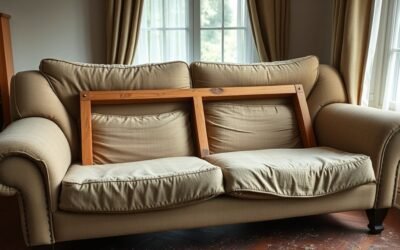
If you look beneath a sofa seat, you may find rows of sinuous springs: heavy steel wires formed into repeating S-shapes and stretched across the frame beneath the cushions. Also called zigzag, serpentine, S-springs, or no-sag springs, they form the sofa’s suspension layer. Their performance depends not just on the spring shape, but also on the wire, spacing, tension, clips, cross ties, frame, and cushions above them.
Quick Answer
Sinuous spring construction uses parallel S-shaped steel wires stretched across a sofa frame beneath the seat cushions. When the springs are correctly tensioned, securely clipped, and tied together, they provide firm, responsive support with a low-profile design. Quality depends on the whole system—wire size, spacing, ties, clips, frame strength, and cushion construction—not on one feature alone.
Key Takeaways
- Sinuous springs are continuous S-shaped steel wires that usually run from the front rail to the back rail of a sofa seat.
- Clips secure the springs to the frame, while cross ties or stabilizing wires can help maintain spacing and make the seat suspension work as a connected system.
- A quality sinuous system can provide durable everyday support; spring type alone does not determine how long a sofa will last.
- Wire specification, spring spacing, attachment quality, frame strength, and cushion construction all influence support and comfort.
- Sagging, clicking, uneven support, or a spring dropping below the frame can indicate a loose clip, damaged spring, failed tie, or frame problem.
What Is Sinuous Spring Construction?

Sinuous spring construction is a sofa suspension method that uses lengths of spring steel bent into a repeating S or zigzag pattern. Multiple springs are normally mounted side by side beneath the seat deck so they flex when someone sits down and rebound when the load is removed.
The springs are commonly secured at the front and rear frame rails with specialized clips. Some systems also use transverse tie wires, rods, or other connectors to keep adjacent springs aligned. For example, HPFi specifies heavy-duty 8-gauge sinuous seat springs running front-to-back with two left-to-right tie wires in one of its commercial lounge-seating systems.
Sinuous construction is popular because it creates a relatively thin, efficient suspension layer without the depth or labor required by traditional hand-tied coil construction. You can find it in furniture at many price levels, so seeing the term sinuous springs on a specification sheet does not by itself tell you whether a sofa is cheap or premium.
Note: “No-sag” is commonly used as a product or construction term for zigzag springs. It should not be read as a guarantee that a sofa can never sag; the springs, attachments, frame, cushions, and usage all affect long-term performance.
How Sinuous Springs Support Sofa Seats
When weight is applied to the seat, each arched S-shaped wire deflects and stores energy. As the load is removed, the spring tries to return to its original shape. Multiple springs working beneath the cushion create the flexible foundation that separates the sitter from the rigid frame below.
The result is not determined by the springs alone. Cushion foam, fiber or down wrapping, seat depth, upholstery tension, spring arc, frame geometry, and the number and spacing of springs all change what the finished sofa feels like.
Weight Distribution
A properly built sinuous system spreads support across multiple spring rows rather than relying on a solid board directly beneath the cushion. Cross ties can link adjacent rows so the springs maintain alignment and move more consistently as a group.
That construction helps the seat maintain an even platform when the suspension is correctly designed. Important details include:
- Spring spacing: consistent spacing avoids unusually large unsupported gaps beneath the cushion.
- Spring tension and arc: springs must be matched to the frame and seat design rather than simply pulled as tightly as possible.
- Cross ties: lateral connectors can stabilize spring position and coordinate movement across the seat.
- Cushion construction: the cushion spreads the sitter’s load before it reaches the suspension and strongly influences perceived firmness.
Mayo Furniture describes its 8-gauge sinuous seat springs as being tied together to maintain even support, illustrating why the entire spring network matters more than an isolated wire.
Frame Attachment
The spring-to-frame connection is one of the most important parts of the system. Each spring is anchored at the frame rails with clips or other hardware that must tolerate thousands of loading cycles without pulling free or damaging the surrounding frame material.
Decor-Rest specifies 8-gauge no-sag seat springs attached to hardwood with polyresin spring clips, which the manufacturer says are used to reduce metal-on-metal squeaking. Other manufacturers use different approved clips and fasteners.
Cross ties or stabilizing wires can also keep the parallel spring rows from shifting out of position. If an attachment loosens, support may become uneven even when the steel spring itself is still intact.
Pro Tip: When comparing sofas, ask for the complete seat-suspension specification: spring type, wire specification, approximate spacing or spring count, cross ties, clip type, frame construction, and suspension warranty. One impressive-sounding specification does not prove the entire seat is well built.
What Affects Sinuous Spring Quality?
Two sofas can both advertise “sinuous spring construction” and still perform very differently. The label identifies the basic suspension type, not the quality of the finished system.
| Quality factor | Why it matters |
|---|---|
| Wire specification | The diameter and properties of the spring steel affect stiffness and resistance to permanent deformation. |
| Spacing and spring count | Consistent spacing helps create an even support surface beneath the cushion. |
| Spring arc and tension | These affect how much the seat deflects and rebounds under load. |
| Clips and fasteners | Secure attachment keeps the springs connected to the frame and can reduce movement-related noise. |
| Cross ties | They help preserve spring alignment and allow adjacent rows to behave as a coordinated suspension. |
| Frame construction | The rails and joints must resist the forces transferred into them by the tensioned springs. |
| Cushions and padding | They influence pressure distribution, firmness, contouring, and whether individual springs can be felt. |
Several manufacturers use 8-gauge sinuous springs in substantial seat constructions. Decor-Rest, Mayo Furniture, Magnussen, and HPFi all publish examples using 8-gauge seat springs. That makes 8-gauge a useful specification to recognize, but it should not be treated as a universal minimum or as proof of quality by itself.
Why Furniture Makers Use Sinuous Springs
Furniture makers use sinuous springs because the system can provide resilient support in a relatively shallow package and can be installed efficiently during production. The parallel spring layout also works with many contemporary frame shapes where a deep traditional coil deck would be inconvenient.
Practical advantages can include:
- Low profile: useful in furniture designs with limited space beneath the seat.
- Efficient manufacturing: preformed springs can be clipped into a prepared frame without hand-tying every coil.
- Serviceability: an individual spring or failed attachment may sometimes be repaired without rebuilding an entire traditional coil deck.
- Tunable support: manufacturers can alter spring dimensions, count, spacing, ties, frame geometry, and cushion construction for the desired seat response.
Sinuous springs are not restricted to inexpensive furniture. They appear in both residential and commercial seating specifications. What matters is how the complete seat was engineered and whether its materials and warranty suit the intended use.
The useful question is not simply “Does this sofa have sinuous springs?” but “How is the entire suspension system built?”
Sinuous Springs vs. Coil Springs
The phrase coil springs needs clarification because springs can appear in different parts of upholstered furniture. Traditional sofa suspension can use upright coil springs beneath the seat deck. Some seat cushions also contain individually pocketed coils surrounded by foam or other padding. Those are different constructions and should not be treated as interchangeable.
For example, Stickley describes its traditional eight-way hand-knotted suspension as hourglass-shaped steel coils tied together in an eight-way web. By contrast, a sofa can use sinuous springs in the frame while also using pocketed coils inside its removable seat cushions.
Support And Durability
Neither “sinuous” nor “coil” automatically establishes durability. A robust sinuous system with strong clips, adequate spring spacing, cross ties, and a sound frame can provide long service. A poorly built coil system can still develop problems if its frame, ties, cushioning, or other components fail.
Traditional hand-tied coils have the advantage of being interconnected in multiple directions, creating a coordinated spring platform. Sinuous systems achieve a flatter profile and can use cross ties to maintain alignment across parallel spring rows.
- Judge the strength and joinery of the frame supporting the suspension.
- Check how springs are attached and interconnected.
- Consider the manufacturer’s warranty and stated use rather than assuming one spring shape lasts longer.
Comfort And Feel
Sinuous suspension often contributes to a structured, responsive seat, while traditional coil constructions can be tuned for a broad range of movement. However, the finished feel depends heavily on the cushion placed above the suspension.
| Feature | Sinuous seat suspension | Traditional coil suspension |
|---|---|---|
| Basic form | Parallel S-shaped steel wires | Upright coil springs arranged across the deck |
| Typical profile | Relatively shallow | Usually requires more vertical space |
| Interconnection | May use transverse tie wires or rods | Traditional hand-tied systems connect coils in multiple directions |
| Seat feel | Often structured and responsive | Can be engineered for responsive, coordinated movement |
| Major comfort variable | Cushion design plus suspension specification | Cushion design plus coil specification and tying method |
If two sofas feel different in a showroom, do not assume the hidden suspension caused the entire difference. Foam firmness, cushion thickness, down or fiber wraps, upholstery tension, seat depth, and back angle can change comfort as much as the suspension type.
Cost And Longevity
Sinuous systems are generally less labor-intensive to assemble than traditional eight-way hand-tied construction, which helps manufacturers control production cost. Traditional hand tying requires more manual work because individual coils must be positioned and connected.
That does not mean the less expensive suspension automatically wears out first. Long-term performance depends on the complete sofa, including its frame, attachments, spring specification, cushions, upholstery, usage, and repairability.
For value comparisons, look beyond the marketing name and check the manufacturer’s construction details and warranty. A well-executed sinuous system can be a better purchase than a poorly executed product that merely advertises a more prestigious spring term.
Sinuous Springs vs. Eight-Way Hand-Tied Springs
These two support systems use substantially different construction methods. Sinuous suspension uses parallel zigzag wires secured to opposite frame rails. Eight-way hand-tied construction uses individual coil springs connected with ties running in multiple directions.
Sinuous springs create a compact, efficient suspension, while traditional eight-way hand tying creates an interconnected grid of individual coil springs.
Eight-way hand-tied construction is associated with traditional premium upholstery because it is labor-intensive and allows the spring deck to move as a coordinated network. Stickley describes its hand-knotted system as an eight-way web that provides uniform movement and support.
Sinuous suspension uses fewer construction steps and occupies less vertical space. When built with suitable steel, secure clips, good spacing, cross ties, and a strong frame, it can still be a substantial everyday seating system.
| Factor | Sinuous springs | Eight-way hand-tied |
|---|---|---|
| Construction | S-shaped wires clipped across the frame | Individual coils tied together in multiple directions |
| Labor | Efficient to install | More labor-intensive |
| Depth | Low-profile construction | Requires room for upright coils and tying |
| Quality check | Wire, spacing, ties, clips, frame | Coils, ties, frame, edge support, craftsmanship |
| Best use | Many residential, commercial, low-profile, and engineered designs | Traditional upholstery where the maker specifically designs around a hand-tied deck |
There is therefore no need to reject a sofa simply because it uses sinuous rather than hand-tied springs. Compare the complete construction, sit on the furniture when possible, and decide whether the feel, specification, warranty, and price suit your needs.
Sinuous Springs vs. Webbing
Webbing supports a seat with woven strips rather than rows of steel spring wire. Depending on the furniture, the webbing may be jute, rubberized, elastic, synthetic, or part of a proprietary support system.
Sinuous springs normally create a more obviously spring-based response, while webbing can provide a softer or lower-profile foundation. However, it is inaccurate to assume that every webbing system is inferior. Material quality, strap spacing, tension, frame design, intended load, and engineering all matter.
If a manufacturer uses webbing, ask what type it is, how it is tensioned and attached, whether it is replaceable, and what warranty covers the suspension. Apply the same scrutiny you would give a spring system.
Common Sinuous Spring Failures and Symptoms
Problems in a sinuous suspension may involve the spring wire itself, but attachment points and the surrounding frame are also important. A seat can lose support when a clip loosens, a tie breaks, a spring becomes permanently distorted, or the frame rail holding the spring is damaged.
Common symptoms include:
- A shallow bowl or low spot: first determine whether the cushion has compressed or whether the suspension underneath has dropped.
- A sudden deep sag: this can indicate a detached or broken spring, failed clip, damaged tie, or frame problem.
- Clicking or metallic ticking: movement may be occurring at a clip, tie, spring, or another frame component.
- Uneven resistance: one spring row or attachment may no longer be supporting the seat like its neighbors.
- Visible spring below the frame: the spring or its attachment requires inspection before continued heavy use.
These symptoms do not automatically mean the entire suspension needs replacement. Upholstery technicians can often identify whether the problem is a cushion, spring, clip, cross tie, or frame component.
Warning: Broken spring wire, clips, staples, and exposed frame fasteners can be sharp and may remain under tension. If you remove a sofa’s underside dust cover, keep hands and eyes away from damaged metal and do not cut or release a tensioned spring unless you know how the suspension is secured.
Heavy-use furniture can use sinuous suspension successfully when the entire product is designed for that duty. HPFi, for example, specifies 8-gauge sinuous seat springs with transverse tie wires in commercial lounge/reception seating. For a business or other high-use setting, rely on the furniture’s commercial rating, construction specification, and warranty rather than spring type alone.
How to Spot Quality Sinuous Springs
To judge a sinuous spring system before buying or reupholstering, inspect as much of the complete construction as the manufacturer makes available. Heavy seat-spring specifications such as 8-gauge wire appear in products from several established manufacturers, but wire size is only one part of the system.
| Check | What to verify |
|---|---|
| Wire specification | Ask for the actual seat-spring specification. Robust manufacturers commonly publish 8-gauge examples, but there is no single universal cutoff for every design. |
| Material and consistency | Springs should be purpose-made spring steel with consistent shape and installation. |
| Spacing | Look for even rows without conspicuously large unsupported gaps. |
| Cross ties | Check whether the design links adjacent springs to maintain alignment and coordinated support. |
| Attachment | Clips and frame rails should appear secure, with no loose hardware, splitting, or obvious movement. |
| Seat feel | Support should feel reasonably consistent across equivalent seat positions without obvious bottoming-out or isolated hard points. |
| Noise | Repeated metallic clicking or scraping deserves investigation before purchase. |
| Frame | The suspension is only as dependable as the rails and joints carrying its load. |
If the underside is covered and the suspension cannot be viewed, ask the manufacturer or retailer for a construction diagram or specification sheet. A useful description should tell you more than simply “premium springs.”
Sofa Suspension Buying Checklist
When comparing sofas in a store or online, use these questions to get past vague marketing descriptions:
- What type of seat suspension is used?
- If it uses sinuous springs, what seat-spring specification does the manufacturer publish?
- How are the springs attached to the frame?
- Are the spring rows connected by tie wires, rods, or another stabilizing system?
- What material and joinery are used in the frame rails carrying the springs?
- Are pocket coils being described as part of the cushion or as the actual frame suspension?
- What is inside the seat cushion above the suspension?
- What warranty applies specifically to the frame and suspension?
- Is the furniture rated for residential or commercial use?
- Can damaged suspension components be serviced or replaced?
When you can test the sofa in person, sit in several positions rather than only the center cushion. Shift your weight, sit near an edge, and listen for abnormal sounds. Compare equivalent seats for consistency and check whether the cushion rebounds normally after you stand.
Frequently Asked Questions
Is sinuous spring construction good?
Yes. A well-designed sinuous spring system can provide dependable everyday sofa support. Judge the wire specification, spacing, cross ties, clips, frame construction, cushion design, warranty, and intended use together. Seeing “sinuous springs” in a specification is neither an automatic sign of low quality nor a guarantee of premium construction.
What is the best spring system for sofas?
There is no single spring system that is best for every sofa. Eight-way hand-tied coils are a traditional premium construction, while well-engineered sinuous systems provide compact, responsive support and work in many residential and commercial designs. The best choice depends on the furniture design, build quality, comfort preference, serviceability, warranty, and budget.
What is the best suspension for a sofa?
Choose a suspension that is well matched to the sofa rather than relying on one construction label. Traditional hand-tied coils, sinuous springs, engineered spring units, and properly designed webbing can all be appropriate in different furniture. Look for transparent specifications, a strong frame, consistent support, suitable cushions, and a meaningful suspension warranty.
Which sofa is better, with springs or without springs?
A sofa does not need one particular type of spring to be well built. Spring systems provide resilient mechanical suspension, while some furniture uses engineered webbing or other support systems. Compare the complete frame, suspension, cushion, upholstery, warranty, and actual seat feel instead of rejecting a sofa solely because it does or does not contain a traditional spring deck.
Are 8-gauge sinuous springs good?
Eight-gauge seat springs are used in substantial residential and commercial furniture specifications from multiple manufacturers, so they are a useful positive specification to recognize. However, gauge alone cannot tell you whether a sofa is well built. Spring spacing, attachment hardware, cross ties, frame quality, cushions, and engineering still matter.
Why does a sinuous spring sofa start clicking or sagging?
Clicking or sagging can come from several places: a compressed cushion, loose spring clip, failed cross tie, distorted or broken spring, damaged frame rail, or another moving frame component. Inspect the cushion first, then have the suspension checked if the support underneath feels uneven or produces metallic noise.
Conclusion
Sinuous spring construction gives a sofa a flexible steel suspension beneath the cushions by using parallel S-shaped wires secured to the frame. It can produce firm, responsive, durable seating when the springs, clips, ties, frame, and cushions are properly engineered together.
Do not judge a sofa from the spring name alone. Check the published wire specification, spring spacing, cross ties, attachment method, frame construction, cushion design, warranty, and intended use. Traditional hand-tied coils and other suspension systems have their own strengths, but a well-built sinuous system is a legitimate construction method rather than merely a budget substitute.
Sources
- Decor-Rest Furniture — How It’s Made — documents 8-gauge no-sag seat springs, spring count, hardwood attachment, and polyresin spring clips.
- Mayo Furniture — Quality & Construction — documents 8-gauge sinuous springs and interconnected spring support.
- HPFi — Accompany Wood Lounge/Reception Specifications — documents front-to-back 8-gauge sinuous seat springs and left-to-right tie wires in commercial seating.
- Stickley — Upholstery Construction — explains traditional eight-way hand-knotted coil construction and modern engineered suspension.
- Flexsteel — Blue Steel Spring — illustrates an alternative engineered steel suspension system and why sofa suspension cannot be reduced to a simple sinuous-versus-coil hierarchy.