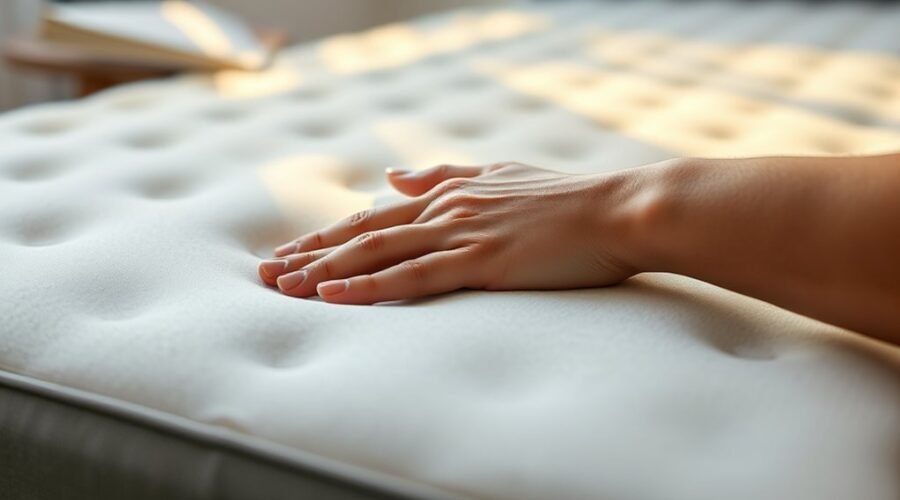
A memory foam mattress uses viscoelastic polyurethane foam in its comfort system to conform closely around the body. The foam responds to pressure and, in many formulations, warmth, which creates the slow-sinking feel memory foam is known for. That contouring can improve pressure distribution and motion isolation, but heat retention, slower movement, edge support, firmness, and construction quality vary widely between mattresses.
Quick Answer
A memory foam mattress uses pressure-responsive polyurethane foam to contour around your body. Its main strengths are close cushioning, pressure distribution, and motion isolation. Its common drawbacks are heat retention, slower response, weaker edges on some models, and initial odor. The right choice depends on firmness, construction, sleep position, body weight, and personal comfort.
Key Takeaways
- Memory foam is a viscoelastic polyurethane foam that contours under pressure and gradually returns toward its original shape.
- Memory foam is usually used in comfort and transition layers; many so-called memory foam mattresses use a separate polyfoam support core.
- Its strongest performance areas are usually pressure distribution, close contouring, quietness, and motion isolation.
- Traditional memory foam can feel warm and slow-moving, while open-cell designs, hybrid construction, and cooling materials are intended to address those drawbacks.
- Firmness, foam density, layer thickness, body weight, sleep position, edge support, trial terms, and warranty requirements matter as much as the words “memory foam.”
What Is a Memory Foam Mattress?
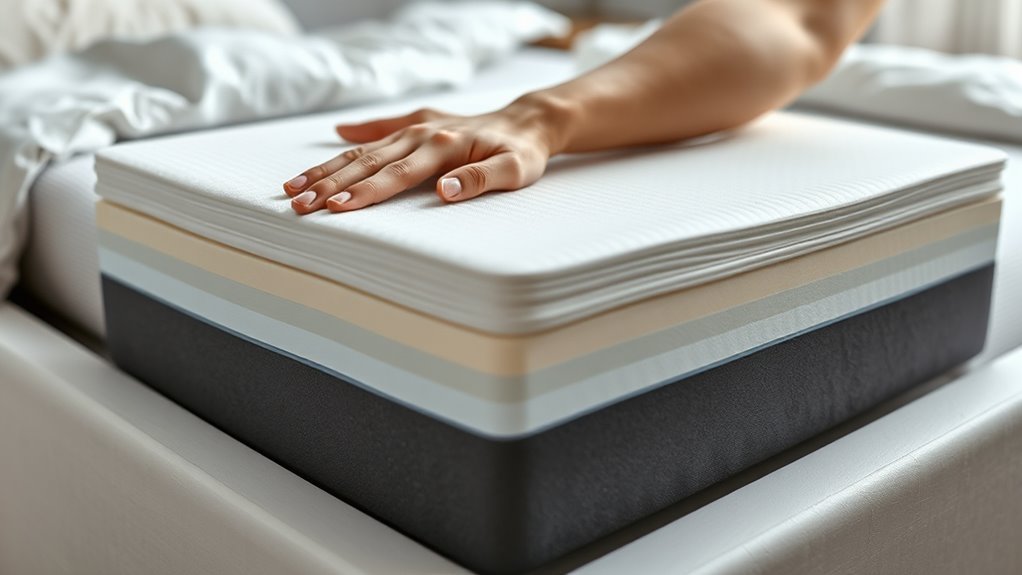
A memory foam mattress is a mattress that uses viscoelastic polyurethane foam as an important part of its comfort system. That does not necessarily mean the whole bed is made from memory foam. Most all-foam models place memory foam or another cushioning foam over a firmer polyfoam support core, while hybrid mattresses may combine memory foam with a coil support system.
Memory foam changes shape under body weight and slowly recovers after the pressure is removed. The result is a close-fitting surface that can cushion the shoulders, hips, and other high-contact areas.
Memory foam is best understood as a contouring comfort material; the complete mattress design determines how supportive, cool, durable, and easy to move on the bed ultimately feels.
The material traces back to aeronautics research conducted under a NASA contract in the late 1960s. NASA describes the original “temper foam” as an energy-absorbing material developed to improve aircraft seating, cushioning, and crash protection. It was later adapted for commercial products, including bedding. NASA’s Spinoff program documents the material’s history.
Modern mattresses use many different formulations, including traditional slow-response foam, open-cell foam, gel-infused foam, and partially bio-based polyurethane foams. These variations can feel noticeably different even though they are all sold under the memory-foam label.
How Memory Foam Contours Your Body
Memory foam contours by compressing where your body applies pressure. Many formulations also become more pliable as they warm, so the foam can settle more closely around the curves of your body after you lie down.
This creates the familiar body-cradling feel. Instead of holding every part of you at the same height, the comfort layer allows heavier or more prominent areas to sink farther while lighter areas sink less.
For a side sleeper, that can mean more cushioning around the shoulders and hips. For a back sleeper, the goal is usually enough contouring to fill the lumbar area without letting the pelvis sink excessively. Stomach sleepers generally need a firmer overall surface so the midsection does not drop too deeply.
Memory foam can also reduce the amount of movement that travels across the surface. This is one reason it is popular with couples and light sleepers who are easily disturbed by a partner changing position.
Memory Foam vs. Spring Mattress
The biggest difference between memory foam and a traditional spring mattress is how the support system responds. Memory foam emphasizes contouring and pressure distribution, while an innerspring or hybrid coil system usually feels more responsive and allows more airflow through the core.
Memory foam generally absorbs movement well, making it useful when motion isolation matters. Traditional innerspring mattresses tend to feel bouncier, and many sleepers find them easier to move across because the surface responds more quickly.
Choose by performance rather than material alone: pressure relief, firmness, movement, edge stability, temperature, and support-core design matter more than the label on the mattress.
Spring and hybrid mattresses also often have stronger perimeter support because their coil systems can be reinforced around the edges. All-foam mattresses can still have good edge support, but softer, deeply contouring models may compress more noticeably when you sit or sleep near the side.
A hybrid can provide a middle ground by combining a memory-foam comfort layer with coils. That construction can preserve much of the contouring feel while adding bounce, airflow, and stronger edges.
Main Benefits of Memory Foam Mattresses
The main advantages of memory foam are close contouring, pressure distribution, motion isolation, and quiet performance. Whether those advantages improve your sleep depends on the firmness and construction of the complete mattress.
Research on mattresses and back discomfort is more supportive of choosing an appropriate overall firmness than of choosing one specific material. A 2026 systematic review covering 47 studies found the most consistent evidence favored medium-firm mattresses for pressure distribution, sleep quality, morning stiffness, and low-back-pain outcomes, although the researchers also noted substantial differences among studies. The review is available through PubMed.
Note: A mattress can influence comfort and sleeping posture, but it is not a treatment for arthritis, fibromyalgia, chronic back pain, or another medical condition. Persistent or worsening pain should be discussed with a qualified healthcare professional.
Pressure Relief Benefits
Memory foam’s contouring ability allows the surface to compress around heavier contact zones instead of pushing equally against every part of the body. This can reduce concentrated pressure around areas such as the shoulders and hips.
That characteristic is especially relevant for side sleepers, who place more direct load on the shoulder and hip than back or stomach sleepers. The ideal amount of sinkage still depends on body weight, firmness, and the thickness of the comfort layers.
More cushioning is not always better. If the foam is too soft for your body, you may sink deeply enough that changing position becomes difficult or your midsection loses support.
Spine Alignment Support
Memory foam can contribute to a more neutral sleeping posture when the mattress allows the shoulders and hips to settle appropriately while still supporting the torso. However, spinal alignment depends on the entire mattress, not the memory-foam layer by itself.
A mattress that is too soft can allow excessive sagging, while one that is too firm may create uncomfortable pressure around prominent areas. Current research generally suggests that medium-firm mattresses are a useful starting point for many adults, particularly when low-back comfort is a concern, but individual needs still vary.
Common Types of Memory Foam
Memory foam is sold in several formulations. The differences usually involve cell structure, additives, response speed, density, and how the foam is combined with other mattress layers.
Traditional Foam Styles
Traditional memory foam usually provides the slow-response, deeply contouring feel most people associate with the material. It can be effective at cushioning pressure and isolating movement, but some sleepers find the close hug warm or restrictive.
Open-cell versions are engineered with a more open internal structure to encourage airflow. Other manufacturers change the foam chemistry or response rate to make the material feel faster, firmer, softer, or less temperature-sensitive.
Some polyurethane foams also use a percentage of plant-derived feedstock. That does not automatically make the mattress natural, petroleum-free, cooler, or more environmentally friendly; the actual composition and verified biobased percentage should be checked with the manufacturer.
Cooling Foam Variants
Cooling variants are designed to address one of memory foam’s most common complaints: heat retention.
Gel-infused memory foam contains gel particles, beads, or other gel materials intended to modify thermal behavior. Some mattresses also use graphite, copper, phase-change materials, ventilated foams, perforations, or cooling covers.
Open-cell memory foam can promote more airflow inside the material than a denser closed-cell structure. Hybrid construction may improve ventilation further because air can circulate through the coil support system.
However, the presence of a cooling additive does not guarantee that a mattress will sleep cool all night. Cover fabric, foam depth, room temperature, bedding, body heat, and the mattress core all affect the final result.
Do Memory Foam Mattresses Sleep Hot or Cool?
Traditional memory foam can feel warm because it contours closely around the body and some formulations allow less airflow than coil-based mattress systems. The effect varies substantially by mattress.
If you tend to sleep hot, compare more than the phrase “cooling memory foam.” Look at the complete construction: cover material, comfort-layer thickness, open-cell or perforated foam, coil ventilation, phase-change materials, and whether independent testing or a home sleep trial is available.
Cooling gel, graphite, copper, and airflow channels are design features—not guarantees. The complete mattress construction determines how warm the bed actually feels.
Hot sleepers may also prefer a shallower memory-foam layer over a breathable coil core instead of a thick, deeply conforming all-foam design.
Who Sleeps Best on Memory Foam?
Memory foam tends to work best for people who enjoy a close, cushioned feel and value pressure distribution or motion isolation.
- Side sleepers: Often benefit from enough cushioning to let the shoulder and hip settle into the mattress without excessive pressure.
- Back sleepers: Usually need a balance of contouring and midsection support rather than maximum sinkage.
- Stomach sleepers: Often prefer a firmer surface that limits deep sinking around the pelvis.
- Couples: May appreciate memory foam’s ability to absorb movement when one partner changes position.
- Light sleepers: May benefit from reduced motion transfer and the quiet construction of an all-foam bed.
- People who change positions frequently: May prefer faster-response foam or a hybrid because very slow memory foam can make movement feel more difficult.
Body weight changes how deeply a person compresses the comfort layers. A firmness that feels supportive to a lighter sleeper may feel much softer to a heavier sleeper, so firmness recommendations should be treated as starting points rather than fixed rules.
Memory Foam Density, Firmness, and Thickness
Density and firmness are not the same measurement. Density describes how much foam material exists in a given volume, usually expressed in pounds per cubic foot in the United States. Firmness describes how resistant the foam or complete mattress feels when compressed.
A higher-density memory foam may feel slower-moving and can influence durability and contouring, but density alone does not tell you exactly how firm the mattress will feel.
Also check the thickness of the memory-foam comfort layer. A thick, soft layer generally allows more sinkage than a thin layer over a firm support core. This is one reason two mattresses advertised as “medium” can feel very different.
When manufacturers provide detailed specifications, compare the memory-foam layer, transition layers, support core, total mattress height, and any reinforced perimeter—not just one density or firmness number.
Edge Support and Ease of Movement
Edge support describes how stable the perimeter feels when you sit or lie near it. Deeply contouring all-foam mattresses may compress more around the sides than mattresses with reinforced coils or firmer foam encasements.
Strong edge support can make more of the mattress surface usable and can make getting in and out of bed easier. This can matter for couples, people who sleep near the edge, and anyone who frequently sits on the side of the bed.
Memory foam also tends to recover more slowly than latex, conventional responsive polyfoam, or coils. If you dislike a “stuck” sensation, look for faster-response memory foam, a thinner foam layer, or a hybrid design.
Off-Gassing, Certifications, and Safety
New polyurethane foam can release an initial odor after unpacking, commonly called off-gassing. The intensity and duration vary by product, packaging, materials, and ventilation.
If odor bothers you, unpack the mattress in a well-ventilated area and follow the manufacturer’s setup instructions. Do not assume every removable-looking mattress cover is meant to be taken off; some manufacturers restrict cover removal or provide specific laundering instructions.
One label shoppers may see is CertiPUR-US®. The program certifies qualifying flexible polyurethane foam for specified content, emissions, and durability criteria. It does not certify an entire mattress or every material used in that mattress.
For mattresses sold in the United States, the U.S. Consumer Product Safety Commission explains that mattresses are subject to federal smoldering and open-flame requirements under 16 CFR Parts 1632 and 1633.
Pro Tip: A certification logo should be verified in the certifier’s directory when possible. Also check exactly what is certified—the foam, textile, component, or complete product—because those are not interchangeable claims.
How to Choose a Memory Foam Mattress
Choosing the right memory foam mattress starts with how you sleep, how deeply you tend to sink into a mattress, and which performance tradeoffs matter most to you.
Start with firmness. Side sleepers usually need enough cushioning for the shoulders and hips, while many back and stomach sleepers need more resistance under the torso. Body weight affects this substantially, so a generic “medium” label should not be treated as precise.
Then examine construction. Check the depth and type of memory foam, the transition layers, support core, edge reinforcement, and whether the mattress is all-foam or hybrid.
Check temperature features realistically. If you sleep hot, open-cell foam, ventilated layers, a breathable cover, or a coil core may matter more than a single cooling additive.
Review independent certification claims. For polyurethane foam, programs such as CertiPUR-US can provide useful information about tested emissions and content criteria, but remember that certification of the foam does not automatically certify the entire mattress.
Read the sleep-trial and return policy before ordering. Check trial length, whether there is a required break-in period, pickup or return fees, exchange limits, and whether opened mattresses are eligible.
Read the warranty. Look for the minimum indentation depth required for a claim, foundation requirements, stain exclusions, transportation costs, and any actions that could void coverage.
If a retailer offers a body-scanning or pressure-mapping system, use the result as one shopping aid rather than as a medical diagnosis. For example, Mancini’s Sleepworld currently promotes a SleepMatch system that scans body and pressure-point information and recommends support categories.
Foundation and Bed-Frame Requirements
A memory foam mattress needs a base that meets the manufacturer’s support requirements. Depending on the model, that may be a platform bed, adjustable base, slatted foundation, or another approved support system.
Do not assume an old box spring is automatically suitable. Some foam mattresses require closely spaced slats or a solid foundation, and using an unsupported base can affect feel, sagging, and warranty eligibility.
Before buying, check the manufacturer’s maximum slat spacing, center-support requirements for larger sizes, and adjustable-base compatibility.
Memory Foam Mattress Care and Durability
How long a memory foam mattress remains comfortable depends on foam quality, density, body weight, layer thickness, support-core construction, foundation quality, and how the mattress is used. A single lifespan number is therefore less useful than the material specifications and warranty terms.
Most modern memory foam mattresses are designed with a dedicated top and bottom and should not be flipped unless the manufacturer explicitly describes the mattress as double-sided.
Rotation instructions vary. Some manufacturers recommend occasional rotation, while others do not require it. For example, Tempur-Pedic currently says rotation is optional for its mattresses and flipping is not recommended. Always follow the care instructions for the specific model rather than applying a universal three- or six-month schedule.
Protect the mattress from moisture, use the required foundation, and follow the manufacturer’s cleaning instructions. If the cover is removable, confirm that it is actually washable before putting it in a washing machine.
Where to Buy Memory Foam Mattresses in Albany
“Albany” needs clarification because the original retailer examples refer to two different states.
Note: Mancini’s Sleepworld serves Albany, California from its Berkeley-area store, while Tip Top Furniture is in Freehold, New York and markets to shoppers in the Albany Capital Region. They should not be presented as two local stores in the same Albany.
If you mean Albany, California, Mancini’s Sleepworld Berkeley is located at 1099 Ashby Avenue in Berkeley and states that it serves Berkeley, Albany, El Cerrito, and surrounding areas. Mancini’s also offers its SleepMatch mattress-matching system at participating locations.
If you mean Albany, New York or the Capital Region, Tip Top Furniture & Flooring is located at 9477 Route 32 in Freehold, New York. The retailer sells mattresses and publishes mattress-shopping information aimed at the Albany Capital Region.
Whether you shop locally or online, compare the same practical factors: the exact mattress model, firmness, construction, trial period, return costs, warranty, delivery terms, old-mattress removal, financing terms, and whether you can test the mattress before committing.
- Albany, CA shoppers: verify current inventory and services with the Berkeley Mancini’s Sleepworld location.
- Albany, NY-area shoppers: verify current mattress inventory with Tip Top Furniture in Freehold or compare other Capital Region retailers.
- Online shoppers: read the complete sleep-trial and return policy before ordering.
- All shoppers: test firmness whenever possible and confirm the required foundation before delivery.
Frequently Asked Questions
What Are the Downsides of Memory Foam Mattresses?
The main drawbacks are that some memory foam mattresses retain heat, respond slowly when you change position, have weaker edge support, feel too enveloping, or release a noticeable new-foam odor after unpacking. All-foam mattresses can also be heavy. These issues vary by formulation and construction, so a breathable hybrid or faster-response foam may solve problems that occur with a softer traditional memory-foam bed.
Why Are People No Longer Buying Memory Foam Mattresses?
It is too broad to say that people no longer buy memory foam mattresses. Memory foam remains widely available, but some shoppers prefer hybrids or latex because they want more bounce, stronger edges, easier movement, or greater airflow. Others still prefer memory foam for its close contouring and motion isolation. The better question is which construction best matches your sleep preferences.
What Mattress Should You Stay Away From?
Avoid mattresses that do not clearly disclose their construction, warranty, return terms, or required foundation, and be cautious about exaggerated health or cooling claims. A very soft or very firm mattress can also be a poor match if it does not support your body comfortably. Material alone is not enough to judge quality: memory foam, latex, innerspring, and hybrid mattresses can all perform well when properly designed.
Are You Supposed to Flip a Memory Foam Mattress?
Usually not. Most modern memory foam mattresses are built with comfort layers on top and a firmer support core underneath, so flipping them would put the support layer on the sleeping surface. Rotation rules vary by manufacturer: some recommend periodic rotation and others do not require it. Follow the care and warranty instructions for your exact mattress rather than using a universal schedule.
Conclusion
A memory foam mattress can be a strong choice when you value close contouring, pressure distribution, quiet performance, and motion isolation. Its tradeoffs can include warmth, slower movement, edge compression, initial odor, and a deeper sinking feel.
The strongest current evidence does not show that memory foam alone is the answer to better sleep or back pain. A 2026 review of 47 mattress studies found that medium-firm support was the most consistently favorable overall for pressure distribution, sleep quality, morning stiffness, and low-back-pain outcomes, while also noting that mattress studies vary considerably.
Instead of choosing by material or marketing claim alone, compare firmness, layer construction, density, edge support, temperature performance, foundation requirements, sleep-trial terms, warranty coverage, and how the mattress actually feels to your body.
Sources
- NASA Spinoff — Memory Foam History — verifies the NASA-contracted development of temper/memory foam in the late 1960s.
- PubMed — 2026 Systematic Review of Mattress Design, Sleep, and Back Pain — supports the discussion of mattress firmness, pressure distribution, sleep quality, and low-back-pain evidence.
- CertiPUR-US — Certification FAQ — explains what polyurethane-foam certification covers and its emissions/content criteria.
- U.S. Consumer Product Safety Commission — Mattress Standards — verifies federal mattress flammability requirements.
- Mancini’s Sleepworld Berkeley — verifies the Berkeley, California location serving Albany, CA.
- Tip Top Furniture & Flooring — verifies the Freehold, New York location serving shoppers in the broader Albany Capital Region.