Canvas wall art should be cleaned conservatively because the paint layer, ground, varnish, and canvas can react differently to pressure, moisture, and cleaning products. Start by inspecting the artwork under good light. If the surface is stable, loose dust can usually be removed with a clean, soft natural-hair artist’s brush. Do not use water, soap, sprays, stain removers, or a cloth on the painted surface unless a qualified paintings conservator has determined that the treatment is safe.
Quick Answer
To clean canvas wall art safely, inspect it for loose, flaking, sticky, or cracked paint. If the surface is stable, remove loose dust with a clean, soft natural-hair artist’s brush using very light strokes. Do not use water, soap, sprays, cloths, or stain removers on the painted surface; use a conservator for grime or stains.
Key Takeaways
- Inspect the paint before touching it. Do not dust loose, flaking, powdery, sticky, mouldy, or water-damaged surfaces.
- For stable paintings, use a clean, soft natural-hair artist’s brush rather than a microfiber cloth on the painted surface.
- Avoid water, soap, household cleaners, sprays, stain removers, rinsing, soaking, and abrasive sponges on the artwork.
- Keep paintings away from direct sunlight, persistent damp, and rapid humidity changes; professional conservation is appropriate for grime, stains, varnish problems, or valuable works.
At a Glance
| Time Required | About 5–10 minutes for inspection and light dusting of a stable painting |
| Difficulty | Easy for loose dust on a stable surface; professional treatment for stains or unstable paint |
| Tools Needed | Clean soft natural-hair artist’s brush, padded work surface, good lighting, and clean dry hands |
| Cost | Minimal for routine dry dusting; professional conservation cost varies by condition, size, and treatment |
Warning: Do not clean the painted surface if you see loose or lifting paint, powdering, cracking, tackiness, mould, water damage, severe distortion, or an unknown fragile medium. Do not attempt to remove varnish, nicotine, grease, adhesive, food stains, or embedded grime yourself.
How to Clean Canvas Wall Art Safely
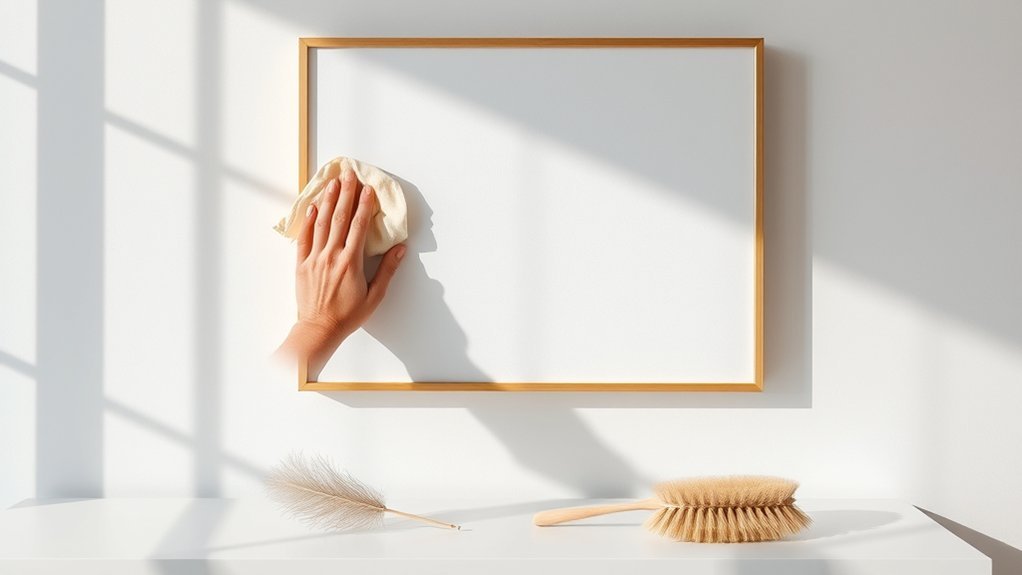
Safe canvas cleaning begins with inspection rather than wiping. Look across the painting in good light for loose or lifting paint, cracks, powdery pigment, tacky areas, raised texture, tears, mould, or signs of water damage. If any of these are present, do not dust the painted surface.
If the paint is firmly attached and the surface is not unusually matte, powdery, or sticky, loose dust may be removed with a clean, soft natural-hair artist’s brush. The Smithsonian Museum Conservation Institute recommends slow, gentle brushing only after confirming there is no loose or flaking paint. Smithsonian guidance on caring for paintings explains that cloths, stiff brushes, feather dusters, and moisture can damage painted surfaces.
The safest home treatment for a stable painting is usually limited to removing loose surface dust. Bonded grime, stains, discoloured varnish, and residues are conservation treatments, not ordinary housekeeping.
Position the artwork securely on a clean padded surface. A slight forward angle allows loosened dust to fall away rather than settle back on the image. Brush lightly across or downward without pressing into the paint or canvas.
Do not use household cleaning sprays, furniture polish, glass cleaner, dish soap, alcohol, solvents, disinfectants, magic erasers, wet wipes, or a barely damp cloth on the painted surface. The Canadian Conservation Institute’s cleaning precautions warn that even water-based solutions can damage paint layers.
Pro Tip: Use a dedicated artist’s brush that is clean, dry, and free from paint, oil, cosmetics, or household-cleaning residue. Stop immediately if the brush catches on texture or you see pigment or flakes moving.
Check the Paint Type First
The paint type and surface condition matter because oil, acrylic, tempera, watercolour, mixed media, varnish, and unvarnished paint can respond very differently to cleaning.
However, paint type alone does not make a wet-cleaning method safe. Acrylic is often described as water-resistant after drying, but acrylic-emulsion paintings may contain water-sensitive additives, can remain relatively soft, and may trap dirt in the paint film. Oil paintings can also contain sensitive pigments, grounds, varnishes, repairs, or later overpaint.
For that reason, identifying an artwork as “acrylic” or “oil” should not be treated as permission to rinse, damp-wipe, or apply soap.
Note: Texture and gloss can provide clues, but they do not reliably identify every paint layer or coating. Artist documentation, gallery records, labels, purchase information, and professional examination are more dependable than appearance alone.
Identify The Paint
Before cleaning, check any available label, receipt, artist documentation, or product information for the paint medium and surface coating. A canvas may contain several materials at once, including ground, paint, varnish, collage elements, metallic leaf, ink, pastel, or other media.
If the medium remains uncertain, assume the surface may be sensitive. Limit home care to visual inspection and, only when the paint is clearly stable, very gentle dry brushing.
Watercolour, gouache, distemper, pastel, charcoal, unbound pigment, and some mixed-media surfaces can be especially vulnerable to contact. Highly textured impasto can also catch cloth fibers or lose small flakes that are difficult to see.
For an important, valuable, historic, damaged, or uncertain work, a paintings conservator can identify condition problems and determine whether cleaning is appropriate.
Match Cleaning Method
The cleaning method should be matched primarily to the condition of the surface, not just to the medium.
- Stable oil or acrylic painting with loose dust: gentle dry brushing may be appropriate after close inspection.
- Loose, flaking, powdery, tacky, or highly matte paint: do not brush or wipe the surface.
- Stains, smoke film, grease, adhesive, discoloured varnish, or embedded grime: seek professional conservation treatment.
- Large stretched canvas: handle it by the frame or stretcher sides and never press against the front or back of the canvas.
A household “spot test” does not make a liquid cleaner safe. Some damage may be subtle, delayed, or limited to coatings and binders that are not obvious to the eye.
Best Supplies for Cleaning Canvas
For routine home care of a stable painting, the most useful supplies are simple: a clean soft natural-hair artist’s brush, good lighting, a clean padded surface, and clean dry hands.
A white microfiber or lint-free cloth can still be useful for a compatible, non-painted frame surface, but it should not be dragged across the painting itself. Liquid cleaning solutions are not universal canvas-cleaning supplies because the response depends on the exact paint, ground, coating, age, previous treatments, and contamination.
Dry-cleaning sponges, swabs, aqueous solutions, solvents, gels, and other conservation materials may be used by trained conservators after testing. Their presence in professional practice does not make them safe for unsupervised household use.
Soft Brushes And Cloths
The preferred tool for loose dust on a stable painted surface is a clean, soft natural-hair artist’s brush. Use light strokes and allow the bristles to barely contact the surface.
Do not use a dry microfiber cloth, paper towel, feather duster, stiff brush, cleaning pad, or ordinary vacuum nozzle directly on the painting. Threads can catch raised paint, stiff fibers may scratch coatings, and suction or pressure can dislodge fragile material.
- Use a dedicated clean, dry artist’s brush.
- Inspect the surface before and during dusting.
- Stop if the brush snags or any paint moves.
- Use lint-free cloths only on suitable frame or glazing surfaces, not across painted canvas.
- Do not use canned compressed air on the painting surface.
Cotton swabs may appear gentle, but they are treatment tools when used on painted surfaces. Rolling a swab with water or solvent can alter paint, coatings, or surface sheen and should not be treated as routine home maintenance.
Gentle Cleaning Solutions
There is no single gentle cleaning solution that is safe for every canvas painting. Even distilled water or a mild pH-neutral soap can affect certain pigments, acrylic additives, grounds, varnishes, previous retouching, or water-sensitive contemporary materials.
The Canadian Conservation Institute advises untrained owners not to attempt removal of grime or discoloured varnish because selecting a cleaning system requires understanding the materials in each layer of the painting.
For routine household care, therefore, the preferred sequence is:
- Inspect the artwork.
- Leave unstable surfaces untouched.
- Remove only loose dust from a stable surface with a soft brush.
- Refer bonded dirt, staining, residues, and varnish problems to a conservator.
Spot-Test Before Wiping
A hidden-area spot test is useful in many ordinary household-cleaning situations, but paintings are different. A successful test with a damp cloth does not prove that broader wet cleaning will be harmless.
Changes in gloss, swelling, pigment loss, blanching, coating disruption, or residue can be difficult to recognize without magnification and conservation experience. Some problems may also appear after the surface dries.
- Do not use colored cloths or abrasive cleaning pads.
- Do not apply harsh chemicals or household cleaners.
- Do not assume “pH-neutral” means compatible with the artwork.
- If liquid treatment appears necessary, have a conservator test the surface first.
Dust Canvas Wall Art Without Scrubbing
Canvas wall art should never be scrubbed. For a stable painting, place it securely on a padded surface and inspect it from several angles under good light. If no loose or flaking paint is visible, use a soft natural-hair artist’s brush to move loose dust gently away from the surface.
Keep pressure extremely light. Work methodically across or downward rather than repeatedly rubbing one area. Highly textured passages deserve extra caution because small projections can break or catch the brush.
There is no universal requirement to clean a painting every one to three months. Cleaning frequency depends on the environment, enclosure, traffic, airborne dust, and surface condition. Unnecessary handling also creates risk, so dust only when there is a real need.
Keep the artwork elevated from the floor during handling and move one painting at a time. Never carry a stretched canvas by the top rail alone or press fingers into the back.
Spot-Test a Barely Damp Cloth
A barely damp cloth is frequently recommended for household décor, but it should not be treated as a default cleaning method for an original or uncertain canvas painting.
Water can affect paint, ground, coatings, previous repairs, canvas tension, and surface appearance. A small hidden-area test may fail to reveal changes that become obvious over a larger area.
If the work is an inexpensive commercially printed canvas and its manufacturer specifically provides wet-cleaning instructions, follow those product instructions. If the object is hand-painted, valuable, old, mixed-media, or uncertain, remain with dry preventive care.
Test In Hidden Area
For an original painting, a hidden-area moisture test is best considered part of professional examination rather than an automatic DIY step. Conservators may use controlled testing to evaluate colour transfer, swelling, gloss change, coatings, solubility, and other reactions before selecting a treatment.
Distilled water avoids the minerals present in some tap water, but distilled water is still water and can damage sensitive paintings. Its purity does not make it universally safe.
- A hidden test cannot rule out every type of damage.
- Some reactions are delayed or difficult to see.
- Water-sensitive paint should remain dry unless professionally treated.
Use Barely Damp Cloth
A barely damp cloth may be suitable for certain non-painted frame surfaces or manufacturer-approved decorative prints, but it should not be wiped across a painted canvas as a general cleaning method.
If cleaning a compatible frame, apply any approved moisture to the cloth rather than spraying the frame directly. Keep the cloth nearly dry and away from joints, gilding, painted decoration, paper backing, and the canvas edge.
For the artwork itself, do not substitute mild soap, distilled water, or immediate drying for a professional assessment. Excess pressure and moisture can both change the surface.
Check For Color Transfer
Visible color transfer onto a swab or cloth is an obvious sign that cleaning must stop, but the absence of visible color transfer does not guarantee safety.
Cleaning can change gloss, remove coatings, swell acrylic films, disturb dirt embedded in soft paint, or alter fragile layers without producing obvious pigment on the cleaning material.
If a professional test produces color transfer, swelling, fading, softening, tackiness, or texture change, the treatment must be reassessed.
- Never continue after visible pigment transfer.
- Do not rely on color transfer as the only safety test.
- Use professional assessment for any liquid treatment of painted surfaces.
Remove Stains From Canvas Carefully
Stains, smoke films, grease, insect deposits, adhesive, fingerprints, nicotine, food residue, and discoloured varnish should not be treated like ordinary dust. Their removal may require a conservator to identify what is original material and what can safely be removed.
| Tool or Method | Appropriate Use | Risk |
|---|---|---|
| Soft natural-hair brush | Loose dust on firmly attached paint | Low only after careful inspection |
| Dry-cleaning sponge | Specialized conservation treatment after testing | Moderate to high when used without training |
| Cotton swab | Precision testing or treatment by a conservator | Can remove or alter original material |
| Water or mild soap | Only when testing shows compatibility and treatment is appropriate | High as a general DIY method |
| Microfiber cloth | Compatible non-painted frame surfaces | Can snag or abrade painted canvas |
Do not scrub a stain, keep re-wetting it, or enlarge the treated area in an attempt to blend the result. An unsuccessful home treatment can permanently alter the paint and may make later conservation more difficult.
If a stain is significant enough that dry dusting does not remove it, leave it in place and consult a paintings conservator. The American Institute for Conservation maintains a Find a Professional directory for locating qualified conservation specialists.
Clean Framed Canvas Without Seepage
Cleaning a frame is different from cleaning the painting. Start by dusting the frame carefully while preventing debris from falling onto the canvas. A compatible plain frame surface may be wiped with a clean microfiber cloth, but fragile gilding, painted ornament, or historic finishes can be damaged even by routine wiping.
If moisture is appropriate for the frame material, place it on the cloth rather than spraying the frame. Keep moisture away from frame joints, backing materials, the canvas edge, and the painted surface.
When glass or acrylic glazing is present, first confirm that the glazing can be safely cleaned and that the cleaner cannot migrate around the edge toward the artwork. Never spray cleaner directly toward a framed painting.
- Clean the top frame edge first.
- Shield the artwork from falling debris where practical.
- Apply any approved cleaner to the cloth, not toward the artwork.
- Do not wet-clean fragile gilded or painted frames without appropriate advice.
Handle Loose or Stretched Canvas
Loose or stretched canvas should be inspected before cleaning because physical handling itself can cause damage. Look for tears, sagging, deformed corners, loose stretcher joints, missing keys, cracked paint, or areas where the paint is lifting away from the ground.
Carry a framed or stretched painting with two hands from the sides of the frame or stretcher. Do not lift it by the top member, push against the face, or press fingers into the back of the canvas. Pressure from behind can deform the fabric and crack paint layers.
Do not apply low-tack masking tape to painted canvas edges as a routine protection method. Adhesive can interact with surfaces or pull away fragile material during removal.
Do not rinse, soak, saturate, unstretch, or remove the canvas from its stretcher for cleaning at home. These are specialized procedures that may alter canvas tension and affect paint and ground layers.
If the canvas is loose, distorted, torn, flaking, or structurally unstable, stop cleaning and obtain professional advice before further handling.
Dry and Rehang Canvas Without Damage
Routine safe dusting uses no added moisture, so an original painting should not normally require a drying stage after home cleaning. If the artwork has accidentally become wet, treat that as water damage rather than as ordinary cleaning.
For normal handling, support the painting from the frame or stretcher sides and keep hands away from the painted face and canvas back. Before rehanging, inspect the hanging hardware, wire, D-rings, hooks, and frame joints for looseness or corrosion.
- Do not rehang an accidentally wet painting until its condition has been assessed.
- Lift from the frame or stretcher sides, not the top rail or canvas fabric.
- Use appropriately rated hanging hardware for the artwork’s weight.
- Keep the painting away from locations where doors, furniture, people, or objects may strike it.
A floater frame can provide an attractive presentation for some canvases, but it is not a substitute for sound handling, stable environmental conditions, appropriate backing, and secure hanging hardware.
How to Prevent Water Damage on Canvas
Preventive care is safer than repeated cleaning. The Canadian Conservation Institute recommends a generally stable 40–60% relative humidity range for paintings, while also emphasizing that rapid or repeated fluctuations can place stress on paint, ground, wood, and fabric supports. See the CCI environmental guidelines for paintings.
Avoid persistent damp, poorly insulated exterior walls, heating or cooling vents, radiators, direct sunlight, and locations where food, drinks, plant mist, cooking grease, or bathroom moisture may reach the artwork.
High relative humidity can support mould growth, particularly when air movement is poor. If mould appears, avoid brushing it through the room. Isolate the artwork from unaffected objects and seek appropriate conservation advice because mould also presents a health concern.
Do not put masking tape on the canvas to block moisture. Instead, prevent leaks and splashes, use appropriate framing or backing where suitable, and choose a stable display location.
For storage, keep paintings off the floor in a clean, dry, stable interior area. Prevent objects from pressing against the painted face or the back of a stretched canvas. Protective backing boards and properly designed storage enclosures can reduce dust, impact, and environmental risk.
Note: If a painting is exposed to a leak, flood, or heavy condensation, do not try to speed-clean it with soap or solvents. Water-damaged paintings may require controlled drying and stabilization because paint, ground, canvas, stretcher wood, and adhesives can all respond differently.
Frequently Asked Questions
What Happens if I Don’t Gesso My Canvas?
It depends on the paint system. Gesso or another suitable ground creates a more consistent surface and improves tooth and absorbency. For oil painting on raw fabric, the canvas should also be properly isolated or sized so oil does not penetrate and weaken the fibers over time. Acrylic paint can be used in different ways on canvas, but gesso commonly improves the surface and long-term bond. Commercial canvases are often already primed.
Does Water Damage Canvas?
Yes. Water can distort canvas tension, stain fabric, swell or soften some paint and ground layers, affect adhesives and coatings, and encourage mould if damp conditions persist. The amount of damage depends on the materials, duration of exposure, and condition of the painting. Avoid routine wet cleaning of original canvas paintings.
What Do Conservators Use to Clean Paintings?
Paintings conservators select methods only after examining the materials and condition of the artwork. Depending on the problem, treatment may involve controlled dry cleaning, specialized brushes or sponges, swabs, aqueous systems, gels, solvents, magnification, and other conservation techniques. The exact method varies because a solution that is safe for one painting can damage another.
What’s the Best Cleaner for Canvas?
For an original canvas painting, there is no universal liquid cleaner. If the paint is stable, the safest routine home care is usually limited to gentle removal of loose dust with a clean, soft natural-hair artist’s brush. Water, soap, sprays, solvents, and stain removers should not be applied to the painted surface without appropriate testing and conservation expertise.
Conclusion
Cleaning canvas wall art safely is mostly about restraint. Inspect the artwork first, and limit routine home cleaning to gentle dry brushing only when the paint is firmly attached and the surface is suitable. Do not use water, soap, sprays, stain removers, cloths, rinsing, or soaking on an original painted canvas without professional guidance.
Long-term preservation also depends on prevention. Keep the artwork in a stable environment, generally around 40–60% relative humidity, avoid direct sunlight and persistent damp, handle the frame or stretcher rather than the canvas, and respond promptly to leaks or mould. If grime, stains, damaged varnish, loose paint, or water damage is present, a qualified paintings conservator is the safest next step.
Sources
- Canadian Conservation Institute — Cleaning Paintings: Precautions — risks of water-based cleaning, dusting, stain removal, and inexperienced treatment.
- Smithsonian Museum Conservation Institute — Caring for Your Paintings — safe handling, inspection, and gentle brush dusting.
- Canadian Conservation Institute — Environmental Guidelines for Paintings — relative humidity, temperature, light, mould, and environmental risks.
- Smithsonian Museum Conservation Institute — Caring for Acrylic Paintings — acrylic surface softness, dirt attraction, and solvent sensitivity.
- American Institute for Conservation — Find a Professional — directory for locating qualified conservation professionals.