Few pairings sound more opposite than carnivore diet vs vegan: one eats only animal foods, the other none. Yet both are strict, rule-based plans that people choose for health, ethics, or both. This guide compares the rules, the nutrients, the risks, and the quality of the evidence, and does not take a side.
Quick Answer
Carnivore diet vs vegan comes down to opposite food rules with opposite nutrient risks. Vegans must plan for vitamin B12 and a few other nutrients, while carnivore eaters give up fiber, vitamin C, and plant compounds. The Academy of Nutrition and Dietetics considers well-planned vegan diets nutritionally adequate, while carnivore evidence is very limited.
Key Takeaways
- Vegan diets have broader research behind them, much of it observational, while carnivore evidence is very limited.
- Vegans need a reliable vitamin B12 source because plant foods have none unless fortified.
- Carnivore diets drop fiber, vitamin C, and plant foods, and can raise saturated fat intake.
- Both diets can be done poorly or well; planning matters more than the label.
- Pregnancy, childhood, kidney disease, and eating disorder history call for professional guidance on either diet.
Two strict plans, opposite rules
Carnivore allows meat, fish, eggs, and sometimes dairy, and excludes every plant food (see carnivore diet). A vegan diet excludes all animal products, including meat, fish, eggs, dairy, and often honey, and is built on vegetables, fruit, grains, legumes, nuts, and seeds. Both ask for careful planning, and both can be motivated by more than health.
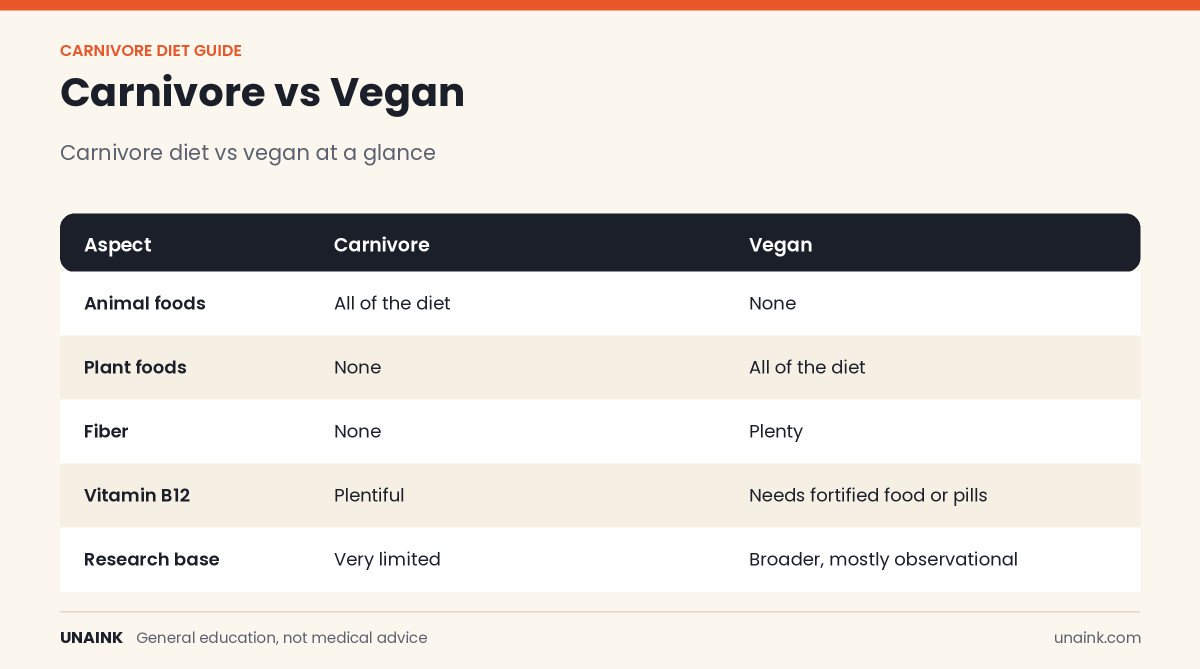
Carnivore diet vs vegan: side by side
| Feature | Carnivore | Vegan |
|---|---|---|
| Animal foods | All of the diet | None |
| Plant foods | None | All of the diet |
| Fiber | None | Plenty from plants |
| Vitamin B12 | Plentiful in animal foods | Needs fortified foods or a supplement |
| Vitamin C | Low unless from organ meats or fresh meat (see vitamin c on carnivore diet) | Plentiful from fruit and vegetables |
| Saturated fat | Often high | Typically lower |
| Research base | Very limited human studies | Broader, mostly observational |
Nutrient strengths and gaps
The NIH notes that only animal foods contain vitamin B12 naturally, so vegans need fortified foods or supplements (NIH vitamin B12 fact sheet). Dietitians also commonly watch iron, zinc, iodine, calcium, vitamin D, and omega-3 intake in vegan eating, so labs and professional advice are worthwhile.
Cleveland Clinic notes that carnivore eating can leave you short on nutrients and cause electrolyte imbalances (Cleveland Clinic). Fiber, vitamin C, and potassium are the usual worries, which is why carnivore diet nutrient deficiency exists as a topic of its own.
What the evidence says
The Academy of Nutrition and Dietetics states that appropriately planned vegetarian diets, including vegan, are healthful and nutritionally adequate and can suit every life stage, with a dependable B12 source (Academy position paper). That statement is about planning, not a guarantee for every person.
For carnivore, a 2026 scoping review of nine human studies called the evidence very limited and said long-term use cannot be recommended (Nutrients review). Cleveland Clinic adds that large amounts of red meat have been linked to colorectal and other cancers. Reports of benefit mostly come from self-reported surveys (2021 survey).
A caution applies to both sides: people who choose strict diets differ from the general population in many ways, so observational results cannot prove that the diet alone caused any health difference.
Ethics, environment, and sustainability
Many people pick a diet for reasons beyond health. Animal welfare, climate impact, cost, and cultural food traditions are legitimate considerations, and they do not have to line up with health evidence. If environment is part of your decision, see carnivore diet environmental impact for what is known and debated.
Who should be careful
- Pregnant or breastfeeding: a vegan diet needs professional planning and B12 supplementation; carnivore has no safety evidence.
- Children and teens: vegan diets need dietitian oversight; carnivore is not recommended.
- Kidney disease: very high protein carnivore eating is a concern; ask your clinician.
- Diabetes or blood pressure medicines: diet changes can alter dosing needs, so involve your prescriber.
- History of disordered eating: either set of rules can be risky.
Carnivore Diet vs Vegan: The Short Version
Carnivore diet vs vegan is a contest of opposite rules with opposite nutrient risks, and neither is a risk-free shortcut. In the carnivore diet vs vegan debate, the best-supported advice is to plan carefully, check your nutrients with a clinician, and choose a pattern you can sustain.
Frequently Asked Questions
Which diet is healthier, carnivore or vegan?
Neither can be called healthier for everyone. Vegan has broader research and major dietetic support when well planned, while carnivore has very limited evidence. Individual health, medicines, and planning matter.
Do vegans need supplements?
Vegans need a reliable vitamin B12 source such as fortified foods or supplements. Others, such as vitamin D or iodine, depend on diet and labs.
Do carnivore eaters need supplements?
Some choose electrolytes or other supplements, but needs vary. A clinician or dietitian can check labs rather than guessing.
Can I switch from vegan to carnivore safely?
A big switch changes fiber, fat, and protein quickly and can upset digestion. Speak with a clinician, especially with any medical condition.
Are there middle options?
Yes. Mediterranean-style, flexitarian, and animal-based patterns include both animal and plant foods and are easier to balance.
Conclusion
Carnivore and vegan eaters can both live well or run into problems depending on planning. Treat the labels with caution, look at the evidence honestly, and get lab tests and professional guidance, especially if you have a health condition or are making a major change.
Medical note
This article is for general education and is not medical advice. Talk with a doctor or registered dietitian before making major diet changes, especially if you have a health condition, take medication, or are pregnant or breastfeeding.
Keep Reading
- Carnivore Diet vs Mediterranean Diet: A comparison with a mixed-food pattern
- Carnivore Diet Nutrient Deficiency: Which nutrients to watch
- Vitamin C on Carnivore Diet: Needs, sources, and debates
- Carnivore Diet Environmental Impact: What is known and debated
Sources
- Position of the Academy of Nutrition and Dietetics: Vegetarian Diets: planned vegan diets and B12
- NIH ODS: Vitamin B12 consumer fact sheet: B12 sources and vegan needs
- The Carnivore Diet (Cleveland Clinic): nutrient gaps and cancer risk with red meat
- Carnivore diet scoping review (Nutrients, 2026): very limited human evidence
- Self-reported carnivore diet survey: 2,029 adults, self-reported data