Many people with POTS are told to eat more salt and drink more fluid, and that overlaps with advice often given on meat-based diets, so the carnivore diet for POTS has caught attention. Postural orthostatic tachycardia syndrome is a real circulation disorder with individualized treatment. This guide covers what is known, why salt and fluid targets must come from your own doctor, and what a meat-only diet may and may not add.
Quick Answer
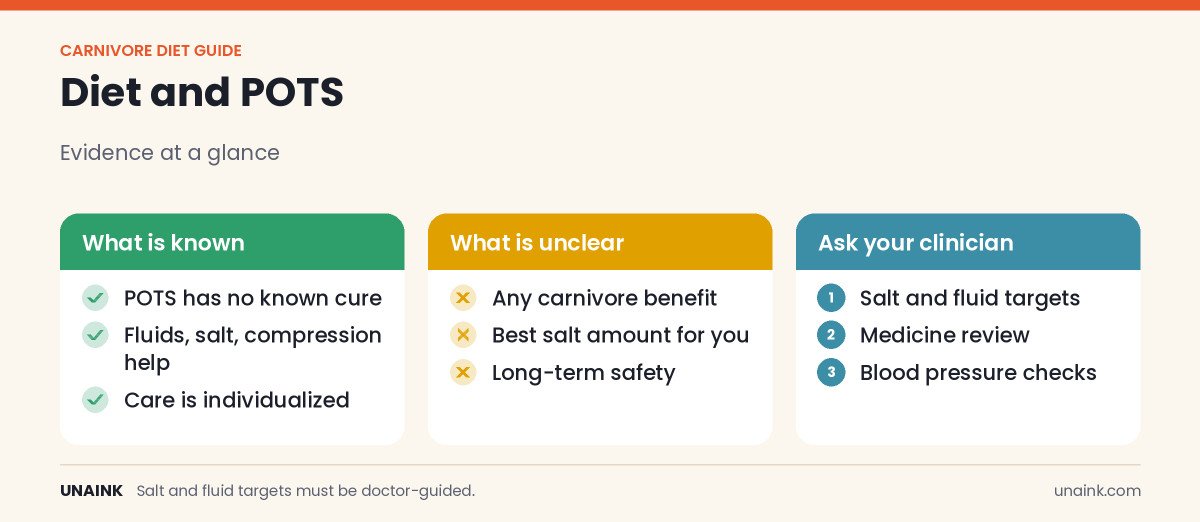
It is unproven. No study has tested a carnivore diet in POTS. Some people with POTS feel better with extra salt and fluid, which doctors do recommend, but the amounts should be set by your clinician based on your heart, kidney, and blood pressure. A carnivore diet is not a substitute for POTS care.
Key Takeaways
- POTS causes a large heart rate rise on standing along with symptoms like lightheadedness, fatigue, and brain fog.
- Standard care includes fluids, salt, compression, graded exercise, and sometimes medicine.
- Salt and fluid advice should be doctor-guided, since too much can harm people with high blood pressure or kidney disease.
- No trial has tested a carnivore diet for POTS.
- Never stop or change POTS medicine without your prescriber.
What POTS Is
According to Johns Hopkins Medicine, POTS is a circulation disorder in which symptoms occur when upright, with an excessive heart rate rise of at least 30 beats per minute in adults or 40 in adolescents within 10 minutes of standing. Symptoms include lightheadedness, fainting, palpitations, fatigue, headache, and brain fog.
Diagnosis requires ruling out other causes such as dehydration and orthostatic hypotension. There is no known cure, but most people can manage symptoms.
How POTS Is Usually Treated
| Approach | What it does | Notes |
|---|---|---|
| Fluids | Supports blood volume | Hopkins cites about 2 to 2.5 liters a day |
| Salt | May support blood volume | Amount set by your clinician |
| Compression garments | Reduce blood pooling in legs | Help some people |
| Graded exercise | Builds tolerance over time | Reclined or aquatic options exist |
| Medicines | Raise blood volume or slow heart rate | Individualized, prescribed |
The Johns Hopkins overview stresses that diet and medicine choices should be made with a clinician.
Salt and Fluids: Why Doctor Guidance Matters
Extra salt is a common part of POTS care, but it is not harmless for everyone. People with high blood pressure, heart or kidney disease, or those taking fludrocortisone, diuretics, or blood pressure medicine may need different targets and monitoring. Do not copy a number from a forum. Ask how much sodium and fluid suits you, and when to recheck. For general carnivore context, see carnivore diet electrolytes and how much salt on the carnivore diet.
Why People Try the Carnivore Diet for POTS
Meat-based eating is often paired with liberal salting and with reduced carbohydrate load, and some people with POTS report fewer blood sugar swings, less bloating, and steadier energy. These are anecdotal reports. People with POTS often feel worse after large carbohydrate meals, which may explain interest in lower-carb plans, though research on this is limited. Very low-carb diets also cause water and sodium loss early on, which could worsen dizziness for some. See carnivore diet dizziness.
Risks and Practical Cautions
- Early low-carb adaptation can cause dizziness, fatigue, and palpitations that overlap with POTS symptoms. See carnivore diet heart palpitations.
- Inadequate fluid or potassium can worsen symptoms, especially with medicines that affect potassium.
- High saturated fat intake may affect cholesterol in some people.
- Many people with POTS have digestive symptoms, and zero fiber may worsen constipation.
- The 2026 scoping review of the carnivore diet found only nine human studies and very limited evidence.
Who Should Not Try This Alone
Teens, who make up a large share of POTS patients, should not follow a carnivore diet without medical guidance, because growth and nutrient needs are higher. Pregnant and breastfeeding people, and anyone with kidney disease or an eating disorder, should avoid it unless supervised. If you take beta blockers, midodrine, fludrocortisone, or other prescribed treatment, keep taking them as directed and talk to your prescriber before changing your diet.
Carnivore Diet for POTS: The Short Version
The carnivore diet for POTS has no clinical evidence, and salt and fluid targets should come from your own clinician. If you want to try the carnivore diet for POTS, do it with medical supervision and keep your treatment plan in place.
Frequently Asked Questions
Do people with POTS need extra salt?
Often clinicians recommend it, but the amount should be set by your doctor based on your health history.
How much fluid should I drink with POTS?
Johns Hopkins cites about 2 to 2.5 liters daily as a goal, but confirm your target with your clinician.
Can the carnivore diet cure POTS?
No. POTS has no known cure, and no diet has been shown to treat it.
Can low-carb eating make POTS symptoms worse?
It may for some people, because early water and sodium loss can cause dizziness. Monitor symptoms with your clinician.
Should teens with POTS try carnivore?
Not without medical guidance. Teens have higher nutrient needs and need clinician oversight.
Conclusion
POTS care is built on fluids, salt, compression, graded exercise, and medicine when needed, all tailored to the person. A carnivore diet may fit some of those habits, but it is unstudied, and it can carry its own risks. Work with your clinician to set salt and fluid targets, monitor symptoms, and decide whether any diet change is worth trying.
Medical note
This article is for general education and is not medical advice. Talk with a doctor or registered dietitian before making major diet changes, especially if you have a health condition, take medication, or are pregnant or breastfeeding.
Keep Reading
- Carnivore Diet Electrolytes: Sodium, potassium, and magnesium basics.
- How Much Salt on the Carnivore Diet: Salt guidance in general terms.
- Carnivore Diet Dizziness: Why lightheadedness can occur.
- Carnivore Diet Heart Palpitations: When palpitations need checking.
Sources
- Johns Hopkins Medicine: POTS: Definition, diagnosis, and treatment.
- Scoping Review of the Carnivore Diet (Nutrients, 2026): Nine human studies, very limited evidence.
- Cleveland Clinic: The Carnivore Diet: Overview and cautions.