Both skip grains, refined sugar, and processed food, so carnivore diet vs paleo can look like cousins, but they part ways quickly on plants, dairy, and salt. This comparison explains what each allows, where they overlap, and what the evidence says, without declaring a winner.
Quick Answer
Paleo centers on foods said to resemble pre-agricultural eating: meat, fish, eggs, vegetables, fruit, nuts, and seeds, while skipping grains, legumes, dairy, and refined sugar. Carnivore allows only animal foods. Paleo has small, short studies suggesting possible benefits for weight, blood pressure, and cholesterol, while carnivore evidence is very limited. Each has nutrient trade-offs.
Key Takeaways
- Paleo includes plenty of plants; carnivore includes none.
- Both exclude grains, legumes, and added sugar, so they overlap more than most diets.
- Paleo usually excludes dairy and limits added salt; many carnivore eaters keep dairy and add salt.
- Neither has long-term safety data, and both can leave nutrient gaps if poorly planned.
- The right fit depends on your health, medicines, budget, and food preferences.
What each diet allows
Mayo Clinic describes the paleo diet as built around fruits, vegetables, nuts, seeds, eggs, lean meats (ideally grass-fed or wild game), omega-3 rich fish, and fruit- or nut-based oils. It excludes grains, legumes, dairy, starchy vegetables such as corn, peas, and white potatoes, refined sugar, added salt, and highly processed foods (Mayo Clinic).
Carnivore, by contrast, removes all plant foods and keeps meat, fish, eggs, and sometimes dairy (see carnivore diet).
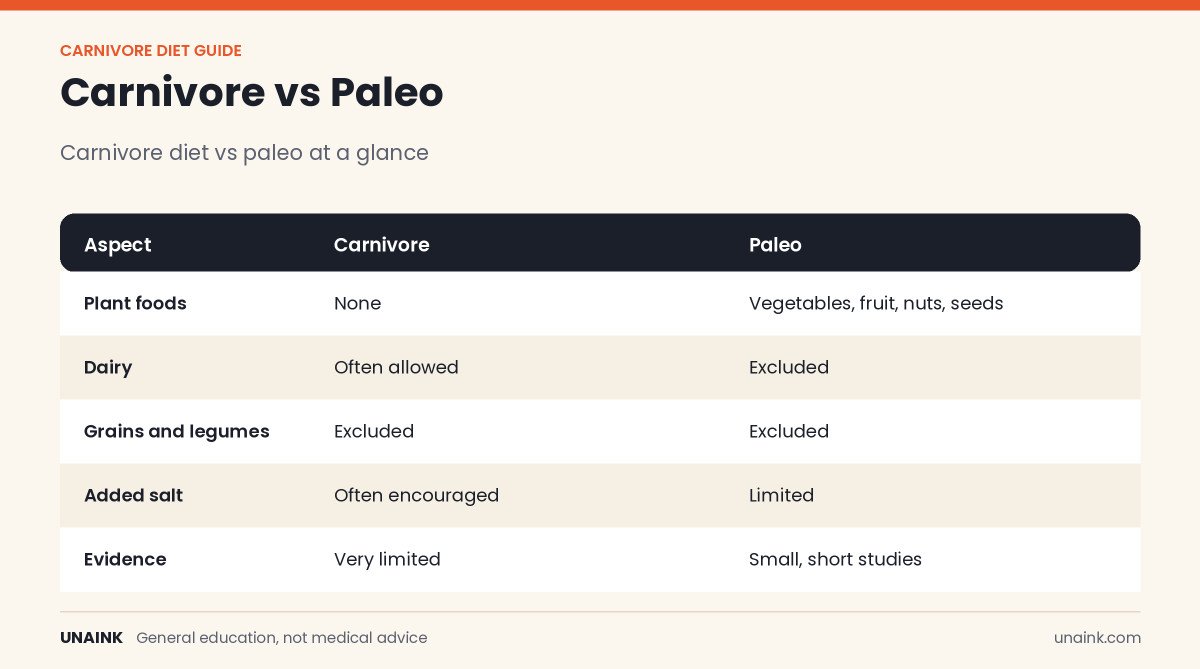
| Feature | Carnivore | Paleo |
|---|---|---|
| Vegetables and fruit | None | Core part of the diet |
| Nuts and seeds | None | Allowed |
| Dairy | Often allowed | Excluded |
| Grains and legumes | Excluded | Excluded |
| Added salt | Often encouraged (see how much salt on carnivore diet) | Limited, according to Mayo Clinic |
| Typical meat choice | Often fatty cuts | Lean meats emphasized |
| Carbohydrates | Near zero | Moderate, from fruit and vegetables |
Carnivore diet vs paleo: where they overlap
- Both avoid grains, legumes, and refined sugar.
- Both lean on whole animal foods such as eggs, meat, and fish.
- Both cut out most packaged and ultra-processed foods.
- Both appeal to people who like clear rules and a story about ancestral eating.
Because of this overlap, some people use paleo as a stepping stone, or carnivore as a short elimination step before reintroducing foods. For a middle path, see animal based diet.
Where they split: plants, dairy, salt, and fat
Plants are the biggest divide. Paleo uses vegetables, fruit, nuts, and seeds for fiber, vitamin C, potassium, and other nutrients. Carnivore relies on animal foods to cover those needs, which is a theory without strong human data (see do you need fiber on carnivore diet).
Dairy is another fork: paleo leaves it out, while many carnivore eaters rely on cheese, butter, and cream. Fat differs too. Paleo traditionally favors lean cuts, whereas carnivore often favors fattier ones, which changes saturated fat intake and LDL cholesterol for some people (see carnivore diet high cholesterol).
The ancestral argument
Both diets lean on the idea that people thrive on what early humans ate. The catch is that ancestral diets varied widely by place and season, and no one agreed menu exists. Researchers have even had to propose a standard definition of Paleolithic dietary patterns because studies define them differently (scoping review of Paleolithic patterns). An appeal to ancestry is a reason to be curious, not proof that either diet is healthier today.
What the evidence shows
Mayo Clinic says short, small paleo studies suggest possible improvements in weight, blood pressure, cholesterol, and triglycerides, but that the long-term risks are not known. It also notes that cutting grains, legumes, and dairy may reduce fiber, protein, vitamin, and calcium intake unless planned for.
For carnivore, a 2026 scoping review found nine human studies and called the evidence very limited, adding that long-term use cannot be recommended (Nutrients review). Cleveland Clinic points out that excluding plant foods can lead to nutrient gaps and electrolyte problems (Cleveland Clinic).
Who might lean which way
- If you like vegetables and want an elimination-style plan with variety, paleo may be easier to maintain.
- If you want very simple rules and a short food list, carnivore appeals, but expect more nutrient and sustainability questions.
- If you have kidney disease, diabetes, heart disease, or take medicines such as insulin or diuretics, talk with a clinician first.
- If you are pregnant, breastfeeding, a child or teen, or have a history of disordered eating, neither diet is recommended without medical guidance.
Cost matters too. Grass-fed meat, wild game, and nuts can be expensive, and Mayo Clinic notes that cost pressure may lead people to eat less of some essential nutrients.
Carnivore Diet vs Paleo: The Short Version
The carnivore diet vs paleo choice mostly comes down to plants and dairy: paleo keeps plants and drops dairy, while carnivore does the reverse. In the carnivore diet vs paleo comparison, neither has proven long-term benefits, so the better fit depends on your health, medicines, and what you can sustain.
Frequently Asked Questions
Is carnivore stricter than paleo?
Yes in one way: it removes all plant foods, while paleo keeps vegetables, fruit, nuts, and seeds. Paleo is stricter on dairy.
Can I eat dairy on paleo?
Mayo Clinic lists dairy among foods paleo excludes. Some people follow a looser version that includes it, but that is a variation.
Which is better for weight loss?
Research on both is limited. Short paleo studies suggest weight changes, and carnivore has no strong trials. Weight loss on either usually comes from eating fewer calories.
Which has more nutrient gaps?
Carnivore removes more food groups, so the potential for gaps in fiber, vitamin C, and some minerals is larger. Poorly planned paleo can also lack calcium and fiber.
Can I go from carnivore to paleo?
Yes. Many people add vegetables and fruit gradually. See the guide on transitioning off carnivore for ideas.
Conclusion
Carnivore and paleo share a distrust of processed food and a love of meat, yet they make opposite choices about plants and dairy. Neither is a proven long-term winner. Choose the one you can follow safely, review your nutrients, and bring a clinician into the decision if you have a medical condition.
Medical note
This article is for general education and is not medical advice. Talk with a doctor or registered dietitian before making major diet changes, especially if you have a health condition, take medication, or are pregnant or breastfeeding.
Keep Reading
- What Is the Animal-Based Diet: A middle path that adds some plants
- Carnivore Diet vs Keto: How the two low-carb approaches differ
- Transition Off Carnivore Diet: Adding foods back gradually
- What Is the Carnivore Diet: The basics of the all-animal approach
Sources
- Paleo diet: What is it and why is it so popular? (Mayo Clinic): foods, evidence, and risks of paleo
- The Carnivore Diet (Cleveland Clinic): dietitian view of carnivore risks
- Scoping review of Paleolithic dietary patterns: how studies define Paleolithic eating
- Carnivore diet scoping review (Nutrients, 2026): very limited human evidence