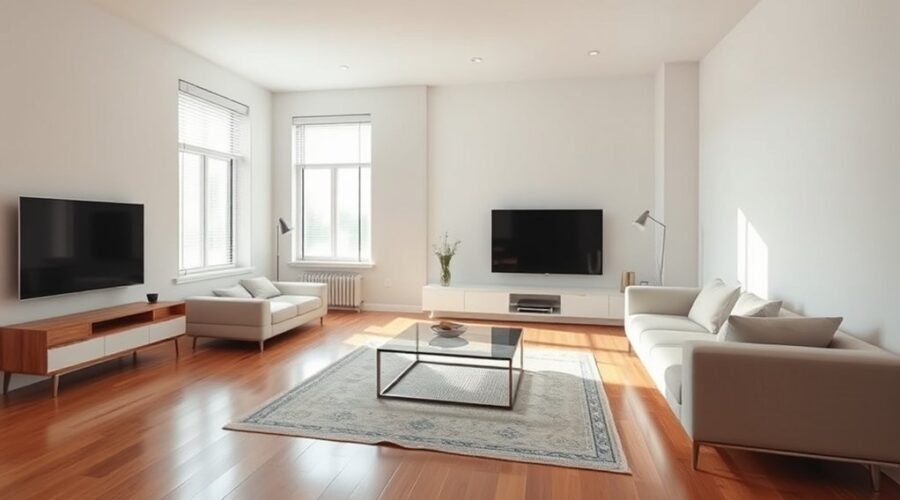
A living room echoes when sound reflects from hard surfaces faster than the room can absorb it. In everyday conversation, people often call this “echo,” although the problem is usually a mix of strong reflections and reverberation. Bare floors, walls, windows, high room volume, and sparse furnishings can all make voices, television dialogue, and music linger longer than they should.
Quick Answer
Living rooms sound echoey when too much sound reflects from hard floors, bare walls, glass, and ceilings instead of being absorbed. Start with a large rug and pad, curtains, upholstered furniture, and other soft surfaces. If reverberation remains strong, add purpose-made acoustic panels to large untreated walls or ceilings.
Key Takeaways
- Hard, smooth surfaces reflect more sound than thick, porous furnishings, so empty rooms with tile, concrete, glass, and bare walls tend to sound more reverberant.
- Treat the largest reflective areas first: usually the floor, windows, broad bare walls, and sometimes the ceiling.
- Rugs, curtains, and upholstered furniture mainly help mid- and high-frequency reflections; their effect varies with material, thickness, coverage, and frequency.
- Reducing echo inside a room is different from soundproofing a room against outside or neighboring noise.
- Acoustic panels make the most sense when ordinary furnishings do not provide enough absorption.
Why Living Rooms Echo So Much
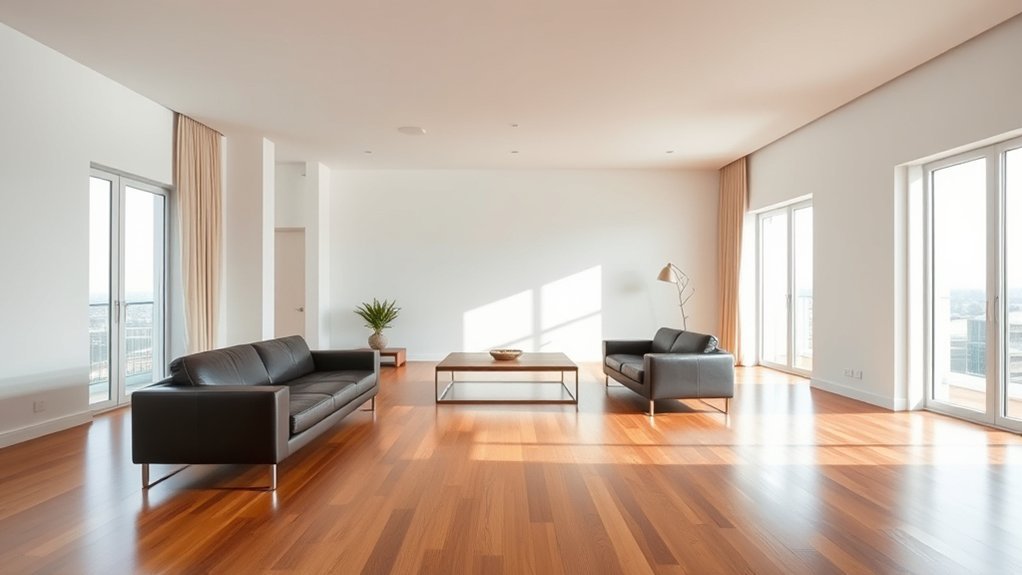
Living rooms often sound echoey because their surfaces favor sound reflection over absorption. When you speak, clap, play music, or turn on a television, sound reaches you directly and also bounces from the floor, ceiling, walls, windows, and furniture.
Multiple closely spaced reflections blend into what acousticians call reverberation. A distinct delayed reflection may be heard as a separate echo, but the “empty-room echo” people commonly notice at home is often excessive reverberation rather than one isolated echo.
The OSHA Technical Manual describes a reverberant field as reflected sound returning from surrounding surfaces and notes that hard room boundaries can increase this buildup of reflected sound.
A room sounds more echoey when reflected sound remains strong for too long instead of being absorbed and allowed to decay quickly.
Tile, wood, concrete, glass, painted drywall, and other hard finishes offer relatively little useful absorption compared with porous materials. A large room can also sustain longer sound paths. Sparse furniture then leaves fewer surfaces available to absorb or scatter those reflections.
The Surfaces That Reflect Sound Most
The most important reflective surfaces are usually the largest hard areas in the room: floors, broad walls, windows, and ceilings. The goal is not to eliminate every reflection. A normal living room should still sound natural. The goal is to prevent reflected sound from dominating conversation and media playback.
Hard Surfaces Reflect Sound
Concrete, tile, glass, painted masonry, and similar hard surfaces tend to return a large portion of incident sound to the room. Smooth parallel surfaces can be especially noticeable because sound can repeatedly travel between them.
Large uninterrupted walls matter because they provide substantial reflective area. Hard floors create another broad reflection path between the floor and ceiling. In a sparsely furnished room, the combined effect can make speech seem less defined.
Hard materials do not literally create extra acoustic power. Instead, they provide less absorption, allowing more of the original sound energy to remain in the room as reflections.
Soft Materials Absorb Sound
Soft, porous materials can absorb part of the acoustic energy that reaches them instead of returning all of it to the room. OSHA notes that porous or fibrous absorbers are commonly used to reduce reverberant sound and that absorption varies with frequency.
Carpets, rugs, padded seating, thick curtains, cushions, and purpose-made acoustic absorbers can therefore reduce reflections. They are usually most useful for mid- and high-frequency sound rather than deep bass.
Thickness, construction, coverage, and placement all matter. A thin decorative fabric covering a small area cannot be expected to perform like a thick acoustic absorber covering a large wall.
How Hard Floors Make Echo Worse
A floor is one of the largest continuous surfaces in most living rooms. When it is finished with tile, hardwood, polished concrete, or another hard material, much of the sound reaching it is reflected rather than absorbed.
Adding carpet or a large area rug reduces the amount of exposed hard flooring. A dense rug pad can add further absorption and also helps secure the rug.
Tile and Wood Reflection
Tile and wood floors are considerably more reflective than typical carpeted surfaces at many speech-related frequencies. The practical effect is most obvious in rooms that also contain bare walls, large windows, and limited upholstery.
| Surface | Typical room-acoustic effect |
|---|---|
| Tile | Highly reflective compared with porous floor coverings |
| Wood | Reflective, especially when most of the floor remains exposed |
| Carpet or large rug | Adds absorption, especially at mid and higher frequencies |
For the biggest practical change, prioritize coverage rather than placing a very small rug in the center of a large hard floor. You do not need to hide every inch of flooring, but treating more of the exposed reflective area usually has a greater effect than treating a tiny patch.
Why Concrete Floors Can Make Echo Seem Stronger
Concrete does not amplify the sound source. Its acoustic problem is that a dense concrete floor provides little absorption at many useful frequencies, leaving more reflected sound in the room.
A Penn State acoustics demonstration documented a highly reverberant room with concrete flooring and measured a substantial decrease in reverberation after carpet was installed. That result applies to the tested room rather than proving a universal percentage for every home, but it illustrates why covering a hard floor can matter.
In an open-plan living area, treating the floor is often a sensible first step because it is easy to change without modifying the building.
Rugs Cut Floor Echo
A thick rug reduces exposed reflective floor area and adds porous material that absorbs part of the sound reaching it. A pad beneath the rug can increase thickness and provides the separate benefits of cushioning and slip resistance.
There is no trustworthy universal claim that a rug reduces echo by a fixed percentage. Results depend on the rug, pad, room dimensions, total coverage, surrounding furnishings, and the frequencies being measured.
Pro Tip: If you already plan to use an area rug, choose one large enough to cover a meaningful part of the main seating zone. Treating more of a hard reflective surface is generally more useful than adding several tiny decorative textiles.
Why Bare Walls Reflect So Much Sound?
Bare drywall, plaster, masonry, and similar walls can return substantial sound into the room. The problem becomes more noticeable when two large hard walls face each other with little furniture, shelving, fabric, or other interruption between them.
Bare walls are not a problem simply because they look empty; they matter acoustically because they leave a large reflective surface untreated.
Bookshelves, upholstered wall elements, thick textile hangings, and purpose-made acoustic panels can change the reflection pattern. Filled bookshelves may scatter some sound because their surfaces are irregular, although an ordinary bookshelf should not be treated as equivalent to a laboratory-rated acoustic diffuser or absorber.
Likewise, ordinary framed artwork is usually decorative rather than acoustically significant. A canvas stretched over a thin frame may change a reflection slightly, but meaningful absorption requires suitable material and sufficient depth or coverage.
High Ceilings and Open Layouts
High ceilings are often associated with echo because they increase room volume and can create longer reflection paths. However, ceiling height alone does not determine reverberation. Room volume, geometry, surface area, furnishings, and the absorption of each surface all contribute.
Open-plan rooms present a similar challenge. Sound can spread through a larger connected volume, while modern open spaces often combine hard flooring, large windows, kitchen surfaces, and minimal furnishings.
Research on room acoustics also shows why this matters for conversation: greater reverberation can reduce speech intelligibility. A peer-reviewed study published in the Journal of the Acoustical Society of America found that speech performance generally declined as reverberation time increased under the tested conditions.
The larger and harder the room, the more important total absorptive coverage becomes. A single small rug cannot compensate for a large floor, tall hard walls, extensive glazing, and an untreated ceiling.
For a tall room that remains reverberant after rugs, curtains, and furniture have been added, wall-mounted absorbers, ceiling-mounted acoustic products, or suspended acoustic elements can treat surfaces that ordinary furnishings cannot reach. Follow the product manufacturer’s mounting and fire-safety requirements.
How Windows and Glass Add Reverb
Large windows and glass doors add broad, hard surfaces with relatively little useful sound absorption. Their influence is often most noticeable in contemporary living rooms that combine glazing with hard floors and minimal window coverings.
Covering some of that glass with substantial curtains can add absorption. Window seals perform a different job: they can reduce sound leakage through gaps but are not a substitute for absorptive treatment inside the room.
Glass Reflection Paths
Glass reflects a significant amount of incident sound instead of functioning like a porous absorber. A large pane can therefore participate in the repeated reflections between the window, opposite wall, floor, and ceiling.
The effect depends on the rest of the room. A large window in a well-furnished, carpeted room may cause little trouble, while the same glazing in a sparse room with concrete flooring can contribute to noticeably longer decay.
The practical solution is not necessarily to cover every window permanently. Curtains can remain open when acoustic control is not needed and closed when conversation, television dialogue, calls, or music sound too lively.
Window Seals and Curtains Do Different Jobs
Heavy curtains can help reduce reflected sound because the fabric adds an absorptive layer over a hard glass surface. Their performance depends on material, thickness, fullness, air space, coverage, and frequency, so “heavy” should not be treated as a precise acoustic rating.
Window seals, weatherstripping, and well-sealed frames mainly help control sound transmission through air gaps. They can be useful if outside noise is entering the room, but sealing a frame does not meaningfully replace a rug, curtain, acoustic panel, or other room absorber when the problem is indoor reverberation.
Note: Reducing echo and soundproofing are different goals. Echo treatment changes how sound behaves inside the room. Soundproofing focuses on reducing sound transmission between the room and adjacent spaces or outdoors.
How Furniture Helps Reduce Echo
Furniture changes a room’s acoustics by adding absorption, scattering reflections, and breaking up large uninterrupted surfaces. Upholstered sofas and armchairs are especially useful because fabric, foam, and padding absorb more sound than similarly sized hard furniture.
Cushions, fabric ottomans, and padded dining chairs add smaller amounts of absorption. A filled bookcase can also break up a broad flat wall and scatter some mid- and high-frequency reflections.
Furniture placement matters most when it prevents the room from remaining a collection of large facing hard surfaces. You do not need to block direct paths deliberately or turn the room into an obstacle course. Normal furniture distributed throughout the living area is usually more useful than concentrating every soft item in one corner.
Which Soft Materials Absorb Echo
Useful household absorbers include plush rugs, carpet, upholstered seating, dense curtains, fabric-covered furnishings, and cushions. Purpose-made acoustic products can provide greater and more predictable absorption when they have published laboratory test data.
Sound absorption is frequency-dependent. OSHA’s published examples of material absorption coefficients show that carpet and other porous materials can absorb substantially more energy at some mid and high frequencies than at low frequencies. This is why adding textiles may make speech and clapping sound noticeably cleaner while doing much less to solve deep bass resonance.
If the main complaint is conversation, television dialogue, or a sharp clap ringing through the space, ordinary soft furnishings are a sensible starting point. If the main problem is bass that booms at particular notes, the room may instead need thicker low-frequency treatment and different placement.
How to Find the Main Source of the Echo
You do not need professional measurement equipment to make a useful first diagnosis. Stand in the main seating area and make a single sharp hand clap while the television, HVAC fan, and music are off. Listen for a lingering ring, rapid repeated reflection, or noticeably long decay.
- Look at the floor: Is most of it exposed tile, wood, stone, or concrete?
- Look at the windows: Is there a large uncovered glass wall or sliding door?
- Look at opposite walls: Are broad hard surfaces facing each other?
- Look upward: Does the room have a tall, hard ceiling with little absorption elsewhere?
- Look at furnishing density: Is the room minimally furnished or dominated by hard furniture?
A clap test is only a rough listening check, not a laboratory measurement of reverberation time. For projects where speech, recording, home theater, or critical music listening matters, an acoustical measurement or professional assessment can provide more reliable information.
The Best Ways to Cut Living Room Echo
The most efficient approach is to treat the largest obvious reflective surfaces first, listen again, and add specialized treatment only if necessary. This prevents spending money on acoustic products before simpler furnishings have been given a chance to work.
| Measure | Main effect | Prioritize when |
|---|---|---|
| Large rug or carpet | Reduces floor reflections | Most of the floor is hard and exposed |
| Substantial curtains | Adds absorption over reflective glass | The room has large uncovered windows |
| Upholstered furniture | Adds practical absorption throughout the seating area | The room is sparse or dominated by hard furniture |
| Filled shelving or irregular furnishings | Breaks up some broad reflections | Large walls are otherwise bare |
| Acoustic wall or ceiling panels | Provides targeted, measurable absorption when properly specified | Ordinary furnishings do not reduce reverberation enough |
A practical sequence is therefore:
- Add or enlarge a rug on a hard floor.
- Add curtains where large areas of glass are exposed.
- Increase upholstered furniture or other soft furnishings if the room is sparse.
- Break up large bare walls with shelving or suitable absorptive décor.
- Listen again before purchasing specialist treatment.
- If reverberation remains distracting, add tested acoustic panels to untreated wall or ceiling areas.
Using several types of treatment across different surfaces is usually more useful than expecting one small item to correct the entire room.
When Acoustic Panels Make Sense
Acoustic panels make sense when echo or reverberation remains noticeable after ordinary furnishings have been added, or when a room needs better-than-normal speech or media clarity.
Purpose-made absorbers are useful because they can add substantial absorptive area exactly where a room lacks it. OSHA describes wall and ceiling absorptive treatment as a standard method of reducing reflected and reverberant sound.
Potential treatment areas include:
- A large bare wall behind or opposite the main seating area.
- A wall beside the television or listening position that produces strong reflections.
- A tall wall in an open-plan or double-height space.
- A hard ceiling when vertical reflections remain a major part of the problem.
For a television or stereo listening area, treating early reflection areas can also improve clarity. For general whole-room reverberation, however, total absorptive coverage matters more than obsessing over one precise point.
When comparing products, look for credible acoustic test data rather than assuming every felt-covered decorative panel performs the same. Absorption depends on the panel’s material, thickness, mounting, air gap, surface area, and frequency.
Corner bass traps are a more specialized treatment. They are useful when the problem is excessive low-frequency resonance or uneven bass, not automatically when the only complaint is speech-range echo.
Frequently Asked Questions
How do I stop my living room from echoing?
Start by treating the largest hard surfaces. Put a large rug and pad over exposed hard flooring, add curtains over large windows, and use upholstered furniture or other soft furnishings. If the room still sounds reverberant, add purpose-made acoustic panels to large untreated wall or ceiling areas.
What causes a room to be echoey?
An echoey room usually has too much reflected sound and too little absorption. Hard floors, bare walls, glass, large room volume, and sparse furnishings allow sound to keep reflecting instead of decaying quickly. What people call “echo” in a living room is often excessive reverberation rather than one distinct delayed echo.
How do you get rid of an echoey room?
Increase absorption across more than one surface. Rugs or carpet reduce floor reflections, curtains treat reflective window areas, upholstered furniture adds absorption around the seating zone, and acoustic panels can treat large bare walls or ceilings. Make one or two substantial changes, listen again, and add specialist treatment only if needed.
How do you get rid of echoes throughout a house?
Treat each problem room according to its surfaces instead of applying one solution everywhere. Large rugs help rooms with hard floors; curtains help where glazing is extensive; upholstered furniture helps sparse rooms; and acoustic wall or ceiling treatments are useful in large or persistent problem areas. Hallways, stairwells, and double-height spaces may need treatment on walls or ceilings because floor furnishings alone may not provide enough absorption.
Do curtains reduce echo in a living room?
Yes, curtains can reduce some reflected sound by placing an absorptive fabric layer over hard glass. Thicker, fuller constructions generally provide more useful absorption than thin fabric, but effectiveness varies with the material, coverage, mounting, and frequency. Curtains are usually much less effective against deep bass than against mid- and high-frequency reflections.
Do acoustic panels soundproof a room?
Not by themselves. Acoustic panels are primarily used to absorb reflections and control reverberation inside a room. Soundproofing aims to reduce sound transmission through walls, doors, windows, ceilings, and other building elements, which usually requires different construction and sealing methods.
Conclusion
A living room usually sounds echoey because hard surfaces allow reflected sound to remain in the room for too long. Hard floors, bare walls, windows, high room volume, and sparse furnishings can all contribute, while rugs, curtains, upholstery, and purpose-made acoustic absorbers shorten those reflections.
Start with the biggest untreated surfaces rather than buying acoustic products at random. Cover part of a hard floor, treat large windows, add soft furnishings, and listen again. If reverberation still interferes with conversation, television dialogue, or music, tested acoustic wall or ceiling panels provide a more targeted next step.
Sources
- Occupational Safety and Health Administration — OSHA Technical Manual: Noise — explains reflected and reverberant sound, absorption, material behavior, and the distinction between absorption and transmission controls.
- Penn State Graduate Program in Acoustics — Reverberation Time in a Small Room — provides measured and calculated examples showing how room surfaces and carpeting affect reverberation.
- Fogerty, Alghamdi & Chan, Journal of the Acoustical Society of America — examines how reverberation time and direct-to-reverberant ratio affect perceived reverberation and speech intelligibility.
- University of California San Diego — Reverberation Time — explains the relationship among room volume, surface absorption, and reverberation time.