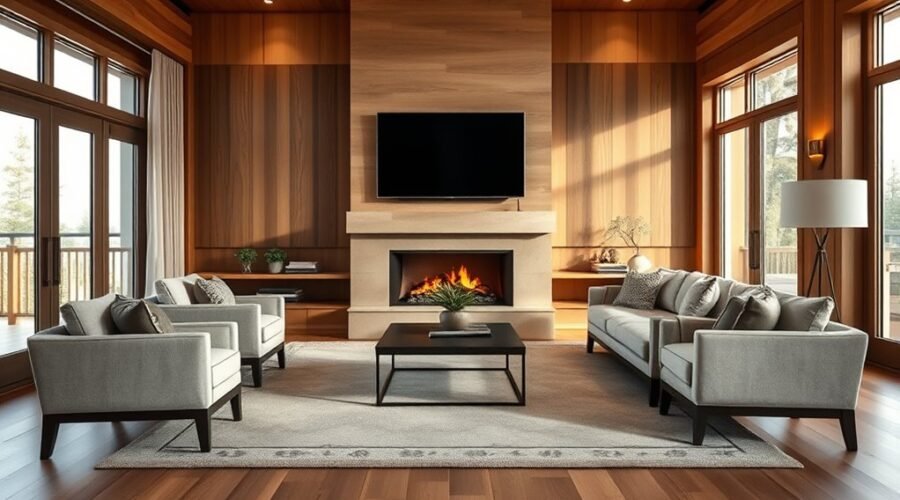
To arrange furniture around a fireplace and TV, start with safety and viewing comfort rather than symmetry. Measure the room, decide which feature needs the clearest straight-on view, and place the main sofa accordingly. Then add chairs or a sectional that can see both features without blocking walkways, doors, windows, or the fireplace’s required clearances.
Quick Answer
Arrange the main sofa toward the feature you use most, then angle secondary chairs toward both the TV and fireplace. Keep combustible furnishings safely away from the fireplace, place the TV center near seated eye level when possible, preserve clear walking paths, and use the fireplace and TV manufacturers’ instructions for heat and mounting clearances.
Key Takeaways
- Decide whether the TV or fireplace needs the most direct view before positioning the sofa.
- Keep the TV center near seated eye level when the room and fireplace design allow it.
- Never assume a fixed TV-to-fireplace clearance; follow the exact fireplace, TV, and mount instructions.
- Keep combustible furniture and decor away from an active fireplace and preserve clear circulation routes.
- Use floating, L-shaped, U-shaped, or angled seating based on whether the two focal points share a wall, meet at a corner, or sit on different walls.
At a Glance
| Time Required | About 30–60 minutes to measure, tape out, and test a layout before moving heavy furniture |
| Difficulty | Easy to moderate |
| Tools Needed | Tape measure, painter’s tape, notepad or floor-plan app, and furniture sliders if needed |
| Cost | Usually $0 when rearranging existing furniture; wall mounts, cable work, cabinetry, or heat-management changes add cost |
Measure the Room Before Moving Furniture
Before you move the sofa, record the room dimensions and the exact positions of the fireplace, hearth, TV wall, windows, doors, floor vents, outlets, and major furniture. A quick sketch prevents you from building a layout that looks good from one angle but blocks a doorway or forces the TV too high.
- Measure the usable wall lengths and the fireplace or chimney-breast width.
- Measure how far the hearth projects into the room.
- Mark doors, windows, openings, vents, outlets, and built-ins.
- Measure the sofa, sectional, chairs, coffee table, and media console.
- Use painter’s tape to mark major furniture footprints before moving anything heavy.
Pro Tip: Stand in every doorway after taping the layout. You should be able to see a clear route through the room without walking around the back of a chair, squeezing past a coffee table, or crossing directly in front of the TV.
Decide Where the TV Goes First
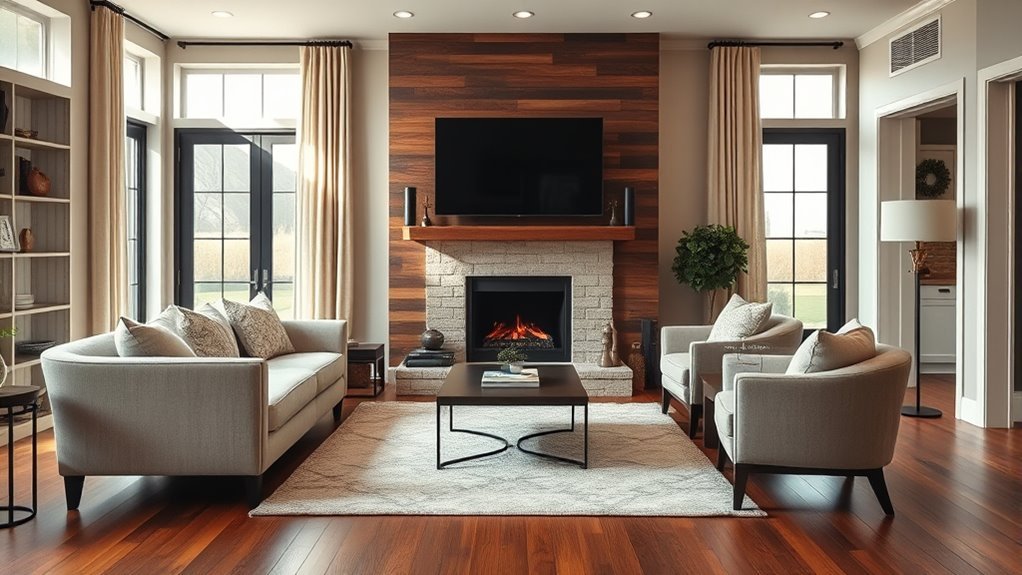
Before you settle on the seating, decide whether the fireplace or the TV should get the most direct view. The answer should reflect how you actually use the room.
If the room is mainly for movies, sports, or gaming, place the main sofa where the TV can be viewed without repeatedly turning your head. If conversation and the fireplace matter more, let the hearth remain the architectural anchor and put the TV on a nearby wall or inside built-ins where it is still easy to see.
For comfortable viewing, aim to place the center of the screen close to your normal seated eye level. Samsung uses about 42 inches from the floor to the screen center as one common starting point for a standard sofa, while LG similarly recommends positioning the middle of the screen at or slightly below eye level. Your actual seating height should decide the final position.
See Samsung’s wall-mount guidance and LG’s TV placement guidance for manufacturer examples.
Check daylight before committing to a wall. A TV directly opposite a bright window may suffer from reflections, while a screen beside a window may be easier to control with curtains, shades, or an articulating mount.
Warning: Do not assume that every TV can be mounted 12 inches above every fireplace. Fireplace models have different heat outputs and required clearances. Follow the fireplace manual, TV specifications, and wall-mount instructions. Samsung, for example, says it does not recommend mounting a TV over a fireplace and states that its TVs should not exceed 104°F (40°C).
Choose a Layout Based on Fireplace and TV Position
The relationship between the TV and fireplace usually matters more than the shape of the sofa. Identify which of these four arrangements matches your room before choosing the furniture layout.
| Fireplace and TV position | Furniture approach | Main concern |
|---|---|---|
| Same wall | Center the sofa on the shared wall and add chairs at the sides | TV height and fireplace heat |
| Adjacent walls | Face the sofa toward the feature used most and angle chairs toward the other | Avoiding constant head turning |
| Opposite walls | Choose one primary direction instead of splitting every seat equally | Competing focal points |
| Corner or off-center fireplace | Float the sofa or sectional and use swivel or angled chairs | Asymmetry and circulation |
Arrange Furniture Around Fireplace and TV
Start with the largest seating piece. Place the sofa so its occupants can comfortably watch the TV and still see the fireplace without forcing every seat to point in exactly the same direction.
An L-shaped or loose U-shaped arrangement works well when both focal points are close together. When they are on different walls, a straight sofa paired with two angled or swivel chairs is often more flexible.
Keep main walking routes open. Around 30 to 36 inches of clearance is a practical target for major circulation paths where the room allows it, but treat that as a planning guideline rather than a universal building-code requirement.
If the room is tight, wall-mounting the TV or using a shallow media console can free floor space. Avoid solving one problem by placing the TV so high that normal viewing becomes uncomfortable.
An area rug can anchor the seating group, but do not let a combustible rug creep into an unsafe fireplace zone. Fireplace safety and the appliance manufacturer’s required clearances come before visual symmetry.
A successful fireplace-and-TV layout is not the one that looks most symmetrical—it is the one that stays safe, feels comfortable from the main seats, and leaves an obvious path through the room.
Pick the Best Sofa Layout
The sofa usually controls the entire room because it is the largest seating piece. Decide its position before adding chairs, ottomans, or side tables.
If possible, avoid pushing every piece against the walls. A floating sofa arrangement can create a more defined conversation area, improve sightlines, and leave space for circulation behind the seating.
When you do float the sofa, leave enough room behind it for people to pass comfortably without brushing the sofa or another piece of furniture.
Sofa Facing the Focal Point
Position the sofa toward whichever feature receives the most attention. If the TV and fireplace share the same wall, the decision is straightforward. If they sit on adjacent walls, aim the sofa toward the TV if you watch it often and use angled chairs to pull the fireplace back into the conversation area.
Do not rely on an arbitrary 8-to-10-foot sofa-to-hearth distance. First meet the fireplace manufacturer’s requirements and fire-safety guidance. Then position the sofa according to room size and comfortable TV viewing distance.
In a compact living room, an L-shaped sofa or modest sectional can add seating without requiring multiple bulky chairs. A chaise works best when it does not project into the main walkway or block access to the fireplace.
Finish with a properly scaled rug that visually connects the seating rather than leaving each piece floating independently.
Floating Layouts for Flow
Floating furniture can make a difficult fireplace-and-TV room more flexible because the sofa no longer has to follow whichever wall happens to be free.
Use the sofa to create the main edge of the seating zone, then angle one or two chairs so they can turn toward conversation, the TV, or the fireplace. Keep enough space between seats for normal movement and conversation rather than forcing every piece into a perfectly symmetrical arrangement.
A console table behind a floating sofa can also make the placement feel deliberate while providing space for lamps, charging points, or storage.
Keep TV Height Comfortable
The most reliable TV-height rule is simple: place the center of the screen near seated eye level whenever possible. A fixed 42-to-48-inch range does not fit every sofa, person, screen size, or fireplace.
| Guideline | What to do |
|---|---|
| Screen height | Measure your seated eye level and use it as the starting point for the center of the screen. |
| Above a fireplace | Follow the exact fireplace and TV instructions rather than using a universal clearance. |
| Higher-than-ideal screen | A tilting or pull-down mount may improve the viewing angle if the manufacturer permits the installation. |
| Viewing distance | Use current guidance for your TV’s size and resolution, then adjust for comfort. |
Viewing distance also depends on screen size, resolution, content, and personal preference. Sony’s current guidance, for example, uses about 1.5 times the screen’s vertical height as a reference for many 4K televisions rather than the older blanket rule of sitting 1.5 to 2.5 screen diagonals away.
See Sony’s current viewing-distance guidance for model and resolution examples.
An art-style television can make the screen less visually dominant when it is off, but the design of the TV does not change the safe mounting height, wall-support requirements, or fireplace heat limits.
Keep Heat, Clearances, and Cables Safe
A fireplace is not just a visual feature; it is a heat source. That changes where furniture, rugs, electronics, cables, and decorative objects can safely sit.
The U.S. Fire Administration advises keeping anything that can burn at least 3 feet from heat sources including fireplaces. Follow the fireplace manufacturer’s instructions if they require greater clearance.
If you want a TV above the fireplace, check the exact fireplace manual before buying a mount or opening the wall. Heatilator’s guidance stresses that fireplace clearances and television specifications both need to be followed because heat management differs by installation.
- Keep combustible furnishings outside the required fireplace clearance.
- Do not secure a TV bracket to fireplace components unless the fireplace manufacturer specifically permits it.
- Use a mount rated for the television’s size and weight and fasten it to appropriate structural support.
- Keep wiring away from hot venting and use properly rated in-wall cable when cables run inside a wall.
- Do not block fireplace vents, heat outlets, service panels, or air intakes with furniture.
Note: Some modern fireplaces use dedicated heat-management systems that allow a TV to sit closer to the firebox than a traditional installation. Those model-specific designs do not create a universal clearance for other fireplaces.
Use Sectionals, Chairs, and Ottomans
A sectional can anchor the room and create a defined seating zone, especially when the fireplace and TV sit close together.
Add accent chairs where they improve viewing angles or conversation rather than simply filling an empty corner. Swivel chairs are particularly useful when the TV and fireplace sit on different walls.
Ottomans add flexible footrest and extra-seat options without committing the room to another large chair.
Sectionals Define Zones
A well-placed sectional can define the room’s flow by separating the seating area from a dining space, entry, game area, or open kitchen.
When the TV and fireplace share a wall, a sectional facing that wall can give everyone a usable sightline. When the focal points are on adjacent walls, avoid choosing a sectional whose fixed chaise forces half the room to face away from the TV.
Add a pair of lighter chairs where you need balance, such as beside a window or near a reading nook. Leaving some negative space is usually better than filling every corner.
This combination gives you enough structure for everyday use while remaining flexible for larger gatherings.
Ottomans Add Flexibility
Once your sectional or sofa defines the main seating zone, ottomans can make the room more adaptable. Move them beside chairs for a footrest, pull them into the seating group when guests arrive, or tuck them away when you need a wider walking path.
A storage ottoman can also replace a traditional coffee table in a small room. Add a sturdy tray when you need a flat surface for drinks or remotes.
Choose rounded or soft-edged ottomans for busy family rooms, especially when the ottoman sits close to a circulation path. Keep it out of the fireplace’s required safety zone.
Solve Small or Long Room Layouts
Long, narrow, and compact rooms often work better when you stop trying to center every object on the fireplace. Instead, create one functional seating zone and let the architectural features sit naturally within it.
| Layout | Best move | Result |
|---|---|---|
| Long room | Place the sofa perpendicular to one long wall or float it to divide zones | Less tunnel-like |
| Small room | Use a shallow console or safe wall mount | More usable floor space |
| Narrow room | Choose lighter chairs and smaller-depth tables | Clearer circulation |
| Corner fireplace | Float or angle the seating instead of forcing wall symmetry | Better dual sightlines |
In a long room, the sofa can sit perpendicular to the fireplace wall when that creates a better TV sightline. A sectional can add capacity, but check the chaise depth so it does not turn the room into a narrow corridor.
In a small room, wall mounting can free floor space, but it is not worth doing if the only available location puts the screen uncomfortably high or exposes it to excessive fireplace heat.
Use area rugs, lighting, and small accent tables to define a conversation corner or reading nook without building unnecessary visual barriers.
Corner Fireplace or Off-Center Fireplace
A corner fireplace rarely looks right when every piece of furniture is forced to line up with it. Instead, position the main sofa on the most practical axis for the TV and use one or two chairs to acknowledge the fireplace angle.
If the TV can go on a flat wall beside the corner fireplace, that often creates a comfortable L-shaped focal zone. A swivel chair can serve both without requiring the sofa itself to sit diagonally.
For an off-center fireplace, resist the urge to center the entire furniture group on the firebox. Center the seating zone on how the room functions, then use a chair, lamp, console, artwork, or built-in storage to balance the extra wall space.
Hide the TV in the Design
If you want the fireplace to remain visually dominant, integrate the television instead of trying to make both features equally bold.
Tuck the TV into bookshelves or cabinetry, place it against a darker wall finish, or use a framed/art-style screen so the black rectangle is less noticeable when the television is off.
Sliding artwork, pivot panels, or suitable lift systems can conceal a screen, but any mechanism used near a fireplace still needs adequate ventilation, heat clearance, structural support, and cable management.
- Use built-ins to make the TV part of the architecture.
- Hide cables and media equipment so the wall stays visually quiet.
- Repeat materials or colors from the fireplace wall around the TV.
- Use doors, art panels, or an art-style display when you want the screen to disappear when not in use.
Curtains or decorative screens can also soften the television’s presence in some rooms, provided they remain outside the fireplace’s safe clearance zone and do not block ventilation.
The goal is not to hide the TV at any cost. It is to keep the technology from overwhelming the room while preserving comfortable viewing and safe operation.
Try Proven Fireplace and TV Layouts
There is no single best layout for every fireplace-and-TV room. Match the arrangement to the wall configuration and the way your household uses the space.
| Layout choice | Best use | Watch for |
|---|---|---|
| Fireplace-centered U-shape | Conversation-focused rooms where the TV is nearby | Do not crowd the hearth |
| TV above fireplace | Rooms with limited wall space and a compatible fireplace installation | Heat and excessive TV height |
| TV beside fireplace | Wide fireplace walls or built-in cabinetry | Uneven visual weight |
| Adjacent-wall dual focus | Rooms where a low TV position matters | Too much head turning |
| Floating sofa + angled chairs | Corner fireplaces and open-plan rooms | Blocked paths behind seating |
If the TV sits over the fireplace, heat and viewing height determine whether the layout succeeds. If the TV is beside or perpendicular to the fireplace, orient the sofa toward the feature you use most and let chairs bridge the second viewing angle.
Matching finishes, built-ins, lighting, or artwork can visually connect two focal points without forcing them into perfect symmetry.
Troubleshoot Common Layout Problems
| Problem | Likely cause | Fix |
|---|---|---|
| Neck strain while watching TV | Screen is too high or too far off-axis | Lower the TV if safe, change the wall, or use an appropriate adjustable mount |
| Screen glare | TV faces a bright window or strong lamp | Change screen angle, move lamps, or add shades |
| Room feels crowded | Too many full-size pieces or furniture blocks circulation | Remove one bulky piece and use lighter chairs or an ottoman |
| Fireplace and TV compete | Both are styled as dominant focal points | Give one priority and visually quiet the other |
| Floating sofa looks stranded | Nothing anchors its back edge | Add a rug, console table, lamp, or clear alignment with the room |
| TV wall gets too hot | Fireplace heat is reaching the proposed TV location | Follow the fireplace and TV manuals; relocate the TV or use an approved heat-management solution |
Frequently Asked Questions
What is the 2/3 rule for furniture?
The 2/3 rule is a visual proportion guideline, not a requirement to fill two-thirds of a room with furniture. For example, a coffee table may look balanced when it is roughly two-thirds the length of the sofa, or artwork may span roughly two-thirds of the furniture below it. Room function and clear circulation should take priority over the ratio.
What is the biggest mistake in furniture placement?
One of the most common mistakes is placing furniture for symmetry while ignoring traffic paths, viewing comfort, fireplace clearance, doors, and windows. Start with the room’s fixed features and largest sofa, then add smaller pieces only when they improve function.
How do you style a fireplace with a TV?
Keep the wall visually simple. Use built-ins, a restrained mantel display, repeated materials, or an art-style television to connect the two features. If the TV sits above the fireplace, confirm the appliance’s heat and clearance requirements before choosing the mounting height or adding decorative materials.
Are TVs over fireplaces still in style?
Yes. TVs above fireplaces are still used in modern media walls and rooms with limited wall space. The arrangement works best when the fireplace system safely manages heat and the TV can remain at a comfortable viewing height. Style should not override those requirements.
Is it safe to mount a TV over a fireplace?
It can be safe with some fireplace and heat-management systems, but there is no universal clearance. Check the fireplace installation manual, TV temperature limits, mantel requirements, wall construction, ventilation, and mounting instructions. If those requirements cannot be met, place the TV on another wall.
Should the sofa face the TV or fireplace?
Face the sofa toward the feature you use most. In a TV-heavy room, give the screen the straightest sightline and use angled chairs to include the fireplace. In a conversation-focused room, the fireplace can lead while the TV sits on a secondary wall or inside built-ins.
How far should furniture be from a fireplace?
Follow the fireplace manufacturer’s clearance requirements first. The U.S. Fire Administration also advises keeping anything that can burn at least 3 feet from heat sources including fireplaces. Some appliances may require additional clearance, so the product manual takes priority.
Where should the TV go with a corner fireplace?
A flat wall beside the corner fireplace is often easier to view than mounting directly over the fire. Float the sofa or sectional so it faces the TV, then use angled or swivel chairs to connect the fireplace to the same conversation zone.
Sources
- U.S. Fire Administration — Heating Fire Safety — fireplace and combustible-material safety guidance.
- Samsung — Things to Consider Before Mounting Your TV to a Wall — screen height, wall support, fireplace heat, and mounting considerations.
- Sony — Recommended Viewing Distance for Watching TV — viewing distance by display resolution and screen size.
- LG — TV Size, Height, and Viewing Guidance — seated eye-level placement and TV sizing guidance.
- Heatilator — Can I Mount a TV Over My Fireplace? — manufacturer-specific heat, mantel, clearance, and TV-placement considerations.
Conclusion
A fireplace and TV can share a living room without forcing an awkward compromise. Start with the room’s measurements and fireplace safety requirements, give the feature you use most the clearest sightline, and place the TV near seated eye level whenever possible. Then use a sofa, sectional, angled chairs, rugs, and smaller movable pieces to connect the two focal points while keeping the room easy to walk through.
The best layout is not determined by one fixed distance or formula. It comes from matching the furniture to your specific walls, fireplace, screen, viewing habits, and circulation needs.