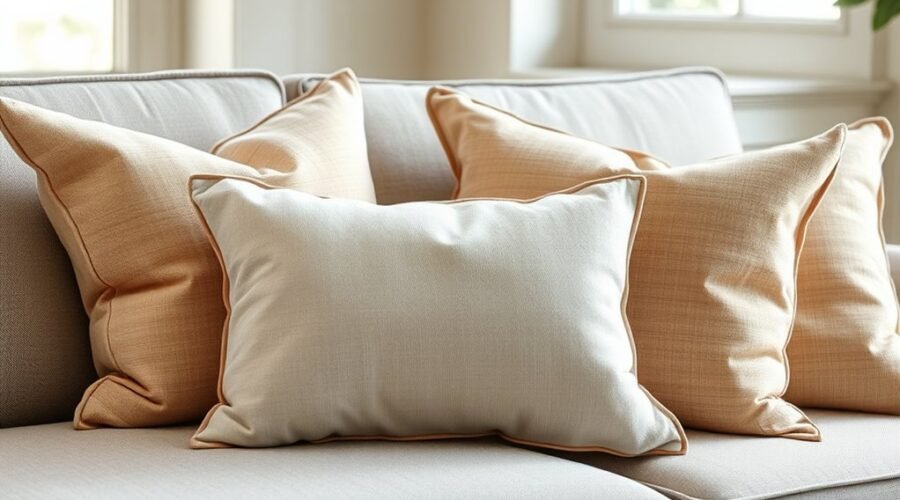
A pillow insert is the inner cushion that gives a decorative pillow its shape, loft, and support. Choosing one is not just a matter of matching two numbers on a label. The fill, shell fabric, construction, cover size, and intended location all affect how full the finished pillow looks and how well it holds up with use.
Quick Answer
Choose a pillow insert by matching the fill, shell, and size to the cover and where it will be used. Down is soft and moldable, feather adds firmer support, and polyester is practical and budget-friendly. For a fuller look, many square covers use an insert 1–2 inches larger, but sizing varies by cover size and shape.
Key Takeaways
- A pillow insert is the inner cushion that supplies a decorative cover with shape, loft, and support.
- Down clusters are soft and quill-free, while feathers contain quills and usually add more structure.
- Polyester can be a practical choice, especially outdoors, but outdoor use also requires a suitable moisture-resistant shell.
- Sizing up by 1–2 inches is common for square covers, but the best increase depends on the cover’s size, shape, fabric, and desired firmness.
- A good insert should have an appropriate fill amount, secure seams, a well-made shell, clear care instructions, and honest fill labeling.
- For natural fill, certifications such as the Responsible Down Standard can provide additional information about animal-welfare and supply-chain practices.
Why Pillow Insert Construction Matters
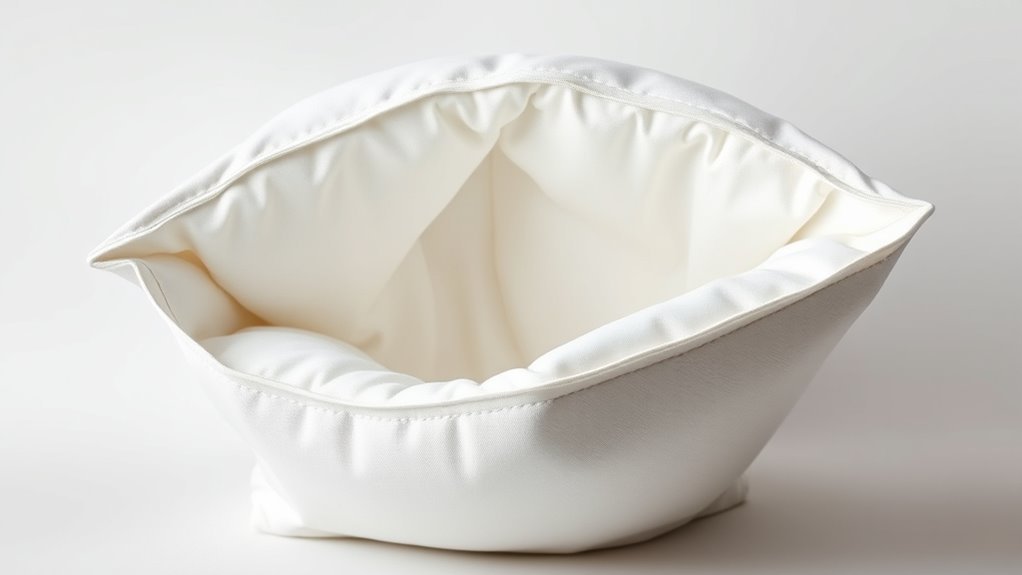
When you choose a pillow insert, construction matters because both the shell and the fill determine how it feels and performs. With a down-and-feather insert, a tightly woven shell helps contain the filling and limits feather migration through the fabric.
The distinction between down and feathers matters here. According to the American Down and Feather Council, down consists of three-dimensional clusters that contain no quill, while feathers do have quills. That is why feather-rich inserts can feel more structured but are also more likely to produce an occasional poking quill if the shell is not sufficiently dense.
Fill quality and fill quantity matter just as much as the fabric. A soft shell cannot compensate for an underfilled insert, while a large amount of fill can make a small or rigid cover uncomfortably tight. Look for clearly stated fill content, solid seams, even distribution, and a shell appropriate for the material inside.
Construction also affects appearance. A properly sized, evenly filled insert supports the corners of a decorative cover and reduces the loose, sagging look that occurs when an insert is too small.
Note: Country of manufacture by itself does not tell you whether an insert is high quality. Compare the fill specification, shell, seams, care instructions, certifications, and actual dimensions instead.
Down, Feather, or Poly Fill?
Once you understand the construction, the next choice is the fill. There is no single best material for every decorative pillow; each creates a different combination of softness, structure, maintenance, and price.
| Fill Type | Typical Feel | Best For | Watch For |
|---|---|---|---|
| Down | Very soft, light, moldable | Relaxed, plush decorative pillows | Higher cost; needs regular fluffing |
| Down/feather blend | Soft with more body and structure | Sofas, beds, pillows that are frequently reshaped | Feather quills can occasionally migrate through weak shells |
| Polyester fiber | Springy to firm, depending on density | Budget-friendly, easy-care, and many outdoor-specific inserts | Low-density fill can compress or clump with extended use |
Down gives you the softest, most moldable feel because its clusters are light and three-dimensional. Feathers are flatter and contain quills, which generally provide more support. A blend combines those characteristics, although the actual feel changes dramatically with the down-to-feather ratio.
Polyester fiberfill can range from very soft to quite firm. It is usually less expensive than natural fill and is available in many washable or outdoor-specific constructions. Durability varies, so it is better to compare the fill density and construction than to assume every polyester insert will perform the same way.
How Fill Affects Pillow Shape and Feel
The fill changes both how a pillow responds when you lean against it and how it looks after you stand up. Soft down can be molded and reshaped easily, while feather-rich blends and firmer synthetic fills tend to create more resistance and structure.
The right choice depends on whether you want a relaxed pillow that can be chopped and reshaped or a more upright accent that stays closer to its original profile.
Down Vs. Poly Fill
Down has a soft, compressible feel and is easy to fluff back into shape. The American Down and Feather Council’s terminology guide describes loft as the fluffiness created by down’s three-dimensional structure.
Polyester fiberfill is more varied. Some inserts imitate the soft feel of down, while others are intentionally firm and springy. Lower-density polyester can flatten or form uneven areas after repeated compression, whereas a well-filled, well-constructed synthetic insert can remain useful for a long time.
Down is also naturally breathable, although that characteristic is more important in sleeping products than in decorative throw pillows. For sofa and bed accents, shape, feel, maintenance, and cost are usually more useful buying criteria.
For maintenance, fluff any loose-fill insert regularly. If the care label allows washing, follow its exact instructions and make sure the insert is completely dry before returning it to the cover.
Shape, Loft, And Bounce
The fill gives a pillow its architecture. Down and down-rich blends compress easily and can create a relaxed silhouette, while feather-rich blends and firmer synthetics provide more resistance. Neither approach is automatically better; the right one depends on the look and feel you want.
- Soft, moldable fill works well for a relaxed, sink-in look.
- Firmer fill gives corners and edges more visible structure.
- A tightly woven shell helps control natural fill migration.
- Enough fill weight keeps the insert from looking hollow at the corners.
- Correct sizing helps the cover look full without overstressing its seams.
Better bounce can help a pillow recover after use, but recovery depends on the fiber, amount of fill, and how frequently the pillow is compressed. That is why the material name alone does not tell the whole story.
Pick the Right Pillow Insert Size
Choosing the right size is one of the fastest ways to improve the finished look. However, “always buy an insert two inches larger” is too simple. The correct amount of oversizing depends on the dimensions and shape of the cover.
Start by removing the insert and measuring the empty cover seam to seam. Do not rely only on the size printed on a tag, especially with handmade, washed, or older covers.
A practical starting guide is:
| Cover | Common Starting Point |
|---|---|
| Small square, about 18 x 18 in. or less | Same size or about 1 inch larger, depending on desired fullness |
| Larger square, about 19 x 19 in. and up | About 2 inches larger is a common fuller-fit starting point |
| Lumbar or rectangular cover | Use the insert maker’s rectangle chart; same-size or modestly oversized inserts are common |
| Very stiff, thick, or tightly tailored cover | Avoid aggressive oversizing that can strain the zipper or seams |
This is consistent with sizing guidance from Pillowflex, which recommends different increases for smaller squares, larger squares, and other shapes.
For example, a 20-inch square cover commonly looks fuller with a 22-inch square insert. By contrast, a 14×18 lumbar cover does not automatically need a 16×20 insert. Rectangular inserts should be chosen according to the cover’s actual dimensions, fabric stiffness, and the manufacturer’s sizing guidance.
If the insert is too small, empty corners and sagging fabric are common. If it is too large, the cover can bulge, become unusually firm, or place unnecessary stress on the zipper and seams.
Pro Tip: Measure the empty cover before ordering. Two pillow covers sold as the same nominal size can measure differently after sewing, washing, or years of use.
Which Pillow Inserts Work Best Outdoors?
For outdoor seating, synthetic fill is usually the practical starting point, but polyester fill alone does not make an insert weatherproof. The shell and construction are equally important.
Look for an insert specifically described by its manufacturer as suitable for outdoor use, preferably with a water-resistant or quick-drying casing. Fairfield, for example, describes its Weather Soft outdoor pillow insert as using a water-resistant shell designed to reduce water penetration into the fill.
- Choose synthetic fill that can tolerate occasional moisture better than natural down.
- Prefer a shell specifically designed for outdoor exposure.
- Check whether the insert is washable and how it must be dried.
- Bring cushions under cover during prolonged or heavy rain when practical.
- Dry any wet insert completely before storage.
Warning: “Polyester” and “outdoor” are not interchangeable terms. An indoor polyester insert with an absorbent shell can still become saturated. Use an insert specifically rated for outdoor conditions and follow its care instructions.
Down and feather blends are better protected indoors because prolonged dampness is harder to manage and natural fill must be dried thoroughly. The insert also does not protect the decorative cover from UV fading; the cover fabric itself needs appropriate outdoor performance characteristics.
Why Down-Proof Ticking Matters
Down-proof ticking is a tightly woven shell fabric designed to keep fine natural fill from migrating through the casing. It is especially useful with feather-containing blends because feathers have quills that can occasionally work toward the surface.
Down clusters contain no quills; feathers do. That difference is one reason shell construction matters so much in feather-and-down blends.
Down-Proof Protection
A well-made natural-fill insert starts with fabric that can reliably contain the fill. A dense, tightly woven shell limits leakage and helps reduce scratchy feather poke-through.
The American Down and Feather Council notes that thread count is one factor associated with how down-proof a fabric is. However, shoppers should evaluate the complete construction rather than chasing the highest thread-count number on a label.
- Dense weave: helps limit fill migration.
- Secure seams: reduce leakage at common weak points.
- Appropriate fill blend: determines softness versus structure.
- Clear specifications: make it easier to compare products objectively.
Do not assume a domestic insert is automatically better constructed than an imported one, or vice versa. Quality control is product-specific. Look at measurable details instead.
If responsible sourcing matters to you, look for recognized certification. The Responsible Down Standard from Textile Exchange covers animal-welfare requirements and chain-of-custody controls and prohibits practices including live-plucking and force-feeding.
Stronger, Fuller Inserts
A durable pillow insert comes from the combination of shell, seams, fill amount, and suitable sizing. Down-proof fabric cannot make an underfilled pillow look full, and extra fill cannot compensate for weak seams.
| Feature | Why It Matters |
|---|---|
| Strong ticking | Helps contain fill and withstand regular handling |
| Down-proof weave | Reduces natural-fill migration and feather poke-through |
| Appropriate down/feather ratio | Balances softness, loft, weight, and support |
| Adequate fill amount | Improves corner fill and overall fullness |
| Correct insert size | Creates fullness without unnecessary seam stress |
When you choose ethically sourced natural fill, use a recognized certification rather than relying only on broad words such as “responsible” or “sustainable.” RDS certification provides a defined standard and traceability system for qualifying down and feathers.
How to Spot a Better Pillow Insert
To spot a better pillow insert, move past adjectives such as “luxury” and “premium” and inspect the actual specifications.
- Check the fill content. A natural-fill product should state whether it contains down, feathers, or a mixture and provide meaningful percentages where applicable.
- Inspect the shell. Natural fill benefits from tightly woven fabric and secure seams.
- Check the fill amount. Two inserts with identical outside dimensions can feel very different if one contains substantially more filling.
- Measure the actual dimensions. Do not assume the printed cover size is exact.
- Read the care label. Verify whether the insert can be washed, spot-cleaned, or tumble-dried.
- For outdoor use, confirm an outdoor rating. Do not infer it from polyester fill alone.
- For natural fill, look for sourcing certification if animal-welfare practices matter to you.
The American Down and Feather Council’s labeling requirements also distinguish products marketed as “down” from down-and-feather blends. Reading the actual content percentages is more useful than assuming all natural-fill inserts have the same feel.
For maintenance, fluff the insert regularly and check its care label before washing. A made-to-order insert may provide a better fit when you have an unusual cover size, but custom production alone does not prove that the insert will last longer.
When Made-to-Order Inserts Are Worth Considering
Made-to-order pillow inserts can be useful when a cover has unusual dimensions or when standard sizes do not produce the fullness you want. The biggest advantage is fit and customization, not a guaranteed increase in lifespan.
An accurately sized custom insert can reduce sagging corners or excessive bulging because you can specify dimensions that better match the cover.
Some custom makers also let you choose the fill material or fill amount. That can help you create a softer or firmer profile instead of accepting whatever density comes in a stock insert.
Fresh production may be appealing, but you should not assume an off-the-shelf insert has been damaged simply because it spent time in storage. What matters more is whether the material recovers after unpacking and whether its construction is appropriate for the intended use.
Material quality remains the deciding factor. Strong ticking, reliable seams, suitable fill, appropriate sizing, and proper care all contribute to longevity.
Custom production may also reduce the need to replace an insert simply because standard dimensions fit poorly. However, sustainability depends on the materials, sourcing, manufacturing, shipping, use, and eventual disposal—not merely on whether an insert was made to order.
How to Care for Pillow Inserts
Care varies by material, so the manufacturer’s label should always come first. Do not assume that two inserts with the same fill type use the same shell or washing method.
- Fluff regularly: Shake, rotate, and reshape loose-fill inserts so filling does not remain compressed in one area.
- Keep natural fill dry: If a washable down or feather insert gets wet, dry it thoroughly according to its care label.
- Spot-clean when required: Some decorative inserts are not designed for machine washing.
- Address outdoor moisture promptly: Allow the insert to dry completely before storage or before covering it for long periods.
- Avoid unnecessary compression: Long-term tight storage can temporarily reduce loft.
For example, The Company Store’s feather-and-down insert instructs owners to machine wash cold on a gentle cycle and tumble dry low until the feathers are thoroughly dry. Other inserts may require different treatment, so use the individual product’s label rather than applying that method universally.
Refresh Your Home With Pillow Inserts
A pillow insert swap can refresh an entire room because the insert controls much of the fullness and structure behind the decorative cover.
For many square covers, choosing an insert slightly larger than the cover creates a fuller silhouette. The correct increase, however, depends on the cover’s dimensions and construction rather than a single rule for every pillow.
Good inserts also make it easier to reuse the same core pieces while changing the visible covers:
- Rotate seasonal covers without buying a complete pillow each time.
- Change color combinations across a sofa, bed, or chair.
- Mix linen, velvet, woven, or outdoor-rated cover fabrics.
- Move inserts between compatible covers when their measurements and shapes match.
You can shift from lighter spring fabrics to heavier autumn textures while keeping suitable inserts in service. That flexibility can make reusable covers and inserts more practical than replacing complete decorative pillows every time your style changes.
If you compare options from Aiden Fabrics or any other decor supplier, evaluate each insert by its measurable specifications—dimensions, fill content, shell fabric, construction, care requirements, and certifications—rather than relying only on general quality claims.
Sources
- American Down and Feather Council — Frequently Asked Questions — explains the structural difference between down clusters and feathers.
- American Down and Feather Council — Down & Feather Terminology — defines loft, fill power, thread count, and construction terminology.
- Pillowflex — Selecting Correct Sizes — provides manufacturer guidance for sizing square and specialty pillow inserts.
- Fairfield — Pillow Insert Guide — documents outdoor-oriented inserts that combine synthetic fill with a water-resistant shell.
- Textile Exchange — Responsible Down Standard — explains RDS animal-welfare and chain-of-custody requirements.
- The Company Store — Feather and Down Pillow Insert — provides a current example of fill specifications, certifications, and care instructions.
Frequently Asked Questions
What is the rule for pillow inserts?
There is no single rule for every cover. A common starting point for larger square covers is an insert about 2 inches larger, while smaller squares may use the same size or about 1 inch larger. Rectangular and lumbar covers often need less aggressive oversizing. Measure the empty cover seam to seam and check the insert manufacturer’s sizing chart.
What is the difference between a pillow insert and a regular pillow?
A pillow insert is primarily designed to fill a removable decorative cover and create the desired shape and fullness. A regular bed pillow is designed mainly to support your head and neck during sleep. Decorative inserts therefore emphasize fit, loft, shape, and compatibility with a cover rather than sleeping position or ergonomic support.
Is a pillow insert the actual pillow?
The insert is the inner cushion. The decorative cover goes over it and provides the visible fabric, color, texture, and pattern. Together, the cover and insert form the finished decorative pillow.
What type of pillow insert is best?
The best insert depends on the job. Down is very soft and moldable. Down-and-feather blends combine softness with more structure. Polyester fiberfill is usually less expensive and is available in easy-care and outdoor-specific versions. Compare the fill, shell, density, care requirements, and cover size rather than choosing by fill name alone.
Can I use an indoor pillow insert outside?
It is better to use an insert specifically designed for outdoor conditions. Synthetic fill can be useful outdoors, but the shell also needs suitable moisture resistance. An ordinary indoor polyester insert can still absorb water through its casing and take a long time to dry.
What does down-proof ticking mean?
Down-proof ticking is a tightly woven shell designed to limit down and feather fill from migrating through the fabric. Down clusters themselves have no quills, but feathers do, so good ticking is especially useful in feather-containing inserts where quill poke-through can otherwise occur.
Conclusion
The pillow insert may be hidden, but it has a major effect on how a decorative pillow looks and feels. Start with the actual cover measurements, then choose a fill and shell suited to the room, desired firmness, and maintenance needs. Down gives you softness and moldability, feather-containing blends add structure, and polyester offers practical options for many budgets and outdoor applications. Pay attention to construction, care instructions, sizing guidance, and credible certifications, and the finished pillow is far more likely to stay full, comfortable, and well proportioned.