Sagging couch cushions can come from several different problems: compressed fiber or batting, worn foam, stretched webbing, weak springs, or a damaged seat base. The right fix depends on where the sag begins. Start by testing the cushions separately from the sofa, then use fluffing, fresh batting, careful rotation, or an under-cushion support only when that method matches the actual problem.
Quick Answer
To fix sagging couch cushions, first determine whether the problem is the cushion or the support underneath. Fluff and rotate fiber-filled cushions, add batting around a sound foam core, and use an under-cushion support only for weak suspension. If foam stays permanently compressed, cracked, or uneven, replace the foam instead.
Key Takeaways
- Remove the cushions and test them on a firm, flat surface before deciding what to repair.
- Fluffing and fresh polyester batting can restore loft when fiber has compressed, but they cannot repair a failed foam core.
- A support board can firm up a weak seat base, but it does not restore deteriorated cushion foam.
- Use steam only when the furniture manufacturer’s care instructions specifically allow it.
- Persistent dips, cracking, crumbling, or major loss of cushion height usually mean the foam or suspension needs replacement.
At a Glance
| Time Required | About 10–45 minutes for basic inspection, fluffing, batting, rotation, or a fitted support; foam or structural repairs can take longer. |
| Difficulty | Easy for fluffing, rotation, and removable-cushion inspection; moderate or professional-level for spring, webbing, frame, or sewn-in cushion repair. |
| Tools Needed | Tape measure and clean work surface; optional polyester batting/fiberfill, manufacturer-approved steamer, or fitted cushion support. |
| Cost | Free for fluffing and rotation; material cost varies for batting, a support insert, replacement foam, or professional upholstery repair. |
What Causes Couch Cushions to Sag?
Couch cushions sag when one or more parts of the seating system lose their original shape or support. The cushion itself may contain flexible polyurethane foam, polyester batting, loose fiber, feathers, down, or a combination of materials. Below it, the sofa may rely on webbing, sinuous springs, coil springs, a platform, or another suspension system.
Foam can gradually lose height, firmness, and resilience under repeated loading. The Polyurethane Foam Association explains that cushion performance involves several different properties, including density, firmness, support factor, resilience, and resistance to fatigue. A cushion can therefore feel softer or begin to bottom out even when the upholstery cover still looks acceptable.
Polyester batting and loose fiber can also compact or migrate. This often creates hollow corners, a flattened crown, or lumps even when the main foam core remains usable. In foam-and-fiber cushions, the fiber layer mainly adds softness and surface fullness; it is not a substitute for a sound load-bearing core.
The problem may also be underneath the cushion. Stretched webbing, weakened springs, loose spring clips, or a damaged frame can allow a perfectly usable cushion to sink into the sofa. That is why identifying the failure point before adding material is the most important part of the repair.
Diagnose the Sag Before Fixing It
Remove each removable seat cushion and place it on a firm, flat surface such as a clean floor or table. Sit on or press the cushion there. Then compare that feel with how the same cushion behaves on the sofa.
- The cushion sags even on a firm surface: inspect the foam, batting, fiber, or other filling.
- The cushion feels acceptable off the sofa but sinks on the sofa: inspect the seat deck, webbing, springs, clips, and frame.
- Only one cushion is low: compare it with a less-used cushion for differences in height, firmness, lumps, or permanent compression.
- The cushion looks loose but still feels supportive: the outer batting or cover may have stretched or flattened rather than the foam core failing.
- The entire seating area slopes or makes unusual noises: inspect the structural support before adding more filling.
Pro Tip: Swap a sagging removable cushion with a less-used cushion of the same shape. If the sag moves with the cushion, the cushion is the main problem. If the low spot stays in the same sofa position, inspect the support underneath.
Warning: Unplug powered sofas and recliners before reaching around their mechanisms. Do not place boards, loose fill, fabric, or tools where they could interfere with hinges, motors, wiring, reclining hardware, or other moving parts.
Fluff Couch Cushions for a Quick Lift
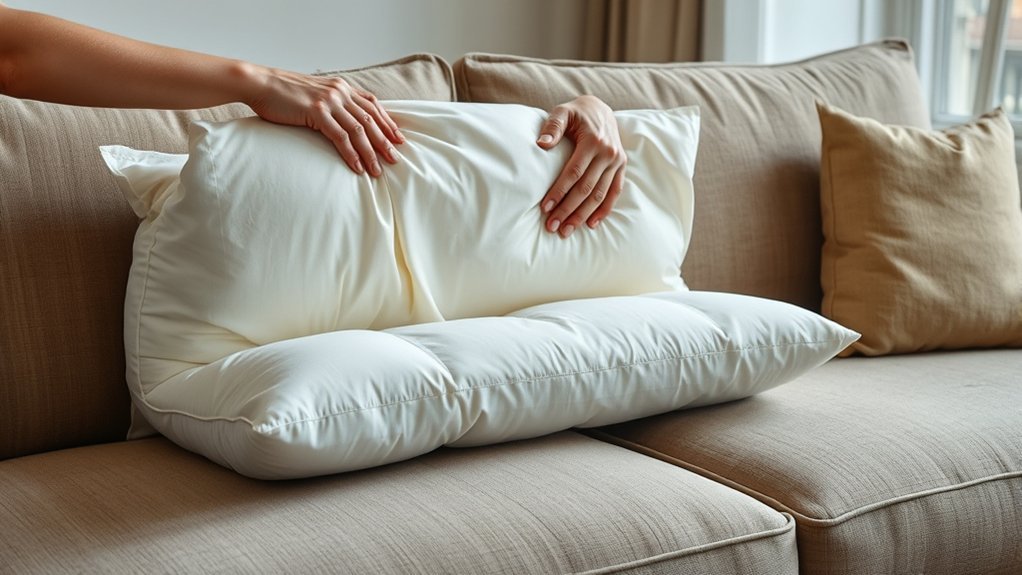
Fluffing works best on cushions that contain loose polyester fiber, feather/down blends, or other fillings that can migrate and compact. It redistributes existing material and restores some surface loft, but it cannot repair foam that has permanently broken down.
Lift the cushion and work around the entire surface rather than pounding only the visible dip. Push compressed filling back toward the corners and edges, knead thicker areas to break up clumps, then reshape the cushion before returning it to the sofa.
Regular reshaping can restore loft in fiber-filled cushions and help distribute wear, but a permanently compressed foam core needs more than fluffing.
- Fluff both faces and work the material toward empty corners.
- Shake loose-filled cushions before reshaping them by hand.
- Swap equivalent cushions from one seating position to another when their shape allows it.
- Inspect for lumps, damaged seams, or a noticeably thinner core while the cushion is off the sofa.
Some furniture manufacturers specifically recommend frequent fluffing for feather/down-blend cushions. The amount of maintenance needed depends on the cushion construction and how heavily the sofa is used.
Add Polyester Fiberfill to Sagging Cushions
When the foam core is still supportive but the cushion looks hollow or the cover has become loose, fresh polyester batting or fiber can restore surface fullness. Many upholstered cushions use foam wrapped with polyester fiber to soften the edges and create a fuller profile; the Polyurethane Foam Association’s furniture guidance describes this type of foam-and-fiber construction.
For a removable cushion with a zipper, open the cover and inspect the existing construction before adding anything. If the foam is wrapped in batting, replace or supplement the flattened wrap evenly instead of packing large clumps into a single low spot. If the cushion is designed around loose fiber, redistribute the existing fill first and add compatible filling only where needed.
Use enough material to fill obvious voids without stretching the seams, distorting piping, or making the zipper difficult to close. Too much fill can create lumps and excessive pressure on the cover.
Fresh batting can make a usable foam core look and feel fuller, but it should not be treated as structural foam repair. Industry testing summarized by the Polyurethane Foam Association shows that polyester fiber contributes much less to load-bearing performance than the foam core itself.
Note: “Polyester fiberfill” covers many different products. Match the new material to the existing cushion construction whenever possible rather than assuming any loose craft filling will perform the same way as upholstery batting.
Steam Cushions Back Into Shape
Steam should be treated as an optional, manufacturer-approved technique rather than a universal cushion repair. Moisture and heat may be unsuitable for the upholstery fabric, adhesives, internal layers, or foam, and steam cannot restore a structurally failed foam core.
Check the furniture manufacturer’s care label or instructions before using a steamer. A cleaning code that permits some water-based cleaning does not automatically mean steam is safe. For example, La-Z-Boy’s upholstery-care guidance specifically says hot-water extraction or steam cleaning is not recommended for its Code W upholstery.
Warning: If the sofa manufacturer does not explicitly permit steaming, skip this method. Never saturate a cushion or trap moisture inside the cover, because slow drying can create staining, odor, or other material problems.
If the manufacturer specifically allows steaming, follow both the sofa-care instructions and the steamer manufacturer’s directions. Use the minimum moisture necessary, keep the tool moving, avoid concentrating heat in one area, and allow the cushion to dry fully before sitting on it. Afterward, reshape any fiber layer gently by hand.
- Verify that steaming is specifically allowed for the upholstery.
- Test an inconspicuous area first when the manufacturer recommends testing.
- Avoid soaking the fabric, batting, or foam.
- Let the cushion dry completely before returning it to normal use.
Add a Cushion Support Board
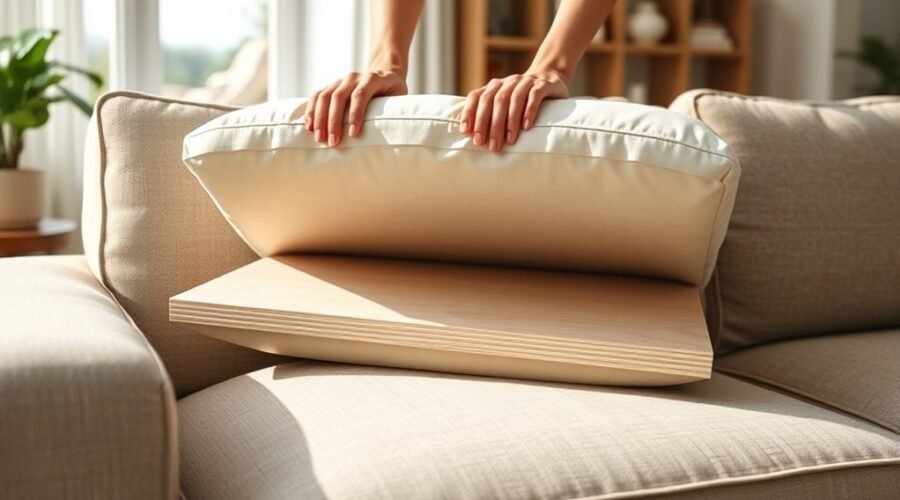
A cushion support board can help when the cushion itself is reasonably sound but the seat base underneath flexes or sags too far. The board creates a firmer surface between the cushions and the weakened support system, which can reduce bottoming out and make the seat feel more level.
Remove the cushions and measure the actual support area inside the sofa rather than measuring the outside width of the furniture. The support should sit flat, remain inside the structural seating area, and avoid hinges, reclining hardware, wiring, handles, brackets, or other moving components.
A purpose-built product such as the Meliusly Couch Cushion Support Board is one current example. Its manufacturer describes a tool-free engineered-wood design intended to sit underneath removable seat cushions. That is a product-specific solution, not proof that every sagging sofa needs a board.
A board does not rebuild compressed foam, reconnect a broken spring, repair torn webbing, or fix a cracked frame. If structural parts are broken rather than merely soft or stretched, repairing the failed component is the more appropriate long-term solution.
Flip and Rotate Couch Cushions Regularly
Flipping, rotating, and swapping removable cushions can distribute wear more evenly when the cushion construction allows it. It is mainly preventive maintenance; it cannot reverse permanent foam fatigue.
- Turn reversible cushions over when both faces are designed for sitting.
- Rotate cushions front to back when their construction and shape permit it.
- Swap equivalent left, center, and right cushions to reduce repeated loading in one favorite seat.
- Check seams, zippers, batting, and cushion height whenever you rotate them.
For a busy sofa, a weekly visual check or quick reshaping can be useful, while a full rotation can be done as needed based on wear. Follow the furniture manufacturer’s instructions if the cushions have a directional shape, one-sided construction, attached fasteners, or specialized filling.
Rotation spreads wear across usable surfaces; it preserves a healthy cushion but cannot make failed foam healthy again.
How to Tell When Foam Needs Replacing
Replacement becomes more likely when the foam has lost substantial height, stays permanently compressed, feels uneven from one area to another, cracks or crumbles, or allows the sitter to bottom out even when the sofa base underneath is firm.
Do not judge replacement foam by firmness alone. According to the Polyurethane Foam Association, foam density and firmness are separate properties. Density is strongly related to durability and retention of original properties, while firmness describes how much force is needed to indent the foam. A high-density foam can therefore be soft or firm depending on its formulation.
Slow Bounce-Back Test
A simple home compression test can reveal obvious deterioration, but there is no universal rule that every healthy sofa cushion must rebound within a specific number of seconds.
Place the cushion on a firm surface, press the main seating area firmly, then release it. Compare the cushion’s height, shape, and feel with a less-used matching cushion if one is available. Persistent compression, a noticeably lower profile, or incomplete recovery after the cushion has had time to relax indicates deterioration more reliably than an arbitrary stopwatch threshold.
- Press the same area on two matching cushions.
- Compare their height and firmness after release.
- Check whether one cushion remains visibly hollow or distorted.
- Repeat the comparison with the cushions removed from the sofa so the suspension does not affect the result.
Lumps And Flat Spots
Lumps and flat spots can come from either the foam core or the material wrapped around it. Unzip the cover when possible and inspect the layers separately.
If the foam remains even but the outer batting is thin, wrinkled, or displaced, fresh batting may restore the cushion’s profile. If the core itself contains permanent depressions, cracks, hard zones, crumbling edges, or large differences in thickness, adding fiber around it will usually mask rather than solve the problem.
Compare the suspect cushion with a less-used cushion of the same design. Differences in core thickness and shape are easier to see when both inserts are removed from their covers.
When Support Is Gone
If a cushion still bottoms out on a firm floor or table, its core may no longer provide enough load-bearing support. If the cushion feels normal off the sofa but collapses only after it is returned to the frame, investigate the sofa’s suspension instead.
- Check the foam for permanent compression, cracks, crumbling, or uneven density.
- Inspect the seat deck for excessive flex.
- Look for torn or stretched webbing where it is safely accessible.
- Check for displaced springs, loose clips, or obvious frame damage without putting hands near powered or loaded mechanisms.
How to Replace Worn Cushion Foam
If the foam has failed but the cover and sofa structure are still in good condition, replacing the insert can restore the seat without replacing the entire couch.
- Remove the insert carefully. Open the existing zipper or manufacturer-provided access and note how the foam, batting, and cover are assembled.
- Measure the existing construction. Record the core’s length, width, thickness, shape, and any curved or T-shaped sections. If the old foam is badly distorted, also measure the cover and compare with an undamaged matching cushion.
- Choose upholstery foam for the intended seat. Discuss density, firmness, support, and expected use with an upholstery-foam supplier instead of relying on firmness alone.
- Recreate the original wrap. If the original core uses polyester batting or another comfort layer, replace it with a compatible layer so the cover retains its intended profile.
- Refit without overstressing the cover. The insert should fill the cover cleanly without forcing seams, piping, or the zipper out of shape.
For irregular shapes, expensive upholstery, antique furniture, or covers without service access, an upholsterer can measure and fabricate the insert with less risk of damaging the cover.
When the Problem Is Springs, Webbing, or the Frame
Good cushions cannot compensate for a badly failed support system. If the cushions feel supportive on the floor but sag when installed, remove them and inspect the seating platform.
Stretched webbing can create a hammock-like dip. A loose or broken spring may create one low seating position, unusual noises, or a hard line where support has shifted. Cracked rails or loose joints can allow the entire sofa to rack or slope.
A fitted support board can be a practical reinforcement when the support surface is merely soft and the furniture design safely accommodates it. Broken springs, detached clips, torn webbing, cracked frame members, or damaged reclining hardware should be repaired rather than simply covered with a board.
If accessing the damaged part requires dismantling upholstery, loading springs, or working near a power-recliner mechanism, professional upholstery repair is the safer option.
Frequently Asked Questions
How to Firm up Saggy Couch Cushions?
First determine what is sagging. Fluff or redistribute loose fiber, replace flattened batting around a sound foam core, and rotate reversible cushions to spread wear. If the cushion is supportive off the sofa but sinks on the frame, inspect the springs or webbing and consider a properly fitted support. Permanently compressed foam should be replaced.
Can I Fix a Sagging Couch Using Non-Removable Cushions?
Sometimes. Start by checking whether the sag comes from the attached cushion or from the seat support below it. Attached cushions may have hidden service access, but do not cut seams unless you are prepared to repair the upholstery correctly. If filling or foam must be replaced through a sewn cover, an upholsterer is usually the cleaner option. An under-cushion board may not be usable when the seat cushion cannot be lifted away from the deck.
What Is the Best Product for Fixing Sagging Couch Cushions?
There is no single best product for every sagging couch. Fresh upholstery batting helps when a sound foam core has lost surface fullness. Replacement foam is appropriate when the core has permanently compressed or deteriorated. A fitted support board can help when the cushion is sound but the seat base underneath is weak. Diagnose the failing layer before buying a repair product.
How Can I Fix Sagging Sofa Cushions?
Remove removable cushions and test them on a firm surface. Fluff loose filling, replace flattened batting, rotate usable cushions, and inspect the foam for permanent compression. If the cushions feel good off the sofa but sink after reinstalling them, inspect the webbing, springs, deck, and frame. Repair the part that is actually failing.
Can Steam Restore a Sagging Foam Cushion?
Steam is not a reliable repair for foam that has lost its structural properties. Some upholstery also should not be steam treated at all. Use steam only when the furniture manufacturer’s care instructions specifically allow it, and avoid saturating the cushion. Permanently compressed, cracked, or crumbling foam should be replaced.
How Often Should Couch Cushions Be Flipped or Rotated?
There is no universal schedule because cushion construction and usage differ. High-use cushions benefit from frequent inspection, reshaping, and position changes when their design permits it. Follow the sofa manufacturer’s care guidance, and rotate sooner if one seating position begins wearing faster than the others.
Conclusion
Sagging couch cushions are often repairable, but the repair should match the cause. Fluffing and rotation can restore shape to movable fiber and spread wear. Fresh batting can fill a loose cover around foam that is still healthy. A properly fitted support board can firm up a weak seat base. Steam should be used only when the furniture maker explicitly permits it. When a foam core remains compressed, cracked, crumbling, or uneven after inspection, replacement is the practical way to restore reliable cushion support.
Sources
- Polyurethane Foam Association — Foam Performance — explains foam density, firmness, support factor, resilience, and fatigue testing.
- Polyurethane Foam Association — Furniture Case Study — documents foam-and-fiber construction used in upholstered furniture cushions.
- La-Z-Boy — Fabric and Leather Care — provides manufacturer upholstery cleaning codes and cautions regarding steam cleaning.
- Meliusly — Couch Cushion Support Board — primary product information for the removable-cushion support example discussed above.