The carnivore diet and mental health connection is one of the most discussed topics in meat-only communities, where many people describe clearer thinking and steadier mood. Science has not caught up with those stories. The closest research looks at ketogenic and low-carb diets, not meat-only eating, and the results are modest and mixed. This guide separates reports from evidence and explains what to discuss with a professional before changing anything.
Quick Answer
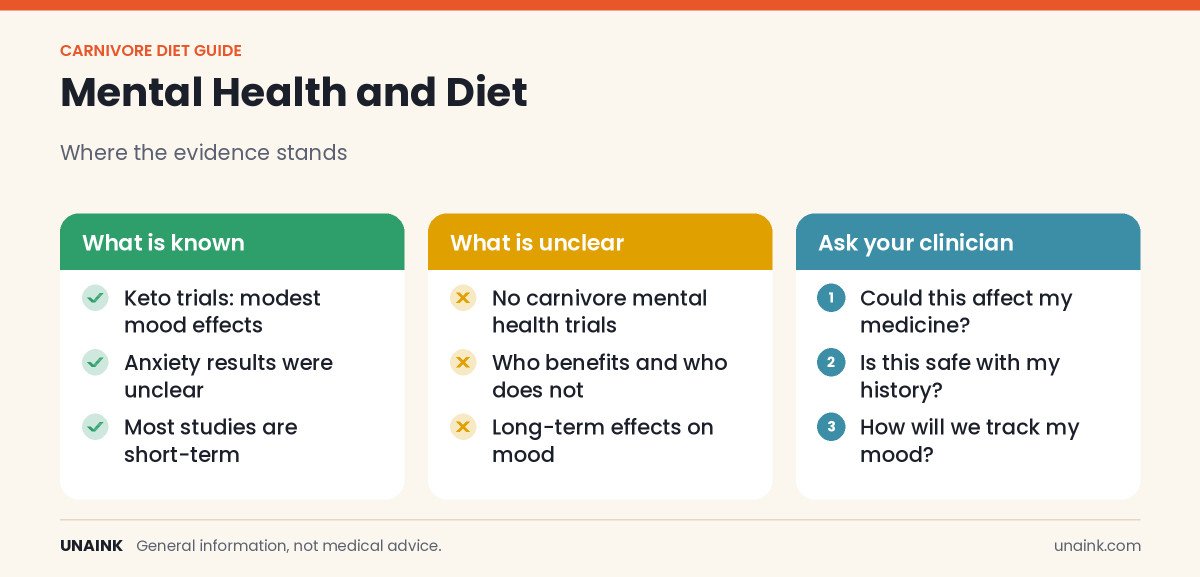
Research on the carnivore diet and mental health is almost nonexistent, so no one can promise it improves mood or anxiety. A 2026 meta-analysis of ketogenic diets found a modest link with lower depressive symptoms but no clear effect on anxiety. Food can be one piece of mental health care, but it should not replace therapy or prescribed medicine.
Key Takeaways
- No trials of a meat-only diet for depression, anxiety, or other mental health conditions exist.
- Ketogenic diet trials show modest benefits for depressive symptoms in some studies, but not for anxiety.
- Most reports from carnivore followers are self-reported and cannot show cause.
- Large diet changes can affect some medicines, including lithium, so prescribers need to know.
- Rigid food rules can worsen disordered eating, so support and monitoring matter.
Why People Link Food and Mood
The brain uses a large share of the body’s energy, and sleep, blood sugar, and gut health all interact with how people feel. Researchers in nutritional psychiatry study how overall eating patterns relate to mood and anxiety. The field is young, and most findings so far are associations rather than proof.
That context explains why a dramatic diet change can feel life-changing, and also why it is hard to know whether the food, the new routine, or the sense of taking control is doing the work.
What Research Shows About Ketogenic and Low-Carb Diets
A 2026 systematic review and meta-analysis covered 50 studies with 41,718 adults. In ten randomized trials, ketogenic diets were linked with lower depressive symptoms, with stronger results when ketosis was verified. Nine randomized trials on anxiety showed no significant effect. The authors noted high variation between studies, differing comparison diets, and short follow-up, and called for larger and better-designed trials (PubMed record).
For bipolar disorder and schizophrenia, the data are thinner still, mostly small studies and case reports (PMC review). None of this tests a diet made only of meat.
Carnivore Diet and Mental Health: What People Report
A 2021 survey of 2,029 adults who ate a carnivore diet found high satisfaction, with many describing better mood and mental clarity (2021 survey). The answers were self-reported, and people who felt worse likely stopped and never took the survey.
A 2026 scoping review of nine human studies concluded that evidence is very limited and that long-term use cannot be recommended (Nutrients review).
Why Mood Might Change
- Steadier blood sugar after cutting sugar and refined carbohydrates.
- Fewer ultra-processed foods and less alcohol.
- Weight loss, better sleep, or more energy.
- A new routine and a sense of control, plus the placebo effect.
- Possible effects of ketosis, which are not proven for a meat-only diet.
Possible Downsides to Weigh
Any link between the carnivore diet and mental health runs both ways. Some people feel worse before they feel better, and some never improve.
| Concern | Why it matters |
|---|---|
| Early adjustment | Irritability, fatigue, headaches, and brain fog are commonly reported in the first weeks. |
| Medicine interactions | Big shifts in salt, fluid, and carbohydrate intake can change how some medicines act, and lithium levels are sensitive to sodium and hydration. |
| Disordered eating | Strict food rules can worsen eating disorders or anxiety around food. |
| Social strain | Restrictive eating can make meals out and with family stressful. |
| Delayed care | Relying on diet can postpone therapy or a medical review. |
Medicines and Professional Care
Do not stop or reduce an antidepressant, mood stabilizer, antipsychotic, or any other psychiatric medicine because of a diet. Stopping suddenly can bring withdrawal effects or relapse. Tell your prescriber before making a large diet change so they can watch for interactions.
A carnivore diet is not recommended during pregnancy or breastfeeding, for children and teens, or with kidney disease or an eating disorder. Therapy, medication, exercise, and sleep care have far stronger evidence for mental health conditions. If you are thinking about harming yourself, contact local emergency services or, in the US, call or text 988.
Exploring Diet and Mood Safely
- Tell your prescriber or therapist about your plans first.
- Track mood, sleep, and energy in a simple daily log.
- Avoid starting during a crisis, a major stressor, or a medication change.
- Keep it time-limited, with a check-in date and a plan to reassess.
- Stop and contact your care team if your mood, sleep, or anxiety worsens.
Carnivore Diet and Mental Health: The Short Version
The evidence on carnivore diet and mental health is anecdotal, and the nearest trials involve ketogenic diets, with modest results for depression and none for anxiety. Anyone exploring the carnivore diet and mental health question should keep treatment in place and involve a professional.
Frequently Asked Questions
Can a carnivore diet help depression?
No trials have tested it. Ketogenic diet trials show a modest link with fewer depressive symptoms in some studies, but a meat-only diet is different and unproven.
Does a carnivore diet help anxiety?
There is no evidence that it does. The 2026 ketogenic diet meta-analysis found no significant effect on anxiety in randomized trials.
Can I stop my antidepressant on a carnivore diet?
No. Never stop or change psychiatric medicine because of a diet. Talk with your prescriber first, since stopping suddenly can cause withdrawal or relapse.
Why do I feel foggy or irritable at the start?
Early weeks of a major carbohydrate cut often bring fatigue, headaches, and brain fog. If symptoms last or mood drops, talk to a clinician.
Is the carnivore diet safe with bipolar disorder?
Evidence is very limited, and lithium levels are sensitive to sodium and fluid changes. Discuss any diet change with your psychiatrist beforehand.
Conclusion
Mood is shaped by many factors, and food is only one. Personal stories of clearer thinking on a meat-only diet are worth noting, but they do not prove it works or is safe long term. If you want to try it, plan it with the people who know your history, keep treatment steady, and watch how you feel.
Medical note
This article is for general education and is not medical advice. Talk with a doctor or registered dietitian before making major diet changes, especially if you have a health condition, take medication, or are pregnant or breastfeeding.
Keep Reading
- Carnivore Diet Insomnia: Sleep changes some people report.
- Carnivore Diet Headache: Why headaches appear in early weeks.
- How Long to Adapt to the Carnivore Diet: What the adjustment period can feel like.
- Who Should Not Do the Carnivore Diet: Groups who need medical guidance first.
Sources
- Ketogenic Diets and Depression and Anxiety: A Systematic Review and Meta-Analysis (PubMed): Primary evidence for the ketogenic diet findings.
- Efficacy of low carbohydrate and ketogenic diets in treating mood and anxiety disorders (PMC): Systematic review of low-carb diets and mood disorders.
- Ketogenic diet in stress, anxiety, depression, schizophrenia, and bipolar disorder (PMC): Review including early-stage data.
- Nutrients scoping review of carnivore diets (PMC): Evidence on carnivore diets is very limited.
- Self-reported survey of 2,029 carnivore adults (PMC): Self-reported outcomes, not a trial.