The grass fed vs grain fed beef question comes up for almost everyone who eats a lot of meat. Both are real beef with plenty of protein, iron, zinc, and B12, so the gap is smaller than marketing suggests. The differences show up mostly in fat composition, a few vitamins and pigments, price, and taste.
Quick Answer
Grass-fed beef tends to be leaner and shows higher omega-3 fats and some antioxidants than grain-fed beef, but the absolute amounts are modest. Grain-fed beef is usually more marbled, softer in flavor, and cheaper. Neither has been shown in good human trials to produce better health outcomes, so choose by budget, taste, and your values.
Key Takeaways
- Grass-fed beef usually has less total fat, a higher omega-3 share, and more beta-carotene and vitamin E.
- The omega-3 difference is real in percentage terms but small in grams per serving.
- Grain-fed beef is typically more marbled, milder, and less expensive.
- No long-term human trials show that either type improves health outcomes.
- Eating enough beef matters more than the label, so buy what you can afford and sustain.
How the Two Types of Beef Are Raised
Nearly all cattle start on pasture and drink milk, then eat forage. The split happens afterward. Grass-fed cattle keep eating grass or other forage until slaughter. Grain-fed cattle are moved to a feedlot for the last months and fed a ration built around corn or other grains, which speeds weight gain and builds fat.
That finishing diet drives most of the nutritional and sensory differences. It is also why grass-fed animals often take longer to reach market weight, which feeds into the higher price. If you want to understand what labels can and cannot promise, see our guide to grass fed vs grass finished beef.
Grass Fed vs Grain Fed Beef Nutrition
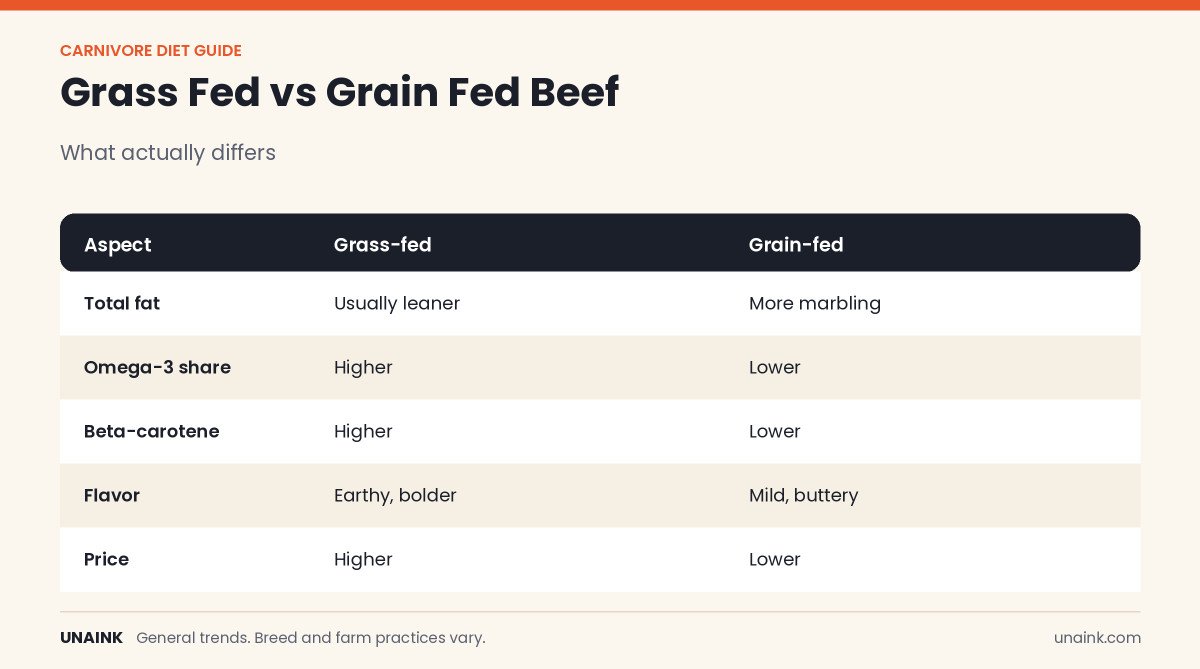
A 2010 review in the Nutrition Journal found that grass-fed beef generally had less total fat and more of certain beneficial compounds. A 2022 review of eight studies reached a similar picture for fatty acids. The table summarizes the general trends, not guarantees for any single steak.
| Feature | Grass-fed | Grain-fed |
|---|---|---|
| Total fat | Usually lower, less marbling | Usually higher, more marbling |
| Omega-3 fats | Higher share of the fat | Lower share |
| Omega-6 to omega-3 ratio | Lower (closer to balanced) | Higher |
| Beta-carotene and vitamin E | Higher | Lower |
| Protein, iron, zinc, B12 | Similar | Similar |
| Flavor | Earthy, sometimes gamey | Buttery, mild |
| Price | Higher | Lower |
The review authors also noted that the studies were small and varied by breed, region, and forage type. In one set of Korean Hanwoo beef data, the grain-fed meat actually had more EPA and DHA, a reminder that breed and feeding details matter.
Does the Omega-3 Difference Matter?
Percentages can mislead. Beef is not a major omega-3 source in either case, and the gap amounts to a few dozen milligrams per serving. Oily fish such as salmon and sardines supply far more long-chain omega-3s than any beef.
Grass-fed beef also tends to carry more conjugated linoleic acid and trans-vaccenic acid, which are naturally occurring fats from ruminants. Researchers have studied them, but the evidence that eating them at beef-level amounts changes disease risk in people is limited. Treat these as small bonuses rather than reasons to spend double.
Fat, Calories, and Marbling
Leaner grass-fed cuts can be a plus or a minus, depending on your goal. On a carnivore plan, enough fat keeps meals satisfying and energy steady, and lean cuts can leave people hungry or drained. Grain-fed beef often delivers that fat built in.
- If you choose lean grass-fed cuts, add fat with beef tallow, butter, or fattier cuts.
- If you choose grain-fed, ribeye and ground beef at 80/20 give plenty of fat without extras.
- Cook grass-fed beef a little gentler, since less fat means it can dry out faster.
Our guide to getting more fat on carnivore has practical ideas for both choices.
Taste, Texture, and Cooking
Grain-fed beef is the style most people grew up with: tender, juicy, and mild. Grass-fed beef has a more mineral, grassy flavor that some people love and others find strong. Seasonal pasture also changes flavor, so grass-fed beef can vary more from one batch to the next.
For steaks, aim for medium-rare to medium and rest the meat. Ground beef should reach 160°F according to USDA guidance, and whole cuts 145°F with a three-minute rest, whichever feeding system produced them.
Cost, Labels, and Practical Choices
Grass-fed beef often costs noticeably more per pound, and eating mostly beef makes that gap add up. Labels also vary. Federal grass-fed standards were withdrawn by the Agricultural Marketing Service in 2016, and claims now go through Food Safety and Inspection Service label review, which relies largely on producer documentation.
- Buying a share of a whole or half animal from a local rancher can cut the price per pound.
- Ground grass-fed beef is usually the cheapest entry point.
- Organ meats from either source are nutrient dense, so see what organ meats are for a cost-effective upgrade.
- Look for labels that state the farm, the finishing diet, and who verified it.
Grass Fed vs Grain Fed Beef: The Short Version
In the grass fed vs grain fed beef debate, grass-fed wins on fat profile and a few micronutrients, while grain-fed wins on price and tenderness. Both fit a carnivore plan, and the grass fed vs grain fed beef choice is far less important than eating enough satisfying beef consistently.
Frequently Asked Questions
Is grass-fed beef healthier than grain-fed beef?
It has a somewhat more favorable fatty acid profile and more beta-carotene and vitamin E, but no long-term human trials show better health outcomes. Both are nutrient-dense sources of protein, iron, zinc, and B12.
Does grass-fed beef have more protein?
No meaningful difference. Protein is similar, though leaner grass-fed cuts have slightly more protein per calorie because they have less fat.
Is grass-fed beef worth the extra cost?
It depends on your budget and values. If cost forces you to eat less beef overall, grain-fed beef is the better choice for most people.
Does grain-fed beef contain omega-3s?
Yes, just less. Beef of either type contains small amounts, and fatty fish is a far larger source.
Which is better on a carnivore diet?
Either works. Grain-fed beef offers more built-in fat, while grass-fed suits people who prefer its flavor or want the fatty acid profile. See the carnivore food list for other staples.
Conclusion
Grass-fed beef has a modest nutritional edge, but it is not a night-and-day difference. Pick the type you can afford regularly, cook it safely, and spend any extra money on variety such as organ meats and fatty cuts.
Medical note
This article is for general education and is not medical advice. Talk with a doctor or registered dietitian before making major diet changes, especially if you have a health condition, take medication, or are pregnant or breastfeeding.
Keep Reading
- Grass Fed vs Grass Finished Beef: What the labels do and do not promise.
- What Is Beef Tallow?: A closer look at the classic carnivore cooking fat.
- What Are Organ Meats?: The most nutrient-dense foods in the beef family.
- Carnivore Diet Food List: What to buy and what to skip.
Sources
- Nutrition Journal: Daley et al., A review of fatty acid profiles and antioxidant content in grass-fed and grain-fed beef: Compares fat, omega-3, CLA, and antioxidant content.
- Food Science of Animal Resources: Nogoy et al., Fatty acid composition of grain- and grass-fed beef: Review of eight studies on fatty acids per 100 g of meat.
- Feedstuffs: AMS rescinds grass-fed, naturally raised beef label: Background on the 2016 withdrawal of the federal standard.
- USDA FSIS: Safe minimum internal temperature chart: Safe cooking temperatures for beef.