
Beef tallow is rendered beef fat, a traditional cooking fat that has found a new audience in carnivore kitchens. It is solid and creamy at room temperature, it handles high heat well, and it has almost no flavor of its own when it is made from clean suet. This guide explains what beef tallow is, how it is made, what a tablespoon contains, how it compares with butter and lard, and how to use and store it.
Quick Answer
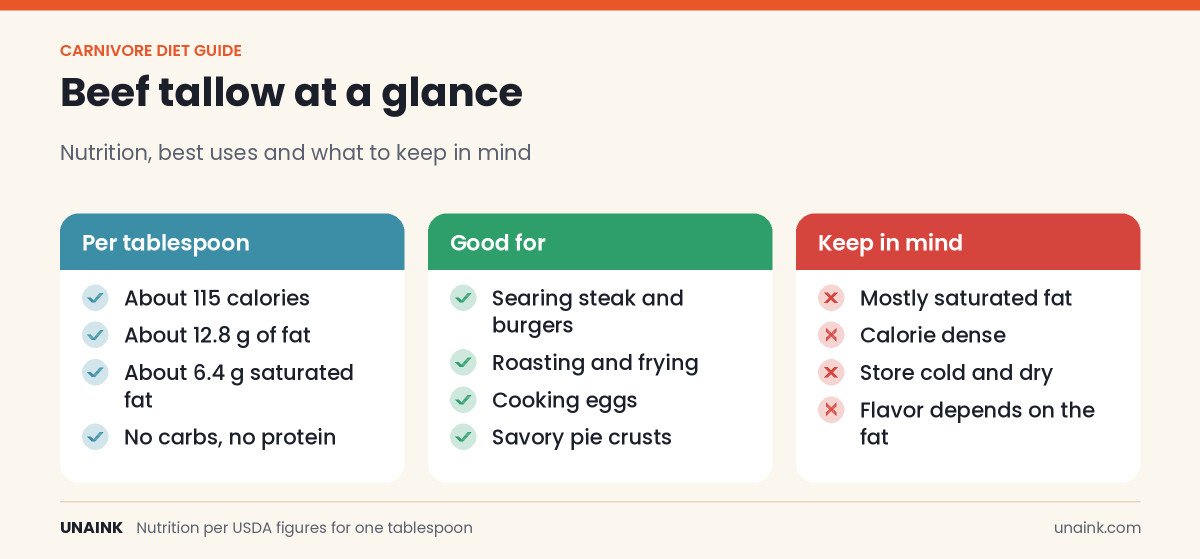
Beef tallow is fat from cattle that has been slowly melted and strained until only pure fat remains. A tablespoon has about 115 calories, 12.8 grams of fat and about 6.4 grams of saturated fat, with no carbohydrate or protein. It is stable at high heat, so it suits searing, roasting and frying. Because it is mostly saturated fat, it should be used in sensible amounts.
Key Takeaways
- Beef tallow is beef fat that has been rendered, strained and cooled into a solid cooking fat.
- Suet, the hard fat around the kidneys, gives the cleanest and most neutral-tasting tallow.
- One tablespoon holds about 115 calories and 6.4 grams of saturated fat, and no carbs or protein.
- Its smoke point is commonly quoted between about 400 and 480°F, which is higher than butter.
- Animal fat is mostly saturated, so Harvard Health advises caution about LDL cholesterol.
What Is Beef Tallow?
Tallow is the name for fat rendered from beef or mutton. Rendering means gently heating raw fat until it melts away from the connective tissue, then straining it. What is left sets into a pale, firm fat that keeps well. Pork fat prepared the same way is called lard, rendered chicken fat is schmaltz and clarified butter is ghee.
Most home cooks buy suet or trimmings from a butcher. Suet, the hard fat around the kidneys, produces the longest-lasting and most neutral tallow, while ordinary trimmings taste more beefy. If you want to try it yourself, our step-by-step guide to how to render beef tallow covers the stove and the oven.
Beef Tallow Nutrition
Tallow is a pure fat. According to USDA figures reported by MasterClass, one tablespoon provides about 115 calories and 13 grams of fat, including roughly 6.4 grams of saturated fat and about 14 milligrams of cholesterol, with no fiber, sugar or protein.
| Per tablespoon (about 13 g) | Amount |
|---|---|
| Calories | About 115 |
| Total fat | About 12.8 g |
| Saturated fat | About 6.4 g |
| Monounsaturated fat | About 5.4 g |
| Carbohydrate and protein | 0 g |
Tallow can contain small amounts of fat-soluble vitamins, but it is not a meaningful source, so do not choose it for micronutrients. It is an energy source and a cooking medium.
How to Use Beef Tallow
- Searing steak and burgers. Tallow tolerates high heat, which helps build a crust. See our guide to cooking steak in a cast iron skillet.
- Roasting and frying. It is a classic fat for crisp roasted potatoes and fried foods, and for roasting meat on a carnivore plan.
- Cooking eggs. A teaspoon in the pan adds a rich, beefy flavor.
- Baking and pastry. Tallow makes tender, flaky crusts in savory pies.
- Carnivore recipes. It is the base of homemade carnivore mayonnaise and of pemmican.
Beef Tallow vs Butter vs Lard
| Fat | Made from | Best for |
|---|---|---|
| Beef tallow | Rendered beef fat | High-heat searing, roasting and frying |
| Butter | Churned cream | Medium-heat cooking, flavor and finishing |
| Lard | Rendered pork fat | Baking, frying and flaky pastry |
| Ghee | Clarified butter | High-heat cooking with a buttery taste |
Sources differ on exact smoke points, but tallow is generally quoted at roughly 400 to 480°F, higher than butter, which begins to smoke far lower because of its milk solids.
Is Beef Tallow Healthy?
Tallow is neither a miracle food nor a poison. It is a concentrated fat. The biggest question is saturated fat. Harvard Health notes that animal fat is mostly saturated fat and that very low carb diets built on it tend to raise LDL cholesterol. If you eat tallow daily, a lipid test is a sensible way to see how your body responds.
There are no good studies on tallow itself, so claims that it fixes skin, joints or inflammation are not supported by strong evidence. Treat it as a stable cooking fat, not a health product.
How to Store Beef Tallow
Strain tallow through fine cloth into clean, dry jars, let it cool and cover it. Keep it in the refrigerator for the longest life, and freeze extra portions. Discard it if it smells rancid, sour or off. Water left in the fat shortens its life, so make sure no moisture gets in.
Frequently Asked Questions
What is beef tallow used for?
It is used for high-heat cooking such as searing, roasting and frying, for baking, and as a base for carnivore recipes such as mayonnaise and pemmican.
Is beef tallow the same as lard?
No. Tallow comes from beef fat, while lard comes from pork fat. Tallow is firmer and slightly more saturated, and lard is softer with a more neutral taste.
Does beef tallow go bad?
Yes, eventually. Kept clean, dry and cold, it lasts for many months, but it can turn rancid. Smell it before use and throw it out if it smells off.
Is beef tallow good for a carnivore diet?
It fits well because it is an animal fat with no carbs. Use it in moderation and monitor your cholesterol because it is mostly saturated fat.
What is the smoke point of beef tallow?
Sources vary, with figures from about 400 to 480°F. It is higher than butter and suits most pan and oven cooking.
Conclusion
Beef tallow is a simple, stable and flavorful cooking fat that fits neatly into a carnivore kitchen. It is not a source of special nutrients and it is mostly saturated fat, so use it for cooking rather than as a health food, and track your cholesterol if you eat it often.
Medical note
This article is for general education and is not medical advice. Talk with a doctor or registered dietitian before making major diet changes, especially if you have a health condition, take medication, or are pregnant or breastfeeding.
Keep Reading
- How to Render Beef Tallow at Home: on the stove or in the oven
- How to Render Lard at Home: from pork fat
- What Is Pemmican?: the original survival food
- How to Get More Fat on the Carnivore Diet: without nausea
Sources
- MasterClass. What Is Tallow?: nutrition per tablespoon and cooking uses
- Wikipedia. Tallow: definition, composition and smoke point
- Harvard Health Publishing. What is the carnivore diet?: animal fat, saturated fat and LDL cholesterol
- Farmhouse on Boone. How to Render Beef Fat: suet versus trimmings



[…] When fat is heated on iron to a high temperature, it bonds to the surface and forms a hard, slick coating. Each layer fills tiny pores in the metal, so a pan improves with repeated use. Beef tallow is a common choice among cooks who want to avoid seed oils. For background, read what beef tallow is. […]