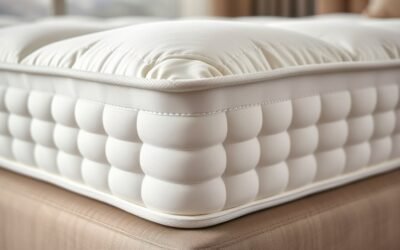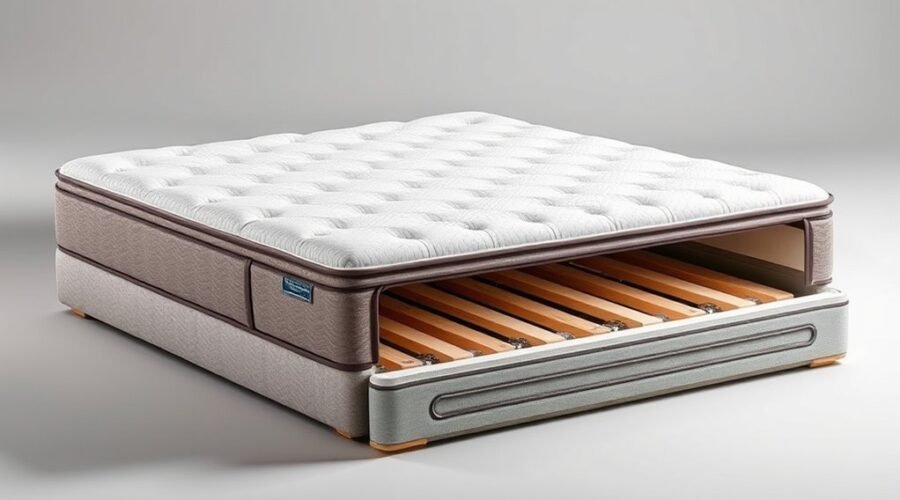
A mattress foundation is the support system beneath your mattress, and choosing the right one matters because an inadequate base can allow excessive flex, contribute to sagging, change how the mattress feels, and sometimes affect warranty coverage. Modern foundations are usually rigid rather than springy, but the exact support you need depends on your mattress manufacturer, mattress type, frame design, and slat spacing.
Quick Answer
A mattress foundation is a firm support surface placed beneath a mattress. It may use closely spaced slats, a rigid deck, or a sturdy metal or wood structure. Unlike a traditional box spring, a foundation normally does not rely on flexible coils. The correct design and slat spacing depend on your mattress manufacturer’s requirements.
Key Takeaways
Key Takeaways
- A mattress foundation provides a firm, stable surface that helps a mattress stay evenly supported.
- A traditional box spring contains springs or flexible components, while a modern foundation is generally rigid.
- There is no universal slat-spacing rule. Purple currently allows gaps up to 3.5 inches for qualifying frames, while other brands publish different limits.
- Foam, latex, hybrid, and innerspring mattresses can have different support requirements, so the mattress warranty should be your final authority.
- Replace or repair a foundation when it develops broken parts, excessive flex, sagging, noise, or inadequate center support rather than relying on a fixed age alone.
- Platform beds and adjustable bases can often support a mattress without a separate foundation when they meet the mattress manufacturer’s requirements.
What Is a Mattress Foundation?
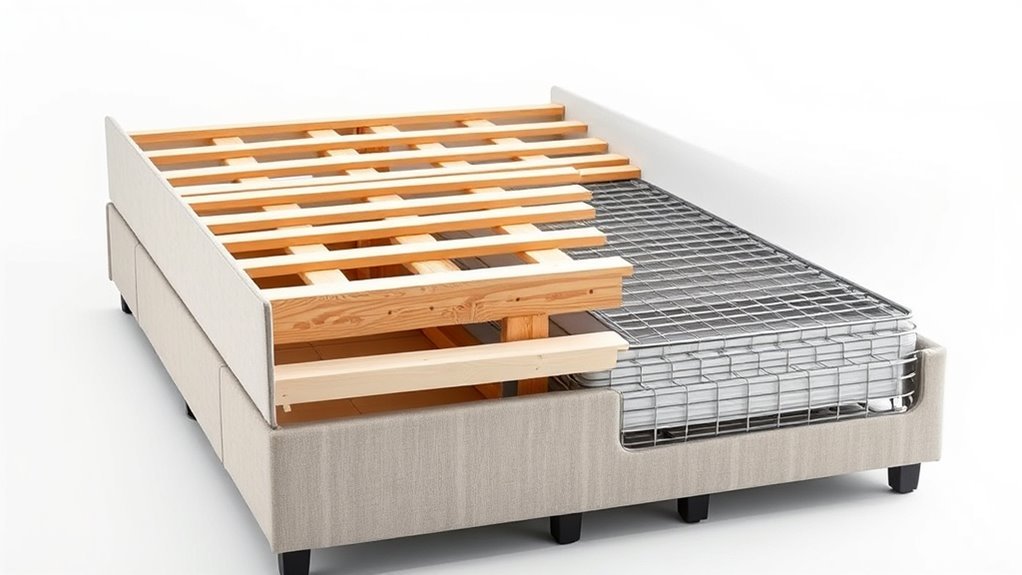
A mattress foundation is a firm support structure placed beneath a mattress. Depending on the design, it may contain closely spaced wood slats, metal supports, or a rigid deck inside an upholstered frame.
Its main job is to provide a level surface and distribute the combined weight of the mattress and sleepers across the supporting bed frame. That stable surface can help the mattress perform as designed and prevent it from dipping between unsupported areas.
A foundation can also raise the mattress to a more comfortable bed height. Slatted designs leave open space beneath the mattress, which can improve ventilation compared with placing a mattress directly on a non-breathable surface.
Foundation construction matters because mattress manufacturers publish different requirements. For example, Purple’s current mattress warranty permits qualifying slatted frames with gaps no greater than 3.5 inches, while Tempur-Pedic’s current warranty guidance allows qualifying slats up to 4 inches apart and specifies additional structural requirements.
There is no single slat-spacing number that works for every mattress. The specification in your mattress warranty or owner’s guide should always take priority.
A good foundation is therefore more than extra furniture. It is part of the structural system that supports the mattress.
Mattress Foundation vs. Box Spring
The traditional distinction is straightforward: a mattress foundation provides rigid support, while a traditional box spring contains springs, coils, or another flexible support system designed to add some movement and shock absorption.
That difference matters because many modern foam and hybrid mattresses are designed for firm, non-spring support. A flexible box spring may provide more movement than the mattress manufacturer allows.
Note: Retailers sometimes use the term “box spring” for rigid upholstered bases that contain no springs. Do not rely on the product name alone. Check how the base is constructed and whether your mattress manufacturer approves it.
Core Structural Differences
A modern mattress foundation is usually built to minimize flex. It may use wood, steel, closely spaced slats, or a rigid panel to support the mattress across a broad surface.
- A traditional box spring uses springs, coils, or flexible metal components.
- A foundation normally uses a rigid or closely spaced support structure.
- Slatted foundations can provide ventilation beneath the mattress.
- A foundation may sit inside a separate bed frame, while some platform beds combine the frame and support surface into one unit.
- Either system must be strong enough for the combined mattress and sleeper load.
Neither design is automatically better in every situation. The correct choice depends on what the mattress manufacturer requires.
Mattress Type Compatibility
Your mattress type is a useful starting point, but it should not replace the manufacturer’s instructions.
All-foam and latex mattresses generally need a firm, level support surface. Hybrids also commonly use rigid platforms or closely spaced slats. Traditional innerspring mattresses historically paired with box springs, but modern innerspring designs do not all follow the same rule.
For example, some current mattresses permit a platform bed, rigid foundation, adjustable base, or an existing foundation as long as specific structural requirements are met. Saatva’s warranty requirements, for instance, allow qualifying platform beds with solid surfaces or closely spaced slats for many models.
The safest rule is simple: identify your exact mattress model and follow its approved support system.
Support And Durability
A foundation helps a mattress by keeping the support surface level and reducing unnecessary flex beneath the mattress core. This is especially important where slats, center rails, or frame joints carry substantial weight.
Durability depends on material quality, joinery, the bed’s total load, center support, and how the foundation is used. A strong foundation should remain level and should not bow noticeably when weight is applied.
- Check for cracked, bent, or loose components.
- Confirm that slats remain flat and properly positioned.
- Make sure queen, king, and California king frames have any center support required by the manufacturer.
- Verify the product’s own load rating rather than assuming a generic capacity.
Why a Mattress Foundation Matters
A mattress foundation matters because the mattress can only perform properly when the surface beneath it provides the support its construction requires.
A stable base helps maintain an even sleep surface, while a weak frame, broken slat, excessive gap, or sagging foundation can allow portions of the mattress to dip downward.
Mattress Support And Shape
When a mattress foundation provides stable support, the mattress is less likely to flex into unsupported gaps. This helps preserve the mattress’s intended shape and feel.
- A rigid surface limits unwanted movement beneath foam and hybrid mattresses.
- Closely spaced slats support the mattress while leaving ventilation gaps.
- Proper center support can reduce bowing in larger bed sizes.
- A compatible base helps the mattress perform according to its design.
Comfort and pressure relief still come primarily from the mattress itself. The foundation’s role is to give that mattress a suitable structural surface rather than create pressure relief on its own.
Airflow And Cleanliness
Because most bed frames and foundations elevate a mattress above the floor, they can provide more ventilation around its underside and make the floor beneath the bed easier to clean.
Slatted systems generally permit more direct airflow than a completely solid panel. Actual ventilation still depends on room humidity, bedding, mattress construction, and the material beneath the mattress.
Elevation also reduces direct contact with floor-level dust and moisture, but a foundation should not be considered an allergen barrier. Regular vacuuming and keeping the bedroom dry remain more important for cleanliness.
Height And Longevity
Foundation height affects the total height of the bed and how easy it is to sit down or stand up. Foundations are available in standard and low-profile versions, so a thick mattress does not necessarily require a tall base.
There is no universal age at which every foundation must be replaced. Material quality, frame design, weight, movement, humidity, and use all affect service life.
Inspect the base whenever you replace a mattress. If it remains flat, quiet, structurally sound, and compliant with the new mattress requirements, age alone does not necessarily make it unusable.
Types of Mattress Foundations
Mattress support systems come in several forms, and the names are sometimes used inconsistently. Understanding the construction is more useful than relying on the product label.
Rigid or flat foundations use a firm internal structure and often resemble traditional box springs from the outside. They are designed to provide support without spring-like movement.
Slatted foundations use wood or metal slats across the width of the bed. They can provide strong support and ventilation when the slats are sufficiently wide, rigid, and closely spaced for the mattress.
Platform beds combine the support surface and bed frame. A platform may use a solid deck or a slatted surface and usually does not require a separate foundation when it already meets the mattress requirements.
Bunkie boards are thin support panels used to create a firmer surface or reduce excessive gaps in some bed setups. They are not universally approved. Tempur-Pedic, for example, states that a bunkie board should not be used to support its mattresses, while other manufacturers permit bunkie boards in certain configurations.
Traditional box springs use flexible spring or coil components. They were commonly paired with older innerspring mattresses but are not suitable for many current foam or hybrid beds.
Traditional box springs contain flexible components, while modern foundations normally provide a rigid support surface.
Adjustable bed bases are motorized support systems that raise or lower parts of the mattress. They require a mattress flexible enough to articulate with the base.
Foundation vs. Platform Bed vs. Bed Frame
These terms describe different parts of a bed setup:
| Component | What It Does |
| Foundation | Provides a firm support layer beneath the mattress and may sit inside another frame. |
| Platform bed | Combines the bed frame and mattress-support surface, often eliminating the need for a separate foundation. |
| Bed frame | Supports the foundation, box spring, platform, or mattress depending on its design. |
| Bunkie board | Adds a thin support layer in certain setups, but compatibility varies by mattress manufacturer. |
A decorative panel-style bed frame may have only a few widely spaced cross supports and therefore need a separate foundation. A true platform bed generally supplies enough continuous or closely spaced support to hold the mattress directly.
How Mattress Foundation Support Helps
The foundation determines whether the mattress sits on a stable surface or flexes into unsupported areas. Proper support helps preserve the mattress’s intended shape and keeps its internal comfort and support layers working under the conditions for which they were designed.
A foundation does not independently create the mattress’s pressure relief, firmness, or spinal support. Instead, it prevents an unsuitable base from interfering with those characteristics.
- Stable support helps preserve the mattress surface.
- Appropriate slat spacing reduces unsupported gaps.
- A rigid base can limit unwanted flex and movement.
- A slatted design can improve ventilation beneath the mattress.
- Following the manufacturer’s base requirements helps protect warranty eligibility.
Which Mattress Works With Which Base
There is no perfect base for every mattress, but the following guide shows common pairings. Always confirm the exact requirement for your mattress model before buying or reusing a base.
| Mattress Type | Commonly Suitable Support | What to Check |
| Memory foam | Rigid foundation, qualifying platform bed, or approved adjustable base | Maximum slat spacing, slat width, center support, floor restrictions |
| Hybrid | Rigid or slatted platform/foundation; approved adjustable base for compatible models | Manufacturer support requirements and adjustable-base compatibility |
| Latex | Firm, level foundation or platform specified by the manufacturer | Slat spacing and whether a solid surface is required |
| Innerspring | May use a box spring, foundation, or platform depending on the mattress design | Do not assume every innerspring requires a traditional box spring |
Memory foam and hybrids commonly need firm support, but mattress construction alone does not determine the warranty requirement. Check the exact model documentation.
Warning: Do not assume that adding plywood, a bunkie board, or a box spring will fix an incompatible bed setup. Some manufacturers approve these solutions and others specifically prohibit them. An unapproved support system can affect warranty coverage.
How to Choose the Right Mattress Foundation
To choose the right mattress foundation, start with the mattress manufacturer’s support requirements rather than shopping by appearance alone.
Mattress Compatibility
Find the warranty, owner’s guide, or support page for your exact mattress model and check:
- Whether a rigid foundation, platform bed, adjustable base, or box spring is approved.
- The maximum permitted space between slats.
- Any minimum slat-width requirement.
- Whether queen and larger beds require a center rail or center leg.
- Whether the mattress or foundation may be placed directly on the floor.
- Whether plywood or a bunkie board is permitted.
- The total weight the frame or base is designed to support.
For perspective, Purple currently specifies slat gaps of no more than 3.5 inches for qualifying slatted frames without an additional foundation. Tempur-Pedic generally specifies slats at least 3 inches wide and no more than 4 inches apart for qualifying slatted frames. Saatva generally requires platform slats to be less than 4 inches apart for many mattresses, with model-specific exceptions.
Pro Tip: Measure the clear open gap from the edge of one slat to the edge of the next slat. Do not measure from the center of one slat to the center of the next.
Foundation Height
Foundation height affects accessibility and the finished look of the bed. A tall foundation paired with a thick mattress may make the sleep surface uncomfortably high, while a low-profile foundation can reduce total bed height without changing the mattress itself.
Before buying, measure from the floor to the top of the frame, add the foundation height, and then add the mattress thickness. Compare that total with a bed height that feels comfortable when sitting on the edge.
Durability And Support
Choose a foundation made from materials capable of remaining flat and rigid under the intended load. Solid wood and steel are common, but construction quality matters more than the material name alone.
Check the manufacturer’s stated weight capacity. Load limits differ significantly between products and should include the mattress, sleepers, bedding, and anything else regularly placed on the bed.
- Inspect joints, rails, slats, and fasteners.
- Confirm the center support reaches the floor where required.
- Make sure slats cannot slide out of position.
- Check that the base sits level without rocking.
- Do not exceed the published distributed-load rating.
How to Check an Existing Foundation Before Reusing It
An older foundation does not automatically need replacement, but it should be inspected before supporting a new mattress.
- Remove the mattress. Look across the foundation from the side and check for visible bowing or sagging.
- Press on several areas. Excessive movement, creaking, or a soft spot can indicate weakened support.
- Inspect every slat or support beam. Look for cracks, bends, missing fasteners, or slats that have shifted.
- Measure the open slat gaps. Compare them with the new mattress manufacturer’s requirement.
- Check center support. Larger beds often need a center rail and one or more supports extending to the floor.
- Inspect the frame beneath the foundation. A strong foundation cannot compensate for a bent or unstable frame.
- Confirm compatibility with the new mattress. An undamaged old box spring may still be unsuitable for a mattress that requires rigid support.
If the support system does not meet the new mattress requirements, replace or modify it only in a way the mattress manufacturer approves.
When to Replace a Mattress Foundation
You should replace a mattress foundation when structural wear prevents it from providing flat, stable support. Age can be a useful reminder to inspect it, but condition matters more than a universal replacement schedule.
| Sign | What You May Notice | Action |
| Broken or cracked parts | Wobbling, movement, noise, or visible damage | Repair only if manufacturer-approved; otherwise replace |
| Sagging or bowing | Uneven mattress surface or center dip | Replace or correct the failed support system |
| Loose or shifting slats | Movement beneath the mattress | Secure or replace according to the frame design |
| Incompatible spacing | New mattress does not meet support specification | Use an approved foundation or compatible frame |
| Damaged upholstery | Exposed structure or difficult cleaning | Inspect underlying structure and replace if damage is significant |
A foundation that remains level and structurally sound may continue working beyond the life of one mattress, but always recheck compatibility before placing a different mattress on it.
What Adjustable Bed Bases Do
Adjustable bed bases use electric motors to change the angle of the mattress. Depending on the model, you may be able to raise the head, raise the feet, adjust lumbar support, save favorite positions, or control each side of a split bed separately.
The clearest benefit is positioning flexibility. Elevation can make reading, watching television, or resting in bed more comfortable for some people.
Head-of-bed elevation may also help reduce snoring for some sleepers. Mayo Clinic lists raising the head of the bed as one possible measure for snoring, and a 2025 randomized pilot study indexed by PubMed found improvements in respiratory sleep measurements with mild head-of-bed elevation.
Warning: An adjustable base is not a substitute for medical evaluation or prescribed treatment. Loud persistent snoring, choking or gasping during sleep, witnessed breathing pauses, or significant daytime sleepiness can be signs of sleep apnea and should be discussed with a qualified healthcare professional.
- Head and foot adjustment can provide more positioning choices.
- Split adjustable bases can let partners select different angles.
- The mattress must be designed to flex safely with an adjustable base.
- Load limits apply and should include the mattress and sleepers.
- Not every adjustable base is compatible with every mattress model.
Purple Foundations to Consider
Purple currently sells several rigid and adjustable support options. Features and compatibility can change, so check the current product page and Purple warranty requirements before choosing one.
Purple Flat Foundation
The Purple Flat Foundation is a rigid, non-spring foundation designed to fit inside many panel-style bed frames. Purple states that its Flat Foundation must be placed on a suitable bed frame rather than directly on the floor.
Purple Metal Platform
The Purple Metal Platform combines a steel frame with mattress support in a low-profile platform design. Purple currently lists the steel frame as supporting up to 2,000 pounds and provides approximately 9 inches of under-bed storage space for the queen configuration shown on its product comparison pages.
Purple Upholstered Platform and Upholstered Bed Frame
The Purple Upholstered Platform uses a steel support structure with an upholstered exterior. Purple currently states that the queen model was tested to support up to 2,000 pounds. An Upholstered Bed Frame configuration is also available for shoppers who want a more finished furniture-style design.
Purple Adjustable Base
The entry-level Purple Adjustable Base provides motorized head elevation and uses a wired remote. Purple currently lists a 750-pound distributed weight capacity for its adjustable-base line.
Purple Premium Smart Base
The Purple Premium Smart Base adds head and foot elevation, a wireless remote, app control, adjustable-height legs, One Touch Flat, Zero-Gravity, and Anti-Snore presets. Purple currently lists a 750-pound capacity and a 10-year limited warranty for the adjustable base.
Purple Premium Plus Smart Base
The Purple Premium Plus Smart Base adds features including pillow tilt, lumbar support, multiple massage settings, custom positions, and under-bed lighting in addition to head and foot elevation. Purple currently lists a 750-pound capacity.
For split-king setups, Purple offers adjustable configurations that allow each side to move independently. Compatibility differs across Purple mattress collections, so match the specific mattress and base rather than assuming every Purple base works with every Purple mattress.
Frequently Asked Questions
Does a mattress foundation make a difference?
Yes. A compatible foundation gives the mattress a stable surface and prevents it from flexing into unsupported gaps. It can also affect overall bed height and ventilation. The mattress itself provides most of the comfort and pressure relief, while the foundation provides the structural support beneath it.
Is a mattress foundation the same thing as a box spring?
Not traditionally. A mattress foundation is generally rigid, while a traditional box spring contains springs or another flexible support system. However, retailers sometimes use “box spring” as a general term for upholstered mattress bases, so check the actual construction rather than relying only on the name.
How do you know if you need a mattress foundation?
Check the support requirements for your exact mattress and inspect your current bed frame. If your frame has only a few widely spaced crossbars, it may need a separate foundation. If it is a qualifying platform bed with a solid deck or sufficiently close slats, a separate foundation may not be necessary.
Can you put a mattress foundation directly on the floor?
Do not assume that you can. Some manufacturers specifically require the foundation or mattress to be elevated on an approved frame. Purple states that its Flat Foundation must be placed on a bed frame, and Tempur-Pedic also warns against placing its sleep systems directly on the floor. Check your warranty before using a floor setup.
How far apart should mattress foundation slats be?
There is no universal maximum gap. Purple currently specifies no more than 3.5 inches for qualifying slatted frames, Tempur-Pedic generally allows up to 4 inches with additional structural requirements, and other manufacturers publish different limits. Follow the specification for your exact mattress.
Do you need a foundation with a platform bed?
Usually not if the platform already provides the solid or closely spaced support required by the mattress manufacturer. A decorative frame with only a few widely spaced cross slats is different and may need a separate foundation.
How long does a mattress foundation last?
There is no universal lifespan. Replace a foundation when it develops structural damage, sagging, excessive flex, broken slats, persistent movement, or support that no longer meets your mattress requirements. Inspect the foundation whenever you replace the mattress.
Conclusion
The right mattress foundation gives your mattress the stable support it was designed to use. A rigid foundation, qualifying platform bed, slatted frame, traditional box spring, or adjustable base can all be appropriate in the right situation, but no single option works for every mattress.
Start with your mattress manufacturer’s requirements, measure slat gaps, check center support, verify the frame’s load rating, and inspect an existing base for damage before reusing it. Those checks are more reliable than choosing a foundation by mattress type or age alone.
When the mattress and base are properly matched, the foundation can help preserve a level sleep surface, maintain the mattress’s intended feel, support ventilation, and protect warranty eligibility over time.
Sources
- Purple Warranty — current frame, foundation, slat-spacing, adjustable-base, and warranty requirements.
- Purple Bed Frames — current Purple foundation, platform, and adjustable-base lineup and specifications.
- Tempur-Pedic Mattress and Flat Foundation Warranty — current slat width, spacing, frame, and support requirements.
- Saatva Warranty — platform-bed, center-support, and slat-spacing requirements showing that support rules vary by mattress manufacturer.
- Mayo Clinic: Snoring Diagnosis and Treatment — guidance on head-of-bed elevation and other snoring measures.
- PubMed: Implementation of Head of Bed Elevation Using Adjustable Bed and Its Effects on Sleep — 2025 pilot randomized trial evaluating mild head-of-bed elevation.