If you shop for sheets, blankets, or comforters, you may see GSM, or grams per square meter, in the specifications. GSM tells you how much a square meter of the specified fabric or filling weighs. It is useful for comparing bedding, but it does not directly measure softness, quality, physical density, or warmth, so the material and construction still matter.
Quick Answer
GSM means grams per square meter, the mass of one square meter of fabric. For sheets, it tells you how light or substantial the fabric is, but it does not directly measure quality, softness, warmth, or physical density. Compare GSM mainly within the same material and weave, then consider fiber, construction, finish, and climate.
Key Takeaways
- GSM means grams per square meter and measures mass per unit area.
- A higher GSM means more mass in the same area, but it does not automatically mean better, softer, warmer, or more durable bedding.
- Compare GSM most confidently when the products use the same material, weave, and type of construction.
- A 10 cm × 10 cm sample covers 0.01 m², so its weight in grams can be multiplied by 100 to estimate GSM.
- For comforters, quilts, and blankets, first check whether the stated GSM refers to the outer fabric, batting, or fill.
What Does GSM Mean in Bedding?
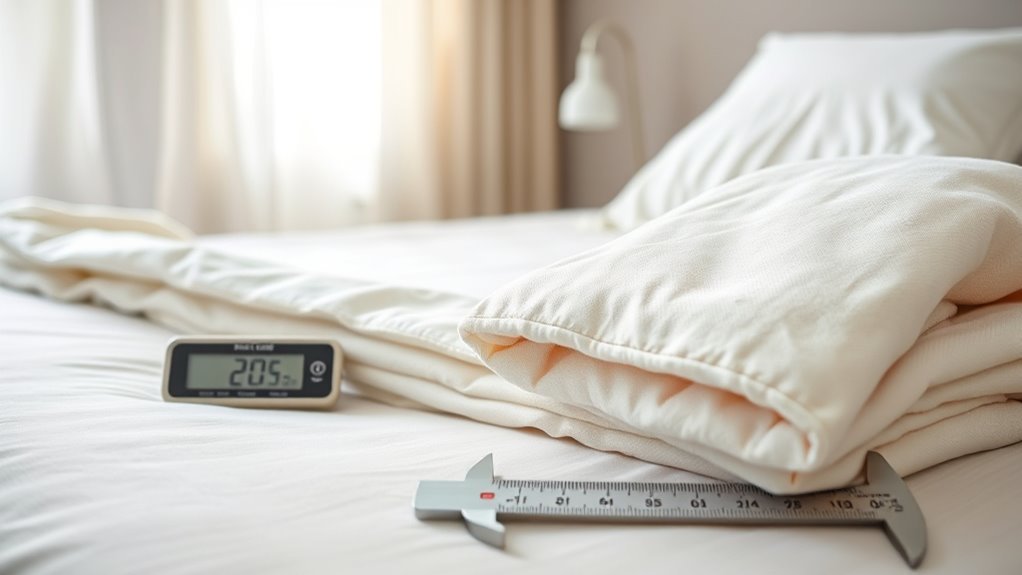
GSM stands for grams per square meter. In textile specifications, it describes the mass of a material per unit of area. The current ASTM D3776/D3776M-20(2025) standard covers measurement of fabric mass per unit area, while ISO 3801 covers mass per unit length and mass per unit area for woven fabrics.
The basic formula is:
GSM = fabric mass in grams ÷ fabric area in square meters.
For example, if exactly 1 m² of fabric weighs 160 grams, its fabric weight is 160 GSM. If a 10 cm × 10 cm sample weighs 1.6 grams, that sample is also 160 GSM because 10 cm × 10 cm equals 0.01 m² and 1.6 × 100 = 160.
Note: GSM is a measure of mass per area. It is often casually called fabric “weight” and may correlate with heft, but it is not the same thing as physical density, thickness, softness, warmth, or quality.
A higher GSM means that more material mass is present in the same measured area. Within two otherwise similar fabrics, that may create a heavier or more substantial feel. Across different fibers, weaves, finishes, or bedding types, however, the same GSM can perform very differently.
How Is GSM Measured at the Mill?
Textile laboratories determine GSM by measuring a known area of fabric and its mass under controlled test procedures. There is not one universal rule that every mill must cut exactly a 10 cm × 10 cm square. ASTM D3776/D3776M includes methods for complete pieces, full-width samples, small swatches, and narrow fabrics, while ISO 3801 also addresses mass per unit area for woven fabrics.
Conditioning matters because many textile fibers absorb or release moisture as humidity changes. Standardized testing therefore controls the test atmosphere and specimen preparation so measurements can be compared more reliably.
How a 10 cm × 10 cm Sample Calculation Works
A 10 cm × 10 cm swatch is convenient because its area is exactly 0.01 m². If the swatch weighs 1.45 grams:
1.45 g ÷ 0.01 m² = 145 GSM.
The same calculation can be written as 1.45 × 100 = 145 GSM.
A manufacturer or laboratory may take more than one specimen when its quality-control or sampling plan requires it. Multiple measurements can reveal variation across a roll, but the exact sampling procedure depends on the applicable specification and test plan.
Certifications should not be confused with the GSM test itself. For example, the Global Organic Textile Standard (GOTS) Version 8.0 covers organic textile processing, traceability, environmental, social, and related certification requirements. ASTM and ISO test methods are the more relevant references when discussing fabric mass per unit area.
GSM vs Thread Count: Which Matters More?
GSM and thread count measure different properties. GSM tells you the mass of fabric per square meter. Thread count generally describes the total number of warp and filling yarns in one square inch of woven fabric.
The Cotton Incorporated cotton-sheets guide explains that thread count is only one part of cotton-sheet construction. Fiber type, yarn spinning, yarn count, fabric weight, weave, and finishing can all affect hand feel, drape, breathability, durability, and performance.
Use GSM to compare fabric weight and thread count to describe yarns in a woven area, but do not treat either number as a complete quality score.
For woven cotton sheets, thread count can be useful when you compare similar yarns and constructions. A larger number is not automatically better. Very tightly packed fabrics or marketing based on unusually high counts can still produce a sheet that feels heavier, less breathable, or simply different from what you prefer.
For linen, flannel, fleece, microfiber, towels, blankets, and other products, sellers may emphasize GSM more heavily because fabric mass often gives shoppers a clearer sense of how light or substantial the material is.
What GSM Is Best for Bed Sheets?
There is no single GSM that is best for every bed sheet. A useful target depends on the fiber, weave, yarn, finish, climate, and the feel you prefer. GSM is most useful when you compare sheets that are otherwise similar.
Ideal GSM Ranges
Treat any “ideal GSM” chart as a shopping guide rather than an industry rule. For example, linen bed fabrics sold through the Alliance for European Flax-Linen and Hemp sourcing platform include real constructions around 140, 160, 165, 178, and 200 g/m², showing that usable bedding is produced across a fairly broad weight range.
For linen shoppers, roughly 150–180 GSM is a reasonable midweight starting point when you want a balance between a light hand and a more substantial feel. Lighter or heavier linen can also be completely appropriate. The weave, finishing, yarn, and intended season matter just as much as the number.
For cotton percale and sateen, there is no recognized universal “best cotton GSM.” Compare the fabric weight together with cotton quality, yarn construction, weave, thread count, and finish rather than choosing from GSM alone.
Fabric Type Differences
Fiber type changes how a given GSM feels. Two 160 GSM fabrics can have the same mass per square meter but very different stiffness, drape, airflow, surface texture, and moisture behavior.
- Cotton: judge GSM alongside weave, yarn quality, staple characteristics, thread count, and finishing.
- Linen: GSM is a useful way to compare light, midweight, and heavier linen constructions, but it still does not define quality on its own.
- TENCEL™ Lyocell: Lenzing notes that TENCEL Lyocell fibers can absorb moisture efficiently, but there is no one universal GSM that guarantees this performance in every finished sheet.
- Microfiber and flannel: GSM is commonly useful for distinguishing lighter from more substantial constructions, but compare products within the same material category.
Sleep Style And Climate
Your sleep temperature and climate should influence your choice, but they should not be converted into rigid GSM bands that apply to every fabric.
- Hot sleepers and warm rooms: start with a lighter, breathable construction in the material you prefer.
- Neutral sleepers: choose a midweight construction that works with your room temperature and usual blanket layers.
- Cold sleepers: a more substantial sheet may feel more comfortable, but blankets, duvets, pajamas, and room temperature usually affect total warmth far more than sheet GSM alone.
- Humid climates: prioritize airflow, moisture handling, and drying behavior rather than simply chasing the lowest GSM.
The original idea that hot sleepers need 200–400 GSM sheets, average sleepers need 400–500 GSM, and cold sleepers need 550+ GSM is not a reliable sheet-buying rule. Those numbers can overlap with much heavier bedding constructions, depending on what component is being measured.
What GSM Works Best for Linen Sheets?
For linen sheets, about 150–180 GSM is a practical midweight shopping range if you want one set that feels substantial without becoming especially heavy. It is a heuristic, not an official textile standard, and excellent linen bedding exists below and above that range.
Ideal Linen GSM Range
Think of linen GSM in broad weight classes rather than treating one number as a quality cutoff:
- Lighter linen: feels airier and less substantial and may be attractive for warm rooms or shoppers who prefer a lighter drape.
- Midweight linen: around the 150–180 GSM neighborhood is a practical starting point for general-purpose bedding.
- Heavier linen: provides a more substantial hand and drape but should not automatically be assumed to be softer, more durable, or higher quality.
For context, the Alliance for European Flax-Linen and Hemp sourcing platform includes a 160 g/m² 100% flax-linen fabric intended for bed linen, while other listed bed-linen fabrics appear at both lighter and heavier weights.
Seasonal Linen Weight Choices
Season is one factor, but GSM should be considered with room temperature, weave openness, finishing, and the rest of your bedding layers.
A lighter linen sheet may feel preferable during hot weather because there is less fabric mass against the body. A midweight sheet is a versatile choice for many bedrooms. A heavier linen sheet has more mass and may feel more substantial in cool conditions, but the number alone does not tell you its thermal insulation.
Do not call heavy linen “flannel-weight” solely because it crosses a particular GSM number. Flannel describes a fabric construction and typically a brushed surface; it is not a universal weight category.
Why Sheets With the Same GSM Feel Different?
Sheets with the same GSM can feel completely different because GSM records only their mass per area. It does not describe where that mass comes from or how the fabric is constructed.
- Fiber type: cotton, linen, lyocell, viscose, polyester, and blends have different surface, moisture, resilience, and drape characteristics.
- Yarn size and structure: fine yarns, coarse yarns, single-ply yarns, and multi-ply yarns can create different surfaces at similar fabric weights.
- Weave or knit: percale, sateen, twill, jersey, and other constructions distribute yarn differently and change airflow and hand feel.
- Finishing: washing, brushing, calendaring, mercerization, softening treatments, and other finishes can change texture and drape.
- Fabric thickness and loft: two fabrics can carry the same mass in different thicknesses, so they do not necessarily trap the same amount of air.
This is why GSM is most reliable as a comparison tool when the two products have similar materials and construction.
Sheet GSM vs Blanket, Quilt, and Comforter GSM
One of the most important buying checks is identifying what the advertised GSM actually measures.
On a sheet, GSM normally describes the sheet fabric itself. On a blanket, it may describe the blanket fabric. On a quilt or comforter, the number could describe the outer shell, batting, or fill material depending on the manufacturer’s specification.
Pro Tip: Before comparing two comforters or quilts by GSM, check whether both numbers describe the same component. A 220 GSM fill cannot be meaningfully compared with a 220 GSM shell fabric as though they measure the same thing.
If two comforters use the same type of fill, similar construction, and the quoted GSM specifically refers to fill weight, the higher-GSM version contains more fill mass per square meter and will often be more substantial. That still does not guarantee identical warmth because loft, fiber type, quilting pattern, moisture, and air trapping also affect insulation.
How Do You Check GSM on Your Own Sheets?
You can estimate GSM at home, but an accurate swatch method is destructive because you must remove a known area of fabric.
- Choose a flat area away from hems, elastic, seams, labels, or repairs.
- Measure and cut a square exactly 10 cm × 10 cm.
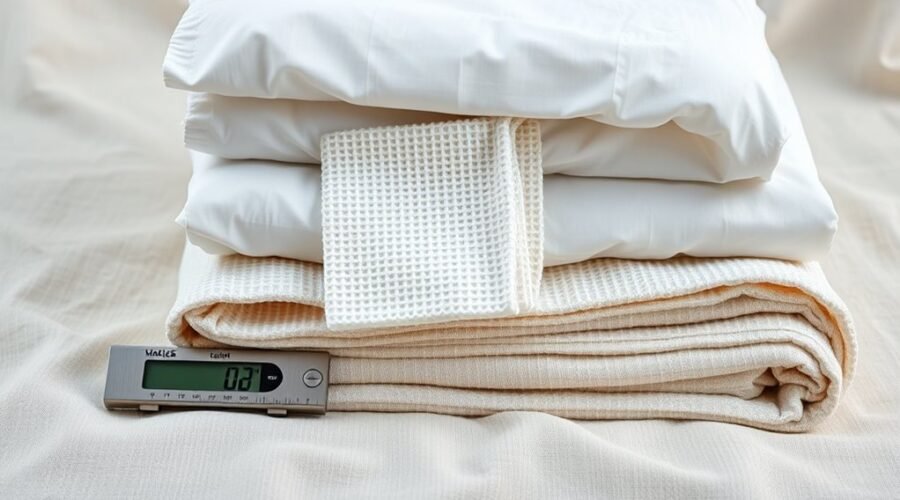
- Weigh the dry sample in grams on a sufficiently precise scale. A scale reading to 0.01 g is much more useful than a whole-gram kitchen scale for a small swatch.
- Multiply the measured grams by 100.
- Repeat with additional samples if practical and average the results.
For example, a 10 cm × 10 cm piece weighing 1.72 g gives an estimated fabric weight of 172 GSM.
Warning: Cutting a swatch permanently damages the sheet. A home measurement also is not equivalent to a standardized laboratory result because humidity conditioning, cutting accuracy, balance accuracy, specimen selection, and other test controls can affect the result.
Can You Estimate GSM Without Cutting the Sheet?
For a simple rectangular flat sheet, you can make a rough non-destructive estimate by weighing the entire dry sheet in grams and dividing by its approximate fabric area in square meters.
For example, if a simple rectangular sheet weighs 800 g and its approximate area is 5 m²:
800 ÷ 5 = about 160 GSM.
This method is only an estimate because hems, doubled fabric at edges, labels, embroidery, and other construction details add mass. It is much less suitable for fitted sheets because the side panels, corners, elastic, and three-dimensional construction make the true fabric area harder to calculate.
How Do You Convert GSM to Ounces per Square Yard?
Some U.S. fabric specifications use ounces per square yard instead of GSM. The approximate conversions are:
- 1 oz/yd² ≈ 33.9 GSM
- GSM × 0.0295 ≈ oz/yd²
- oz/yd² × 33.9 ≈ GSM
For example, a 170 GSM fabric is about 5.0 oz/yd².
Common GSM Mistakes When Buying Sheets
The biggest mistake is treating a higher GSM as an automatic quality upgrade. More mass per square meter is simply more mass per square meter; whether that improves your experience depends on the material and construction.
- Comparing unrelated fabrics: a 160 GSM linen fabric and a 160 GSM cotton sateen do not have to feel or perform alike.
- Ignoring weave and yarn: construction affects airflow, smoothness, drape, and durability.
- Confusing shell GSM with fill GSM: this is especially common with comforters and quilts.
- Assuming certification verifies GSM: a sustainability or organic certification serves a different purpose from an ASTM or ISO fabric-mass test.
- Assuming missing GSM means poor quality: many sheets are marketed primarily through material, weave, thread count, or other specifications.
- Equating weight with warmth: heavier materials can feel warmer within comparable constructions, but thermal insulation also depends on loft, fiber, airflow, layers, and construction.
GOTS certification can be useful when you specifically care about certified organic textile processing and its environmental and social requirements, but it should not be treated as proof that a particular GSM number is correct.
How Do You Choose the Right GSM for Bedding?
Choose the right GSM by first identifying the bedding category and material, then using the number as one part of the comparison.
- Identify what is being measured. Is the GSM for sheet fabric, blanket fabric, comforter shell, batting, or fill?
- Compare similar products. GSM is most meaningful between products with the same fiber and similar construction.
- Decide how substantial you want the fabric to feel. Lower GSM generally means less mass per area; higher GSM means more.
- Consider temperature and humidity. Hot sleepers usually benefit from breathable, lighter constructions, while cold sleepers may prefer more substantial layers.
- Check fiber and weave. These strongly affect touch, moisture handling, airflow, and drape.
- Read the complete specification. Do not let GSM or thread count override every other characteristic.
If you are choosing cotton sheets, use GSM together with fiber, yarn, weave, thread count, and finishing. If you are choosing linen, GSM is particularly useful for deciding whether you want a lighter, midweight, or heavier hand. If you are choosing a quilt or comforter, determine whether the GSM describes the fill or only the outer fabric before drawing conclusions about warmth.
Frequently Asked Questions
What Is a Good GSM for Bed Sheets?
There is no universal best GSM for all bed sheets. For linen, roughly 150–180 GSM is a useful midweight starting point rather than an official standard. For cotton, compare GSM with fiber quality, yarn, weave, thread count, and finishing. Hot sleepers may prefer lighter constructions, while people who like a more substantial sheet can move heavier within the same fabric category.
Is 300 GSM a Heavy Blanket?
A 300 GSM specification means that one square meter of the stated material or component weighs 300 grams. Whether that makes the blanket heavy or especially warm depends on the fiber, thickness, loft, weave or knit, and whether the number describes the whole blanket material or only one component. Compare it directly with another GSM mainly when the materials and construction are similar.
What Does a 700 GSM Quilt Mean?
It means the component identified by the manufacturer weighs 700 grams per square meter. If 700 GSM refers to the quilt’s batting or fill, that is a very substantial amount of fill mass per unit area. If it refers to an outer fabric, it says nothing directly about how much filling is inside. Check the product specification before using the number as a warmth comparison.
Which Comforter Is Better, a 120 GSM or a 220 GSM Fabric?
Neither number is automatically better. If both numbers describe the same fill material in otherwise similar comforters, 220 GSM means more fill mass per square meter and will generally create a more substantial product. If the numbers describe only the shell fabric, they do not tell you the fill weight or total warmth. Check what the manufacturer is measuring first.
Does Higher GSM Mean Better Sheets?
No. Higher GSM means more material mass per square meter. Quality and comfort also depend on fiber, yarn, weave, finishing, construction, and your preferences. A lighter well-made sheet can be a better choice for a hot sleeper than a much heavier fabric.
Can You Compare GSM Across Different Materials?
You can compare their mass per square meter mathematically, but you should not assume equal GSM means equal softness, thickness, breathability, warmth, or durability. GSM gives the most useful shopping comparison when the fiber and construction are similar.
Conclusion
GSM gives you one precise piece of information: how much the specified material weighs per square meter. Lower and higher numbers can help you compare lighter and more substantial versions of similar fabrics, but GSM is not a standalone quality, warmth, softness, or durability score. For sheets, read it with fiber, yarn, weave, thread count, and finishing. For blankets, quilts, and comforters, first confirm whether the number describes fabric, batting, or fill. That context makes GSM genuinely useful instead of just another number on a product page.
Sources
- ASTM D3776/D3776M-20(2025) — current ASTM test methods for fabric mass per unit area.
- ISO 3801:1977 — international standard covering mass per unit length and mass per unit area of woven fabrics.
- Cotton Incorporated: Cotton Sheets Buying Guide — thread count, fiber, yarn, fabric construction, weight, finishing, hand, drape, breathability, and durability.
- Global Organic Textile Standard Version 8.0 — current GOTS requirements and scope, distinct from fabric-mass testing.
- TENCEL™ Home: Bed and Bath — manufacturer information on moisture absorption and bedding properties of TENCEL Lyocell fibers.
- Alliance for European Flax-Linen and Hemp — real-world example of a 160 g/m² 100% flax-linen fabric intended for bed linen.