
When you shop for a duvet, fill power tells you how much loft a given amount of down can produce. Higher fill power generally means the down traps more air per ounce, so it can provide strong insulation with less weight. However, fill power alone does not tell you how warm a finished duvet will feel. Fill weight, construction, fabric, bedroom temperature, and your own sleep preferences matter too.
Quick Answer
Duvet fill power measures the loft and insulating efficiency of down. Higher numbers mean each ounce of down expands to a greater volume. An 800-fill duvet is not automatically warmer than a 600-fill duvet, though; the finished duvet’s warmth also depends on fill weight, construction, fabric, and how the fill is distributed.
Key Takeaways
- Fill power measures loft, not total duvet warmth. In the common U.S. system, it describes how many cubic inches a specified ounce of down occupies under standardized test conditions.
- Higher fill power means better insulation and loft for the same amount of down, which can produce a lighter duvet for a given warmth level.
- Fill weight matters just as much when comparing finished duvets. A heavily filled 600-fill duvet can be warmer than a lightly filled 800-fill duvet.
- Baffle construction, shell fabric, fill distribution, bedroom temperature, and whether you sleep hot or cold all affect comfort.
- Use manufacturer warmth levels or TOG ratings, when supplied, alongside fill power instead of choosing by fill power alone.
What Is Duvet Fill Power?
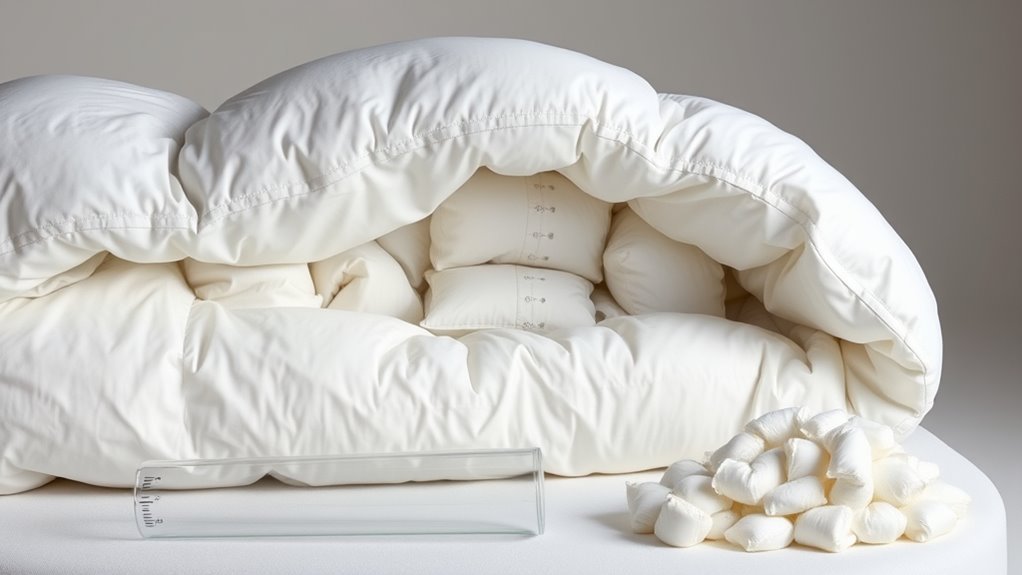
Duvet fill power is a measure of the volume and loft produced by down. In the commonly used U.S. measurement system, the number represents approximately how many cubic inches one ounce of conditioned down occupies during a standardized test.
For example, 600-fill down produces less volume per ounce than 800-fill down when measured under comparable conditions. The higher-fill material therefore provides more loft and insulating potential for the same weight of down.
IDFL, an independent textile and filling laboratory, explains that higher-quality down generally requires less filling by weight to achieve a given level of thermal retention.
Note: Fill power is mainly a measure of the filling material. It should not be treated as a direct temperature rating for the complete duvet.
How Is Down Fill Power Tested?
Fill-power testing is more controlled than simply letting loose down expand on a table. Laboratories condition a sample, place a specified amount into a measuring cylinder, apply a specified load, and measure the resulting volume.
According to IDFL’s down and feather testing guidance, results may be reported in units such as cubic inches per ounce, cubic centimeters per gram, or related measurements depending on the test standard being used.
Conditioning also matters because compression, humidity, handling, storage, and previous use can change how fully down rebounds. This is one reason you should compare fill-power claims from reputable manufacturers rather than assuming every number was produced under identical conditions.
Fill power describes how efficiently down creates loft. It does not, by itself, tell you the total warmth of the finished duvet.
How Fill Power Affects Warmth and Loft
Higher fill power allows a given weight of down to occupy more space. That creates more loft and helps the filling trap still air, which slows heat transfer.
The practical advantage is a better warmth-to-weight ratio. If two duvets contain the same weight of down and are otherwise constructed similarly, the duvet using higher-fill-power down will generally have greater loft and insulating potential.
That does not mean every 800-fill duvet is warmer than every 600-fill duvet. A manufacturer can put much more 600-fill down into one duvet than 800-fill down into another.
Loft Increases Insulation
Down works by creating thousands of small air spaces around its clusters. Higher-fill-power down expands more for the same weight, so it can hold a larger volume of insulating air.
This is why premium high-fill-power duvets can feel very lofty without being unusually heavy. The advantage becomes especially noticeable when a manufacturer wants to produce a warm duvet while keeping total weight low.
Loft can still be limited by the finished duvet’s design. Overfilling a small chamber, compressing the duvet under heavy fabrics, or using construction that pinches the filling tightly at seams can reduce the amount of usable loft.
Higher Fill Warms More
A more accurate way to phrase this is: higher fill power provides more insulating efficiency per unit of down.
If you compare equal weights of 600-fill and 800-fill down under similar conditions, the 800-fill material should create more loft. But when you compare two complete duvets in a store, you also need to know how much down each duvet contains.
For that reason, do not choose solely by seeing the largest fill-power number on the package.
What Fill Power Numbers Mean
Fill-power numbers commonly range from roughly 300 to 900 in down-product testing, although products at the upper end are generally positioned as premium high-loft options. The number describes loft efficiency, not a universal season or bedroom-temperature rating.
Fill Power Basics
| Approx. Fill Power | What It Tells You |
| 400–500 | Lower loft efficiency; more filling may be needed to reach the warmth of a higher-fill product. |
| 550–650 | Moderate loft and warmth-to-weight efficiency. |
| 700–800 | High loft efficiency, allowing strong insulation with relatively low fill weight. |
| 850+ | Very high loft efficiency, commonly used in premium lightweight down products. |
These ranges are useful for understanding relative loft, but they are not standardized comfort categories. Always compare the completed duvet rather than assuming that a particular fill-power number equals “summer,” “winter,” or a specific room temperature.
Number Ranges Explained
The most useful way to read fill power is as an efficiency scale. Higher numbers mean the down creates more volume for a given weight.
A 600-fill duvet can still be extremely warm if it contains a large amount of filling. An 850-fill duvet can be deliberately made light for a warmer bedroom by using less filling. That is why products with similar fill power are often sold in several warmth weights.
Warmth And Loft Impact
If two otherwise comparable duvets contain the same fill weight, the one with higher fill power should usually produce greater loft and insulating efficiency.
If their fill weights differ, however, you cannot determine which finished duvet is warmer from fill power alone. Check the manufacturer’s warmth designation, total fill weight, TOG rating where available, and construction.
Which Fill Power Works for Your Climate?
There is no universal rule that says a particular fill-power number belongs to a particular climate. Instead, use fill power together with the duvet’s overall warmth level.
- Warm bedroom or hot sleeper: Look first for a summer/light warmth rating or lower fill weight. High-fill-power down can still work because the manufacturer can simply use less of it.
- Typical heated bedroom: A medium or all-season warmth level is often more useful than choosing a specific fill-power number.
- Cold bedroom or cold sleeper: Look for a higher total fill weight, winter warmth class, or suitable TOG rating in addition to good fill power.
- Very cold or unheated room: Prioritize the manufacturer’s warmest finished-duvet specification rather than assuming 800+ fill power alone guarantees enough warmth.
Your normal bedroom temperature and whether you naturally sleep hot or cold are often more useful buying inputs than outdoor climate alone.
Fill Power vs. Fill Weight in Duvets
Fill power and fill weight measure two different things.
- Fill power: How much loft a specified amount of down can produce.
- Fill weight: How much filling is actually inside the duvet.
A higher fill power means the manufacturer can often achieve a desired insulation level with less down. For example, an 800-fill duvet may require less filling than a lower-fill-power design intended to provide similar warmth.
However, that does not mean reducing fill weight always produces equivalent performance. Chamber dimensions, shell fabric, stitching, fill distribution, and the manufacturer’s overall design all affect the finished result.
Pro Tip: When comparing two duvets, look for four details together: fill power, total fill weight, warmth or TOG rating, and construction. That comparison tells you much more than fill power alone.
How Baffle Box Construction Changes the Feel
Construction affects how well the down can use its available loft. A baffle-box duvet contains internal fabric walls that divide the filling into chambers while giving it space to expand vertically.
That design can reduce compression along chamber boundaries and help maintain more even loft. Feathered Friends’ 2026 comforter guide explains that its baffled construction allows down to loft without being pinched directly at the seams.
- Internal chambers help control fill movement.
- Extra chamber depth can allow high-loft down to expand.
- More even loft can reduce thin areas in the insulation.
- Construction changes both the warmth and feel of the finished duvet.
Sewn-through construction stitches the top and bottom shell together at chamber edges. It can create a classic quilted appearance and keep filling contained, but those stitched seams provide less room for loft directly at the seam.
Neither construction is automatically “best” for every sleeper. The important point is that two duvets using the same down can perform differently because their construction is different.
Down vs. Down-Alternative Fill Power
Traditional consumer fill-power ratings are most strongly associated with natural down. Down-alternative bedding is usually marketed using other specifications such as fiber type, fill weight, loft, warmth class, or TOG rather than the familiar 600-, 700-, or 800-fill labels.
That does not mean synthetic filling cannot be tested volumetrically. IDFL provides volumetric and fiber-power testing for synthetic loose fills. The important buying point is that the numbers used for synthetic bedding may not be directly comparable with the down fill-power number printed on a natural-down duvet.
When comparing down with down alternative, compare the finished products’ warmth rating, filling weight, loft, construction, washability, and manufacturer care instructions instead of trying to convert one marketing number into another.
What Else Determines Duvet Warmth?
Fill power is only one part of the system. Finished warmth can also change because of:
- Total fill weight: More insulating material generally increases potential warmth.
- Construction: Baffles, sewn-through seams, chamber depth, and fill distribution affect usable loft.
- Shell fabric: Fabric weight, weave, and breathability can change the feel and overall thermal performance.
- Duvet cover: A thick cover can add weight and some additional insulation.
- Bedroom temperature: A duvet that feels perfect at one room temperature may be uncomfortable in another.
- Personal metabolism: Warm sleepers and cold sleepers often need different warmth levels in the same room.
- Sharing the bed: Two sleepers can create more heat under the same duvet than one person.
For this reason, a manufacturer’s finished-product warmth category is often more useful for predicting comfort than fill power by itself.
How to Choose the Right Fill Power
Choosing a duvet starts with the warmth you need, not with chasing the highest fill-power number.
- Check the finished warmth rating. Look for light, medium, winter, extra-warm, or TOG information supplied by the manufacturer.
- Check fill power. Higher fill power can provide the desired loft with less weight and bulk.
- Check fill weight. This tells you how much insulation is actually in the duvet.
- Consider construction. Baffle-box and sewn-through designs can produce different loft and warmth characteristics.
- Think about your bedroom. Use your normal nighttime room temperature rather than relying only on outdoor climate.
- Account for how you sleep. Hot sleepers often need less total insulation; cold sleepers may prefer more.
- Check care requirements. Make sure the duvet’s cleaning and storage instructions suit your household.
Note: A higher fill-power number can indicate better loft efficiency, but it does not automatically make a duvet a better choice. A well-designed 650-fill duvet can be more suitable for your room and sleep style than a lighter 850-fill model.
How to Keep Your Duvet Lofty
Good care helps down recover its loft and prevents long-term compression. Always start with the manufacturer’s sewn-in care label because washing instructions vary by shell fabric, construction, and filling.
For routine care:
- Shake and redistribute the duvet periodically so the filling does not remain compressed in one area.
- Use a duvet cover if recommended to reduce direct exposure to body oils and dirt.
- Keep the duvet completely dry before storing it.
- Store it uncompressed in a breathable cotton, linen, or mesh bag rather than tightly packed plastic.
- Avoid leaving it compressed for long periods.
Feathered Friends recommends breathable, uncompressed storage for down comforters and stresses that they should never be stored wet or damp. IDFL also notes that compression and storage can temporarily reduce measured fill power and that proper conditioning can help down regain loft.
If washing is allowed, follow the specific care label. Some large duvets need a high-capacity machine and extended drying to ensure that the down is completely dry. Do not assume one generic wash cycle is appropriate for every product.
Frequently Asked Questions
Is 800 fill down warmer than 600?
Not automatically. If you compare the same weight of down in otherwise similar construction, 800-fill down should produce more loft and insulating efficiency than 600-fill down. But a finished 600-fill duvet containing substantially more down can be warmer than a lightly filled 800-fill duvet.
What is a good fill power for a duvet?
There is no single ideal number. Fill power around 600 or above can provide useful loft, while 700–800 and higher offers greater loft efficiency and can reduce the amount of filling needed for a given warmth level. Also compare fill weight, construction, and the manufacturer’s finished warmth rating.
Is 600 fill power good for a down comforter?
Yes. A 600-fill-power comforter can provide comfortable loft and insulation when it is designed with an appropriate amount of down. Its total warmth depends on fill weight and construction, so judge the finished comforter rather than the 600 figure alone.
Is 650 fill power good?
Yes. A 650-fill duvet uses down with moderate-to-good loft efficiency and can make an excellent comforter. Whether it is warm enough for you depends on how much down the duvet contains, its construction, your room temperature, and whether you sleep hot or cold.
Does higher fill power always mean a better duvet?
No. Higher fill power provides greater loft per unit of down, but a good duvet also needs appropriate fill weight, even distribution, suitable construction, a comfortable shell fabric, and the right warmth level for the sleeper.
What should I compare besides fill power?
Compare total fill weight, warmth or TOG rating, chamber construction, shell fabric, care requirements, and the manufacturer’s recommended sleeping conditions. Those details give you a much better picture of finished-duvet performance.
Conclusion
Fill power tells you how efficiently down creates loft, not exactly how warm an entire duvet will be. Higher fill power can deliver excellent insulation with less weight, but fill weight, baffle design, shell fabric, fill distribution, room temperature, and your own sleeping habits determine how the finished duvet actually feels.
When comparing duvets, use fill power as one part of the decision. Pair it with the manufacturer’s warmth rating and total filling information to choose a duvet that provides the level of warmth you need without unnecessary weight or bulk.
Sources
- IDFL — What Is Fill Power? — explains fill power, loft, insulation efficiency, and how higher-quality down can achieve thermal retention with less weight.
- IDFL — Down and Feather Testing — explains fill-power testing, conditioning, measurement units, and typical test values.
- IDFL — Conditioning Methods Evaluation — explains how compression, construction, fill density, fabric, and conditioning affect usable fill power.
- IDFL — Polyester Fills Testing — explains volumetric and fiber-power testing for synthetic loose fills.
- Feathered Friends — Down Comforter Guide — current 2026 manufacturer guidance on fill power, warmth weight, baffled versus sewn-through construction, and care.