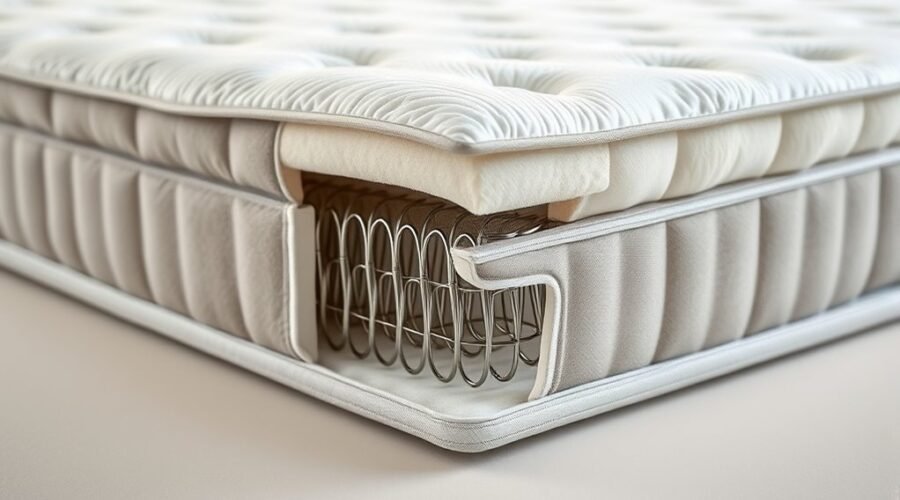
An innerspring mattress uses a steel coil support system beneath a relatively thin comfort section. The coil design, wire gauge, edge reinforcement, and materials above the springs all affect how responsive, firm, cool, and durable the mattress feels. Understanding those parts also helps you separate a traditional innerspring from a thicker, more contouring hybrid mattress.
Quick Answer
An innerspring mattress is a bed built around a steel coil support core with thinner cushioning layers above it. It usually feels responsive, springy, and breathable. Coil type, gauge, edge design, and comfort materials influence support and motion transfer, so coil count alone should never be used as a quality score.
Key Takeaways
- An innerspring mattress uses a steel coil system as its main support core.
- Traditional innersprings usually have thinner comfort layers than hybrids, which use a more substantial foam, latex, or other comfort system.
- Bonnell, offset, continuous-wire, and pocketed coils behave differently; pocketed coils generally provide better contouring and motion isolation.
- Coil gauge, design, steel quality, zoning, edge reinforcement, and the overall mattress build matter alongside coil count.
- The open space around coils encourages airflow, but the materials above the springs also affect how warm or cool the mattress feels.
- Always check the mattress maker’s foundation, slat-spacing, warranty, trial, and rotation instructions before buying.
What Is an Innerspring Mattress?
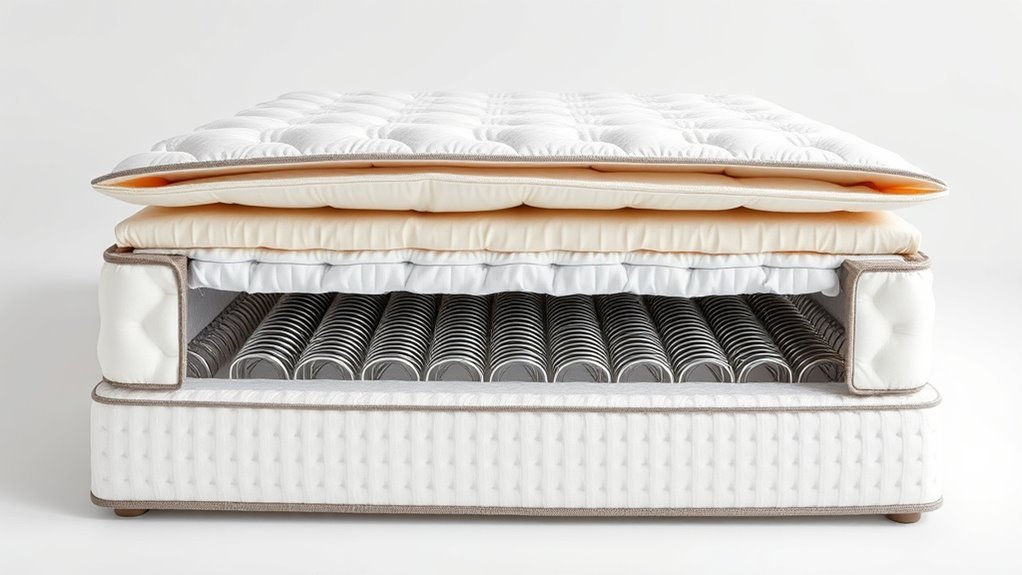
An innerspring mattress is a traditional mattress design that uses a network of steel coils as its main support system. The coils compress under weight and rebound when pressure is removed, creating the buoyant, responsive feel associated with spring mattresses.
Linked coil systems move more as a unit, while individually wrapped or pocketed coils can respond more independently. That difference influences contouring and motion transfer, particularly when two people share a bed. Mattress-component manufacturer Leggett & Platt describes open-coil and fabric-encased systems as two major innerspring families.
Comfort materials sit above the support core to keep you from lying directly on the springs. Depending on the mattress, these layers may include polyurethane foam, latex, cotton, wool, fiber, quilting, or other cushioning materials.
The springs provide the support structure, while the layers above them largely determine surface softness, cushioning, and pressure relief.
The open space around a coil unit also creates room for air to circulate. That generally gives traditional innersprings less heat retention than thick all-foam beds, although the cover and comfort layers still influence temperature.
There is no single expiration date for every innerspring mattress. Current Sleep Foundation lifespan guidance places traditional innersprings at roughly six years on average, but construction quality, sleeper weight, use, care, and the comfort materials can shorten or extend useful life.
Innerspring vs. Hybrid Mattress
The terms innerspring and hybrid are sometimes used loosely, but the amount of cushioning above the coils is an important distinction.
- Traditional innerspring: A coil support core with relatively thin upholstery, quilting, foam, or fiber above it. It generally feels bouncier, flatter, and less contouring.
- Hybrid: A coil support core combined with a more substantial comfort system, often made from memory foam, polyfoam, latex, microcoils, or several materials.
Current mattress listings can blur those categories. Some beds marketed as innersprings use thick comfort systems and function more like hybrids, so examine the layer-by-layer construction rather than relying only on the product name.
Note: If you want the bounce and airflow of coils plus deeper contouring and pressure relief, you may actually be shopping for a hybrid rather than a traditional innerspring.
How Is an Innerspring Mattress Built?
Innerspring mattresses rely on a steel coil core for foundational support. Above the springs, insulation and comfort materials separate your body from the coil unit and adjust the mattress’s firmness and surface feel.
- Cover and quilting: The outer fabric and stitched padding create the first layer of surface comfort.
- Comfort layers: Foam, latex, fibers, wool, cotton, or similar materials add cushioning and pressure relief.
- Insulator or transition material: Some designs use a layer between the coils and softer upholstery to keep materials stable and prevent excessive compression into the springs.
- Coil support core: Bonnell, offset, continuous-wire, or pocketed coils carry most of the load.
- Edge system: Firmer coils, border rods, or other reinforcement may strengthen the perimeter and reduce the feeling of roll-off.
Traditional innersprings normally use a relatively thin comfort section so the responsive coil feel remains prominent. A mattress with several inches of foam, latex, or other substantial cushioning over a coil unit is commonly classified as a hybrid.
Some innersprings are built with two usable sleep surfaces and can be flipped, but many modern mattresses are one-sided. Follow the manufacturer’s care instructions rather than assuming a mattress should be flipped.
A well-designed mattress balances the spring system with the layers above it. Strong coils cannot compensate for poor-quality comfort materials, just as thick padding cannot correct a weak or poorly supported core.
What Coil Types Are Used in Innerspring Mattresses?
Steel springs are the main support element in innerspring and hybrid mattresses. At a broad manufacturing level, systems are often described as open coils or fabric-encased coils, but shoppers commonly encounter four main support-core designs: Bonnell, offset, continuous-wire, and pocketed coils.
Bonnell Coils
Bonnell coils have an hourglass shape and are connected to neighboring springs with helical wire. Because the coils are linked, the unit responds more collectively. Bonnell systems are usually responsive and relatively economical, but they offer less precise contouring and can transmit more movement across the bed.
Offset Coils
Offset coils are related to Bonnell springs but use a modified shape that allows the coil to hinge more easily under pressure. They remain interconnected, yet they can contour more closely and may transfer less movement than a basic Bonnell system.
Continuous-Wire Coils
Continuous-wire systems form rows of springs from long pieces of wire. They can create a firm, stable, cost-effective support unit, but their interconnected construction generally provides less independent contouring than pocketed coils.
Pocketed Coils
Pocketed coils, also called fabric-encased or individually wrapped coils, sit inside separate fabric sleeves. Each spring can react more independently to pressure, helping the mattress contour more closely and limiting the amount of movement transmitted to surrounding coils. Current Beautyrest pocketed-coil systems are one modern example of this construction.
Microcoils and Minicoils
Microcoils, minicoils, and nanocoils are much shorter than full-size support springs. They are more commonly used in comfort or transition layers to add responsiveness, airflow, and localized support. Their presence does not automatically make a mattress better; they are one component of the overall design.
Coil Gauge and Coil Count
Coil gauge describes wire thickness. A lower gauge number means thicker wire, while a higher gauge number means thinner wire. Mattress coils commonly fall around the 13- to 17-gauge range, although actual specifications vary by design. Thicker, lower-gauge coils tend to resist compression more strongly, while thinner coils can feel more flexible.
Coil count is the number of springs in the mattress. It can matter, but it should never be read without context. Mattress size, coil diameter, gauge, height, number of turns, steel quality, zoning, and overall construction all influence performance.
Pro Tip: Do not choose between two mattresses simply because one advertises a higher coil count. Compare the count for the same mattress size, then look at coil type, gauge, edge reinforcement, comfort materials, and the complete construction.
A higher coil count is not automatically a better mattress. The design and quality of those coils matter just as much as the number.
How Comfort Layers Change an Innerspring Mattress
Comfort layers change how an innerspring mattress feels at the surface. Traditional models generally keep these layers relatively thin, while hybrids use a thicker comfort system.
Common materials include polyurethane foam, memory foam, latex, cotton, wool, fiber padding, and quilted foams. Their density, thickness, resilience, and position in the mattress affect surface softness, pressure relief, responsiveness, motion feel, and durability.
- Quilted tops add a thin, evenly padded surface.
- Pillow tops and Euro tops add a deeper cushioned section above the main mattress body.
- Polyfoam can range from soft cushioning to firmer transition material.
- Memory foam adds closer contouring and more motion absorption but may reduce the traditional springy feel.
- Latex adds cushioning while generally retaining more bounce and responsiveness.
- Natural fibers such as cotton or wool may be used for quilting, padding, moisture management, or temperature control.
If you prefer a classic, lively innerspring feel, look for thinner cushioning that allows the coil system to remain noticeable. If you want deeper pressure relief without giving up a spring core, compare hybrid designs with thicker comfort layers.
Who Should Buy an Innerspring Mattress?
You should consider an innerspring mattress if you like a traditional, buoyant sleep surface that responds quickly when you change positions.
Many back and stomach sleepers who prefer a flatter, firmer surface may like this construction, but no mattress type automatically guarantees proper alignment. Firmness, body weight, sleeping position, coil design, and the comfort layers all affect fit.
If you sleep hot, the open structure around the springs can also be appealing because it leaves more space for airflow than a solid foam core. The materials above the coils still matter, so a thick foam pillow top may retain more heat than a thinly cushioned innerspring.
Traditional innersprings also appear across a wide range of price points and can be attractive to budget-conscious shoppers. Price alone, however, does not reveal the quality of the steel, upholstery, edge system, or comfort materials.
If you are a side sleeper or are sensitive to pressure around the shoulders and hips, pay closer attention to the comfort system. A very firm traditional innerspring with minimal cushioning may provide less pressure relief than a softer innerspring or hybrid.
Couples who are easily disturbed by movement should look carefully at the coil design. Pocketed coils can reduce motion transfer compared with highly interconnected spring units, although thick foam comfort layers generally absorb even more motion.
In short, innersprings make the most sense when you value responsiveness, airflow, easier movement, and a more traditional mattress feel over deep body-hugging contouring.
What Should You Look for Before Buying One?
Start with the coil system, but do not stop there. A good mattress is a complete construction, so the springs, comfort layers, edge support, foundation, warranty, and return policy should all make sense for your needs.
- Coil type: Pocketed coils usually contour more independently and reduce motion transfer, while interconnected systems often feel firmer and more uniformly responsive.
- Gauge: Lower-gauge wire is thicker; higher-gauge wire is thinner and generally more flexible.
- Coil count: Compare it only alongside mattress size, coil dimensions, gauge, material quality, and design.
- Comfort layers: Check what materials are used, how thick the cushioning is, and whether the surface provides enough pressure relief.
- Edge support: Reinforced perimeter coils or other edge systems can create a steadier sitting edge and a more usable sleep surface.
- Zoning: Some mattresses use different coil strengths or arrangements in specific areas to change how the surface responds under the torso, hips, or perimeter.
- Breathability: Coils create airflow space, but dense foams and thick pillow tops can still influence heat retention.
- Noise: Pocketed coils are generally quieter than some interconnected systems, but any spring mattress may become noisier as materials age.
- Warranty: Read what is actually covered, the required foundation, indentation threshold, exclusions, and claim process. A longer warranty is not automatically proof of longer useful life.
- Sleep trial and returns: Compare the trial length together with return fees, required break-in periods, exchange rules, and refund conditions rather than judging a mattress by one number.
Check the Foundation Requirements Before You Buy
An innerspring mattress does not automatically require an old-fashioned spring-style box spring. Many current mattresses can use a rigid foundation, platform bed, adjustable base, or properly spaced slats.
However, the exact requirements vary by manufacturer. For example, Sealy’s current support guidance specifies structural and slat requirements and warns that inadequate support can affect warranty coverage.
Warning: Do not assume that any box spring, platform, or widely spaced slatted frame is acceptable. Check the exact mattress warranty before setup because inadequate support can damage the mattress or affect warranty eligibility.
Think About Edge Support
The perimeter of an innerspring mattress may use firmer coils, a border rod, foam, or a dedicated coil edge system. Stronger edge support can make it easier to sit on the side of the bed and may let you use more of the mattress surface without feeling as though the edge is collapsing.
Match the Feel to Your Sleep Style
There is no single best innerspring firmness for everyone. Consider your sleeping position, body weight, sensitivity to pressure, preferred amount of bounce, whether you share the bed, and how easy you want it to be to change positions.
If possible, use the seller’s trial period to evaluate the complete mattress rather than focusing on one specification in isolation.
How to Care for an Innerspring Mattress
Basic care can help the mattress wear more evenly and protect its materials.
- Use the foundation or bed frame specified by the manufacturer.
- Rotate the mattress if the care instructions recommend rotation.
- Do not flip a one-sided mattress unless the manufacturer specifically says it is flippable.
- Use a mattress protector if you want additional protection from spills and stains.
- Keep the mattress dry and follow the manufacturer’s cleaning instructions.
- Check the bed frame periodically for loose hardware, sagging slats, or inadequate center support.
Replace the mattress when it no longer provides comfortable, even support rather than relying only on its age. Persistent sagging, visible depressions, broken or noisy springs, an uneven sleep surface, or a clear decline in comfort are more useful replacement signals than a calendar date alone.
Frequently Asked Questions
What Are the Pros and Cons of Innerspring Mattresses?
The main advantages are responsive support, strong airflow through the coil core, easy movement on the surface, broad firmness choices, and many price options. Traditional innersprings can provide less contouring and pressure relief than foam-heavy beds, and interconnected coils may transfer more motion or develop noise as they age. Allergy concerns depend more on the cover, accumulated dust, cleaning, and bedding than on the presence of springs themselves.
Can I Buy an Innerspring Mattress Without a Box Spring?
Yes. Many innerspring mattresses can be used on a rigid foundation, solid platform, suitable slatted frame, or compatible adjustable base. A traditional spring-style box spring is not universally required and may be inappropriate for some mattresses. Always follow the specific manufacturer’s support and slat-spacing requirements because the wrong base can damage the mattress or affect warranty coverage.
What Is the Lifespan of an Innerspring Mattress?
There is no fixed lifespan. Current consumer guidance places traditional innersprings at roughly six years on average, but a well-built model may last longer and a lower-quality mattress may wear out sooner. Construction quality, sleeper weight, frequency of use, foundation support, comfort-layer durability, and care all matter. Replace the mattress when sagging, unevenness, noise, or lost support meaningfully affects comfort.
Do People Still Buy Innerspring Mattresses?
Yes. Traditional innersprings remain available, and major manufacturers continue to use steel coil and pocketed-coil systems in current mattress collections. However, many modern beds marketed around springs also use thick foam or latex comfort systems, making them closer to hybrids than classic thinly padded innersprings.
Is a Higher Coil Count Better?
Not automatically. A higher count can allow the manufacturer to use more, smaller coils, but the number alone does not tell you how supportive or durable the mattress will be. Coil gauge, steel quality, coil height, shape, turns, zoning, mattress size, edge construction, and comfort layers all affect performance.
What Is the Difference Between an Innerspring and a Hybrid Mattress?
Both use a coil support core. A traditional innerspring normally has relatively thin upholstery or comfort layers, which preserves a springier and flatter surface. A hybrid combines its coil core with a more substantial comfort system made from foam, latex, microcoils, or other materials, usually producing more contouring and pressure relief.
Conclusion
An innerspring mattress is built around a steel coil support core, but the springs are only part of the story. Coil type, gauge, edge reinforcement, zoning, comfort materials, foundation support, and overall construction all influence how the mattress feels and how well it holds up.
When comparing mattresses, do not chase the highest coil count or longest warranty in isolation. Decide whether you want a traditional thinly cushioned innerspring or a more contouring hybrid, compare the complete construction, check the manufacturer’s foundation requirements, and use the sleep trial to judge real-world comfort. That approach gives you a much clearer picture of whether a mattress fits your body and sleep preferences.
Sources
- Leggett & Platt Bedding Group — Innersprings — open-coil and fabric-encased spring construction, steel coils, and innerspring engineering.
- Sleep Foundation — Mattress Coil Types — Bonnell, offset, continuous-wire, and pocketed coils, plus coil gauge and coil-count guidance.
- Sleep Foundation — Best Innerspring Mattresses of 2026 — current innerspring construction, performance, lifespan, and traditional-innerspring versus hybrid context.
- Sleep Foundation — How Long Should a Mattress Last? — mattress lifespan estimates and factors that affect durability.
- Sealy — Mattress Base and Foundation Requirements — platform, slat, foundation, and warranty-support requirements.
- Beautyrest — Pocketed Coil Technologies — current examples of individually wrapped coil construction and motion separation.