A small living room can look noticeably bigger when you reduce visual breaks and make better use of light, floor space, and wall height. Start with a cohesive palette, furniture that fits the room, clear walking paths, high-and-wide curtains, reflective surfaces, and layered lighting. The goal is not to hide the room’s size, but to make every inch feel intentional, comfortable, and visually open.
Quick Answer
To make a small living room look bigger, use a light or low-contrast color scheme, choose furniture that fits the room, expose some floor beneath furniture, keep pathways clear, hang curtains high and wide, place mirrors where they reflect light or an open view, reduce clutter, and light dark corners instead of relying on one overhead fixture.
Key Takeaways
- Use a cohesive color palette to limit harsh visual breaks and make better use of available light.
- Choose appropriately scaled, legged, or multi-functional furniture so more floor remains visible.
- Keep major walking paths and sightlines open instead of filling every available corner.
- Hang curtains high and extend the rod beyond the window so more glass can remain exposed when panels are open.
- Use mirrors, wall lighting, hidden storage, and vertical elements to add depth without crowding the floor.
At a Glance
| Time Required | 30–60 minutes for decluttering and rearranging; longer if you paint or mount curtains, mirrors, or shelves. |
| Difficulty | Easy for layout and décor changes; moderate when wall mounting is required. |
| Tools Needed | Tape measure and painter’s tape; appropriate mounting hardware, drill, screwdriver, and stud finder if installing wall-mounted items. |
| Cost | Potentially $0 for decluttering and rearranging; additional cost depends on paint, curtains, mirrors, lighting, storage, or furniture you choose to add. |
Use a Light, Cohesive Color Palette
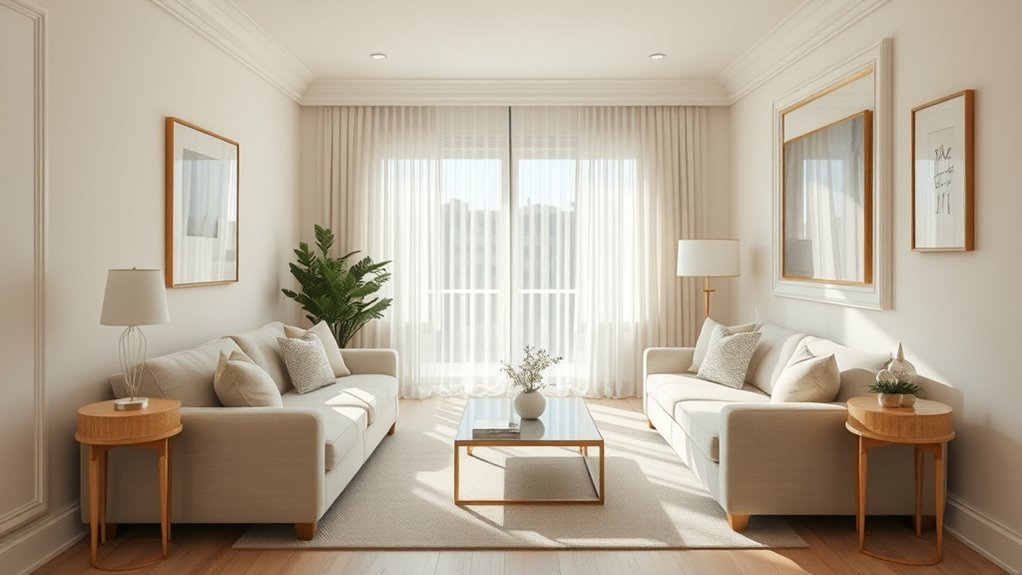
A light, cohesive color palette is one of the easiest ways to make a small living room feel brighter and less visually broken up. Soft whites, creams, pale grays, light blues, and other higher-reflectance colors can work well when they suit the room’s daylight and furnishings.
Research into interior color perception has found that increasing the lightness of walls and ceilings can increase perceived room height. A controlled study of surface lightness and perceived room dimensions found particularly clear effects from wall and ceiling lightness.
Lighter walls and ceilings can influence how tall an interior appears, but color is only one part of the effect; lighting, contrast, furniture, and layout matter too.
A low-contrast or monochromatic scheme can also reduce abrupt boundaries between walls, trim, curtains, and large furniture. Sherwin-Williams similarly recommends cohesive palettes and light colors as practical ways to create more visual continuity in a small space.
If you want more personality, add subtle accent colors through art, pillows, plants, or a throw. You do not need an all-white room. Dark or saturated colors can still be beautiful in a small living room when the goal is a cozy, dramatic look rather than maximum brightness.
Note: Test paint samples on more than one wall and look at them during the day and after dark. The same paint can appear very different as natural and artificial light change.
Pick Furniture That Fits the Room
Once you have a cohesive backdrop, choose furniture that matches the room’s scale. In a small living room, the best sofa is not automatically the smallest one; it is the piece that provides the seating you need without blocking circulation or forcing too many extra chairs and tables into the room.
Measure Before You Buy or Rearrange
Measure the room, doorways, windows, and the furniture you plan to use. Painter’s tape can help you mark a sofa, chair, or coffee-table footprint on the floor before you buy or move anything. This makes it easier to see whether doors will open properly and whether people can walk through the room comfortably.
Choose streamlined pieces with visible legs or open bases when they fit your style. Seeing more continuous floor beneath a sofa, chair, or console can reduce visual weight. Light upholstery can strengthen that effect, although darker upholstery can also work when the rest of the room remains balanced.
Look for multi-functional furniture, such as a storage ottoman, nesting tables, a sofa bed, or a coffee table with hidden compartments. IKEA’s current small-living-room guidance likewise recommends flexible pieces that perform more than one function.
Create Clear Sightlines and Walking Paths
A room often feels cramped because furniture interrupts movement and sightlines, not simply because the square footage is small. Start by identifying the route from the doorway to the main seating area, windows, and any connecting room.
Keep those paths as clear as practical. Avoid placing a bulky chair, table, basket, or plant where people constantly have to walk around it. When possible, group furniture into one intentional seating zone rather than scattering many small pieces throughout the room.
Do not assume every sofa or cabinet has to be pushed tightly against a wall. In some layouts, moving a piece slightly inward creates a cleaner arrangement and better circulation. The correct layout depends on the room’s shape, doors, windows, and focal points.
Pro Tip: Take a photo from the doorway after rearranging the room. Objects that interrupt the main sightline are often easier to notice in a photo than while you are standing inside the space.
Use Mirrors to Make a Small Living Room Look Bigger
Mirrors can make a small living room feel brighter and deeper because they reflect light and repeat part of the view. They do not create physical space, but a well-positioned mirror can reduce the feeling of a blank, closed wall.
Place a mirror where it reflects something useful: a window, an attractive part of the room, artwork, or an open sightline. A mirror opposite or near a window can redistribute daylight, while a large mirror can create a stronger sense of depth than several tiny reflective accents.
- Use one oversized mirror when you want a strong visual focal point.
- Use a small group of mirrors only when the arrangement remains simple and cohesive.
- Reflect attractive views rather than clutter, a television, or a busy storage area.
- Keep frames proportionate to the wall so they do not add unnecessary visual heaviness.
Strategic placement matters more than simply adding more reflective surfaces. Too many mirrors can make a small room visually busy instead of calm.
Hang Curtains Higher Than the Window
Mounting a curtain rod above the window frame can make the window treatment read as taller and draw attention toward the ceiling. Rather than following a rigid ratio, judge the space between the window trim and ceiling and position the rod high enough to create a longer vertical line without crowding molding or hardware.
Extending the rod beyond the sides of the window also allows open curtains to sit against the wall instead of covering as much glass. That can expose more daylight and make the window appear wider. Sherwin-Williams recommends both mounting rods high and extending them beyond the window frame when the goal is greater visual openness.
Ceiling-High Curtain Placement
When the wall proportions allow it, place the rod closer to the ceiling than to the top of the window trim. Use floor-length panels so the fabric creates one uninterrupted vertical line.
- Mount the rod noticeably above the window frame.
- Extend the rod beyond both sides of the window.
- Use panels long enough to reach or just skim the floor.
- Choose sheer or light-filtering fabric when preserving daylight is important.
- Keep curtain color close to the wall color when you want a quieter, lower-contrast look.
Pro Tip: Before drilling, use painter’s tape to mark the planned rod height and width. Step across the room and check the proportions before making permanent holes.
Long Drapes, Taller Feel
Long drapes work best when they create a clean line from the rod to the floor. Short panels that stop awkwardly above the floor can visually divide the wall, while floor-length curtains make the treatment look more deliberate.
| Choice | Visual Effect | Best Use |
|---|---|---|
| High curtain rods | Emphasize wall height | Rooms where the window sits well below the ceiling |
| Floor-length curtains | Create a continuous vertical line | Most full-size living-room windows |
| Light or sheer fabrics | Preserve more daylight | Rooms that feel dark or enclosed |
| Wider rods | Expose more glass when open | Windows with enough adjacent wall space |
Use Vertical Lines to Raise the Eye
You can emphasize height with vertical lines and tall proportions. Floor-to-ceiling curtains, narrow shelving, vertically oriented artwork, slender lamps, and tall plants all encourage the eye to move upward rather than stopping at sofa height.
Tall Shelves and Art
A narrow bookcase can use vertical wall space without taking up the footprint of a wide cabinet. Keep the shelves edited so the bookcase looks intentional rather than packed from edge to edge.
For artwork, choose vertically oriented frames or an arrangement that uses some of the wall above the furniture. You do not need to hang ordinary artwork unnaturally high; the goal is to use vertical proportions while keeping the composition comfortable to view.
Pair tall shelving or vertical art with natural elements such as a slender plant or sculpture. This breaks up long horizontal furniture lines without adding another large piece of furniture.
Warning: Secure tall bookcases, cabinets, and other tip-prone furniture according to the manufacturer’s instructions. The U.S. Consumer Product Safety Commission recommends anchoring furniture such as bookcases securely to the wall to reduce tip-over hazards, especially where children live or visit.
Use Curtain Lines From High to Low
Curtains contribute to the room’s vertical rhythm when the rod is mounted high and the fabric reaches the floor. The effect is strongest when the panels are simple enough that the eye follows the length of the fabric instead of stopping on heavy horizontal bands or busy patterns.
Mounting the rod wider than the window can also help keep more of the view clear when the curtains are open. A low-contrast color scheme between the curtains and walls can make the treatment blend into the architecture rather than chopping the wall into separate sections.
Vertical Decor Accents
Vertical decor can reinforce the sense of height without taking much floor area. Useful choices include:
- A slim, tall bookshelf
- Vertically oriented wallpaper or paneling
- A narrow floor mirror
- Vertical artwork or stacked frames
- A slender floor lamp
- A tall plant or plant stand
Use one or two of these techniques rather than filling every wall with vertical elements. Leaving some negative space is just as important as adding height.
Declutter to Open Up the Space
When you clear unnecessary items from floors, tables, shelves, and window areas, the eye can move through the room more easily. That makes the layout feel calmer and also reveals the actual floor space you already have.
Keep decorative items selective. Instead of spreading many small accessories over every surface, create a few intentional groupings and leave some empty space around them.
Use smart storage for blankets, remotes, toys, chargers, magazines, and other everyday items. Storage ottomans, lidded baskets, wall-mounted cabinets, and furniture with built-in compartments can hide visual clutter while keeping frequently used items accessible.
When suitable for the room, use some of the wall height for storage instead of adding another wide floor cabinet. IKEA’s small-space guidance similarly recommends multifunctional furniture and vertical storage as ways to get more function from a limited footprint.
Give frequently used items a designated place so the room is easier to reset after daily use. A tidy room will not become physically larger, but fewer scattered objects make its shape and available floor area easier to see.
Layer Lighting for a Brighter Room
Lighting can strongly affect how spacious a room appears. Instead of depending on one bright ceiling fixture, use layered lighting to illuminate different heights and surfaces. Research on perceived spaciousness has found that illuminated walls can increase the perception of space.
- Use wall sconces when you want light without using table or floor space.
- Add a floor or table lamp where reading or task lighting is needed.
- Light dark corners rather than allowing them to disappear visually.
- Use accent lighting on shelves or artwork to add depth.
- Keep windows as unobstructed as practical during the day.
- Use dimmers or adjustable lamps when you want different light levels for daytime and evening.
The best color temperature depends on the room and the mood you want. Cooler white light can feel crisp and bright, while warmer light often feels softer and more intimate. More important than choosing one universal temperature is creating balanced illumination without harsh glare or large dark zones.
Frequently Asked Questions
How can you make a small living room look bigger?
Use a cohesive color scheme, correctly scaled furniture, clear walking paths, floor-length curtains mounted high, strategically placed mirrors, hidden storage, and several light sources. Showing some floor beneath furniture and keeping windows and major sightlines clear can also reduce visual heaviness.
What is the 3-5-7 rule in decorating?
The 3-5-7 rule is a flexible styling guideline based on grouping decorative elements in odd numbers, usually three, five, or seven. For example, three objects of different heights can form a simple coffee-table arrangement. It is not a rule requiring three colors, five textures, and seven décor items, and symmetry can still work when it suits the room.
What color furniture makes a small room look bigger?
Light and medium neutral furniture can reduce visual weight, especially against a similarly light background, but color is only one factor. Furniture scale, leg height, silhouette, contrast, and placement matter just as much. A dark sofa can still work well if it fits the room and the surrounding palette stays balanced.
What are some cheap ways to make a room look bigger?
Start with free changes: remove clutter, rearrange furniture to open pathways, move objects away from windows, and simplify crowded surfaces. You can also reposition an existing mirror, raise curtains if the current hardware allows it, use fewer decorative objects, and move lamps into dark corners.
Do large mirrors really make a small room look bigger?
A mirror does not change the room’s physical dimensions, but it can create a convincing illusion of depth and reflect additional light or an attractive view. Placement matters: a mirror that reflects clutter can make the room look busier rather than larger.
Does a small living room have to be painted white?
No. Light walls can help with brightness and perceived height, but white is not mandatory. Pale neutrals, soft blues, greens, and other cohesive colors can work well, and darker schemes can create an intentional cozy effect. Choose the result you prefer rather than treating light paint as an absolute rule.
Conclusion
You do not need to remodel a small living room to make it feel more open. Begin with the changes that cost nothing: clear clutter, improve walking paths, expose windows, and rearrange oversized or unnecessary pieces. Then use color, curtains, mirrors, vertical elements, hidden storage, and layered lighting to improve the room’s proportions. The strongest result comes from combining several subtle changes rather than relying on one decorating trick.
Sources
- PubMed — Oberfeld & Hecht, “Fashion versus perception” — research on surface lightness and perceived interior dimensions.
- Sustainability — Light Distribution and Perceived Spaciousness — research on light patterns, illuminated walls, and perceived spaciousness.
- Sherwin-Williams — How to Make a Room Look Bigger — guidance on color, lighting, mirrors, curtains, clutter, and visual space.
- IKEA — Very Small Living Room Ideas — guidance on multifunctional furniture, storage, lighting, and maximizing limited space.
- Pottery Barn — Living Room Furniture Layout Ideas — guidance on pathways, furniture arrangement, and small-space layouts.
- U.S. Consumer Product Safety Commission — Furniture Tip-Over Safety — current guidance on securing bookcases, TVs, and heavy furniture.