Leather furniture can crack when the hide and its finish lose flexibility through age, very dry conditions, heat, sunlight, wear, or unsuitable cleaning products. The damage usually appears first on high-use areas such as seat cushions, armrests, and creases. Good care can slow new cracking, but an existing crack is physical damage and may need professional repair.
Quick Answer
Leather sofas crack when the material or protective finish becomes less flexible and repeated sitting stretches the weakened area. Very dry air, direct sunlight, nearby heat, dirt, body oils, age, and unsuitable cleaners can speed deterioration. Preventive care helps, but conditioner cannot physically close a crack that has already formed.
Key Takeaways
- Dryness, heat, sunlight, age, abrasion, and repeated flexing can all contribute to leather cracking.
- Identify the upholstery type before using any cleaner, conditioner, oil, or repair product.
- Protected leather, aniline leather, nubuck, bonded leather, and faux leather do not share one universal care routine.
- Conditioner can help compatible leather remain supple, but it does not glue or close an existing physical crack.
- Deep cracks, peeling, exposed backing, tears, or widespread color loss are good reasons to consult a leather-repair professional.
Why Leather Sofas Crack
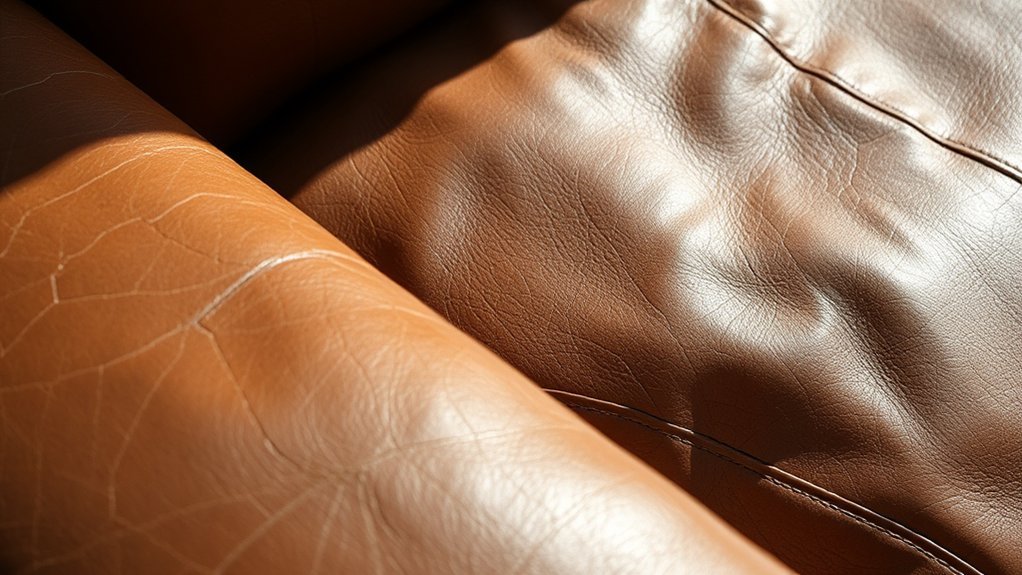
Leather sofas crack when the upholstery becomes less able to flex with normal use. Leather contains a network of collagen fibers, and tanning plus added lubricants help give the finished material its strength and flexibility. Over time, environmental stress, repeated bending, abrasion, and deterioration of the surface finish can make vulnerable areas stiffer and more likely to split.
Very dry conditions are one contributor. The Canadian Conservation Institute notes that leather exposed to very dry environments can lose moisture and flexibility, increasing its risk of physical damage. Heat can intensify local drying, while light and ultraviolet exposure can contribute to fading and long-term weakening.
Furniture makers give similar practical advice. La-Z-Boy’s leather-care guidance recommends avoiding prolonged direct sunlight and keeping its leather furniture at least 12 inches from radiators and other heat sources.
Cracking is usually a combination of reduced flexibility and repeated stress, not simply a lack of conditioner.
The type of upholstery also matters. Full-grain and corrected-grain describe aspects of the hide, but the surface finish is especially important when choosing a cleaning or conditioning method. Protected or pigmented leather can tolerate care methods that may be inappropriate for aniline, nubuck, bonded, or synthetic upholstery.
Identify the Leather Type Before Treatment
Before treating a sofa, check the care tag, purchase paperwork, or manufacturer’s website. Room & Board, for example, recommends confirming whether upholstery is top-grain, nubuck, or synthetic before choosing a cleaner or conditioner.
| Upholstery Type | Care Consideration |
| Protected or pigmented leather | Common on furniture and usually has a protective surface finish. Use only products approved for that finish. |
| Semi-aniline leather | Has a lighter protective finish and can be more sensitive than heavily pigmented leather. |
| Aniline or nubuck | More absorbent or delicate finishes may darken, stain, or change texture when treated with an unsuitable product. |
| Bonded leather | A layered upholstery material containing leather fibers and a surface coating. It does not behave like genuine hide. |
| Faux or polyurethane leather | Synthetic coated upholstery. Follow the synthetic-material instructions rather than assuming a genuine-leather conditioner is suitable. |
Palliser’s upholstery guide describes bonded leather as a layered construction with fabric, shredded leather fibers, and a polyurethane surface, and specifically notes that it does not have the same properties as genuine leather.
Warning: Do not assume that a conditioner labeled simply “for leather” is appropriate for every sofa. Check the manufacturer’s care instructions and test any approved product on a hidden area first. Using the wrong cleaner or conditioner can darken, stain, soften, dull, or damage some finishes and may affect a furniture warranty.
How Dryness Damages Leather
Leather naturally gains and loses moisture as surrounding conditions change. When the environment becomes extremely dry, leather can become less flexible. Repeated sitting then bends and stretches the driest areas, increasing stress at creases and high-contact zones.
The Canadian Conservation Institute advises extra caution with leather in environments below 30% relative humidity because moisture loss can reduce flexibility and increase the risk of physical damage. That figure is useful as a warning about severe dryness, but it should not be treated as a universal household humidity setting.
Household humidity should also be managed with the building, season, climate, and condensation risk in mind. A small digital hygrometer can tell you whether the room is actually very dry instead of relying on assumptions.
Direct sunlight adds another form of stress. Light can fade dyes and finishes, while radiant heat can warm exposed sections of the sofa. A sofa placed partly in strong afternoon sun may therefore age unevenly, with the exposed arm or cushion changing faster than shaded areas.
Signs Your Leather Sofa Is Dry
A dry or deteriorating leather sofa often changes gradually. Early recognition is useful because preventive care is easier than repairing deep cracks.
- Stiffness: the leather feels less flexible when a cushion or armrest is pressed.
- Dull or uneven appearance: areas may lose their normal surface appearance, although normal patina should not automatically be mistaken for damage.
- Fine lines: shallow stress lines become more noticeable in heavily flexed areas.
- Rough texture: the surface may feel less smooth than surrounding areas.
- Visible cracking: the finish or leather itself has begun to separate along stress lines.
- Peeling or flaking: this deserves closer inspection because coated, bonded, or synthetic upholstery can fail differently from genuine leather.
Pay particular attention to the front edge of seat cushions, headrests, armrests, seams, and areas regularly exposed to sunlight. These areas receive more body contact, flexing, oils, and abrasion than lightly used panels.
What Dries Out Leather Furniture
Leather deterioration usually has more than one cause. Common contributors include:
- Very dry indoor air: prolonged extreme dryness can reduce flexibility.
- Direct sunlight: prolonged light exposure can fade the upholstery and contribute to deterioration.
- Radiators, fireplaces, and heaters: localized heat can accelerate drying.
- Body oils, perspiration, and grime: high-contact areas accumulate residue that can affect the finish over time.
- Harsh or incompatible cleaners: household chemicals can damage certain coatings or dyes.
- Age and repeated flexing: every seat cushion bends thousands of times during its service life.
- Neglected spills: staining and residue become more difficult to manage when allowed to remain.
Pro Tip: Prevention starts with placement. Keep the sofa out of prolonged direct sunlight where practical, leave appropriate clearance from heat sources, dust or vacuum gently, and deal with spills promptly using the method approved for your upholstery.
How Utah’s Climate Speeds Cracking
Utah’s generally dry climate makes moisture management worth paying attention to, especially in homes where heating or air conditioning further lowers indoor humidity. The National Weather Service climate report for Salt Lake City describes the area as having a semi-arid continental climate and notes hot, dry summers with generally low relative humidity.
Outdoor climate does not tell you the exact relative humidity beside your sofa, however. Indoor conditions vary by house, HVAC system, season, cooking, bathing, humidification, and ventilation. A hygrometer provides a much better guide than assuming every Utah home is equally dry.
- Measure the room’s humidity during the driest part of the year.
- Keep the sofa away from strong direct sun where practical.
- Avoid placing it directly beside a radiator, fireplace, or other intense heat source.
- Inspect sun-facing and high-use sections regularly for stiffness or fine cracking.
- Follow the sofa manufacturer’s cleaning and conditioning instructions rather than increasing treatment frequency automatically.
If indoor air is persistently extremely dry, a properly operated humidifier may help the room environment, but humidity should remain appropriate for the building and season so that condensation or moisture problems are not created elsewhere.
How to Condition a Leather Sofa
Conditioning can help maintain suppleness on leather for which the manufacturer recommends it. The safest procedure starts with identifying the leather and reading its care instructions rather than choosing a product solely because it says “leather conditioner.”
At a Glance
| Time Required | About 15–30 minutes of hands-on work, plus any drying or curing time specified by the product maker |
| Difficulty | Easy for compatible, undamaged upholstery |
| Tools Needed | Soft lint-free cloths, soft vacuum attachment, and only the cleaner/conditioner approved for the upholstery |
| Cost | Varies by the manufacturer-approved cleaning and conditioning products required for your sofa |
- Identify the upholstery. Check the sofa tag, receipt, manual, or manufacturer’s product page.
- Read the care instructions. Confirm that conditioning is recommended for that particular leather or finish.
- Remove loose dust. Use a soft upholstery attachment or soft lint-free cloth, paying attention to seams and creases.
- Clean only as directed. Some finished leathers tolerate an approved cleaner, while delicate aniline or nubuck products may require a different method.
- Test a hidden area. Allow the test spot to dry completely and check for color, sheen, or texture changes.
- Apply a small, even amount. Follow the conditioner manufacturer’s directions rather than saturating the leather.
- Remove excess product if directed. Buff gently with a clean cloth only when the product instructions call for it.
- Allow the sofa to dry or cure. Do not sit on treated upholstery until the manufacturer’s stated drying time has passed.
Note: There is no single correct conditioning interval for every sofa. Some manufacturers recommend periodic treatment, while others limit what may be used on particular finishes. Condition according to the furniture maker and product instructions rather than automatically treating the sofa every few months.
What to Do When Small Cracks Appear
When small cracks appear, first determine whether you are seeing dry-looking surface lines, a broken finish, a crack extending into genuine leather, or peeling from a coated synthetic or bonded material. The repair method changes with the material and depth of damage.
Clean the area only with the method approved for the upholstery. If the surrounding genuine leather is dry and its care instructions permit conditioning, an appropriate conditioner may help the undamaged material remain flexible. It will not physically glue a visible crack closed.
Inspect Crack Severity
Look closely under good light and gently inspect the damaged area without pulling it apart.
- Fine surface lines with no opening: clean and maintain the leather according to its care instructions, then monitor it.
- A visible crack in the finish or hide: conditioning may help surrounding leather stay supple, but the damaged line may need filling and refinishing.
- Deep cracks, tears, lifted edges, or exposed backing: stop experimenting with home treatments and consider professional repair.
- Peeling or flaking over a fabric-like backing: identify whether the sofa is bonded or synthetic before treating it as genuine leather.
Clean Before Conditioning
Dust, body oils, and residue should not be sealed under a care product. Use a soft cloth, vacuum attachment, or manufacturer-approved cleaner as appropriate for the upholstery.
Avoid saturating the area with water. Do not assume diluted dish soap, saddle soap, household polish, or another common cleaner is safe simply because it works on a different leather product. The care instructions for the sofa should control the decision.
Allow any cleaned area to dry as directed before applying another product.
Rehydrate With Conditioner
If the sofa manufacturer approves conditioning, apply a compatible product to help maintain flexibility in the surrounding leather. Use a thin, even application and follow the product label for quantity, dwell time, buffing, and repeat treatments.
Do not repeatedly apply conditioner every day in an attempt to close a crack. Too much product can leave residue, change appearance, or conflict with the furniture’s finish system.
Conditioner is primarily maintenance. Once a visible crack has physically opened, repairing that break is a different job.
When to Call a Leather Repair Pro
A leather-repair professional is worth considering when damage has progressed beyond light surface wear. Deep cracks often require flexible filler, color matching, refinishing, or reinforcement that ordinary conditioning cannot provide.
Professional assessment is also useful when you are unsure whether the upholstery is genuine leather, bonded leather, polyurethane, or a leather-match construction. Correct identification prevents spending money on the wrong repair method.
Signs Of Serious Damage
Professional help is especially useful when you see:
- Deep cracks that open when the cushion flexes
- Tears or exposed substrate beneath the surface
- Widespread peeling or delamination
- Damage along seams or heavily loaded cushion edges
- Large areas of missing color or finish
- Persistent stiffness combined with active cracking
- A previous DIY repair that is lifting, hardening, or changing color
When damage affects a seam, structural panel, or large seating area, delaying repair can allow continued flexing to enlarge the damaged section.
Benefits Of Professional Repair
A qualified repair technician can identify the upholstery, determine whether the damage is repairable, and select materials designed to remain flexible under normal seating movement.
For genuine leather, a professional repair may include cleaning, preparation, flexible filling, grain or texture work, color matching, and a compatible protective finish. For bonded or synthetic upholstery, the technician can determine whether localized repair is practical or whether widespread coating failure makes panel replacement or furniture replacement more sensible.
Professional color matching is particularly useful on visible seat cushions and armrests, where a poorly matched DIY repair can be more noticeable than the original crack.
How to Prevent Leather Sofa Cracking
Preventive care is usually easier and less expensive than repairing advanced cracking. A practical routine includes:
- Keep the sofa out of prolonged direct sunlight when possible.
- Maintain appropriate clearance from radiators, fireplaces, heaters, and other concentrated heat sources.
- Use a hygrometer if your home regularly feels extremely dry.
- Dust or vacuum gently so abrasive dirt does not accumulate in creases.
- Blot spills promptly instead of rubbing them into the finish.
- Rotate or redistribute cushion use where the furniture design allows it.
- Inspect headrests, seat fronts, arms, and sun-facing panels several times a year.
- Use only cleaning and conditioning products approved for the specific upholstery.
- Do not over-condition in response to every normal wrinkle or crease.
- Keep the original care guide so future cleaning decisions are based on the manufacturer’s instructions.
Frequently Asked Questions
Can Dry Cracked Leather Be Restored?
Sometimes. Compatible conditioning can improve the suppleness of dry leather around minor damage, but it cannot physically close a developed crack. Shallow finish damage may be repairable with preparation, flexible filler, color, and refinishing. Deep cracks, tears, or widespread damage are better assessed professionally.
How Many Years Should a Leather Couch Last?
There is no reliable universal lifespan for every leather couch. Longevity depends on the leather and finish, frame and cushion construction, amount of use, pets and children, sunlight, heat exposure, cleaning habits, maintenance, and whether worn areas are repaired before damage spreads.
What Is the Best Treatment for Cracked Leather?
The best treatment depends on the upholstery and depth of damage. Start by identifying the leather, cleaning it according to the manufacturer’s instructions, and determining whether the damage is a dry surface line, a broken finish, a true crack, or peeling synthetic material. Existing cracks may need flexible filling and refinishing rather than conditioner alone.
What Should I Put on a Leather Couch to Stop Cracking?
Use only the cleaner, conditioner, or protectant approved for your sofa’s specific leather and finish. Avoid choosing a household oil or generic treatment without checking compatibility. Protection from prolonged sunlight, concentrated heat, abrasive dirt, and extreme dryness is just as important as any product applied to the surface.
Does Leather Conditioner Fix Existing Cracks?
No. Conditioner can help compatible leather remain flexible and may make a dry surface look or feel better, but it does not bond the two sides of an existing crack. A visible break may require filler, recoloring, refinishing, reinforcement, or professional repair.
Conclusion
Leather furniture can crack when age, repeated flexing, very dry conditions, sunlight, concentrated heat, wear, or unsuitable care reduces the material’s ability to move without damage. Prevention starts with identifying the upholstery correctly, following its care instructions, controlling avoidable environmental stress, and cleaning high-contact areas gently.
If fine dryness appears, appropriate maintenance may help preserve flexibility. Once a true crack has opened, however, conditioner alone cannot rebuild the damaged surface. Deep cracking, peeling, tears, or widespread finish failure should be assessed for proper repair before continued use makes the damage larger.
Sources
- Canadian Conservation Institute — Caring for Leather, Skin and Fur — supports information on leather structure, extreme dryness, light, heat, humidity, and deterioration.
- La-Z-Boy — Fabric & Leather Care — supports furniture-specific guidance on sunlight, heat sources, dusting, cleaning, and leather-type differences.
- Room & Board — Leather Furniture Care and Cleaning — supports identifying upholstery type before selecting cleaning or conditioning products.
- National Weather Service — Climate of Salt Lake City, Utah — supports the description of Salt Lake City’s semi-arid climate and generally low summer relative humidity.
- Palliser — Upholstered Furniture Warranty and Product Care — supports the distinction between genuine leather, bonded leather, polyurethane upholstery, and their different care requirements.