
The carnivore diet environmental impact debate centers on beef, because cattle are the largest source of livestock emissions and a diet built on animal foods leans heavily on them. Critics point to greenhouse gases and land use, while defenders point to grazing on marginal land and wide differences between farms. Both sides have a point, and the numbers show how much depends on how the meat is produced.
Quick Answer
Beef has one of the highest climate footprints of any food. Global averages are around 60 kg of CO2 equivalent per kg of beef, and even the lowest-carbon beef still exceeds most plant foods. Footprints vary roughly tenfold between producers, so a carnivore diet’s impact depends on the animals chosen and how they are raised, and the evidence on grazing offsets is uncertain.
Key Takeaways
- Livestock supply chains emitted about 8.1 gigatonnes of CO2 equivalent in 2010, and cattle accounted for about 62 percent, according to FAO modeling.
- Beef averages about 25 kg CO2e per 100 g of protein, with a range from 9 to 105 kg across producers.
- Livestock use more than three quarters of agricultural land but supply 18 percent of calories and 37 percent of protein.
- Methane from ruminants is a short-lived gas, so reductions can slow near-term warming.
- Environmental impact and personal health are separate questions, and neither settles the other.
Why Beef Dominates the Conversation
The FAO’s GLEAM model estimates that livestock supply chains emitted about 8.1 gigatonnes of CO2 equivalent in 2010. Cattle produced roughly 5.0 gigatonnes, about 62 percent of the sector total, with beef meat at about 3.0 and cattle milk at about 1.6. Feed production was the second-largest source at around 41 percent of emissions.
Per kilogram of protein, beef averaged about 295 kg of CO2 equivalent globally, second only to buffalo meat among livestock products in that model. That is why species mix matters for anyone eating mostly animal foods.
Carnivore Diet Environmental Impact: The Numbers
Our World in Data, drawing on a major 2018 life-cycle analysis of 38,700 farms in 119 countries, puts average beef at about 60 kg CO2 equivalent per kg. Per 100 g of protein, beef averages about 25 kg but ranges from 9 to 105 kg. The authors note the lowest-carbon beef and lamb still carry a higher footprint than most plant-based foods.
Land is the other pressure. About half of habitable land is farmed, and more than three quarters of that goes to livestock, which supply 18 percent of global calories and 37 percent of protein. These are global averages, so they say little about any single farm. For diet background, see what the carnivore diet is.
Methane: Short-Lived but Significant
The FAO reports that ruminant digestion and manure make up over 32 percent of global human-caused methane emissions, and up to 12 percent of a ruminant’s energy intake can be lost as methane. Because methane breaks down in the atmosphere relatively quickly, cutting it can slow near-term warming. That is a reason both for concern and for targeted mitigation.
What Defenders Argue
Supporters of meat-heavy eating raise several points. Grazing can use land that is unsuitable for crops, and well-managed pasture may store carbon in the soil. Eating organs and bones, as in nose-to-tail eating, gets more food from each animal. The tenfold spread in footprints suggests production methods matter.
The strength of evidence varies. The tenfold spread is documented. The size of soil carbon offsets is uncertain, and this guide found no figures that settle whether they cancel emissions at scale. Comparisons such as grass-fed vs grain-fed beef also depend on how the analysis is bounded.
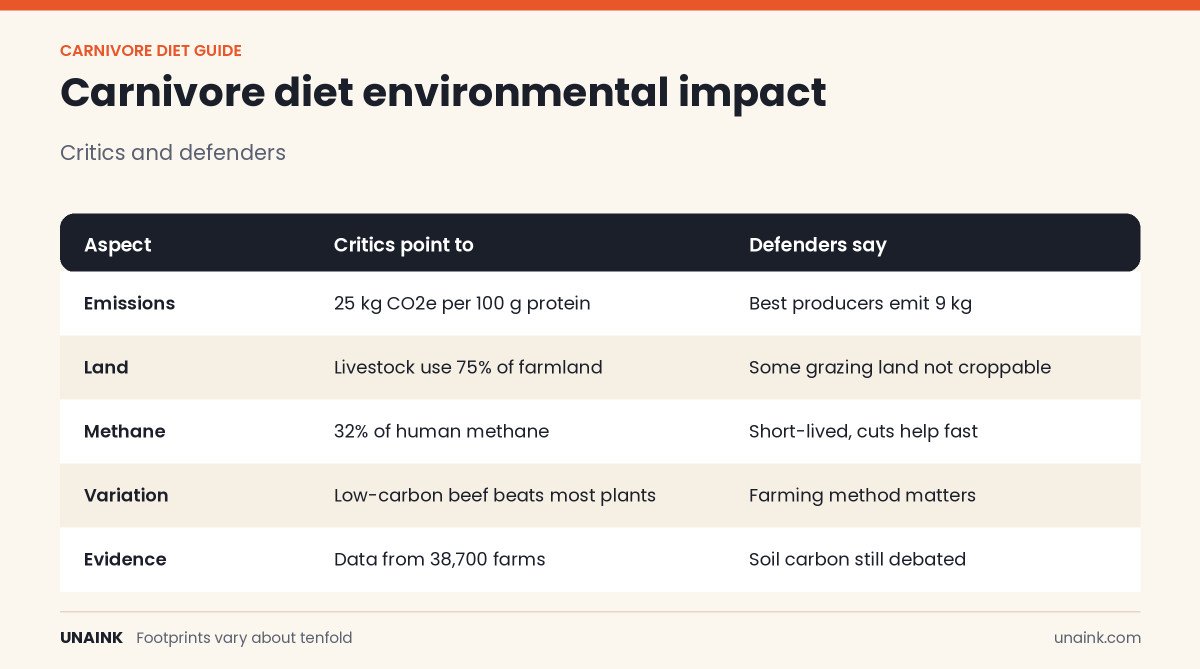
| Aspect | Critics point to | Defenders say |
|---|---|---|
| Emissions | Beef averages 25 kg CO2e per 100 g protein | Best producers emit about 9 kg |
| Land | Livestock use over three quarters of farmland | Some grazing land is not croppable |
| Methane | 32 percent of human-caused methane | Short-lived, so cuts help quickly |
| Variation | Even low-carbon beef beats most plants | Tenfold range shows farming matters |
| Evidence quality | Life-cycle data from 38,700 farms | Soil carbon offsets still debated |
Carnivore Is Not One Footprint
A ruminant-only plan such as the lion diet concentrates on the highest-emitting animals, while a plan with more eggs, fish or poultry spreads across other animal foods. The sources reviewed here quantified beef and dairy in detail, so exact figures for other animals are not stated. What the data do show is that beef sits at the high end.
Health and the Environment Are Separate Questions
A low-impact diet is not automatically healthy, and a healthy-seeming diet is not automatically low-impact. A 2026 scoping review of the carnivore diet found only nine small human studies and concluded long-term adherence cannot be recommended. See whether the carnivore diet is healthy and the red meat evidence.
Carnivore Diet Environmental Impact: The Short Version
The carnivore diet environmental impact is driven mostly by beef, with large uncertainty about offsets from good grazing. Weighing the carnivore diet environmental impact means looking at which animals you eat, how they are raised and how little is wasted.
Frequently Asked Questions
Is the carnivore diet bad for the environment?
Beef has a high footprint, so a beef-heavy carnivore diet likely has a larger footprint than most plant-rich diets. Actual impact depends on the foods and farms involved.
Is grass-fed beef better for the climate?
It depends on how the comparison is made. Production systems vary widely, and claims about soil carbon offsets are still debated.
How much CO2 does beef produce?
Our World in Data cites an average of about 60 kg CO2 equivalent per kg of beef, with large variation between producers.
Does eating organ meats help?
Using more of each animal can reduce waste, though the sources reviewed did not quantify the climate benefit.
Does environmental impact affect health advice?
No. Health and environmental questions are assessed separately. Talk to a clinician about the health side.
Conclusion
Beef is a high-footprint food, but footprints vary a great deal and some mitigation claims remain unsettled. If you are weighing diet choices for health or the planet, a doctor or dietitian can help with the health side.
Medical note
This article is for general education and is not medical advice. Talk with a doctor or registered dietitian before making major diet changes, especially if you have a health condition, take medication, or are pregnant or breastfeeding.
Keep Reading
- Grass-Fed vs Grain-Fed Beef: How the two compare.
- Nose-to-Tail Eating: Using more of the animal.
- Is Red Meat Bad for You?: Weighing cancer and heart risks.
- Is the Carnivore Diet Healthy?: Benefits and risks side by side.
Sources
- FAO GLEAM: results: Livestock emissions by species and source
- Our World in Data: environmental impacts of food: Beef footprint, land use and variation
- FAO: enteric methane background: Ruminant methane facts
- Carnivore Diet: A Scoping Review of the Current Evidence: Health evidence on carnivore diets