People keep asking, is the carnivore diet healthy, and the fair answer is that no one knows for the long term. Some followers report feeling better, while major health sources raise concerns about cholesterol, fiber, and missing nutrients. The research is thin enough that confident claims in either direction go beyond the evidence.
Quick Answer
There is no good long-term evidence that the carnivore diet is healthy or unhealthy. A 2026 scoping review of nine small human studies found short-term reports of weight loss and satiety but also higher LDL cholesterol and gaps in several nutrients, and concluded that long-term use cannot be recommended. Harvard Health and Cleveland Clinic voice similar caution.
Key Takeaways
- A 2026 scoping review found only nine mostly low-quality human studies and said long-term adherence cannot be recommended.
- Reported benefits, such as satiety and weight loss, come mostly from self-reported surveys and case reports.
- Harvard Health and Cleveland Clinic experts highlight LDL cholesterol, fiber, kidney, and cancer-risk concerns.
- Nutrients such as vitamin C, calcium, magnesium, and fiber often fall short in modeled meal plans.
- Anyone with a medical condition, medication, or pregnancy should talk with a clinician before trying it.
What the Research Actually Shows
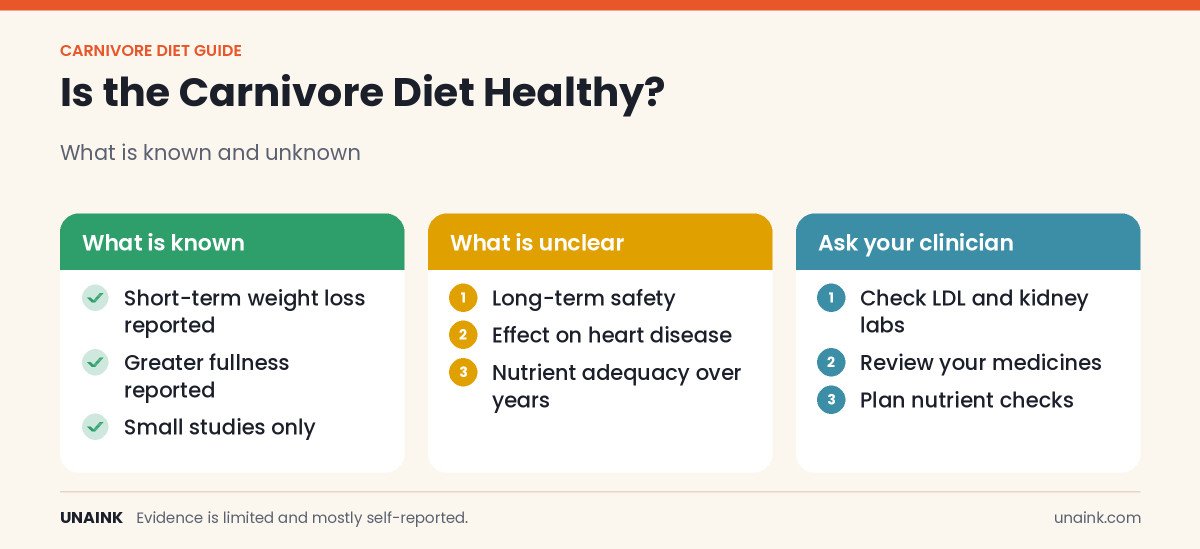
The most recent overview is a 2026 scoping review in Nutrients covering nine human studies published from 2021 to 2025. They included case reports, social media surveys, and modeling studies, with small samples, short durations, no control groups, and no standard definition of the diet.
Because of those limits, the authors said the evidence is very limited and that long-term adherence cannot be recommended, since long-term safety cannot yet be judged. Our carnivore diet benefits page lists what people report in more detail.
Is the Carnivore Diet Healthy? What Reported Benefits Look Like
The review noted weight loss and greater fullness, mostly from self-reported survey data. Triglycerides and HbA1c improved in participants who already had metabolic disorders, and a small group with inflammatory bowel disease showed lower fecal calprotectin. A 2021 survey of 2,029 adults reported high satisfaction among people who followed the diet.
Those findings are interesting but weak. Survey respondents choose themselves, recruiters often find enthusiasts, and no one can say whether improvements came from the diet, from cutting ultra-processed foods, or from ketosis, placebo effects, or simply eating fewer calories.
Concerns Raised by Experts
Harvard Health notes that animal fat is mostly saturated and raises LDL cholesterol, and links very high protein intake with kidney, kidney stone, gout, and bone concerns. The author said he would never recommend the diet for weight loss. Cleveland Clinic adds constipation, electrolyte problems, and the cancer link with large amounts of red meat.
- Lipids: LDL and total cholesterol rose in several studies, and one cohort moved from 157 to 256 mg/dL.
- Nutrients: modeled intakes fell short of references for vitamin C, vitamin D, calcium, magnesium, iodine, and fiber.
- Kidney and stones: one man with kidney stones worsened on the diet and improved after stopping.
- Cancer context: the WHO cancer agency classes red meat as probably carcinogenic and processed meat as carcinogenic, and says risk rises with intake.
Some of these effects may vary by person. Many followers eat fewer processed meats and more organs, which could change the picture, though the evidence is not yet there.
Who Needs Extra Caution
- Pregnant or breastfeeding people, children, and teens: no safety evidence, and nutrient needs are higher.
- People with kidney disease, gout, heart disease, or high LDL: ask a clinician first.
- People with diabetes taking insulin, sulfonylureas, or SGLT2 inhibitors: low carbohydrate changes can affect medication needs, so never adjust medicine without your care team.
- People on blood pressure drugs or diuretics: electrolyte shifts matter.
- Anyone with an eating disorder history: restrictive diets can be risky.
How to Think About It Practically
If you are curious, a time-limited trial with medical guidance and blood tests is more sensible than an open-ended commitment. Ask about lipids, kidney function, and nutrient status before and during the trial.
Quality still matters. Our carnivore food list and organ meat guide cover variety, and electrolytes explains common adaptation issues. A dietitian can also design a lower-risk approach, such as an elimination plan that adds foods back.
Is the Carnivore Diet Healthy: The Short Version
Asking is the carnivore diet healthy has no solid long-term answer today, and the available evidence leans cautious. If you still wonder is the carnivore diet healthy for you, the most defensible step is to discuss it with a clinician who can track your labs.
Frequently Asked Questions
Is the carnivore diet safe long term?
Long-term safety has not been studied well. The 2026 scoping review said long-term adherence cannot be recommended because safety cannot yet be judged.
What do doctors say about the carnivore diet?
Harvard Health and Cleveland Clinic experts voice concern, mainly about LDL cholesterol, fiber, kidney strain, and nutrient gaps. They note the evidence base is small.
Does the carnivore diet raise cholesterol?
It did in several of the reviewed studies, with LDL rising in some people. Responses vary, so ask a clinician to track your lipids.
Can the carnivore diet help with weight loss?
Some people report weight loss and fullness, mostly in self-reported data. Whether it is better or safer than other approaches is not known.
Who should avoid the carnivore diet?
Pregnant or breastfeeding people, children, people with kidney disease, and anyone with a complex condition or eating disorder history should seek medical guidance first.
Conclusion
The honest summary is mixed and uncertain. The carnivore diet may help some people feel better in the short term, yet the evidence is limited and major sources urge caution. Make decisions with a clinician and your own lab results, not with hype from either side.
Medical note
This article is for general education and is not medical advice. Talk with a doctor or registered dietitian before making major diet changes, especially if you have a health condition, take medication, or are pregnant or breastfeeding.
Keep Reading
- What Is the Carnivore Diet?: The basics of how it works.
- Carnivore Diet Benefits: What people report and what research says.
- How to Start the Carnivore Diet: A cautious way to begin.
- Carnivore Diet Electrolytes: Sodium, potassium, and magnesium basics.
Sources
- Nutrients (2026): Scoping review of the carnivore diet: Nine human studies, very limited evidence, long-term use cannot be recommended.
- Self-reported survey of 2,029 adults on a carnivore diet (2021): Self-reported survey with high satisfaction and clear limitations.
- Harvard Health: What is the carnivore diet?: Expert view on LDL, kidney, and other risks.
- Cleveland Clinic: The carnivore diet: Anecdotal benefits, risks, and a dietitian’s view.
- World Health Organization: Red meat and processed meat carcinogenicity Q&A: IARC classification and risk context.