Getting carnivore diet macros right mostly means balancing two numbers, fat and protein, since carbohydrates sit near zero. Too much lean meat can leave you hungry, while too much fat can upset digestion and stall weight loss. Understanding the ratio helps you choose cuts and adjust when something feels off.
Quick Answer
Carbohydrates are close to zero, so most calories come from fat and protein. Many people aim for roughly equal grams of fat and protein, or somewhat more fat, but there is no official or proven ratio. Choose cuts based on appetite, energy, and your clinician’s advice, especially if cholesterol is a concern.
Key Takeaways
- Carbs are near zero, so the real decision is the fat to protein balance.
- Fat has 9 calories per gram and protein has 4, so a gram ratio is not a calorie ratio.
- A typical ketogenic diet is about 70 to 75 percent fat, 20 percent protein, and 10 percent or less carbs.
- Standard guidelines recommend less saturated fat than most carnivore menus provide.
- There is no proven ideal ratio; adjust by hunger, energy, digestion, and lab work.
The Three Macros on Carnivore
Carbohydrates come from tiny traces in eggs, dairy, or organ meats, and protein and fat supply nearly everything else. Harvard Health describes carnivore as an extreme form of keto, where a typical keto plan runs about 70 to 75 percent fat, 20 percent protein, and no more than 10 percent carbohydrate. Carnivore plans do not have a fixed official split.
Fat vs Protein Ratio in Common Foods
Fat has more than twice the calories of protein per gram, so a food that looks balanced by grams is fat-heavy by calories. These are approximate calorie shares from fat in raw cuts, so check labels or USDA FoodData Central:
| Food | Approx. share of calories from fat | Typical use |
|---|---|---|
| 80/20 ground beef | About 70 to 75 percent | Satiating, easy base |
| 90/10 ground beef | About 55 percent | Middle ground |
| 93/7 ground beef | About 40 to 45 percent | Needs added fat |
| Whole eggs | About 60 percent | Flexible add-on |
| Chicken breast, white fish | Under 20 percent | Very lean, pair with fat |
Carnivore Diet Macros and Standard Guidelines
The National Academies acceptable ranges for adults are 10 to 35 percent of calories from protein, 20 to 35 percent from fat, and 45 to 65 percent from carbohydrate. Carnivore eating falls outside the carbohydrate and often the fat range. The 2025 to 2030 Dietary Guidelines also advise keeping saturated fat under 10 percent of calories, which fatty red meat can exceed.
That is why Cleveland Clinic and Harvard Health raise LDL cholesterol concerns. Evidence on carnivore eating is limited, so discuss labs with your clinician.
Signs Your Balance May Be Off
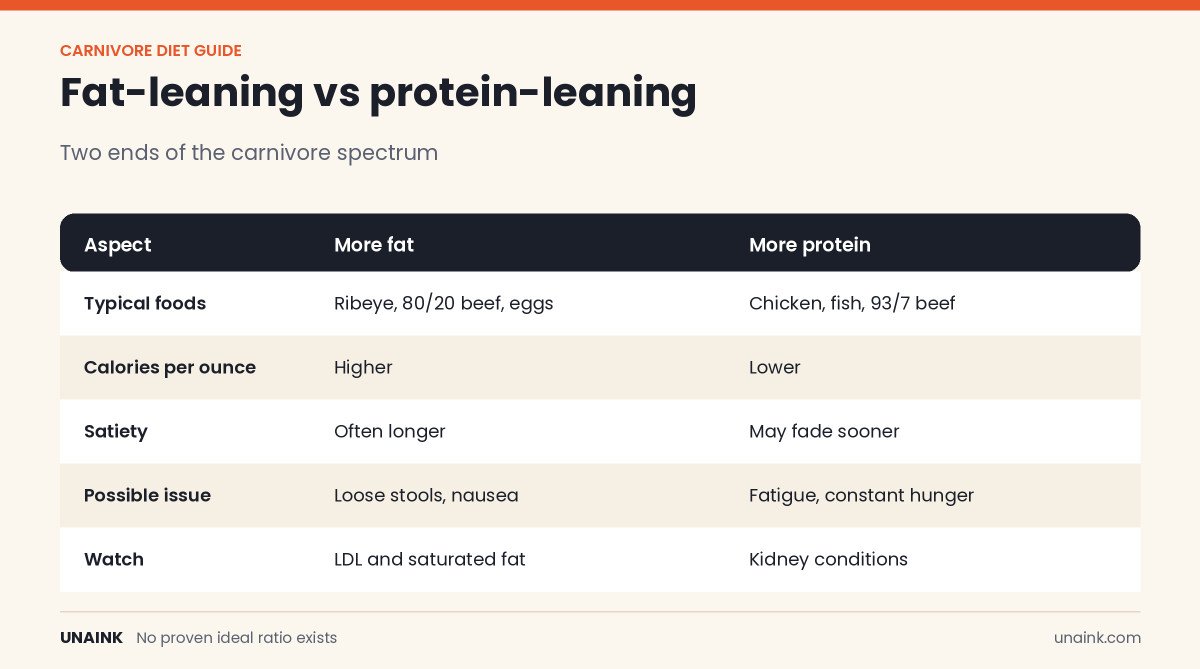
- Too lean: constant hunger, low energy, cravings, poor workouts. See rabbit starvation.
- Too fatty: loose stools, nausea, greasy meals that sit heavily, stalled weight loss.
- Too little food overall: cold, tired, hair shedding, or irregular cycles.
Related reading: how to get more fat on carnivore and carnivore diet nausea.
How to Adjust Your Mix
- Start with fattier cuts like ribeye, 80/20 beef, or salmon.
- Track hunger and energy for two weeks.
- If you are hungry or tired, add fat such as tallow or butter.
- If digestion is rough, reduce added fat and cook leaner cuts.
- Recheck labs with your clinician after a few months.
Who Needs Extra Care
A high-fat, high-protein pattern lacks safety evidence for pregnancy, breastfeeding, children, and teens. People with kidney disease, high LDL, gallbladder issues, or on insulin, sulfonylureas, SGLT2 inhibitors, diuretics, or blood pressure drugs should work with a clinician. Never change medication on your own.
Carnivore Diet Macros: The Short Version
Carnivore diet macros come down to fat and protein, with no proven ideal ratio, so pick fattier or leaner cuts to match your hunger and digestion. Review carnivore diet macros with a clinician, because saturated fat and LDL are real concerns.
Frequently Asked Questions
What is the ideal fat to protein ratio on carnivore?
There is no proven ideal. Many people aim for about equal grams of fat and protein, or more fat, then adjust to hunger and digestion.
Do I need to track macros on carnivore?
Not necessarily. Tracking for a couple of weeks can reveal if you are too lean or under-eating, then many people go by appetite.
Why do grams of fat and protein not match calories?
Fat has 9 calories per gram and protein has 4, so an equal gram split is mostly fat by calories.
Is 80/20 beef a good choice?
Many people like it for satiety and cost. It also carries more saturated fat, so consider your cholesterol.
Can too much protein hurt?
Very high intakes are a concern for people with kidney disease. Healthy kidneys are not generally harmed, according to a StatPearls review, but ask your clinician.
Conclusion
Macros on this diet are simple on paper and personal in practice. Use cut choice to dial fat up or down, watch energy and digestion, and keep lab work in the loop.
Medical note
This article is for general education and is not medical advice. Talk with a doctor or registered dietitian before making major diet changes, especially if you have a health condition, take medication, or are pregnant or breastfeeding.
Keep Reading
- How to Get More Fat on Carnivore: Practical ways to add fat.
- How Much Meat per Day: A protein-based formula.
- Carnivore Diet High Cholesterol: When rising LDL matters.
- What Is Beef Tallow: A common fat source.
Sources
- Harvard Health: What Is the Carnivore Diet?: Typical keto macro split and risks.
- National Academies: Macronutrient ranges: Acceptable ranges for adults.
- Oklahoma State Extension: 2025 to 2030 Dietary Guidelines: Saturated fat and protein guidance.
- StatPearls: Low-Carbohydrate Diet: Low-carb definitions and cautions.