

Carnivore diet high cholesterol is one of the most discussed results in this community, and also one of the most contested. LDL often rises on a diet built on animal fat, but whether that rise is harmless for a given person is not settled. This guide explains the numbers, what is known, and when to act.
Quick Answer
LDL cholesterol often rises on a carnivore diet because animal fat is mostly saturated fat, which raises LDL. Whether that increase carries the same heart risk when HDL is high and triglycerides are low has not been shown in long-term studies. The practical answer is to test, not guess: get a lipid panel before and after starting, ask about additional tests, and discuss any LDL rise with a clinician.
Key Takeaways
- Harvard Health notes that animal fat is mostly saturated and that keto diets tend to raise LDL.
- In a self-selected 2021 survey, those who reported lipids had a median LDL of 172 mg/dL, which the authors called markedly elevated.
- Long-term outcome data for carnivore diets do not exist, so the heart risk is unknown, not proven safe.
- Family history, diabetes, smoking, and an existing heart condition make a high LDL more worrying.
- Never stop or change cholesterol medicine without your prescriber.
Why LDL Often Rises
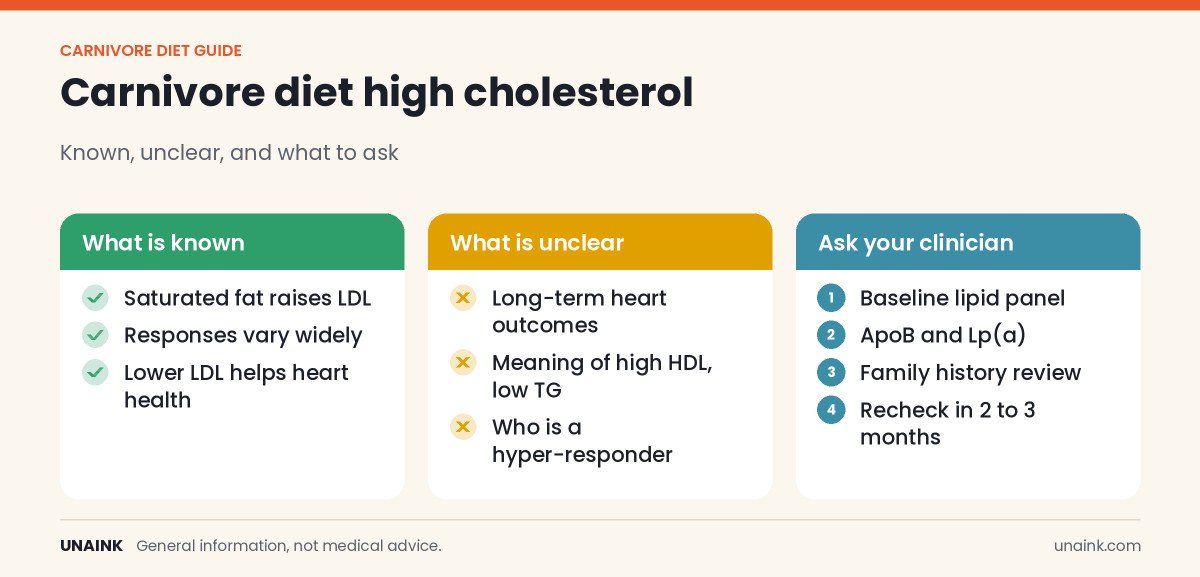
Harvard Health says animal fat is mostly saturated fat, which raises LDL, and that keto diets tend to raise it in both the short and long term. Cleveland Clinic makes the same point and notes that the American Heart Association recommends limiting red meat. Individual responses vary widely, and genetics play a role. Losing weight can lower LDL for some people, while eating more fat can lift it for others.
What the Numbers Mean
MedlinePlus lists less than 100 mg/dL as a healthy LDL for most adults, and the American Heart Association says targets depend on age, family history, diabetes, and past heart events. People at very high risk may aim for 70 or 55 mg/dL. In the 2021 survey, the subset reporting lipids averaged LDL 172, HDL 68, and triglycerides 68 mg/dL. The authors called HDL and triglycerides optimal and LDL markedly elevated. But respondents were self-selected, and the numbers were self-reported.
| Marker | Healthy reference | Why it matters |
|---|---|---|
| LDL-C | Under 100 mg/dL for most adults | Linked with artery buildup |
| HDL-C | 60 mg/dL or higher is best | Higher is generally preferred |
| Non-HDL | Under 130 mg/dL | Captures all atherogenic particles |
| Total cholesterol | Under 200 mg/dL | Broad screening number |
What Is Known and Unknown
The AHA says lower LDL is linked with better heart and brain health. That evidence comes from many studies of other eating patterns. For carnivore specifically, we do not have trials tracking heart attacks or strokes. A 2026 scoping review of nine human studies concluded that evidence is very limited and that long-term use cannot be recommended. Some people describe a lean, low-carb pattern with very high LDL, sometimes called a lean mass hyper-responder phenotype; a published case report discusses this, but it is not proof that the pattern is safe.
Tests to Ask Your Clinician About
- A full lipid panel before starting and again after about 8 to 12 weeks.
- ApoB and Lp(a), which some clinicians use to refine risk.
- Blood pressure, A1c or fasting glucose, and kidney function.
- A coronary artery calcium scan, if your clinician thinks it fits your risk.
- Family history review, including early heart disease.
A clinician interprets these in context. For related background, see carnivore diet and heart health and triglycerides on carnivore.
When Rising LDL Matters Most
Act sooner if your LDL is very high, rising quickly, or you have diabetes, high blood pressure, kidney disease, a family history of early heart disease, or you smoke. A very high LDL can also reflect an inherited condition, which needs evaluation. Options your doctor may discuss include changing the types of fat and protein you eat, a different overall diet, or medicine. If you already take a statin or other drug, do not stop it because of what you read online.
Warning Signs Need Emergency Care
- Chest pain or pressure, especially with sweating, nausea, or pain spreading to the arm or jaw.
- Sudden shortness of breath, fainting, or severe dizziness.
- Sudden weakness, face drooping, or trouble speaking.
- Pain, swelling, or discoloration in a leg.
High cholesterol itself usually causes no symptoms, which is why blood tests matter.
Carnivore Diet High Cholesterol: The Short Version
Carnivore diet high cholesterol is a real and common finding, and the long-term meaning is uncertain. Test your lipids, understand your personal risk, and work with a clinician instead of assuming carnivore diet high cholesterol is either dangerous or harmless.
Frequently Asked Questions
Does carnivore always raise LDL?
No. Responses vary widely, though many people see increases.
Is high LDL with high HDL fine?
That has not been demonstrated in long-term carnivore studies. Discuss your full picture with a clinician.
How often should I test?
A baseline and a repeat after about two to three months are common. Your clinician may suggest a different schedule.
Can I lower LDL and stay carnivore?
Some people try leaner meats or less saturated fat. Results vary, and a clinician can guide you.
Should I stop a statin?
No. Do not stop or change prescribed medicine without talking to your prescriber.
Conclusion
Cholesterol is a measurable piece of the puzzle on a diet with limited evidence. Get numbers, share them with a professional, and make decisions based on your overall risk. Carnivore diet high cholesterol is not a reason to panic, but it is a reason to test and track. If you see carnivore diet high cholesterol on your lab report, repeat the test and review it with a professional.
Medical note
This article is for general education and is not medical advice. Talk with a doctor or registered dietitian before making major diet changes, especially if you have a health condition, take medication, or are pregnant or breastfeeding.
Keep Reading
- Carnivore Diet and Heart Health: What is known about cardiovascular risk.
- Carnivore Diet Triglycerides: The other lipid number.
- Is Saturated Fat Bad for You?: The evidence explained.
- Carnivore Diet Long-Term Effects: What we know and do not know.
Sources
- Harvard Health: What is the carnivore diet?: Saturated fat, LDL, and risks
- Self-reported survey of 2029 adults consuming a carnivore diet: Lipid values reported by participants
- American Heart Association: What your cholesterol levels mean: LDL and heart risk, individual targets
- MedlinePlus: Cholesterol levels: Adult reference values
- Case report: lean mass hyper-responder phenotype: Discussion of very high LDL on low carb diets

[…] see large LDL rises. Ask your clinician whether to track LDL, ApoB, or a calcium score. See carnivore diet and high cholesterol and carnivore diet and heart […]
[…] Carnivore Diet High Cholesterol: LDL changes and what to monitor. […]