Strength dropping, clothes loosening in odd places, or a softer look despite a lower number on the scale can make anyone worry about losing muscle on carnivore diet plans. It can happen on any way of eating, and the cause is usually total calories, protein amount, or training habits rather than meat itself. Here are the usual culprits and how to check what is really going on.
Quick Answer
Yes, you can lose muscle on carnivore, mostly when total calories are too low, protein is low for your size and age, or you stop lifting. Meat is a rich protein source, so the diet is not built to waste muscle, but rapid fat loss often takes some lean mass with it. Resistance training, enough food, and tracking real progress markers help protect muscle.
Key Takeaways
- Weight loss on any plan includes some lean mass, and carnivore is no exception.
- The first fast drop on the scale is mostly water and stored carbohydrate, not muscle.
- Eating too little overall is the most common cause, and protein amount matters second.
- Lifting weights and spreading protein across meals do more for muscle than any food rule.
- No trial has followed muscle mass on a carnivore diet, so advice here rests on general nutrition science.
Is it really muscle? How to tell
Your body stores carbohydrate together with water, so when carbs drop the scale can fall quickly in the first weeks. That early change is not muscle. Real muscle loss shows up as lifts getting heavier to complete, slower recovery, and tape measurements shrinking at the thighs, arms, or shoulders.
- Track the weight you lift or reps you complete for three or four key exercises.
- Take tape measurements monthly instead of relying only on the scale.
- If you want numbers, a DEXA scan is more reliable than most home scales.
- Compare photos taken in the same light every four weeks.
Common reasons for losing muscle on carnivore diet
The evidence on carnivore is thin. A 2026 scoping review found only nine human studies and called the evidence very limited (Nutrients review), so these reasons come from general nutrition principles applied to an all-animal plan.
| Cause | Why it happens | What to adjust |
|---|---|---|
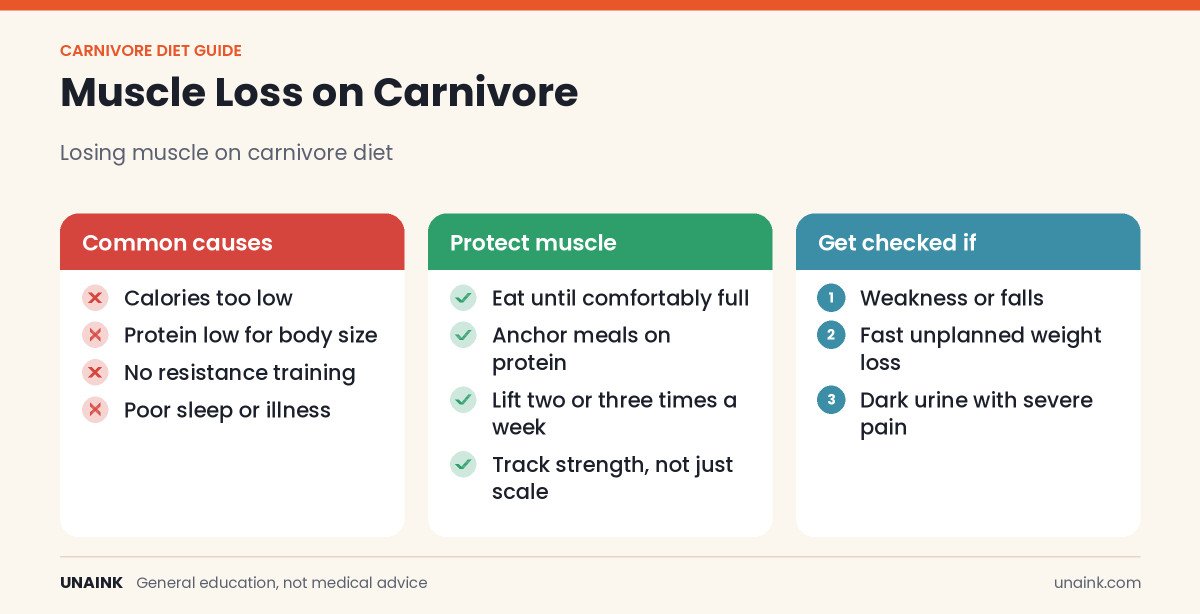
| Calories too low | Fatty meat is filling, appetite may shrink, and fasting windows add up | Eat until comfortably full and consider an extra meal (see how many meals a day on carnivore diet) |
| Protein low for your size | Bacon, eggs, and tallow-heavy meals can be fat-rich but protein-light | Anchor meals on steak, ground beef, fish, or poultry |
| Very lean only | Too little fat means energy shortfalls (see rabbit starvation) | Mix lean and fatty cuts |
| No resistance training | Muscle needs a reason to stay | Lift two or three times a week |
| Age, illness, poor sleep | All raise the risk of lean mass loss | Prioritize rest and talk with a clinician |
| Electrolyte problems | Cramps and weakness cut training quality (see carnivore diet electrolytes) | Review salt, fluids, and minerals |
How much protein is enough?
The US recommended dietary allowance of 0.8 grams per kilogram of body weight is a minimum to prevent deficiency in most healthy adults. Active people, older adults, and people losing weight are often advised to aim higher, and sports nutrition groups commonly cite about 1.2 to 2.0 grams per kilogram for active adults. For an 80 kg person, that is roughly 96 to 160 grams a day.
As a rough guide, 100 grams of cooked beef or chicken provides about 25 to 30 grams of protein, and a large egg about 6 grams. Very high protein is not right for everyone, especially people with kidney disease, so read is carnivore diet bad for kidneys and ask your clinician before raising intake.
Training, sleep, and recovery
Protein alone does not hold muscle. Progressive resistance training is the main signal that tells the body to keep it. Two or three full-body sessions a week, with weights that get gradually heavier, is a practical starting point.
- Pair a calorie deficit with strength work, not with extra cardio only.
- Aim for steady sleep, since poor sleep makes recovery harder.
- Avoid cutting calories deeply while training hard.
- See carnivore diet for muscle gain and carnivore diet for athletes for training-focused guidance.
Older adults, medications, and other cautions
Muscle loss is a bigger concern with age, so older adults who change their diet should have a plan and medical oversight (see carnivore diet for seniors). Appetite-suppressing medicines such as GLP-1 drugs can also lead to losing lean mass along with fat, and an all-meat plan has not been studied in that group (see carnivore diet on glp 1 medications). Anyone with kidney disease, an eating disorder history, or a chronic condition should speak with a clinician before changing protein intake. Do not change any medication on your own.
When to get checked
- Unexplained weakness, trouble climbing stairs, or falls
- Rapid weight loss you did not plan
- Severe muscle pain with dark urine after hard exercise (seek urgent care)
- Numbness, swelling, or new fatigue alongside muscle loss
- Muscle loss that continues despite eating more and lifting
A clinician can look at thyroid function, vitamin levels, kidney markers, and medication effects that diet changes alone will not fix.
Losing Muscle on Carnivore Diet: The Short Version
Losing muscle on carnivore diet plans usually traces back to eating too little, too little protein for your size, or no strength training. If you are worried about losing muscle on carnivore diet, track strength and measurements, eat enough food, lift weights, and speak with a clinician if weakness shows up.
Frequently Asked Questions
Does carnivore cause muscle loss?
Not by itself. Meat provides high-quality protein, but any diet that cuts calories sharply, or is paired with no strength training, can lead to lean mass loss.
How much protein should I eat on carnivore?
The recommended allowance is 0.8 grams per kilogram as a minimum, and active adults often aim higher, around 1.2 to 2.0 grams per kilogram. Individual needs vary, so ask a dietitian, especially with kidney issues.
Is early weight loss on carnivore muscle?
Mostly no. The first weeks involve a loss of stored carbohydrate and water, which can drop the scale quickly without affecting muscle.
Can too much lean meat cause problems?
Eating only very lean meat with little fat can leave you short on energy and is linked to the old idea of rabbit starvation. A mix of fatty and lean cuts is a more balanced approach.
Should I take creatine or supplements?
Supplements are a personal decision and should be discussed with a clinician or dietitian, especially if you have kidney concerns or take medications.
Conclusion
Muscle is easier to keep than to rebuild. Eat enough, choose protein-dense foods at most meals, lift regularly, and check your progress with more than the scale. If strength keeps slipping, get medical advice rather than cutting calories further.
Medical note
This article is for general education and is not medical advice. Talk with a doctor or registered dietitian before making major diet changes, especially if you have a health condition, take medication, or are pregnant or breastfeeding.
Keep Reading
- Carnivore Diet for Muscle Gain: Training and protein for building lean mass
- How Many Calories on Carnivore Diet: Check whether your intake is high enough
- Rabbit Starvation: Why very lean meat alone can backfire
- Carnivore Diet for Seniors: Extra cautions for older adults
Sources
- What Is the Carnivore Diet? (Harvard Health): overview of risks and evidence
- The Carnivore Diet (Cleveland Clinic): dietitian view of nutrient gaps and risks
- Carnivore diet scoping review (Nutrients, 2026): very limited human evidence
- Self-reported carnivore diet survey: 2,029 adults, self-reported data