
A carnivore diet for women raises questions that most online advice skips: how it fits with the menstrual cycle, iron needs, bone health, and the hormone shifts of midlife. Many women say they feel better eating only animal foods, yet no controlled trial has tested this diet in women. This guide explains what is known, what is only anecdotal, and who should talk to a clinician first.
Quick Answer
There is no good evidence that a carnivore diet for women improves hormones or menstrual cycles, and no long-term safety data exists. Some women report steadier energy and fewer cravings, but those reports are self-selected and unverified. The biggest practical risk is under-eating, which can disrupt periods on any restrictive plan.
Key Takeaways
- No trial has tested a carnivore diet in women, so claims about hormones are anecdotal.
- Eating too little, not carbohydrate alone, is the best-documented cause of missed periods.
- Women have higher iron needs before menopause and higher calcium needs after it.
- Animal fat is mostly saturated, and keto-style diets tend to raise LDL cholesterol in many people.
- Pregnancy, breastfeeding, eating disorder history, and kidney disease call for medical guidance first.
What a Carnivore Diet for Women Actually Involves
The plan is meat, fish, eggs, and sometimes dairy, with no plant foods at all. Harvard Health describes it as an extreme version of a ketogenic diet and cautions against it. For a broader primer, see what the carnivore diet is.
The research base is thin for everyone. A 2026 scoping review found only nine human studies and concluded that long-term use cannot be recommended. The largest data set is a self-reported survey of 2,029 adults who chose the diet themselves. Neither was designed to answer questions about cycles or female hormones.
Hormones and Menstrual Cycles: What Is Known
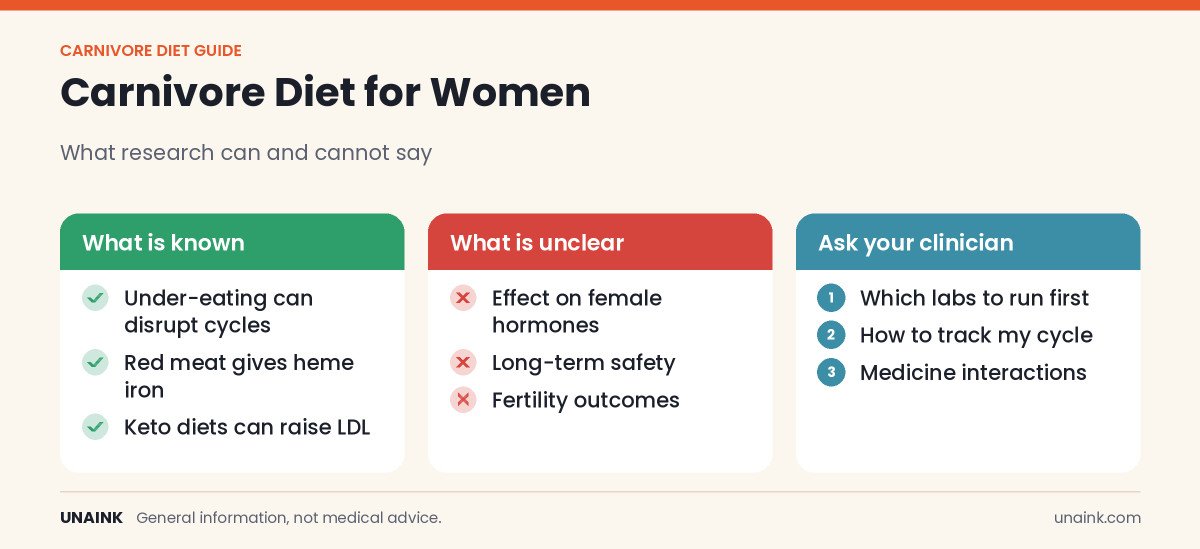
Reproductive hormones such as estradiol and progesterone depend on the body getting enough energy. Sports medicine research on low energy availability shows that too few calories for a body’s needs can disrupt menstrual function and weaken bone, as the IOC consensus statement on RED-S explains. That finding is about energy, not about meat.
It still matters here. Animal foods are filling, and many people eat less without meaning to. A woman who loses her appetite on this diet can drift into under-eating, and her cycle may be the first thing to show it.
Signs You Are Not Eating Enough
These signs can have many causes, so they are a reason to check in with a clinician, not to self-diagnose.
- Periods that become irregular or stop for several months
- Hair shedding that is new or heavier than usual
- Feeling cold much of the time
- Poor sleep, dizziness, or persistent fatigue
- Low mood or an intense preoccupation with food rules
Some women report lighter periods or milder PMS on this diet. Others report the opposite. Neither claim has been verified, and weight loss, placebo effects, and cutting out ultra-processed foods could all play a part.
Iron, Calcium, and Other Nutrient Gaps
| Nutrient | Why women need attention | On a carnivore plan |
|---|---|---|
| Iron | The NIH recommendation is 18 mg a day for ages 19 to 50 and 8 mg from 51 | Red meat supplies well-absorbed heme iron, a real strength |
| Calcium | The NIH recommendation is 1,000 mg a day to age 50 and 1,200 mg for women 51 to 70 | Hard to reach without dairy or bone-in canned fish |
| Folate, magnesium, vitamin C | Plant foods are the main sources for most people | Organ meats and fish help, but long-term intakes are rarely measured |
Women who skip dairy should look closely at calcium and vitamin D. A blood test for ferritin, vitamin D, and a complete blood count gives a clearer picture than guessing.
Heart Health and Cholesterol
Harvard Health notes that animal fat is mostly saturated and that keto diets tend to raise LDL cholesterol. A review of the American Heart Association’s 2020 scientific statement in the Cleveland Clinic Journal of Medicine treats menopause itself as a cardiovascular risk factor. Women with high LDL, a family history of early heart disease, or midlife changes should get a lipid panel before starting and again after a few months.
Who Should Not Try It Alone
- Anyone who is pregnant, trying to conceive, or breastfeeding (see carnivore diet while pregnant)
- Anyone with a history of disordered eating
- People with kidney disease, gout, or osteoporosis
- Women taking insulin, blood pressure medicine, diuretics, or thyroid medicine
- Teens, whose growth and bone building are still underway
Never change a prescription on your own. Diet changes can shift how much medicine you need, so any adjustment should come from your prescriber.
Questions to Ask Your Clinician
- Which baseline labs make sense for me: lipids, ferritin, A1c, thyroid, vitamin D?
- How should I track my cycle and what change should prompt a call?
- Does this diet interact with my medicines or conditions?
- Is a dietitian-guided approach a safer way to reach my goal?
Carnivore Diet for Women: The Short Version
A carnivore diet for women remains an unstudied experiment, so personal results are not proof of safety. If you choose to try a carnivore diet for women, do it with lab monitoring, enough food, and a clinician who knows your history.
Frequently Asked Questions
Does a carnivore diet affect periods?
Research on low energy intake shows that under-eating can disrupt periods. No study has tested whether a carnivore diet itself changes cycles, so reports are anecdotal.
Is a carnivore diet safe for women?
Safety is unknown over the long term. Risks include low calcium, higher LDL for some people, and under-eating. Medical guidance is wise.
Can women get enough iron on a carnivore diet?
Red meat contains well-absorbed heme iron, so many women can meet needs. Premenopausal women should still check ferritin and blood counts.
Will it balance my hormones?
There is no evidence that it does. Hormone problems such as PCOS or thyroid disease need proper diagnosis and treatment.
Should I try it while trying to conceive?
Talk to your doctor first. There is no safety evidence for pregnancy or conception planning on this diet.
Conclusion
Women deserve more than slogans about hormones. The honest picture is a diet with some strong iron sources, real gaps, and almost no female-specific research, so keep your cycle, labs, and energy intake in view and bring a clinician into the plan.
Medical note
This article is for general education and is not medical advice. Talk with a doctor or registered dietitian before making major diet changes, especially if you have a health condition, take medication, or are pregnant or breastfeeding.
Keep Reading
- Carnivore Diet for Women Over 50: What changes after menopause.
- Carnivore Diet While Pregnant: What doctors say about safety.
- How to Start the Carnivore Diet: A cautious starting guide.
- Carnivore Diet Electrolytes: Sodium, potassium, and magnesium basics.
Sources
- Harvard Health: What is the carnivore diet?: Expert commentary on risks
- Nutrients 2026 scoping review of carnivore diets: Nine human studies, very limited evidence
- NIH ODS: Iron fact sheet: Recommended intakes
- NIH ODS: Calcium fact sheet: Recommended intakes
- IOC consensus statement on RED-S, 2018 update: Low energy availability and health
[…] Carnivore Diet for Women: Hormones and nutrient needs. […]
[…] Carnivore Diet for Women: Hormones, cycles, and nutrient gaps. […]
[…] If you are breastfeeding, periods may be absent for natural reasons, and the diet carries its own question marks (see carnivore diet while breastfeeding). For a broader look at the diet and female health, read carnivore diet for women. […]