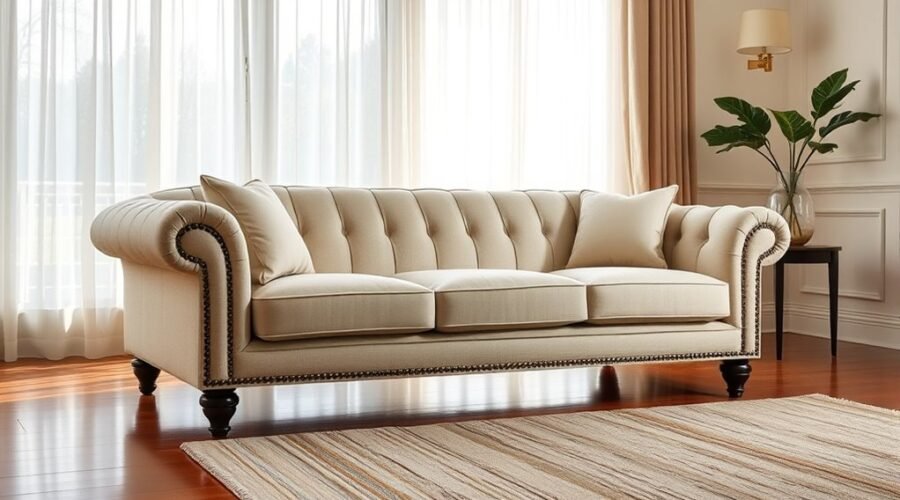
A roll arm sofa combines a soft, curved arm profile with a classic upholstered shape that can work in traditional, transitional, farmhouse, and even modern rooms. The arm style gives the sofa much of its character, but comfort depends just as much on seat depth, cushion firmness, back angle, suspension, and overall proportions. Understanding those details helps you choose a sofa that looks right and actually fits the way you sit.
Quick Answer
A roll arm sofa has padded arms that curve or roll outward rather than ending in a straight, square edge. An English roll arm version typically uses lower, set-back arms with a relaxed seat. The style is versatile, but frame construction, cushion materials, seat depth, and firmness vary widely by manufacturer.
Key Takeaways
- A roll arm sofa is identified mainly by its softly curved or outward-rolling upholstered arms.
- An English roll arm usually has lower, set-back arms and relaxed proportions, but details differ among manufacturers.
- Comfort depends on seat depth, height, cushion firmness, back angle, and suspension—not the arm shape alone.
- Frames, springs, webbing, foam, latex, fiber, feather, and down are all possible construction materials.
- Measure both the room and the full delivery path before ordering.
- Follow the upholstery manufacturer’s cleaning code instead of assuming water or mild soap is safe for every fabric.
What Is a Roll Arm Sofa?
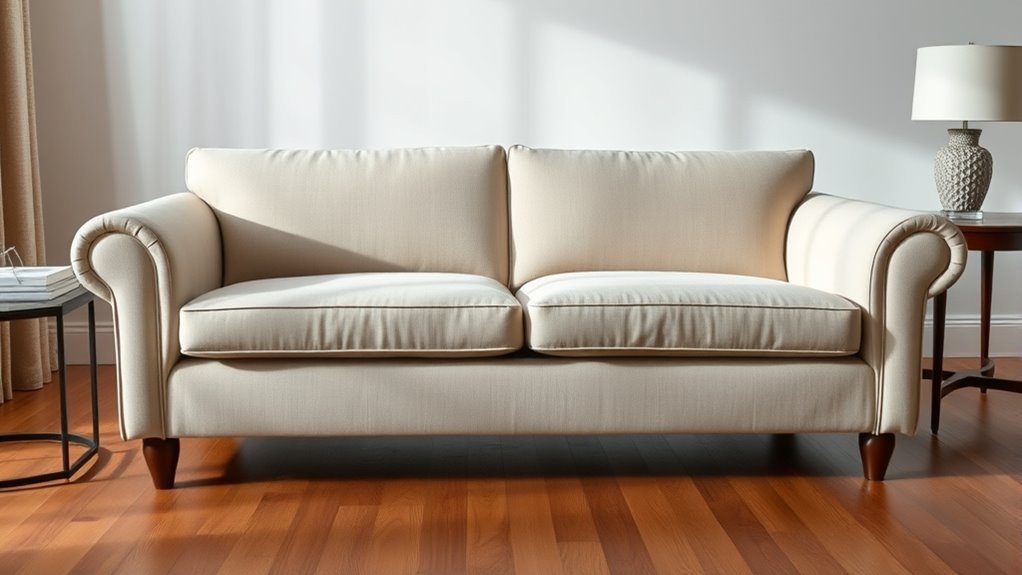
A roll arm sofa is defined primarily by upholstered arms that curve outward or downward instead of ending in a straight track-arm profile. The curve softens the sofa’s outline and gives it the traditional character associated with many British-inspired designs.
The term covers more than one variation. Some sofas have high, heavily rounded arms, while an English roll arm sofa usually has lower arms that sit slightly back from the front edge of the seat. English versions often pair those arms with loose cushions, visible legs, and a relaxed seating position.
The rolled arm defines the silhouette, but seat depth, cushion construction, and back support usually matter more to how comfortable the sofa feels.
This versatility is one reason the shape works in many interiors. Linen or cotton can make it feel relaxed, velvet can push it in a richer direction, and a cleaner leg or cushion treatment can make the same basic silhouette feel more contemporary.
Many models also offer several widths, cushion configurations, and upholstery choices. That means the useful question is not simply whether you like a roll arm, but whether a particular sofa’s dimensions and construction fit your room and sitting habits.
Rolled Arm vs. English Roll Arm
These terms are related, but they are not always interchangeable. A rolled arm is a broad description for an arm that curves outward. An English roll arm is a more specific interpretation that typically uses a lower, recessed arm with a relaxed seat and traditional British influence.
| Style | Typical Arm | Overall Feel |
|---|---|---|
| English roll arm | Low, rounded, often set back from the seat front | Relaxed, traditional, adaptable |
| Traditional rolled arm | Can be higher, fuller, or more prominently rounded | Classic and often more formal |
| Track arm | Straight and squared | Clean, modern, architectural |
| Lawson-style arm | Usually lower than the back; may be rounded or squared | Casual and tailored |
Why Roll Arm Sofas Feel So Comfortable
A roll arm can provide a comfortable place to rest an elbow or lean against, especially when the arm is low and padded. However, the arm alone does not determine comfort. The seat depth, seat height, cushion firmness, back angle, and suspension have a much larger effect on how your body feels after an hour of sitting.
- A low padded arm can give your arms a relaxed resting point.
- A slightly reclined back can encourage lounging.
- Deeper seating gives you more room to curl up or stretch out.
- Shallower seating may give shorter users better foot and lower-back support.
- Coil springs, sinuous springs, webbing, and other suspension systems can all provide effective support when properly engineered.
- Foam, latex, fiber, feather, and down create very different firmness and maintenance levels.
Pro Tip: If possible, sit on the sofa for several minutes before buying. Your feet should feel comfortably supported, and you should not need to slide forward or pile on pillows just to reach the backrest.
Deep cushions can create an inviting lounge feel, but they are not automatically better. A very deep sofa may be ideal for reclining or napping yet uncomfortable for a shorter person who prefers upright sitting. That is why individual dimensions matter more than broad labels such as “plush” or “English style.”
Where the Roll Arm Sofa Design Came From
The roll arm belongs to a long tradition of upholstered British seating that developed through the Georgian and Victorian periods. One influential name is Howard & Sons, a London furniture maker founded in 1820 that became especially well known for upholstered seating.
Sotheby’s documentation notes that George Howard patented an “Elastic Seat” in 1866, reflecting the period’s growing attention to comfortable upholstered construction. Surviving Howard & Sons sofas also show outward scroll arms, deep upholstered forms, tapered legs, and casters.
It is safer to view Howard & Sons as an important Victorian influence rather than the sole inventor of the English roll arm. Rolled and scrolled upholstered arms appeared in multiple furniture forms, and the familiar modern category developed through continued reinterpretation.
That heritage explains why the design can feel traditional without looking rigid. The low arm, generous seat, and relatively simple outline can be dressed up for a formal sitting room or simplified for a casual apartment.
Roll Arm Sofa vs. Other Sofa Styles
A roll arm sofa sits between highly formal traditional furniture and very linear modern seating. The curved arm softens the profile, while exposed legs, loose cushions, a bench seat, or streamlined upholstery can make the design feel lighter.
- Compared with a track-arm sofa: a roll arm looks softer and more traditional, while a track arm creates cleaner straight lines.
- Compared with a Chesterfield: a roll arm sofa usually has less button tufting and a more relaxed seat-and-back arrangement.
- Compared with a Lawson sofa: both can be casual and comfortable, but an English roll arm has a more distinctive low, curved arm profile.
- Compared with a sectional: a standard sofa usually takes less visual and physical space, but it also offers less sprawling seating.
- Compared with many mid-century sofas: a roll arm trades sharp lines and thin arms for softer curves and a more traditional presence.
Do not assume every roll arm works in a small room. A low arm can visually reduce bulk, but some models are more than 40 inches deep. Always compare the actual width and depth with your floor plan.
The Frame and Springs Inside a Roll Arm Sofa
There is no single frame or suspension system used in every roll arm sofa. The arm shape describes the exterior design, not the hidden construction.
A premium traditional build may use solid hardwood and coil springs. For example, the current Roseland Rolled Arm Sofa uses a solid maple-and-poplar frame, hand-tied coil springs, and oak or walnut legs. That is one manufacturer’s specification, not a requirement for the style.
Other well-made rolled-arm sofas use different methods. West Elm’s current Parlor Sofa, for example, uses a kiln-dried solid-pine and engineered-wood frame with webbed seat and back support.
| Component | Common Options | What to Check |
|---|---|---|
| Frame | Solid hardwood, engineered hardwood, plywood, or combinations | Joinery, reinforcement, warranty, and manufacturer specifications |
| Suspension | Eight-way hand-tied coils, sinuous springs, webbing, or other systems | Even support, noise, sagging, and serviceability |
| Legs | Various hardwoods, painted wood, metal, casters | Attachment method, floor protection, and whether they can be removed for delivery |
If you would like guidance on construction details, contact the sofa’s manufacturer or retailer and ask for the actual frame, suspension, cushion, and warranty specifications rather than relying on the style name alone.
What’s Inside the Cushions?
Roll arm sofa cushions can contain polyurethane foam, latex, polyester fiber, feathers, down, or layered combinations. There is no standard filling simply because the sofa has rolled arms.
Some cushions are firm and tailored; others are intentionally soft and require regular reshaping. Check whether cushions are removable, reversible, zippered, or permanently attached because those details affect both maintenance and long-term wear.
Cushion Core Materials
The cushion core has a major effect on support and recovery. High-resiliency polyurethane foam is common because it can provide predictable structure. Latex is used in some premium or specialty sofas and tends to rebound quickly. Fiber wraps and feather/down envelopes can soften the surface feel around a firmer core.
One current Roseland configuration uses GOLS-certified organic latex cores with a 95:5 feather-and-down surround. Other rolled-arm models use polyurethane foam with down or fiber wraps instead, so this should be treated as a product-specific example.
If a sofa contains CertiPUR-US-certified flexible polyurethane foam, the certification applies to that foam and indicates that it meets the program’s criteria for content, emissions, and durability. It does not certify the entire sofa.
- Latex can provide resilient support and quick shape recovery.
- Polyurethane foam can range from soft to firm depending on density and formulation.
- Fiber wraps add surface softness.
- Feather and down increase loft and softness but usually require more reshaping.
- Mixed constructions can balance support with a softer top layer.
Feather-Down Fill
Feather-down fill creates an inviting, moldable surface feel, especially when it surrounds a supportive foam or latex core. The trade-off is maintenance: feathers shift with use, and cushions may develop a relaxed appearance unless they are fluffed and rotated.
A 95% feather and 5% down blend is one specific formulation used by some manufacturers, but it should not be assumed to be standard. Other cushions use different feather/down ratios, synthetic fiber, foam-only construction, or no natural filling at all.
Feather and down do not automatically make a sofa more ergonomic. Proper posture depends on the relationship between the sitter and the sofa’s seat depth, seat height, lumbar support, back angle, and cushion firmness.
Fluffing And Care
Loose cushions generally last and look better when their filling is redistributed periodically. The correct routine depends on the cushion design and the manufacturer’s instructions.
- Fluff loose feather, down, or fiber cushions when they begin to look compressed.
- Rotate or flip reversible cushions to spread wear.
- Pat edges and corners to restore the intended shape.
- Inspect seams, zippers, and cushion ticking during routine cleaning.
- Use only upholstery-cleaning methods permitted by the fabric’s care code.
Wooden legs should also be cleaned according to their finish. Beeswax may suit certain finishes, but it is not appropriate as a universal treatment for every painted, lacquered, oiled, or sealed wooden leg.
Best Fabrics for a Roll Arm Sofa
The best upholstery depends on where the sofa will live and how it will be used. A formal sitting room has different requirements from a family room shared with children or pets.
Before choosing by appearance alone, check the fabric’s cleaning code, durability rating, weave, texture, stain treatment, and whether the cover can be removed. Performance upholstery can be useful in busy rooms, while natural fibers may appeal to buyers who prioritize hand feel and texture.
Durable Everyday Fabrics
Cotton blends, tightly woven synthetics, performance fabrics, and some leathers can work well for frequent use, but durability varies from one textile to another. A fiber name by itself does not tell you how a fabric will perform.
- Tightly woven upholstery generally handles abrasion better than loose decorative weaves.
- Performance treatments can make some fabrics easier to clean.
- Mid-tone, heathered, or textured fabrics can visually disguise minor everyday wear.
- Removable covers may simplify maintenance when the manufacturer allows laundering or professional cleaning.
- Always check the cleaning code before treating a spill.
Velvet, Linen, And Leather
Velvet, linen, and leather can all suit a roll arm sofa, but each creates a different look and maintenance routine.
| Material | Strength | Consideration |
|---|---|---|
| Velvet | Rich color, soft hand, traditional or dramatic look | Pile can show pressure, shading, or marks depending on fiber and finish |
| Linen | Light, textured, relaxed appearance | Wrinkling and stain resistance vary; blends and performance finishes behave differently |
| Leather | Distinctive aging, easy dust removal, strong visual character | Care depends on leather type and finish; sunlight and heat can cause fading or drying |
| Performance fabric | Designed for demanding everyday use | Cleaning method and performance still vary by manufacturer |
How to Choose the Right Size and Seat Depth
A sofa can look perfect online and still feel wrong once you sit on it. Check both the sofa’s exterior size and the dimensions that affect your body.
- Overall width: determines how much wall or floor space the sofa occupies.
- Inside seat width: tells you how much actual sitting space remains between the arms.
- Seat depth: affects whether you can sit upright with back support or prefer a deeper lounge position.
- Seat height: affects how easily your feet reach the floor and how easy it is to stand up.
- Arm width: thick rolls can consume more of the overall width than narrow, recessed English arms.
- Overall depth: determines how far the sofa projects into the room and affects delivery clearance.
For reference, current made-to-order English roll arm sofas can vary substantially in depth. Roger + Chris, for example, lists different configurations with seat depths ranging from the low 20-inch range into much deeper lounge territory. That variation is why measuring the specific model matters more than following a single “ideal” number.
How to Measure for Delivery
Before your roll arm sofa arrives, measure every access point it must pass through. Room & Board’s delivery-measuring guidance recommends checking doorways, hallways, stairways, elevators, turns, ceiling heights, and fixed obstacles.
- Measure doorway width and height at the narrowest point.
- Include trim, doorknobs, railings, and other fixed obstructions.
- Measure hallways and the clearance needed to turn corners.
- Measure stairway width, ceiling height, and landing dimensions.
- For elevators, check the door opening plus the interior width, depth, and height.
- Compare those measurements with the sofa’s width, depth, height, and diagonal depth.
Some sofas have removable legs that can provide extra clearance, but do not assume they do. Confirm that detail before ordering.
Pro Tip: Measure the entire path from the delivery truck entrance to the final room—not just the front door. Stair landings, narrow hallway turns, elevators, and low ceilings are common failure points.
White-glove delivery is available for some sofas, but service level, price, assembly, and packaging removal depend on the seller. Confirm exactly what your retailer includes before scheduling delivery.
How to Care for a Roll Arm Sofa
Routine care is determined more by the upholstery and cushion construction than by the rolled arms. Vacuuming, cushion rotation, prompt spill response, and protection from excessive sunlight can all help, but the manufacturer’s instructions should come first.
Routine Cushion Fluffing
Feather, down, and loose-fiber cushions naturally compress and shift. Fluff them when they start to look uneven, and rotate or flip them if the design allows.
- Lift and reshape compressed cushions.
- Rotate reversible seat cushions to distribute wear.
- Swap compatible left, center, and right cushions when recommended.
- Redistribute loose filling toward compressed edges.
- Vacuum crumbs and dust from the deck and crevices.
There is no universal rule that every cushion must be fluffed daily or rotated weekly. Use the manufacturer’s schedule when one is provided and adjust based on how heavily the sofa is used.
Gentle Spot Cleaning
Blotting a fresh spill is generally safer than aggressive rubbing, but the next step depends on the upholstery’s cleaning code. La-Z-Boy’s upholstery-care guidance distinguishes among water-cleanable, solvent-cleanable, combination, and vacuum-only fabrics.
Warning: Do not automatically use water, soap, steam, or household stain remover on upholstery. A fabric marked “S” may require a water-free solvent, while an “X” code generally calls for vacuuming or light brushing rather than liquid cleaning. Check the sofa’s care label first.
When the manufacturer’s instructions permit spot cleaning, pretest the recommended cleaner in an inconspicuous area, avoid oversaturating the fabric, and blot rather than scrub. Persistent or widespread staining may require a professional upholstery cleaner.
Leg And Spring Care
Inspect exposed legs periodically for looseness, chips, or uneven contact with the floor. Use only a polish, oil, wax, or cleaner that is compatible with the actual finish.
You normally do not need to open the sofa to inspect its springs. Instead, watch for practical signs such as new sagging, squeaking, uneven support, a tilted seat, or a sudden change in cushion height. If those symptoms appear, consult the manufacturer or a qualified upholstery technician.
Regularly rotating loose cushions can reduce uneven wear, while fixing a loose leg or structural problem early may prevent more extensive damage.
Why Repairability Matters for Sofa Longevity
Repairability matters because a sofa that can be opened, reupholstered, re-tied, re-cushioned, or fitted with replacement components may remain useful much longer than one whose major components cannot be serviced.
Traditional coil-spring upholstery can be repairable, but repairability is not limited to one construction method. What matters is whether the manufacturer provides access to parts, whether the frame and suspension can be serviced, and whether replacement cushions or covers are available.
Roseland, for example, describes its current rolled-arm sofa as repairable by design and offers an Heirloom Warranty subject to its published terms. That is a brand-specific program, not a standard warranty included with all roll arm sofas.
Before buying, check how long the structural warranty lasts, whether cushion cores or covers can be replaced, what normal wear is excluded, who pays shipping or labor, and whether repair service is available in your area.
What to Check Before Buying a Roll Arm Sofa
A good-looking arm shape should be only one part of the decision. Before ordering, compare the specifications that affect comfort, durability, maintenance, and fit.
- Room fit: overall width, depth, height, and visual scale.
- Body fit: seat depth, seat height, back angle, and firmness.
- Usable seating: inside width after the rolled arms are accounted for.
- Frame: materials, joinery, reinforcement, and warranty.
- Suspension: coil springs, sinuous springs, webbing, or another system.
- Cushions: foam, latex, fiber, feather/down, reversibility, and replacement availability.
- Fabric: cleaning code, abrasion performance, sunlight sensitivity, and stain treatment.
- Delivery: diagonal dimensions, removable legs, stair/elevator clearance, and service level.
- Repairability: replacement covers, cushions, parts, and access to upholstery service.
Frequently Asked Questions
Are rolled arm couches still in style?
Yes. Rolled arms remain a widely used traditional and transitional sofa detail. Their appearance changes considerably with upholstery, legs, cushions, skirts, and proportions, so the same basic arm profile can look formal, farmhouse-inspired, eclectic, or relatively contemporary.
What type of sofa arm is the most comfortable?
There is no universally most comfortable arm. A low padded roll can feel comfortable for lounging and leaning, while a higher arm may provide more support for some sitters. Seat depth, height, back angle, and cushion firmness generally affect overall comfort more than the arm style by itself.
What does an English roll arm sofa look like?
An English roll arm sofa typically has low, rounded arms that are slightly recessed from the front of the seat, along with a relaxed upholstered body. Many versions use loose cushions and exposed wooden legs, although skirts, bench cushions, tight backs, and other variations also exist.
Which English roll arm sofa is the best?
The best choice is one whose dimensions, seat depth, firmness, fabric, construction, delivery requirements, and warranty match your room and lifestyle. Do not choose by width or cushion material alone; compare the full specification and, when possible, test the seat before buying.
Is an English roll arm the same as any rolled arm?
Not exactly. “Rolled arm” is the broader category. An English roll arm generally refers to a lower, softer, set-back version associated with traditional British-inspired seating. Other rolled-arm sofas may have higher, fuller, or more formal arms.
Are deep English roll arm sofas good for shorter people?
They can be, especially for lounging, but a very deep seat may leave a shorter sitter’s feet unsupported when sitting upright. Check the actual seat depth and test it if possible. A lumbar or back pillow can reduce usable depth, but choosing the right dimensions from the start usually gives better everyday comfort.
Conclusion
A roll arm sofa gives a room a softer, more traditional silhouette without locking you into one decorating style. The most important choice is not simply linen versus velvet or English versus traditional roll arms. Look at the actual seat dimensions, frame, suspension, cushion construction, upholstery care, delivery clearance, and repair options. Choose those details thoughtfully, and the classic curved-arm shape can remain comfortable and useful through years of everyday living.
Sources
- Sotheby’s — Howard & Sons Victorian sofas — history of Howard & Sons and the 1866 Elastic Seat patent.
- Roseland — Rolled Arm Sofa — current example of solid-wood framing, hand-tied springs, organic latex, and feather/down construction.
- West Elm — Parlor Sofa — current rolled-arm example using a different frame, support, and cushion construction.
- CertiPUR-US — About Certified Foam — what CertiPUR-US certification does and does not cover.
- La-Z-Boy — Fabric & Leather Care — upholstery cleaning codes and care methods.
- Room & Board — Measuring for Furniture Delivery — doorway, hallway, stairway, elevator, and delivery-path measurements.