
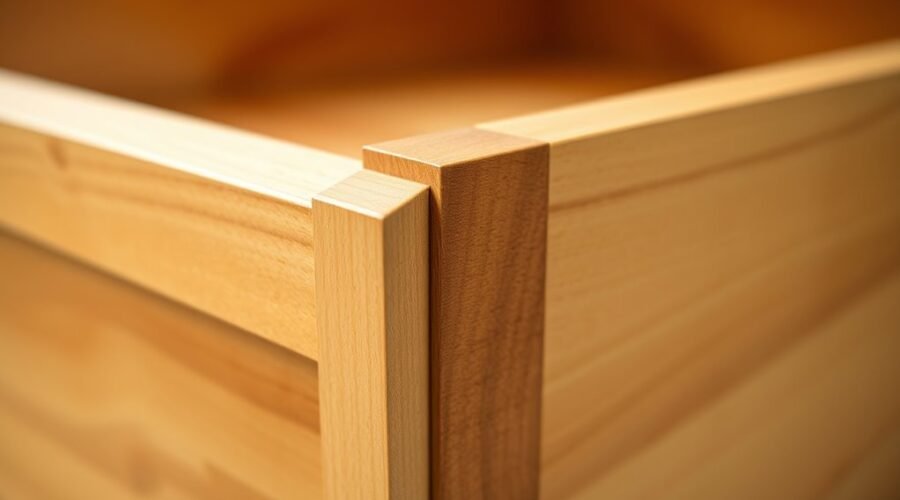
Dovetail drawers are valued because their corners use interlocking pins and tails rather than relying only on staples, screws, or a straight glue joint. That mechanical interlock makes a well-fitted dovetail especially resistant to the repeated pulling force placed on a drawer front. Still, dovetails are only one part of a durable drawer: material quality, the bottom panel, slides, fit, and workmanship also matter.
Quick Answer
Dovetail drawers last because their wedge-shaped pins and tails mechanically lock the drawer sides to the front and resist being pulled apart. A tight, properly glued dovetail can stay together even if the glue bond begins to fail. However, overall drawer durability also depends on the wood, bottom panel, slides, load, and workmanship.
Key Takeaways
- A dovetail joint uses flared pins and tails that mechanically resist pull-apart forces at a drawer corner.
- Half-blind dovetails are commonly used at drawer fronts because they hide the joint from the front face; through dovetails expose the joinery on both boards.
- Dovetails are strong, but they are not automatically stronger than every box joint, lock rabbet, or other well-made drawer joint.
- Solid wood and quality plywood can both be used for drawer boxes, although dovetail machining can be harder on plywood veneers.
- A durable drawer also needs an appropriate bottom panel, correctly rated slides or runners, square assembly, and materials suited to the expected load.
- Dovetail drawers are most worthwhile when you value long-term serviceability, traditional craftsmanship, visible joinery, and furniture intended for frequent use.
What Is a Dovetail Joint in Drawers?
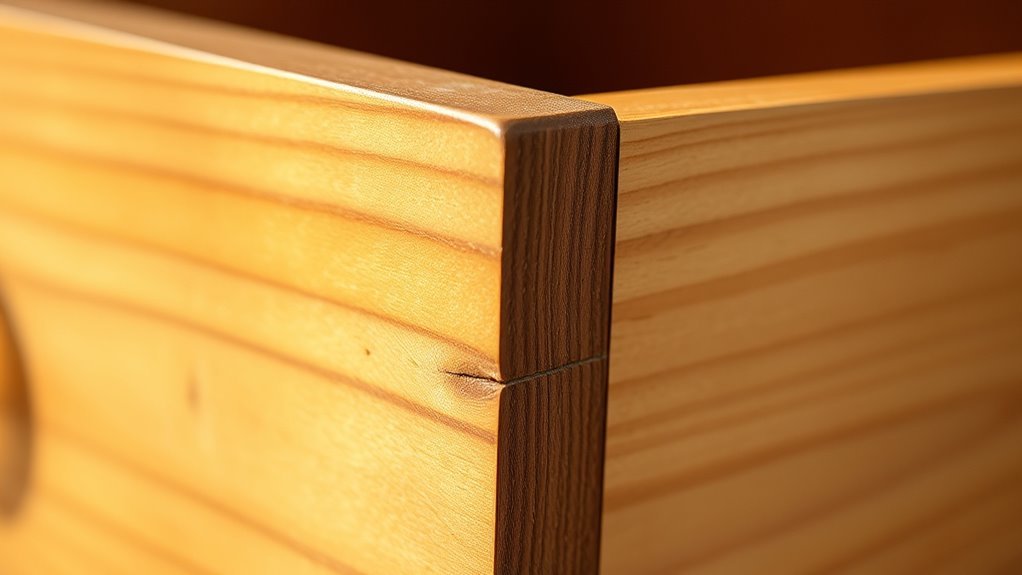
A dovetail joint connects two pieces of a drawer box with matching wedge-shaped tails and pins. Once assembled, the wider ends of the tails are trapped by the pins, so the pieces cannot simply pull straight apart.
That geometry is particularly useful at a drawer front because opening the drawer repeatedly places a pulling load on the connection between the front and the sides. A dovetail adds a mechanical lock to the adhesive bond instead of relying on glue or fasteners alone.
Professional drawer-building guidance from WOOD Magazine describes half-blind and through dovetails as strong, established options for drawer construction. A good dovetail should fit closely without large gaps, crushed pins, or excessive force during assembly.
Note: Dovetail construction describes the drawer-box joinery. It does not tell you the quality of the slides, bottom panel, cabinet box, finish, or hardware, so the joint alone should not be treated as proof that an entire cabinet is premium.
Why Dovetail Drawers Can Last a Long Time
A well-made dovetail drawer can remain serviceable for many years because the joint combines mechanical interlock with an adhesive bond. Even if the glue begins to crack, the pins and tails can continue holding the parts together instead of allowing the front to separate immediately.
That behavior showed up in WOOD Magazine’s comparative drawer-joint testing: through-dovetail and half-blind dovetail samples remained mechanically connected after their glue bonds had cracked.
The key advantage of a dovetail is not simply “more glue.” Its shape keeps the drawer corner mechanically engaged even when the adhesive is no longer doing all the work.
However, a dovetail is not indestructible. Loose machining, split pins, weak material, poor glue coverage, or a badly racked drawer can reduce its strength. Other drawer joints can also perform extremely well when they are designed and made correctly.
The USDA Forest Products Laboratory’s Wood Handbook also documents how wood properties vary with species, grain, moisture, and service conditions. Those material factors still apply to a dovetailed drawer.
Common Types of Dovetail Drawer Joints
Half-Blind Dovetail
A half-blind dovetail is one of the most common traditional choices for joining a drawer side to an integral drawer front. The tails enter sockets that stop before reaching the front surface, so you can see the dovetails from the side but not from the face of the closed drawer.
This provides a clean-looking front while keeping the mechanical interlock. Popular Woodworking describes half-blind dovetails at drawer fronts and through dovetails at the backs as a classic fine-furniture arrangement.
Through Dovetail
With a through dovetail, the pins and tails extend through the full thickness of both boards, so the joinery is visible from both directions. Through dovetails are straightforward to inspect, provide a strong mechanical connection, and are often used at drawer backs or as a visible design feature.
Sliding or “French” Dovetail
A sliding dovetail uses a long tapered tongue that slides into a matching dovetail-shaped groove rather than a repeating series of pins and tails. Some furniture sellers call this a French dovetail. The terminology is not used consistently throughout the woodworking industry, so it is better to inspect the actual joint than rely on a marketing label.
Sliding dovetails can be useful in particular designs, but they should not automatically be assumed to be stronger than a conventional half-blind or through dovetail. In controlled drawer-joint testing, sliding dovetails were weaker than several alternative joints in the tested configuration.
How Dovetail Drawers Are Built
Skilled woodworkers and modern factories can cut dovetails either by hand or with machines, routers, CNC equipment, or dedicated dovetail jigs. Machine-cut dovetails are not inherently inferior; what matters is whether the parts are accurately cut and properly fitted.
The basic construction process is:
- Prepare square, flat parts. The drawer front, sides, and back must be straight and accurately sized.
- Lay out or machine the pins and tails. Matching cuts are made so the parts interlock without large gaps.
- Test-fit the joint. A correct joint should seat firmly without needing destructive hammering or leaving obvious looseness.
- Cut the drawer-bottom groove. Many well-made drawers capture the bottom in grooves around the drawer box.
- Apply glue to the mating surfaces. Coverage and fit matter; extra glue cannot compensate for badly machined parts.
- Assemble the box square. The drawer is checked diagonally or against a square before the glue cures.
- Fit the drawer and hardware. Final operation depends on accurate slide installation or properly fitted wooden runners.
Pro Tip: When inspecting a finished dovetail drawer, look at several corners rather than one. Consistently tight pins and tails, clean edges, a square drawer box, and smooth operation tell you more about workmanship than the mere presence of a dovetail pattern.
Materials, Drawer Bottoms, and Slides Matter Too
Dovetail joinery does not eliminate the need for appropriate materials. Drawer boxes can be made from solid wood or suitable plywood. Solid wood is traditional and easy to plane or repair, while good plywood offers dimensional stability. However, routing dovetails in plywood can produce veneer chipping or tear-out if the tooling and material are not well matched.
Material thickness should also match the intended load. A small jewelry drawer does not need the same side and bottom thickness as a wide drawer carrying cookware or tools. WOOD Magazine recommends heavier materials and appropriately rated slides as drawer loads increase.
The drawer bottom is especially important. A bottom fully captured in grooves around the drawer box is generally better supported than a thin panel merely attached underneath. For a heavily loaded drawer, a weak or sagging bottom can become the failure point even when the dovetail corners remain sound.
Slide hardware matters just as much to everyday performance. A beautifully dovetailed box on undersized or poorly installed slides can still bind, sag, or fail under load. For heavy contents, choose slides with a load rating that matches the intended use.
Wood Movement and Seasonal Changes
Solid wood gains and loses moisture as indoor humidity changes, which causes dimensional movement across the grain. Dovetail joints do not stop that natural process.
The USDA Wood Handbook documents the relationship between moisture content and dimensional change in wood. For furniture, well-dried stock, sensible grain selection, proper drawer-bottom construction, and allowing material to acclimate before final machining all help reduce problems.
In fine furniture, a solid-wood bottom is traditionally installed in a way that permits seasonal movement. Plywood bottoms move much less with changes in humidity and are common in modern drawer boxes.
Dovetail Drawers vs Standard Drawers
“Standard drawer” is not a precise construction term. A non-dovetailed drawer might use a box joint, lock rabbet, dado, dowel, screw, staple, or another system, and it may be made from solid wood, plywood, MDF, particleboard, metal, or a combination of materials.
| Feature | Dovetail Drawer | Simpler Fastened or Rabbeted Drawer |
| Pull-apart resistance | Mechanical pins and tails continue to interlock. | Depends more heavily on the specific joint, glue, screws, staples, or other fasteners. |
| Manufacturing | Requires accurate machining or skilled hand cutting. | Often faster and less expensive to manufacture. |
| Appearance | Traditional joinery is visible and often valued as a craftsmanship detail. | Can be plain or completely concealed depending on the design. |
| Strength | Strong mechanical connection, especially useful against front pullout. | Can range from light-duty to extremely strong; some box and lock-rabbet designs perform very well. |
| Cost | Often higher because of machining, material, or labor. | Often lower, particularly in high-volume furniture. |
The practical lesson is that joint design and build quality matter more than the label alone. A precise box joint or lock rabbet can be a stronger choice than a poorly cut dovetail. Conversely, a tight dovetail provides a valuable mechanical lock and can be easier to reglue if an adhesive bond eventually fails.
How to Tell if a Dovetail Drawer Is Well Made
If you are evaluating cabinetry or furniture, inspect the entire drawer rather than looking only for a zigzag dovetail pattern.
- Check the fit: Pins and tails should meet closely without large gaps.
- Look for splits: Thin pins, tails, or surrounding wood should not be cracked.
- Check squareness: The drawer should not look twisted or racked.
- Inspect the bottom: It should be adequately supported for the expected load and should not sag.
- Operate the drawer: It should open smoothly without binding or excessive side-to-side play.
- Inspect the slides: They should be securely installed and appropriate for the drawer’s size and expected contents.
- Look beyond appearance: Uniform machine-cut dovetails can be excellent; irregularity is not automatically proof of superior hand craftsmanship.
When Dovetail Drawers Are Worth It
Dovetail drawers are often worth paying more for when you are buying furniture or cabinetry you expect to keep for a long time, especially when the drawers will be opened frequently or carry moderate to heavy contents.
They also make sense when traditional woodworking, repairability, and visible craftsmanship are part of the value you want from the furniture.
They may be less important in a lightly used nightstand, temporary furniture, budget storage, or a modern drawer system where a well-engineered box, bottom, and slide assembly already provide adequate performance.
Do not pay a large premium for dovetails without checking the rest of the construction. A dovetailed box with a weak bottom, undersized slides, poor alignment, or low-quality surrounding cabinetry can still disappoint.
Frequently Asked Questions
What are the disadvantages of dovetail drawers?
Dovetail drawers usually require more accurate machining or handwork than basic stapled or screwed construction, which can increase manufacturing cost. Poorly cut dovetails can split, gap, or fit too tightly. They also do not compensate for a weak drawer bottom, poor slides, unsuitable material, or bad cabinet alignment.
What are the disadvantages of using dovetail joints?
Dovetails demand accurate layout and fit. Hand-cut versions take skill and time, while machine-cut joints require proper tooling and setup. Some sheet goods can chip during machining, and a badly proportioned pin or tail can weaken the surrounding wood. For simple utility drawers, an easier box joint or lock rabbet may be more efficient.
What is the best type of joint for drawers?
There is no single best joint for every drawer. Half-blind and through dovetails offer excellent mechanical interlock and traditional appearance. Box joints can provide substantial glue area and strength, while lock rabbets are fast to machine and can also be very strong. The right choice depends on load, material, appearance, equipment, cost, and repairability.
Are dovetail drawers worth it?
They often are when you want long-term furniture, traditional craftsmanship, a mechanically locked drawer box, and joints that can potentially be reglued if the adhesive fails. For light-duty or budget furniture, a properly designed alternative joint may provide all the strength you need for less money.
How can you tell if a dovetail drawer is good quality?
Look for tight, consistent pins and tails without large gaps, splits, crushed edges, or loose corners. Then check that the drawer is square, the bottom is well supported, the slides operate smoothly, and the drawer does not rack or wobble. Those details are more meaningful than the dovetail pattern by itself.
What is the difference between half-blind, through, and French dovetails?
A half-blind dovetail hides the joint from the front face and is common at drawer fronts. A through dovetail exposes the pins and tails through both boards. “French dovetail” is a furniture-industry term often used for a sliding dovetail, where one long tapered tongue slides into a matching groove. Because naming varies by manufacturer, inspect the actual construction when comparing furniture.
Conclusion
A dovetail drawer earns its reputation from the geometry of its corner joint. Interlocking pins and tails help resist the repeated pull placed on a drawer front, and that mechanical connection can keep the corner engaged even if an adhesive bond deteriorates.
That does not mean every dovetail drawer is stronger or better than every alternative. A quality drawer is a complete system: accurate joinery, sound material, an adequately supported bottom, suitable slides or runners, square assembly, and workmanship all contribute to its service life. When those details are handled well, dovetail construction is a durable and attractive choice for furniture you expect to use for years.
Sources
- USDA Forest Products Laboratory — Wood Handbook: Wood as an Engineering Material — wood properties, moisture behavior, materials, adhesives, and dimensional change.
- WOOD Magazine — Drawers 101 — drawer materials, slides, joinery, bottom construction, and load-related design.
- WOOD Magazine — Wood Joint Torture Test 2: Doors & Drawers — comparative testing of dovetails, box joints, lock rabbets, sliding dovetails, and other drawer joints.
- Popular Woodworking — How to Make Dovetailed Drawers — half-blind and through dovetail construction, materials, fitting, and fine-furniture drawer design.


