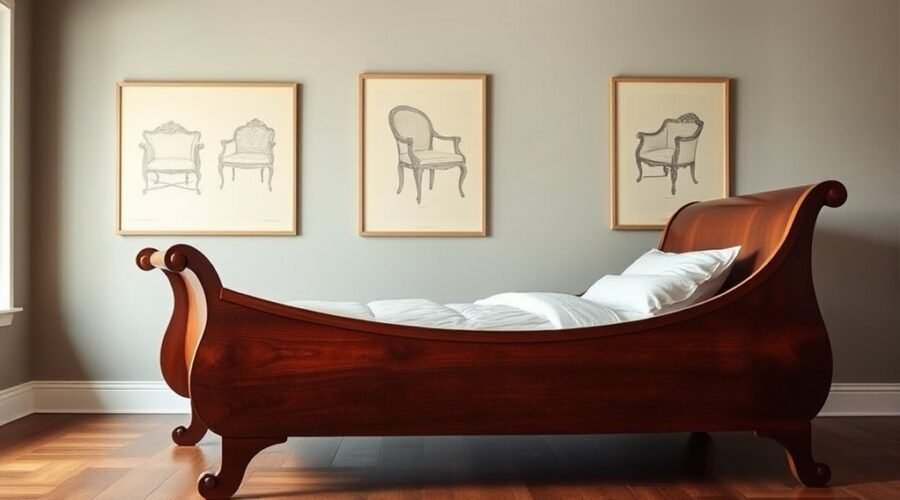
If you’re trying to identify a sleigh bed, look for a bed frame with a headboard and usually a footboard that curve or scroll outward, creating a profile similar to a sled or sleigh. The design has strong links to French neoclassical furniture around the turn of the 19th century and became especially fashionable during the Empire period. Modern versions keep the basic curved silhouette while using everything from traditional wood to upholstery and streamlined platform construction.
Quick Answer
A sleigh bed is a bed frame with a curved or scrolled headboard and usually a matching footboard that gives it a sleigh-like profile. The form appeared in France around the Directoire period and became strongly associated with Empire furniture. Today, sleigh beds come in wood, upholstered, metal, platform, and low-footboard designs.
Key Takeaways
- A traditional sleigh bed has curved or scrolled head and foot ends that create its recognizable sled-like silhouette.
- The French lit en bateau, or boat bed, appeared during the Directoire and became fashionable during the Empire and Restoration periods.
- Early American makers adapted French and Greco-Roman ideas in styles ranging from restrained to highly decorated.
- Modern sleigh beds may use solid wood, engineered wood, metal, upholstery, slats, or platform-style support.
- Do not assume a sleigh bed needs a box spring. Check both the bed-frame instructions and your mattress manufacturer’s support requirements.
What Is a Sleigh Bed?

A sleigh bed is a bed frame defined by a curved or scrolled headboard and, in the traditional form, a similarly shaped footboard. Viewed from the side, those raised ends create the outline that gave the bed its name.
Traditional versions were often substantial wood pieces, especially in mahogany and other furniture woods. Modern versions may be upholstered, made with engineered wood or metal, or designed with a much lower footboard. Some contemporary beds are described as sleigh beds even when most of the curve is concentrated in the headboard.
The style has a strong visual presence. That can make the bed an effective focal point, but it also means you should compare the complete outside dimensions of the frame, not just the mattress size, before buying.
Pro Tip: Measure the bed’s total width, length, and height from the manufacturer’s specification sheet. Curved ends can make a sleigh frame noticeably larger than the mattress it holds, which affects walkways, nightstand placement, doors, and dresser drawers.
Where the Sleigh Bed Shape Came From
The sleigh-bed form is closely connected to French neoclassical furniture around the turn of the 19th century. According to Les Arts Décoratifs, the French “sleigh” bed appeared during the Directoire and became very fashionable during the Empire and Restoration periods.
In France, the form was known as a lit en bateau, or “boat bed,” because its curved ends created a boat-like profile. Empire-period designers drew heavily on the art and furniture of ancient Greece and Rome, translating classical shapes into bold furniture with strong silhouettes.
| Feature | Historical context | Effect on the design |
|---|---|---|
| Curved ends | Directoire and Empire-era French furniture | Creates the boat- or sleigh-like outline |
| Classical influence | Greek and Roman revival design | Introduced sweeping forms and classical ornament |
| American adoption | Early 19th-century cabinetmaking | Produced both restrained and highly decorated variations |
The form soon appeared in American furniture as well. Surviving examples show that there was no single American treatment: some sleigh beds were relatively plain, while others used rich veneers, brass mounts, carving, and other classical details.
How Empire Style Shaped Sleigh Beds
The Empire style gave the sleigh bed much of the historical identity it still carries. Empire furniture favored strong silhouettes and references to classical antiquity, often combined with luxurious woods, veneers, metal mounts, and symbolic ornament.
That makes the sleigh bed more than a bed with decorative curves. In its historical form, the shape was part of a broader effort to make furniture feel architectural and connected to Greek and Roman precedent.
Empire Style Roots
An important American example survives at The Metropolitan Museum of Art. The bedstead made by Charles-Honoré Lannuier and Jean-Charles Cochois around 1805–1808 has a sweeping frame that the museum compares with a Roman lectus, or couch/bed.
- The French sleigh-bed form developed before and during the rise of the Empire style.
- Empire designers drew heavily on Greek and Roman forms.
- Mahogany, veneers, metal mounts, and classical ornament appeared on high-style examples.
- American cabinetmakers adapted these European ideas for their own customers.
The Met’s Lannuier bedstead, dated about 1805–1808, shows how early American furniture makers translated classical European design into a sweeping bed frame inspired by ancient forms.
Curved Forms And Influence
As French neoclassical design reached the United States, American furniture makers created their own versions of French and Grecian bedsteads. Some were simple and architectural; others were richly ornamented.
Charles-Honoré Lannuier, a Paris-trained cabinetmaker who moved to New York in 1803, was one important figure in this exchange. His surviving furniture demonstrates how French design ideas were adapted within American cabinetmaking rather than copied in one fixed way.
That variety still exists. A modern sleigh bed may preserve only the broad curved outline while removing most historical ornament, making the shape easier to combine with contemporary or transitional interiors.
Key Sleigh Bed Features to Check Before Buying
Before buying a sleigh bed, look beyond the curved profile. The frame has to fit your room, support your mattress correctly, and remain stable under normal use.
Frame And Rail Stability
Check how the side rails connect to the headboard and footboard. Loose connections, undersized hardware, damaged joints, or flexing rails can cause movement and noise regardless of whether the bed is made from solid wood or engineered materials.
- Check the rail-to-headboard and rail-to-footboard connections.
- Look for movement or gaps at structural joints.
- Confirm that all required cross-supports and legs are present.
- Check the manufacturer’s stated weight and support requirements when available.
Material matters, but construction quality matters too. A well-built veneered frame can outperform a poorly joined solid-wood frame, so do not judge durability by the material label alone.
Support System Requirements
Do not assume every sleigh bed requires a box spring. Support systems differ by model. Some traditional-style frames are designed for a foundation, while many modern sleigh beds use built-in slats or a platform-style support system.
The mattress can also impose its own requirements. For example, Tempur-Pedic’s current support guidance says its mattresses require a suitable solid or properly designed slatted base and should not be placed on a conventional box spring.
Note: Check two sets of instructions before assembling the bed: the sleigh-bed manufacturer’s support requirements and the mattress manufacturer’s warranty requirements. If they conflict, contact the manufacturers before use.
If the frame uses slats, verify their width, spacing, center support, and load rating against your mattress requirements. Those specifications matter more than whether the frame is marketed as a sleigh bed.
Finish And Material Quality
Sleigh beds can be built from solid wood, wood veneer, engineered wood, metal, upholstery, or combinations of these materials. Each construction has different advantages.
Traditional examples commonly used mahogany and other furniture woods, sometimes together with veneers and decorative metal mounts. Modern upholstered beds may use engineered structural components beneath fabric, while contemporary wood beds may simplify the historic curves.
- Look for an even finish without rough edges or obvious cracks.
- Check whether upholstery seams are straight and securely attached.
- Ask what materials are used in structural rails and supports, not just visible surfaces.
- Inspect joints, hardware, slats, and center supports before focusing on cosmetic details.
Measure the Complete Frame, Not Just the Mattress
A queen mattress and a queen sleigh bed do not have identical outside dimensions. The headboard, footboard, posts, upholstery, and curved ends add to the overall footprint.
Measure the exact frame dimensions against your available floor space. Make sure there is enough room to walk around the bed and to open nearby doors, closets, and drawers. Also measure hallways, stair turns, elevators, and doorways if the bed has large components that must be carried into the room.
Sleigh Bed Materials and Build Quality
Traditional sleigh beds are strongly associated with wood construction, but there is no single correct material. Historic examples include mahogany, veneers, secondary woods, metal mounts, and other decorative materials.
Modern makers use solid wood, plywood, engineered wood, metal, upholstery, or mixed construction. Upholstery softens the appearance and can make the headboard more comfortable to lean against, while exposed wood emphasizes the sculptural curve.
Modern sleigh beds can preserve the historic curved profile while using platform slats, upholstery, engineered materials, or simplified low-footboard designs.
Build quality is more important than a single material label. Look for secure joints, properly supported rails, stable slats or foundations, smooth finished edges, and hardware that can be tightened or replaced if necessary.
If you plan to keep the bed for many years, also consider repairability. Replaceable hardware, accessible fasteners, removable upholstery components, and refinishable wood surfaces can make future maintenance easier.
Sleigh Bed Sizes and Mattress Compatibility
Sleigh beds are sold in common mattress sizes, but the external frame dimensions vary by design. A thick upholstered headboard and rolled footboard can add considerably more length and width than a slim platform frame.
Before buying, verify:
- The exact mattress size the frame accepts.
- The total outside width, length, and height of the bed.
- The maximum recommended mattress thickness, if specified.
- Whether a foundation is required, optional, or prohibited.
- Whether the frame can accept an adjustable base if you plan to use one.
- The required slat spacing and center support for your mattress.
A very thick mattress can also change the look of a sleigh bed by hiding more of the headboard or footboard, so check both structural compatibility and visual proportion.
Sleigh Bed Pros and Cons
| Advantages | Possible drawbacks |
|---|---|
| Distinctive shape creates a strong bedroom focal point. | Curved ends can increase the frame’s footprint. |
| Available in traditional, transitional, and modern versions. | Large wood or upholstered models can be heavy to move. |
| Upholstered versions can provide a comfortable surface for sitting up. | A tall footboard can make bedding harder to tuck and may visually crowd a small room. |
| Modern versions may include slats, platform support, low footboards, or storage. | Support requirements vary, so mattress and frame compatibility must be checked carefully. |
Who Should Choose a Sleigh Bed
If you value historical design and want a bed that can act as a room’s main visual feature, a sleigh bed may fit your style. Traditional wood versions work naturally in classic interiors, while upholstered and simplified versions can suit transitional and contemporary rooms.
- You like a substantial headboard and footboard.
- You have enough floor space for the complete frame dimensions.
- You want the bed to function as a focal point.
- You appreciate furniture with a connection to early 19th-century design.
There is no universal minimum room size. A sleigh bed works when the specific frame fits comfortably without blocking circulation, doors, storage furniture, or other functions in the room.
If your bedroom is compact, consider a sleigh-inspired model with a slimmer frame or lower footboard. That keeps some of the curved character without adding as much visual weight.
How to Style a Sleigh Bed at Home
Styling a sleigh bed works best when you let its curved silhouette become the main shape in the room instead of surrounding it with equally ornate furniture.
Choose nightstands and lamps that are proportionate to the headboard. Cleaner-lined case pieces can balance a heavily curved or carved bed, while softer rounded furniture can complement a more contemporary upholstered version.
If the frame is dark wood, lighter bedding can create contrast. Crisp sheets, a textured coverlet, and a restrained number of cushions keep the bed from feeling visually heavy. With a light upholstered frame, deeper bedding colors or natural wood furniture can provide contrast instead.
Leave enough visible wall space around a tall headboard for the shape to read clearly. A rug that extends beyond the sides and foot of the bed can help define the sleeping area, but size it according to the full bed frame rather than the mattress alone.
Frequently Asked Questions
What Are the Disadvantages of a Sleigh Bed?
A sleigh bed can be heavier and take up more floor space than a simpler platform frame because of its curved headboard and footboard. A tall footboard can also make bedding harder to tuck, restrict sightlines in a small room, and complicate moving or assembly. The exact drawbacks depend on the individual design.
Are Sleigh Beds Still In?
Sleigh beds are still actively sold in 2026, including traditional wood, transitional, upholstered, platform, and lower-footboard designs. That does not make every sleigh bed a current design trend, but the form remains commercially available and continues to be updated rather than existing only as an antique style.
Does a Sleigh Bed Need a Box Spring?
Not necessarily. Some sleigh beds are designed for a separate foundation, while others have slats or a platform that supports the mattress directly. Your mattress may also prohibit a conventional box spring. Follow both the bed-frame instructions and the mattress manufacturer’s support and warranty requirements.
Do Sleigh Beds Take Up More Room?
They can. Curved headboards, footboards, posts, and upholstery may extend beyond the mattress footprint. The amount varies by model, so compare the manufacturer’s complete external dimensions with your available floor space instead of estimating from mattress size alone.
What Did a Bed Look Like 1000 Years Ago?
There was no single bed design around 1,000 years ago. Sleeping arrangements varied by region, wealth, and setting. In medieval Europe, simple bedding could include straw-filled mattresses; for example, English Heritage documents straw mattresses in the medieval dormitory at Rievaulx Abbey. Wealthier households could use more substantial furniture and textiles. The later sleigh bed belongs to a very different design period.
How Much Is a Sleigh Bed Worth?
The price varies widely by size, materials, construction, brand, and whether the bed is new or antique. As checked on September 18, 2026, the Pottery Barn Layton upholstered sleigh bed was listed from $1,399 to $2,299, while the Ethan Allen Paeton sleigh bed had a starting list price of $4,295 before promotional pricing. Lower-cost models also exist. An antique sleigh bed should not be valued from retail ranges alone; maker, age, provenance, condition, originality, size, materials, and local demand can all affect appraisal value.
Sources
- Les Arts Décoratifs — Bed, France, First Empire — supports the Directoire origin and Empire-era popularity of the French sleigh or lit en bateau.
- The Metropolitan Museum of Art — Charles-Honoré Lannuier Bedstead — supports the early American classical bedstead history and Roman influence.
- Tempur-Pedic — Mattress Base and Foundation Guidance — supports the requirement to match the mattress with an appropriate foundation or slatted support system.
- English Heritage — Rievaulx Abbey Teachers’ Kit — documents straw mattresses in a medieval monastic dormitory.
- Pottery Barn — Layton Upholstered Sleigh Bed — provides a current example of a modern slatted sleigh bed that does not require a box spring or foundation.
- Ethan Allen — Paeton Sleigh Bed — provides a current premium wood sleigh-bed example and current-price reference.
Conclusion
A sleigh bed is defined by its distinctive curved profile, but the design has more history than its name suggests. The French form appeared during the Directoire and became closely associated with Empire-era furniture before spreading into American cabinetmaking. Modern versions now range from substantial wood frames to upholstered and platform designs. If you like the silhouette, focus on the complete frame dimensions, construction quality, mattress-support requirements, and available room space rather than assuming every sleigh bed is built or used the same way.