

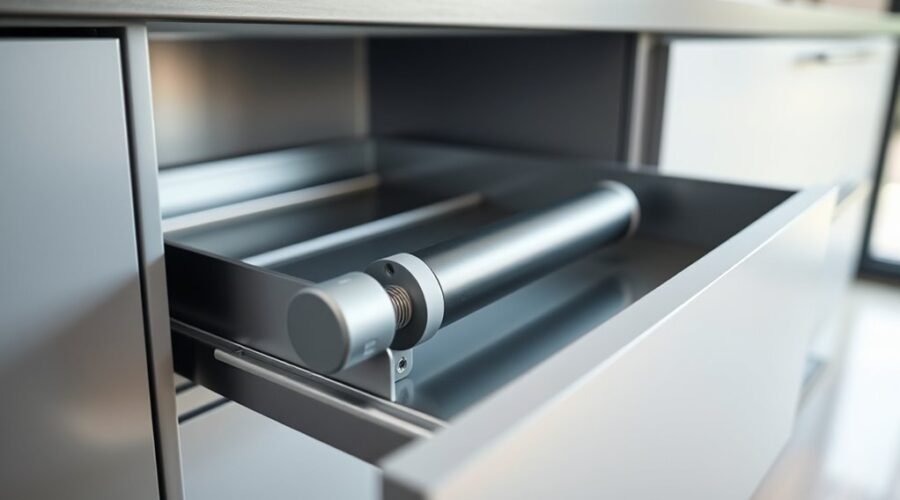
A soft close drawer uses a damping system to slow the drawer during the final part of its travel, so it settles into the cabinet instead of slamming. The basic idea is simple, but the hardware is not universal. Some drawers use concealed undermount runners, others use visible side-mount slides, and each system can use a different release method. Identifying that hardware first is the key to removing, reinstalling, or troubleshooting the drawer without damaging it.
Quick Answer
A soft close drawer uses a damper to control closing speed near the end of travel. To remove one, empty and fully open the drawer, identify whether it has undermount or side-mount slides, operate the correct locking device or disconnect lever, and lift or pull the drawer free without forcing the hardware.
Key Takeaways
- Soft-close hardware slows the final part of drawer travel and reduces impact and noise.
- The damper, catch, self-closing mechanism, locking device, and runner arrangement vary by manufacturer.
- Do not assume every drawer has black release tabs or that the soft-close damper must be dismantled for drawer removal.
- Identify the runner type and manufacturer before pressing, prying, unscrewing, or lifting anything.
- Correct alignment, secure locking devices, clean tracks, and the proper load rating are essential for reliable operation.
At a Glance
| Time Required | About 10–20 minutes for identification, removal, and reinstallation |
| Difficulty | Easy to moderate, depending on the slide design |
| Tools Needed | Flashlight; small screwdriver only if the specific hardware requires one |
| Cost | Usually $0 for simple removal and reinstallation; replacement hardware costs extra |
What Is a Soft Close Drawer?

A soft close drawer is a drawer fitted with hardware that controls its closing speed near the end of travel. Instead of allowing the drawer front to hit the cabinet abruptly, the mechanism slows the motion and lets the drawer settle into its closed position.
Soft-close hardware may be built into concealed undermount runners, side-mounted ball-bearing slides, or a complete metal drawer system. The design determines how the drawer is attached, how it is removed, and whether the soft-close unit is integrated into the slide.
For example, Accuride describes its 3135EC undermount system as using an internal fluid damper that controls the drawer during the final part of closure. GRASS Dynapro documentation describes an enclosed liquid damping system integrated into the runners.
The practical benefits are quieter closing, less impact on the drawer front and cabinet, and more controlled everyday operation. The exact load capacity and operating characteristics depend on the specific runner model, so use the manufacturer’s published rating rather than assuming all soft-close drawers carry the same weight.
How the Soft Close Mechanism Works
A soft-close system normally does two jobs near the end of drawer travel: it captures or engages the drawer and controls how quickly it finishes closing. The precise parts vary, but the result is the same—a fast-moving drawer is slowed before it reaches the cabinet face.
Soft Close Parts
Common components include the drawer runners, a damping unit, an engagement catch or trigger, and—on many designs—a self-closing or pull-in mechanism. Concealed runners may also use separate front locking devices that secure the drawer box to the slides.
The damper controls speed. In fluid-damped designs, resistance inside the damper absorbs part of the drawer’s motion so the front does not strike the cabinet abruptly. The catch or trigger determines when the closing system engages. If the runner also has a self-closing function, that mechanism supplies the final pull toward the closed position.
These parts should be treated as a system. A locking device used to remove the drawer is not necessarily part of the internal damper, and releasing the drawer from its runners does not normally require opening the damper itself.
Closing Dampens Motion
As the drawer approaches the engagement point, the soft-close system begins controlling the final movement. The damper adds resistance, reducing the closing speed while the runner keeps the drawer aligned.
The distance over which this happens depends on the hardware. Accuride, for example, states that the fluid damper in one of its undermount systems engages during roughly the last two inches of travel. Other runner systems use different geometries and engagement distances.
Spring and Piston
Some soft-close designs use a piston-style damper together with a spring or another self-closing mechanism. However, it is misleading to assume every soft-close drawer has the same spring-and-piston layout.
Blum, for example, distinguishes between its integrated BLUMOTION damping system and the self-closing function used in some MOVENTO runners. The important point for troubleshooting is therefore not the exact internal spring arrangement but whether the drawer is being captured, pulled in, and damped correctly.
Soft Close Drawer Parts and Their Roles
| Component | What It Does |
| Runner or slide | Guides the drawer and carries its rated load. |
| Damper | Controls closing speed near the end of travel. |
| Catch or trigger | Engages the soft-close action at the designed point. |
| Self-closing or pull-in mechanism | On systems that include one, pulls the drawer into its final closed position. |
| Locking device or disconnect lever | Secures the drawer to the runner and allows removal when released. |
| Mounting screws and brackets | Keep the slides square, parallel, and properly positioned in the cabinet. |
When diagnosing a problem, first determine which component is actually involved. A drawer that will not come out may have a release issue, while a drawer that comes out normally but slams shut may have a damper or engagement problem.
Why Soft Close Drawers Stop Slamming
Soft-close drawers reduce slamming by controlling the energy of the drawer before the front reaches the cabinet. Instead of letting the drawer continue at nearly the same speed until impact, the damper progressively resists the final movement.
- The runner keeps the drawer aligned during travel.
- The catch engages the closing system near the end of travel.
- The damper limits the closing speed.
- A self-closing mechanism, when included, helps pull the drawer fully shut.
Soft-close controls how the drawer finishes closing; the locking device or disconnect mechanism controls how the drawer separates from the cabinet. They are related hardware, but they are not the same thing.
Soft Close vs. Self-Closing Drawers
Soft close describes controlled deceleration. Self-closing describes a mechanism that pulls the drawer through the final part of its travel. A runner can include both functions.
For example, Blum’s MOVENTO runner documentation covers integrated soft-close hardware and separate locking devices used for drawer installation and removal. Some MOVENTO specifications also identify BLUMOTION soft close and BLUMATIC self-closing as distinct functions.
This distinction helps with troubleshooting. If the drawer slows but stops before fully closing, the damping function may still work while the pull-in action, alignment, or engagement is incorrect.
Identify Your Slide Type Before Removal
Before pressing any tab or lifting the drawer, open it fully and inspect the hardware.
- Undermount slides: The main runners are hidden beneath the drawer. Look under the front left and right corners for locking devices, catches, or release levers.
- Side-mount ball-bearing slides: Metal slides are visible along both sides of the drawer. Look for a disconnect lever on each slide member.
- Metal drawer systems: The drawer sides themselves may be part of the hardware system. Release points can be hidden behind covers or underneath the drawer.
- Lift-off or friction-release systems: Some drawers separate by reaching full extension and lifting or pulling in a specific way rather than by pressing obvious clips.
Look for a manufacturer name, logo, part number, or model code on the metal runner or locking device. Once you have it, use the manufacturer’s instructions for that exact system.
Warning: Empty a heavy drawer before removal and support it with both hands. Keep fingers away from slide edges and pinch points. If a release does not move with reasonable hand pressure, stop and identify the hardware instead of prying, hammering, or forcing the drawer.
Tools You Need to Remove the Drawer
Many modern soft-close drawers can be removed without tools. Start with a flashlight and a clear, stable surface where you can set the drawer after removal.
A small flathead or Phillips screwdriver may be useful if the manufacturer’s instructions specify a screw, recessed catch, or cover that must be removed. Do not automatically reach for pliers or a mallet; tool-free release levers and locking devices are common, and unnecessary force can crack plastic parts or bend a slide.
- Flashlight
- Stable work surface
- Small screwdriver only when the hardware calls for one
- Manufacturer installation/removal instructions when the model can be identified
Pro Tip: Photograph the left and right release hardware before removing the drawer. The photo makes it much easier to confirm that the locking devices are in the same position when you reinstall it.
How to Remove a Soft Close Drawer
- Empty the drawer. Removing the contents reduces weight and makes the drawer easier to control.
- Pull the drawer fully open. Stop at its normal full-extension point instead of yanking against the stop.
- Identify the slide type. Check underneath the front corners for concealed locking devices or along the sides for disconnect levers.
- Operate the correct release. Follow the appropriate method for that runner design. Do not assume the release must be black or that both sides move in the same direction.
- Support the drawer while releasing it. Some drawers pull straight out after release; others require the front to be lifted slightly.
- Set the drawer on a stable surface. Avoid resting its weight on plastic locking devices or adjustment hardware.
Undermount Slides With Locking Devices
Concealed undermount runners commonly use locking devices near the front underside of the drawer. Release both sides as instructed by the manufacturer, then separate the drawer from the runners.
For example, Blum MOVENTO removal instructions use release levers on the front locking devices. The documented MOVENTO procedure releases the locking devices and then allows the drawer to be pulled outward and upward. That procedure is correct for the specified Blum hardware, but it should not be copied blindly to every soft-close drawer.
Side-Mount Slides With Disconnect Levers
Side-mounted ball-bearing slides often use a lever disconnect. Extend the drawer until the levers are accessible, operate the left and right releases, and pull the drawer member away from the cabinet member while keeping the drawer supported.
Accuride documents several disconnect designs, including lever, friction, push-latch, and rail disconnects. Even within one manufacturer’s range, removal methods therefore differ.
When You Cannot Find a Release
Do not assume a hidden clip is broken simply because you cannot see one. Check the underside, both slide members, the rear of the drawer, and any plastic covers near the front adjustment hardware.
If you can find a brand or model number, stop and check its instructions. If the drawer still will not release, avoid progressively stronger pulling because some systems use lift-off stops, catches, screws, or locking devices that must be positioned correctly first.
How to Disengage the Damper Hardware
Removing the drawer from the cabinet and disabling the soft-close damper are two different jobs. In most integrated runner systems, you should not open the damper housing or remove an internal piston and spring as a general DIY procedure.
Manufacturers may use sealed fluid dampers or enclosed damping units. Opening or altering them can damage the slide and may make reassembly unreliable.
Note: If your goal is simply to remove the drawer for cleaning or cabinet access, leave the damper intact. Release only the drawer’s approved locking or disconnect hardware.
If you specifically want the drawer to operate without soft close, first check whether the manufacturer provides an approved on/off adjustment or replaceable damping module. If it does not, the reliable solution is usually to install compatible non-soft-close runners rather than dismantling an integrated damper.
How to Reassemble the Drawer Without Soft Close
If the original runners have an integrated soft-close system, simply reinstalling the drawer on those runners will normally restore the same soft-close function. Removing the drawer alone does not convert the slides to standard non-soft-close operation.
To intentionally change to standard slides, use runners that match the cabinet and drawer dimensions, mounting style, extension type, side clearance, and required load capacity.
- Identify the existing runner length and mounting type.
- Check the replacement manufacturer’s required drawer dimensions and clearances.
- Use a left/right pair intended to work together.
- Mount the new slides square and parallel according to their instructions.
- Reinstall the drawer and confirm that any locking devices or disconnect hardware fully engage.
- Open and close the drawer several times before loading it heavily.
Do not mix unmatched left and right runners or assume two slides with the same nominal length have identical mounting dimensions.
Test the Drawer After Removal
After reinstalling the drawer, move it through several complete open-and-close cycles. The drawer should stay level, move freely, and remain secured to both runners.
- Confirm both sides are fully engaged.
- Check that the drawer front clears the cabinet evenly.
- Listen for scraping, grinding, repeated clicking, or a hard impact.
- Watch whether the soft-close action engages on both sides at the expected point.
- Confirm the drawer reaches the fully closed position without needing excessive force.
If one side sits higher or farther forward, inspect the locking devices and runner alignment before making adjustments. Do not compensate for a badly seated drawer by forcing the front shut.
Common Soft Close Drawer Problems
| Symptom | Likely Checks |
| Drawer will not close completely | Check for an obstruction, incorrect seating, warped or misaligned mounting, or a runner that is not parallel. |
| Drawer closes but no longer slows down | Check whether the soft-close catch engages and inspect the damper for visible damage. An integrated failed damper may require slide replacement. |
| Drawer stops before the cabinet | Confirm both slides are fully seated and that rear hooks, brackets, or front locking devices are engaged correctly. |
| One side drags or closes ahead of the other | Check slide alignment, mounting screws, drawer squareness, and left/right engagement. |
| Drawer clicks or feels loose after reinstallation | Recheck the locking devices or disconnect members and make sure both sides are fully secured. |
Sugatsune’s troubleshooting guidance also identifies installation accuracy and environmental conditions as possible causes when soft-close slides do not close properly.
Soft Close Drawer Maintenance
Keep exposed runner surfaces free of crumbs, sawdust, sticky residue, and loose objects that can interfere with travel. A dry or lightly damp cloth is usually a safer starting point than spraying chemicals directly into the hardware.
Lubrication depends on the runner design. Accuride provides specific grease guidance for standard ball-bearing slides, but that does not mean every concealed runner or sealed damper should be lubricated the same way.
Follow the maintenance instructions for your exact model. Do not inject oil, silicone spray, or grease into a sealed soft-close damper unless the manufacturer specifically directs you to do so.
Frequently Asked Questions
How Does the Soft Close Drawer Mechanism Work?
A soft-close system engages near the end of drawer travel and uses a damper to limit closing speed. Many designs also include a catch and self-closing or pull-in mechanism. The exact spring, piston, and trigger arrangement varies by manufacturer, so the hardware should be treated as a complete runner system rather than a universal mechanism.
What Are the Common Problems With Soft Close Drawer Slides?
Common problems include the drawer not being fully seated, slides mounted out of parallel, debris in the runner, loose locking devices, an engagement catch that is not resetting, and a worn or damaged damper. Start with seating, alignment, and cleanliness before replacing parts.
Can Regular Drawers Be Converted to Soft Close?
Often, yes, but compatibility matters. The replacement soft-close runners must fit the cabinet depth, drawer construction, required clearances, mounting style, extension type, and expected load. Do not choose a retrofit solely because its nominal length matches the existing slide.
Are Soft Close Drawers Worth It?
They are useful when you value quieter closing and reduced impact on the drawer and cabinet. Whether an upgrade makes sense depends on the condition of the current drawers, the cost of compatible hardware, and whether the cabinet dimensions support the required slides.
How Do I Know Which Release Mechanism My Drawer Uses?
Open the drawer fully and inspect the front underside and both slide members. Concealed undermount runners commonly have locking devices underneath, while visible side-mount slides often have disconnect levers. Look for a manufacturer name or part number and use the instructions for that exact runner.
Can I Remove the Soft Close Feature Without Replacing the Slides?
Only if the manufacturer designed that runner with an approved deactivation or removable damping feature. Do not open an integrated or sealed damper simply to disable soft close. When no supported deactivation method exists, compatible standard runners are the safer way to change the drawer to non-soft-close operation.
Conclusion
A soft close drawer gets its smooth final movement from a damping system built into or paired with the runners. The most important point when servicing one is that the damper and the drawer-release hardware are not the same thing. Identify the slide type first, use the proper locking device or disconnect method, and avoid dismantling an integrated damper unless the manufacturer specifically provides a service procedure.
After removal or repair, confirm that both sides are seated and locked, the runners remain square and parallel, and the drawer closes fully without scraping or impact. If the damper itself has failed and is not a serviceable component, replacing the compatible runner set is usually more reliable than attempting to open the damping unit.
Sources
- Blum — MOVENTO Assembly and Installation — locking devices, adjustment, installation, and drawer removal guidance.
- Accuride — 3135EC Eclipse Undermount Slide — internal fluid-damper operation and soft-close behavior.
- Accuride — Drawer Slide Disconnect Methods — lever, friction, push-latch, and rail disconnect designs.
- GRASS — Dynapro Slide System — enclosed liquid damping and front locking-device information.
- Hettich — Quadro V6 with Silent System — integrated soft closing, concealed-runner design, load data, and catches.
- Sugatsune — Soft-Close Drawer Troubleshooting — installation accuracy, alignment, and operating-condition troubleshooting.