

Is saturated fat bad for you? It is one of the longest-running arguments in nutrition. Most major health organizations say it raises LDL cholesterol and heart risk when eaten in excess, while a minority of researchers argue the link to actual heart attacks and deaths is weaker than once believed. The details, especially what replaces saturated fat, explain most of the disagreement.
Quick Answer
Saturated fat raises LDL cholesterol, and a Cochrane review found that cutting it for at least two years reduced combined heart and stroke events by about 17 percent, with moderate certainty. The same review found little or no effect on total deaths. What you swap it for matters: unsaturated fats help, while refined carbohydrates do not.
Key Takeaways
- Saturated fat reliably raises LDL cholesterol, a well-established risk marker for heart disease.
- A 2020 Cochrane review of 15 trials found a 17 percent drop in combined cardiovascular events when saturated fat was cut.
- The same review found little or no effect on all-cause or cardiovascular death.
- A 2010 meta-analysis of cohort studies found insufficient evidence linking saturated fat itself to heart disease, which fuels the debate.
- Replacing saturated fat with refined carbs offers little net benefit; replacing it with unsaturated fat does.
What Saturated Fat Is and Where It Hides
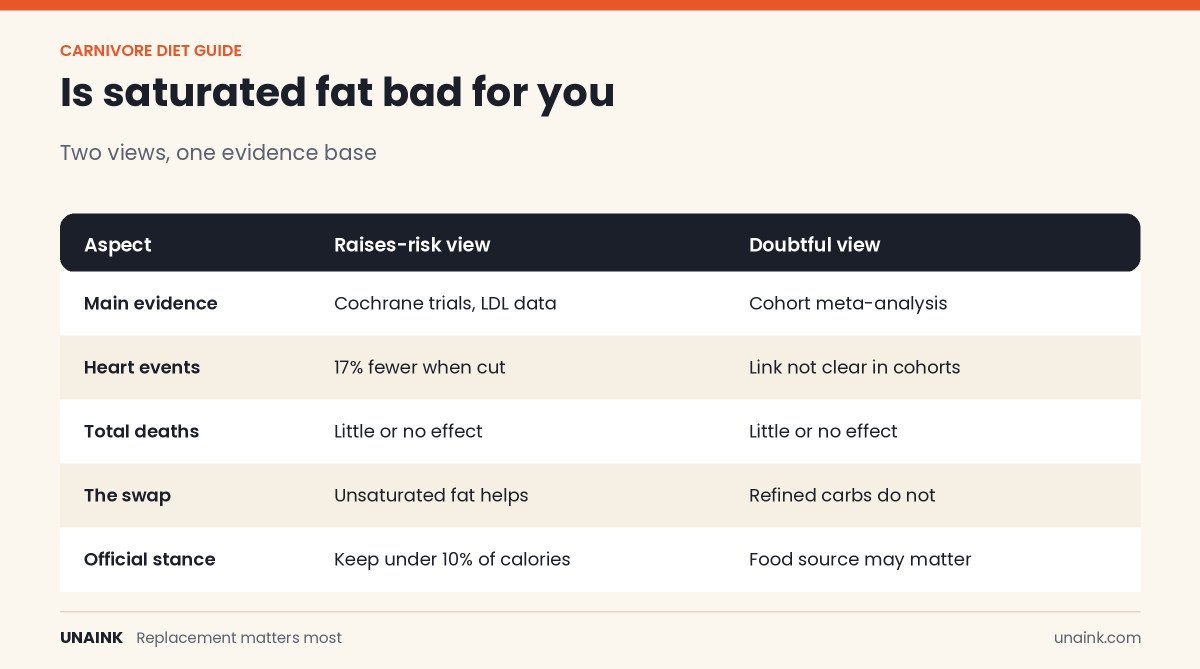
Saturated fat is a type of fat that is solid at room temperature. It is found in beef, lamb, pork, butter, cheese, cream, tallow, lard and tropical oils such as coconut and palm. The Dietary Guidelines for Americans advise keeping it under 10 percent of daily calories, and the American Heart Association’s 2026 report supports that cap.
The Case That It Raises Risk
The Cochrane review, published in 2020, pooled 15 randomized trials with about 56,700 adults followed for at least two years. Cutting saturated fat reduced combined heart disease and stroke events (risk ratio 0.83). Larger reductions in saturated fat and cholesterol were linked to greater benefit, and the authors found no evidence of harm.
The AHA’s 2026 guidance cites strong evidence that swapping butter for non-tropical plant oils lowers LDL cholesterol, and does not recommend beef tallow or butter for cooking. See is red meat bad for you for how this applies to meat.
The Case for Doubt
A 2010 meta-analysis by Siri-Tarino and colleagues pooled 21 cohort studies covering about 350,000 people and concluded there was insufficient evidence that saturated fat is associated with coronary disease, stroke or cardiovascular disease. Harvard’s Nutrition Source calls that conclusion controversial, and the Cochrane review found no clear effect on total mortality.
Skeptics also note that foods differ. Dairy, meat and coconut oil may not behave identically, and food-based studies are hard to separate from the rest of a diet. Observational studies can show association, not cause.
Is Saturated Fat Bad for You? It Depends on the Swap
Harvard reports that replacing saturated fat with refined carbohydrates lowers LDL but also lowers HDL and raises triglycerides, so the net effect is about as bad for the heart. Replacing it with unsaturated fat lowers LDL and improves the cholesterol ratio. A meta-analysis of randomized trials found that replacing saturated fat with up to 15 percent of calories from polyunsaturated fat can lower heart disease risk.
| Swap | Likely effect | Evidence |
|---|---|---|
| Saturated to polyunsaturated fat | Lower LDL, lower heart risk | Trials and meta-analyses |
| Saturated to monounsaturated fat | Lower LDL, effect on events unclear | Cochrane: unclear |
| Saturated fat to refined carbs | Little net benefit | Harvard review of lipid data |
| Saturated fat to protein or whole foods | Depends on the food | Mixed, observational |
Where Official Advice Differs in 2026
The 2025 to 2030 Dietary Guidelines for Americans endorse butter and beef tallow for cooking and a more relaxed stance on red meat and full-fat dairy. The AHA’s 2026 report takes a more cautious line, preferring non-tropical plant oils and low-fat or fat-free dairy. Both keep the 10 percent saturated fat cap, so experts disagree on emphasis, not on the cap.
What It Means on a Carnivore Diet
Animal foods are rich in saturated fat. A 2026 scoping review found modeled carnivore plans exceeding the WHO limit for saturated fat and reported higher LDL and total cholesterol in several studies. Responses vary between people, and no long-term trial tracks heart attacks in carnivore eaters. See high cholesterol on carnivore, heart health and tallow vs butter.
- Get a baseline lipid panel, then recheck after a few months on any high-fat change.
- Ask whether additional tests, such as ApoB, make sense for you.
- Never stop or change a cholesterol or heart medicine without your prescriber.
- Discuss family history of early heart disease before choosing a high-saturated-fat pattern.
Is Saturated Fat Bad for You: The Short Version
Is saturated fat bad for you? In excess it raises LDL and, per moderate-certainty trial data, combined heart events, though its effect on total deaths is unclear. Whether saturated fat is bad for you in practice depends heavily on what it replaces and on your own lipid numbers.
Frequently Asked Questions
Is butter bad for your heart?
Butter is high in saturated fat. The AHA says swapping it for plant oils lowers LDL, though butter in small amounts can fit within the 10 percent calorie cap.
Does saturated fat cause heart attacks?
Saturated fat raises LDL, a risk factor. Trials show fewer combined cardiovascular events when intake is cut, while links to individual outcomes are less certain.
Is coconut oil healthy?
Coconut oil is high in saturated fat and raises LDL. The AHA prefers non-tropical plant oils for cooking.
Why do some studies find no link?
Many look at foods instead of nutrients, and results depend on what replaces the fat. Observational designs also cannot prove cause.
How much saturated fat is too much?
The Dietary Guidelines and AHA support keeping it under 10 percent of daily calories. Your clinician can tailor that to your cholesterol and risk.
Conclusion
The balanced reading is that saturated fat is not uniquely toxic, yet it is a reliable driver of LDL, and trial data suggest cutting it helps when unsaturated fat replaces it. Speak with a doctor or dietitian, especially if you have high cholesterol or heart disease. So is saturated fat bad for you? It raises LDL, and what you swap it with matters most. Is saturated fat bad for you if your LDL is already high? Ask your clinician.
Medical note
This article is for general education and is not medical advice. Talk with a doctor or registered dietitian before making major diet changes, especially if you have a health condition, take medication, or are pregnant or breastfeeding.
Keep Reading
- Carnivore Diet High Cholesterol: Why LDL can rise and what to do.
- Beef Tallow vs Butter: How the two fats compare.
- Carnivore Diet and Heart Health: What is known and unknown.
- Are Seed Oils Bad for You?: Inflammation claims examined.
Sources
- Cochrane review: reduction in saturated fat intake for cardiovascular disease: Hooper et al. 2020, 15 trials
- Harvard Nutrition Source: Types of Fat: Replacement effects and the 2010 meta-analysis
- Baking Business: AHA 2026 dietary guidance: AHA guidance versus federal guidelines
- Carnivore Diet: A Scoping Review of the Current Evidence: LDL and saturated fat in carnivore diets
- Harvard Health: What is the carnivore diet?: Animal fat and LDL
[…] plant oils with butter or tallow raises saturated fat, which the AHA links to higher LDL. See saturated fat, tallow vs butter and inflammation on […]
[…] Red meat can also be high in saturated fat, which raises LDL cholesterol. In March 2026, the American Heart Association advised choosing lean cuts, limiting portion size and frequency, and avoiding processed meat, while moving toward plant proteins. It noted this differs from the federal 2025 to 2030 dietary guidelines, which are friendlier to red meat. See carnivore and heart health and the saturated fat debate. […]
[…] Is Saturated Fat Bad for You?: The evidence explained. […]
[…] past that limit quickly. If you eat that way, LDL is the number to watch, and it is worth reading is saturated fat bad for you for the broader […]