

Is red meat bad for you? Major health bodies say a high intake is linked to higher cancer and heart risks, while a well-known 2019 guideline panel judged the same evidence low in certainty and suggested no change. Both positions rest on the same body of mostly observational research, so the honest answer depends on the type of meat, how much you eat and what you compare it with.
Quick Answer
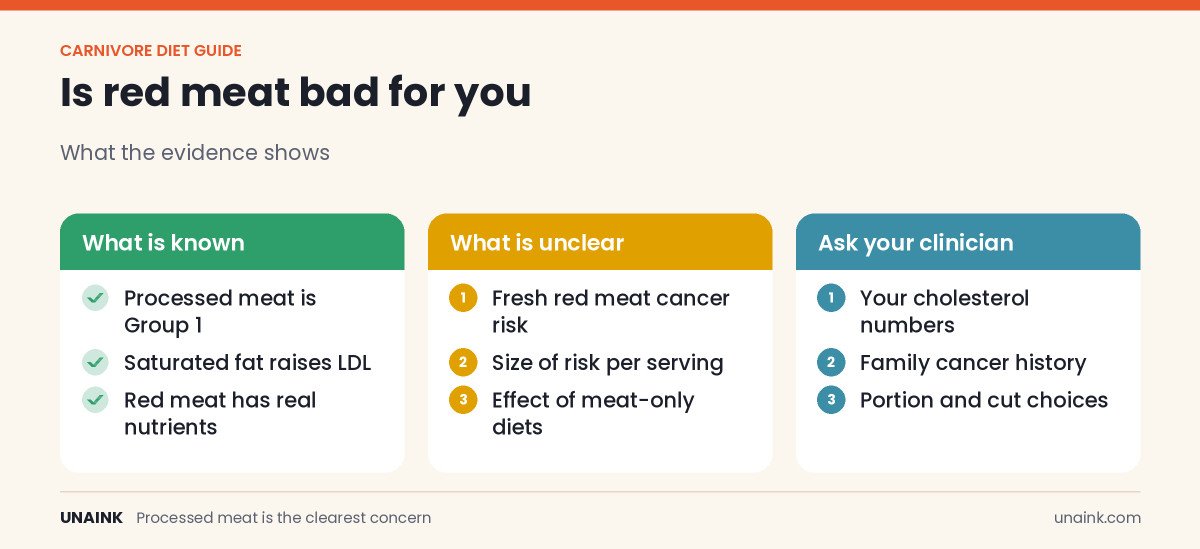
The evidence is strongest against processed meat, which the WHO cancer agency IARC classifies as carcinogenic for colorectal cancer. For unprocessed red meat, the evidence is more limited, and the risk increases appear modest. The American Heart Association advises lean cuts and limited portions, whereas some panels rate the certainty low.
Key Takeaways
- IARC classes processed meat as Group 1 and unprocessed red meat as Group 2A (probably carcinogenic) based on limited human evidence.
- Each 50 gram daily portion of processed meat was linked to an 18 percent higher colorectal cancer risk.
- A large Harvard cohort analysis linked rising red meat intake to higher mortality, but such studies show association, not cause.
- The 2019 NutriRECS panel rated the evidence low in certainty and suggested no change in intake, a stance other experts dispute.
- Processed meat is the clearest concern; for fresh red meat, moderation and lean cuts are the common middle ground.
Red Meat, Processed Meat and the Real Question
Studies treat three things differently: unprocessed red meat such as beef, pork and lamb; processed meat such as bacon, ham, sausage and deli meats; and total meat in the overall diet. Mixing them up is the source of many arguments. Most of the alarming headlines concern processed meat, while the evidence on fresh beef is weaker.
Is Red Meat Bad for You? What the Cancer Evidence Shows
In 2015, a working group of 22 experts from 10 countries reviewed more than 800 studies. IARC classified processed meat in Group 1, carcinogenic to humans, based on sufficient evidence for colorectal cancer. It classified red meat in Group 2A, probably carcinogenic, citing limited human evidence and strong mechanistic evidence. IARC also said red meat has nutritional value.
Group 1 describes how sure scientists are that a link exists, not how big the risk is. The WHO explains that each 50 gram portion of processed meat eaten daily raised colorectal cancer risk by about 18 percent, and that if the red meat link is causal, each 100 gram daily portion could raise it by about 17 percent. WHO estimates around 34,000 cancer deaths a year are linked to diets high in processed meat, compared with roughly 1 million from tobacco. See carnivore diet and colon cancer risk.
Heart Disease and Early Death
A Harvard analysis of the Nurses’ Health Study and Health Professionals Follow-Up Study followed about 81,500 people free of heart disease and cancer. Raising processed meat by half a serving a day or more was linked to a 13 percent higher risk of death from any cause over the next eight years, and unprocessed red meat to a 9 percent higher risk. Swapping in nuts, fish, poultry or whole grains was linked to lower mortality.
Red meat can also be high in saturated fat, which raises LDL cholesterol. In March 2026, the American Heart Association advised choosing lean cuts, limiting portion size and frequency, and avoiding processed meat, while moving toward plant proteins. It noted this differs from the federal 2025 to 2030 dietary guidelines, which are friendlier to red meat. See carnivore and heart health and the saturated fat debate.
The Case Against Alarm
The NutriRECS panel, publishing in Annals of Internal Medicine in 2019, suggested adults keep their current red and processed meat intake. It rated the recommendation weak and the evidence low in certainty. Trial data showed little effect, and the estimated differences were very small, such as roughly 1 to 6 fewer cardiometabolic events per 1,000 people for a cut of three servings a week.
Observational studies cannot fully separate meat from the rest of a person’s lifestyle, because heavy meat eaters often smoke more, exercise less or eat fewer vegetables. That confounding makes small associations hard to interpret. Many nutrition scientists disagreed with the panel’s approach, so this is a real scientific debate and not a settled one.
How Strong Is the Evidence?
| Question | What the sources say | Strength |
|---|---|---|
| Processed meat and colorectal cancer | IARC: sufficient evidence, 18% per 50 g daily | Strongest of the group |
| Red meat and colorectal cancer | IARC: limited human evidence, probable | Moderate to limited |
| Red meat and early death | Harvard cohorts: 9% higher with rising intake | Observational association |
| Cutting meat and outcomes | NutriRECS: low-certainty, small effects | Low certainty |
| Saturated fat and LDL | Raises LDL; AHA supports a 10% calorie cap | Well established |
Putting It in Context
Red meat supplies protein, iron, zinc and B12, so cutting it matters most when the replacement is something better, not refined carbohydrates. People following very high-meat patterns should note that none of the reviewed studies tested a meat-only diet. A 2026 scoping review of the carnivore diet found only nine small human studies. Read more on carnivore diet myths and the environmental impact.
What Most Experts Suggest in Practice
- Limit or avoid processed meats such as bacon, ham and sausage.
- Choose leaner cuts and moderate portions of fresh red meat.
- Mix in fish, poultry, legumes and nuts.
- Build meals around vegetables, legumes and whole grains alongside meat, since Harvard’s substitution findings favored those swaps.
- Check cholesterol and blood pressure with your clinician, particularly if you eat a lot of meat.
Is Red Meat Bad for You: The Short Version
Is red meat bad for you? Processed meat has the strongest link to harm, while fresh red meat shows modest and less certain risks that depend on amount and diet. If you ask is red meat bad for you in a heart-health context, lean cuts and moderate portions are the safest advice.
Frequently Asked Questions
Is red meat carcinogenic?
IARC lists unprocessed red meat as probably carcinogenic (Group 2A) and processed meat as carcinogenic (Group 1), mainly for colorectal cancer.
How much red meat is safe?
No safe level was set. WHO says risk generally rises with the amount eaten, and the AHA advises limiting portions and frequency.
Is processed meat worse than fresh red meat?
The evidence is stronger for processed meat, with an estimated 18 percent higher colorectal cancer risk per 50 g daily portion.
Why do some experts say not to worry?
The NutriRECS panel found low-certainty evidence and small absolute effects, and noted limits of observational research.
Does this apply to carnivore dieters?
The studies did not test meat-only diets. Anyone eating large amounts of meat should discuss cholesterol and cancer screening with a clinician.
Conclusion
The science supports limiting processed meat and being moderate with fresh red meat, but the size of the risk for typical eaters is debated. Talk with a doctor or dietitian about what level fits your age, family history and cholesterol. So is red meat bad for you? The evidence points to limiting processed meat and keeping fresh red meat moderate. Is red meat bad for you in a way that matters for your own risk? Your clinician can help answer that.
Medical note
This article is for general education and is not medical advice. Talk with a doctor or registered dietitian before making major diet changes, especially if you have a health condition, take medication, or are pregnant or breastfeeding.
Keep Reading
- Carnivore Diet and Colon Cancer Risk: What is known about meat-heavy eating.
- Is Saturated Fat Bad for You?: The debate explained simply.
- Carnivore Diet and Heart Health: Cholesterol and cardiovascular risk.
- Environmental Impact of Carnivore Diet: The beef debate.
Sources
- IARC press release: carcinogenicity of red and processed meat: Group 1 and Group 2A classification, 18 percent per 50 g
- WHO Q and A: red meat and cancer: Meaning of classifications and death estimates
- Harvard Gazette: red meat and early death: Cohort analysis of about 81,500 adults
- NutriRECS guideline, Annals of Internal Medicine: Low-certainty evidence and weak recommendation
- Baking Business: AHA 2026 dietary guidance report: AHA advice on lean cuts and processed meat
- Carnivore Diet: A Scoping Review of the Current Evidence: Limited evidence on meat-only diets
[…] Is Red Meat Bad for You: The broader evidence on red meat. […]