Shoppers who see both terms on a package often wonder whether grass fed vs grass finished beef is a real difference or just a marketing split. In principle, the labels point to the same goal, which is cattle that ate forage rather than grain. In practice, how each phrase is used, checked, and enforced can differ a lot.
Quick Answer
Grass fed should mean cattle ate only grass or forage after weaning, and federal guidance says feedlot beef cannot carry the claim. Grass finished is a producer term for the last stage of life, and the guidance reviewed here does not define it separately. The safest approach is to look for both phrases plus the farm name and a third-party certification.
Key Takeaways
- Federal guidance ties grass-fed claims to a 100 percent forage diet after weaning.
- Grass finished emphasizes the last months, which is when many cattle are moved onto grain.
- Federal grass-fed standards were withdrawn in 2016, and labels now rely on producer documentation.
- Percentage claims like 85 percent grass must be disclosed on the label.
- Ask the rancher or look for a named third-party certifier when the claim matters to you.
What Grass Fed Means on a Label
In 2016 the Agricultural Marketing Service withdrew its voluntary grass-fed standard, after a legal review concluded it lacked authority to set one. Since then, the Food Safety and Inspection Service has approved grass-fed claims one label at a time, based on documents that producers submit.
Under later FSIS guidance, beef can be labeled grass fed only if the animals ate grass or forage for all of their post-weaning lives and were never confined in a feedlot. If cattle also ate grain, the label has to say so, for example by stating the share of grass and corn.
What Grass Finished Adds
Nearly every calf eats grass early on. The question is what happens in the final months. Conventional cattle usually move to a feedlot, where a grain ration builds weight and marbling. Grass finished signals that the animal stayed on forage through that final stage.
The term helps because it points to the part of life that most affects the meat. It can still be vague, since a producer might finish cattle on grass while supplementing at other times, and the guidance reviewed does not give grass finished its own definition.
Grass Fed vs Grass Finished Beef: Side by Side
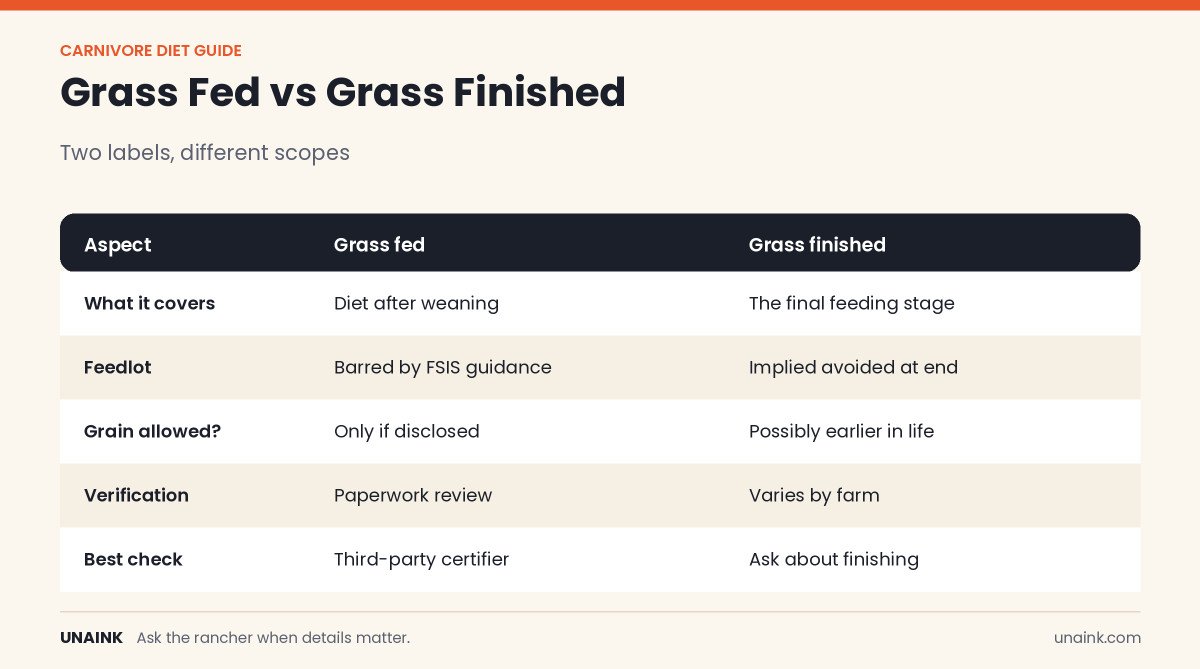
| Feature | Grass fed | Grass finished |
|---|---|---|
| Focus | Whole post-weaning diet | Final feeding stage |
| Federal handling | FSIS reviews claim and documents | No separate definition in the guidance reviewed |
| Feedlot confinement | Not allowed under FSIS guidance | Implied to be avoided at the end |
| Common loophole | Percentage claims, if disclosed | Grain earlier in life |
| What to ask | Was grain ever fed? | Where and how was it finished? |
The National Sustainable Agriculture Coalition has criticized the system because approval depends on paperwork, with no required on-farm checks. That is why independent certifications and direct questions to ranchers carry weight.
Terms That Sound Similar but Are Not
- Grass-fed and grain-finished: cattle grazed for most of life but ate grain at the end, which does not satisfy a grass-fed claim under FSIS guidance.
- Pasture-raised: describes where animals lived, not necessarily what they ate.
- Natural: relates to minimal processing, not diet.
- Organic: refers to organic feed and practices, and organic cattle can still be finished on organic grain.
Does It Change Nutrition?
Reviews comparing grass-fed and grain-fed beef find leaner meat with a higher omega-3 share and more beta-carotene and vitamin E, but the amounts per serving are modest. Our grass fed vs grain fed beef guide covers those numbers in detail.
Cooking rules do not change either way. Ground beef should reach 160°F and whole cuts 145°F with a three-minute rest, as set by USDA.
How to Shop Smarter
- Look for both terms on the label, plus a farm or ranch name.
- Check for a third-party certifier rather than relying only on the word grass.
- Ask the rancher about finishing diet, supplements, and days spent in confinement.
- Compare prices per pound for ground beef, which is usually the best value.
- Consider organ meats from the same farm, which are often inexpensive.
Grass Fed vs Grass Finished Beef: The Short Version
The grass fed vs grass finished beef distinction is mostly about how much of the animal life the label covers. Treat grass finished as a useful clue, treat grass fed as a regulated claim with limited verification, and in any grass fed vs grass finished beef purchase, ask questions when the details matter.
Frequently Asked Questions
Is grass finished the same as 100 percent grass fed?
Not necessarily. Grass finished describes the last stage, while 100 percent grass fed covers the whole post-weaning diet. A farm can be both, but the phrases do not guarantee each other.
Can feedlot beef be labeled grass fed?
No. FSIS guidance specifically bars feedlot beef from the grass-fed claim, though other label claims may still apply.
Is grass-fed beef organic?
Not automatically. Organic certification covers feed, pesticides, and drug use, and cattle can be organic while eating grain.
Does grass finished beef taste different?
Often yes, with a more mineral, grassy flavor and leaner texture than grain-finished beef.
Do I need grass-fed beef on a carnivore diet?
No. It is a preference, and eating enough beef consistently matters more than the label. See the carnivore food list for staples.
Conclusion
Grass fed and grass finished are overlapping claims that deserve a closer look rather than blind trust. Check the details, buy from sources you can question, and remember that no label replaces safe cooking and a varied meat selection.
Medical note
This article is for general education and is not medical advice. Talk with a doctor or registered dietitian before making major diet changes, especially if you have a health condition, take medication, or are pregnant or breastfeeding.
Keep Reading
- Grass Fed vs Grain Fed Beef: How the nutrition and taste really compare.
- Carnivore Diet Food List: What to buy and what to skip.
- Nose to Tail Eating: Making use of the whole animal.
- What Are Organ Meats?: Nutrient-dense cuts worth knowing.
Sources
- Feedstuffs: AMS rescinds grass-fed, naturally raised beef label: Background on the 2016 withdrawal of the federal standard.
- Agri-Pulse: USDA clarifies meat and poultry labeling claims: Summary of FSIS guidance on grass-fed claims.
- National Sustainable Agriculture Coalition: FSIS grassfed update: Concerns about verification and percentage claims.
- Food Science of Animal Resources: Nogoy et al., Fatty acid composition of grain- and grass-fed beef: Review of fatty acid differences.