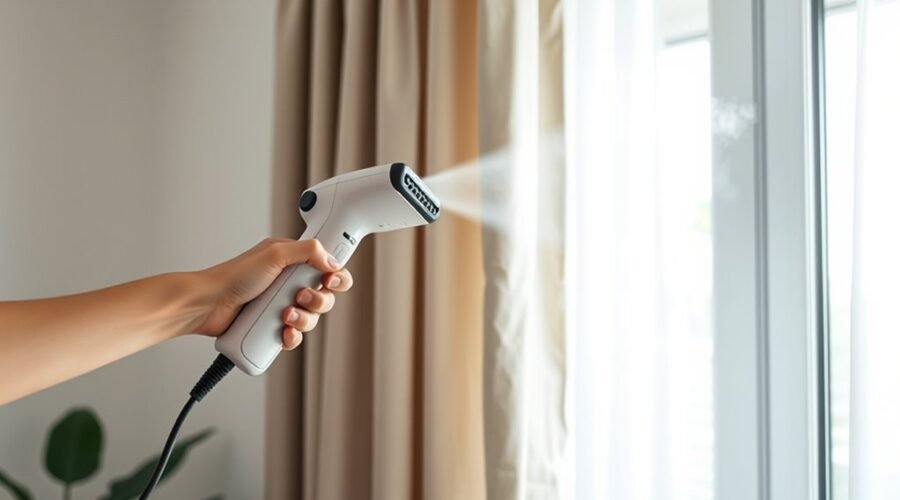
Steaming curtains while they hang is one of the simplest ways to relax packaging folds and everyday wrinkles without taking each panel off the rod. The safest method is to check the curtain’s care instructions and your steamer manual first, test a hidden area, then work in controlled passes while keeping your hands clear of hot steam.
Quick Answer
Yes. You can steam many curtains while they hang if the curtain maker allows steam. Spread the panel, test a hidden spot, use the water and nozzle position specified by your steamer, work in slow vertical passes, keep your hands out of the steam path, and let the fabric dry fully before closing or tying it back.
Key Takeaways
- Check both the curtain-care instructions and the steamer manual before applying heat or moisture.
- Steam one section at a time while the curtain hangs straight, using slow vertical passes and gentle tension when safe.
- Do not assume every steamer should stay 1–2 inches away or that every steam head can touch fabric; designs differ.
- Use the type of water specified for your steamer rather than automatically choosing distilled water or adding chemicals.
- Give sheer, velvet, lined, blackout, coated, or unfamiliar curtains extra caution and always test a hidden area first.
At a Glance
| Time Required | About 5–10 minutes per standard panel; large, lined, or heavy panels may take longer |
| Difficulty | Easy, provided the fabric is approved for steaming |
| Tools Needed | Garment steamer, approved water, clean cloth, and a stable step stool if needed |
| Cost | No meaningful consumable cost if you already own a suitable steamer; steamer prices vary by model |
How to Steam Curtains While They Hang
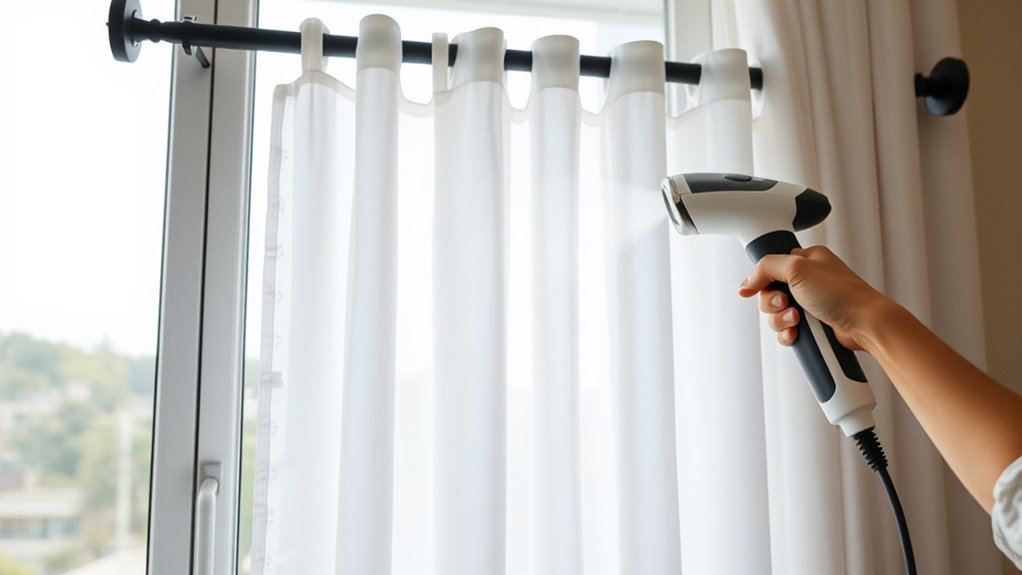
To steam curtains while they hang, leave the panels on the rod, spread the fabric so it is not bunched together, and work through one vertical section at a time. A current Rowenta curtain-steaming guide estimates about 5–10 minutes for many panels, although heavier or lined curtains can take longer.
- Check the curtain instructions. Look for warnings about heat, steam, ironing, coatings, decorative finishes, or professional cleaning. If the manufacturer says not to steam the curtain, do not override that instruction.
- Read the steamer manual. Confirm the correct water, operating position, attachments, steam level, and whether the steam head should touch the fabric or remain clear of it.
- Prepare the panel. Spread the curtain evenly and remove loose dust or hair with a suitable soft brush, vacuum attachment, or lint tool before adding moisture.
- Test a hidden area. Steam a small section near a side or bottom edge and check for spotting, color change, distortion, coating damage, or texture change.
- Work in controlled vertical passes. Start near the top and move steadily through one section at a time. Keep the steam head moving instead of dwelling on one spot.
- Add light tension only when it is safe. You can gently hold the fabric below the area being treated, but keep your hand well away from the steam path and hot steam head.
- Let the curtain dry while hanging. Leave the panel spread out until it is fully dry before tying it back, stacking folds together, or closing it tightly.
Warning: Steam and expelled hot water can cause serious burns. Never aim a steamer toward your hand or body, do not overfill it, and stop using a unit that leaks or spits hot water abnormally. The U.S. Consumer Product Safety Commission has documented burn injuries and recalls involving handheld garment steamers. Check your model against current recall information if you are unsure.
The frequently repeated 1–2 inch rule is not universal. Rowenta currently suggests roughly 1–2 inches for many curtains and slightly more clearance for lightweight sheers, while a Conair steamer manual instructs users not to touch fabric with that model’s steam head. By contrast, some Philips Steam&Go models are specifically designed for safe plate contact on ironable fabrics. Your own appliance instructions take priority.
Tools and Supplies for Steaming Curtains
A few simple tools make steaming curtains easier and safer. A handheld garment steamer is convenient for short sessions, while a larger standing steamer or steam station may be easier for multiple heavy panels. Use a stable step stool if you cannot comfortably reach the top of the curtain from the floor.
- Handheld or standing garment steamer suitable for the fabric
- Water specified in the steamer manual
- Clean cloth for wiping cool drips or surfaces
- Stable step stool if the curtain header is out of reach
- Soft brush, lint roller, or suitable vacuum attachment for surface dust
- Any fabric guard, pad, brush, or accessory specified by the steamer manufacturer
Do not assume distilled water is always required. For example, the current Rowenta Pure Pop instructions specify untreated tap water and recommend a 50/50 mix of tap and distilled water when the local water is very hard. Other steamers may specify something different.
Note: Never add vinegar, fragrance, fabric softener, descaling chemicals, or other additives to a steamer tank unless the appliance manual expressly tells you to use that substance for a specific maintenance procedure.
Check the Curtain Fabric Before Steaming
The fiber name alone does not tell you everything you need to know. Curtains can have coatings, linings, printed finishes, adhesives, embroidery, trims, or layered constructions that respond differently to heat and moisture. Test first even if you have successfully steamed another curtain made from a similar fiber.
| Curtain Type | What to Check |
|---|---|
| Cotton, linen, polyester, blends | Check the finished curtain’s instructions, especially if it has a lining, print, or special finish. |
| Sheer or lightweight panels | Use gentle steam output when available, avoid oversaturating the fabric, and begin cautiously after a hidden-area test. |
| Velvet | Avoid crushing or flattening the pile. Follow the curtain maker’s instructions and avoid direct pressure unless specifically permitted. |
| Blackout, thermal, or coated curtains | Check the coating or backing instructions. Some coated curtains can be damaged by direct heat, moisture, or steam contact. |
| Silk or unfamiliar delicate fabric | Treat as high risk for water marks, texture change, or heat damage and follow the maker’s care instructions rather than guessing. |
How to Steam Sheer Curtains Safely
Sheer curtains need a light touch because thin material can become wet quickly. If your steamer has adjustable output, begin with a gentle setting and test first. Rowenta’s current curtain guide suggests keeping a steamer somewhat farther from lightweight sheers than from ordinary panels, but the exact clearance should still follow your appliance instructions.
The Pure Pop Handheld Steamer mentioned in the original article is a real compact model: Rowenta lists a 15-second heat-up time and a reversible pad with a velvet side intended for delicate textiles. That does not mean every sheer curtain is automatically safe to steam, so check the curtain first.
| Step | Action |
|---|---|
| 1 | Test a small hidden area and wait long enough to check for spotting or distortion. |
| 2 | Spread the sheer panel so it hangs freely rather than bunching into several layers. |
| 3 | Use the gentlest suitable output and the clearance or contact method specified by the steamer manufacturer. |
| 4 | Move continuously through each section instead of concentrating steam on one spot. |
| 5 | Leave the panel spread out until it is fully dry before gathering or tying it back. |
Pro Tip: If a sheer starts looking visibly wet, stop adding steam and let that section dry. More moisture is not automatically more effective.
How to Steam Blackout, Lined, Velvet, and Heavy Curtains
Heavy and specialty curtains deserve more caution than ordinary unlined panels. With blackout or thermal curtains, identify whether the wrinkle is in the decorative face fabric or the coated backing. Rowenta advises checking the care information on blackout and coated curtains because some coatings can be damaged by direct steam.
With velvet, the main risk is flattening or marking the pile. Avoid pressing a hot plate into velvet unless the curtain manufacturer and your steamer instructions specifically allow it. Rowenta’s curtain guide suggests additional clearance for velvet rather than direct pressure.
Lined curtains combine multiple materials, so a method that is safe for the front fabric may not be safe for the lining, adhesive, or blackout layer. Test carefully and stop if you see bubbling, puckering, color change, gloss, water marks, or separation between layers.
Heavy linen or cotton may need a slower pass or a second treatment after the first section has cooled and dried. Avoid holding the steam head motionless over one crease in an attempt to force it flat.
How to Remove Stubborn Curtain Wrinkles
When stubborn curtain wrinkles remain after the first pass, give the fabric time to cool and dry before deciding that it needs more steam. Packaging folds can relax gradually once the panel is hanging at full length.
- Keep the curtain hanging evenly so gravity can work on the crease.
- Repeat a controlled steam pass only after confirming the first pass caused no spotting or damage.
- Use gentle tension below the crease if you can keep your hand safely outside the steam path.
- If the curtain maker permits light misting, use plain clean water rather than an improvised vinegar or chemical mixture.
- If the curtain instructions permit ironing or pressing, follow their specified temperature and method instead of guessing.
- If the care information prohibits steam or heat, use the approved cleaning or wrinkle-removal method instead.
If you have just washed the curtains and their care instructions permit hanging or line drying, hanging them promptly and evenly can reduce new creasing as they dry. Do not rehang a curtain in a way that conflicts with its drying instructions.
Note: A vinegar-and-water mixture sometimes appears in steamer descaling instructions. That is appliance maintenance, not evidence that vinegar should be sprayed onto every curtain fabric.
What to Do If the Steamer Spits, Leaks, or Leaves Water Spots
Stop steaming if the appliance begins ejecting unusually large droplets, leaking hot water, or behaving differently from normal. Turn it off, unplug it when safe to do so, let it cool, and consult the troubleshooting section of the manual.
Common checks include the water level, whether the tank is overfilled or seated correctly, whether the appliance is being held in its required operating position, and whether mineral buildup needs manufacturer-approved maintenance. Do not open a hot reservoir or improvise a descaling formula.
Hot-water ejection is a genuine safety issue. The U.S. Consumer Product Safety Commission has recalled handheld steamers after reports of hot water spraying or spitting from the nozzle and causing burn injuries. If your steamer model is subject to a recall or safety warning, stop using it and follow the official remedy.
How to Keep Curtains Wrinkle-Free Longer
To keep curtains looking smooth after steaming, make sure they hang evenly and are not crushed against the floor, furniture, or each other. Spread freshly steamed panels while they dry so damp folds do not become new creases.
There is no universal need to steam curtains every 2–3 months. Refresh them when wrinkles actually return and according to the fabric maker’s care guidance. In dusty rooms, kitchens, or homes with pets, removing loose surface debris before steaming can help keep the fabric looking cleaner.
For sheer or lightweight curtains, use sewn-in or manufacturer-approved hem weights only when the curtain is designed for them. Avoid adding improvised weights that could pull delicate fabric out of shape.
Before storing curtains, make sure they are clean and completely dry. Store them in a breathable, dry place without crushing them under heavy items. Depending on the fabric and construction, loose rolling or careful folding may be appropriate; follow the manufacturer’s storage guidance when available.
Frequently Asked Questions
Can I Steam Curtains While They Are Hanging?
Yes, many curtains can be steamed while hanging. Check the finished curtain’s care instructions first, test a hidden spot, then use the water, operating position, steam output, and fabric-contact method specified by your steamer manufacturer.
How Do You Get Wrinkles Out of Curtains While They Are Hanging?
Spread the panel, test an inconspicuous area, and steam one vertical section at a time while keeping the steam head moving. Use gentle tension only if your hand remains safely away from the steam path. Leave the curtain hanging until it is fully dry.
Will Wrinkles Eventually Come Out of Curtains?
Light packaging wrinkles may relax after the curtains hang freely for a while, especially in heavier panels. Deep fold lines can remain and may need an approved steaming or pressing method. Avoid increasing heat or moisture beyond the fabric’s care instructions just to speed the process.
How Do You Steam Creases Out of Curtains?
Work steadily across the crease using the steam level and nozzle position allowed by your equipment. Keep the steam head moving, use light fabric tension when safe, and let the area cool and dry before making another pass. Do not hold concentrated steam on one spot.
Can You Steam Blackout Curtains?
Sometimes, but check the curtain manufacturer’s instructions first. Blackout and thermal curtains can use coatings, foam layers, adhesives, or linings that react differently to heat and moisture. Avoid direct steam on a backing unless the maker specifically permits it.
Should I Use Distilled Water in a Curtain Steamer?
Use whatever water your steamer manufacturer specifies. Some models accept tap water, some recommend distilled water, and others recommend a mixture in hard-water areas. Using the wrong water or adding unapproved chemicals can cause deposits, staining, spitting, or premature wear.
Should the Steamer Head Touch the Curtain?
It depends on the steamer and the fabric. Some manufacturers instruct users to keep the steam head off the fabric, while other steamers have heated plates designed for contact with ironable textiles. Follow the instructions for your exact appliance and curtain rather than using one universal rule.
Conclusion
Steaming hanging curtains is straightforward once you stop treating every fabric and every steamer the same. Check the curtain and appliance instructions, test first, work steadily through the panel, keep your hands away from hot steam, and allow the material to dry fully. Give sheers, velvet, lined panels, and blackout coatings extra care, and never force a stubborn crease with excessive heat or moisture.
Sources
- Rowenta — How to Steam Curtains While Hanging and Get Wrinkles Out — curtain technique, approximate panel timing, sheer, velvet, blackout, and drying guidance.
- Rowenta — Pure Pop Handheld Steamer Instructions and FAQ — 15-second heat-up, delicate-fabric pad, water guidance, additives, leaks, and maintenance.
- Conair — GS2 Fabric Steamer Instruction Booklet — vertical steaming, fabric testing, operating precautions, and model-specific no-contact guidance.
- Philips — Steam&Go Handheld Garment Steamer — example of a steamer designed for plate contact with ironable fabrics, demonstrating why contact guidance is model-specific.
- U.S. Consumer Product Safety Commission — Handheld Garment Steamer Recall — documented hot-water ejection and burn hazards.