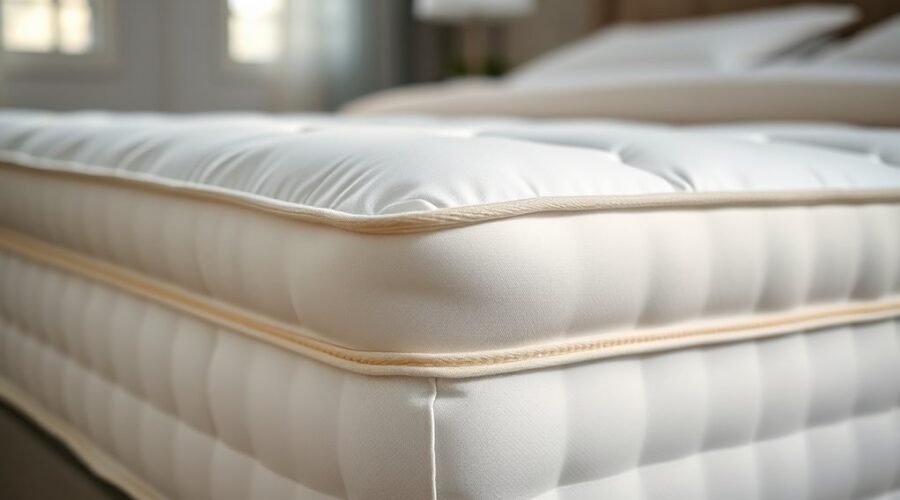
A Euro top mattress adds an extra comfort section beneath the top cover so the cushioning sits flush with the mattress edges. The result is a smooth, tailored profile instead of the visibly raised cushion you see on a traditional pillow top. However, “Euro top” describes the construction style—not a specific firmness, lifespan, or level of support.
Quick Answer
A Euro top mattress has an extra comfort layer finished flush with the sides of the bed for a smooth, integrated appearance. Euro tops can feel plush, medium, or firm depending on the materials underneath. Compared with traditional pillow tops, the edges often feel more uniform, but actual support and durability depend on the entire mattress construction.
Key Takeaways
- A Euro top places cushioning beneath the top cover and finishes it flush with the mattress sides.
- Euro top is a construction style, not a firmness rating; Euro-top mattresses can range from plush to firm.
- The flush perimeter may feel more uniform than a traditional pillow top, but reinforced coils or foam rails largely determine true edge support.
- Pressure relief, motion isolation, temperature control, and durability depend on the foams, fibers, coils, and support core used in the specific mattress.
- Choose by overall firmness, sleep position, body support, materials, trial policy, and construction quality rather than the Euro-top label alone.
What Is a Euro Top Mattress?

A Euro top mattress has an additional comfort section made from foam, fiber, latex, wool, or similar cushioning materials. Instead of appearing as a separate pillow-like layer, the Euro top is finished beneath the mattress cover and extends to the perimeter.
Serta describes the main Euro-top difference as the way the padding extends to the edge and creates a smooth, integrated appearance. A traditional pillow top, by contrast, has a visibly raised cushioning section sewn to the top of the mattress.
That distinction is important because a Euro top is not a standardized firmness level. One Euro-top mattress may be plush and deeply cushioned, while another may feel medium or firm. The foams, fibers, coils, and support system below the surface determine most of the bed’s overall feel.
Think of “Euro top” as a description of how the upper comfort section is finished—not as a promise that the mattress will be firm, soft, orthopedic, or especially durable.
How Euro Top and Pillow Top Mattresses Differ
Both Euro tops and traditional pillow tops add cushioning above the main support system. The clearest difference is how that cushioning is attached and finished.
| Feature | Euro Top | Traditional Pillow Top | Tight Top |
|---|---|---|---|
| Appearance | Smooth and flush with the sides | Raised, pillow-like layer with a visible seam or gap | No separate plush top section |
| Firmness | Can range from plush to firm | Can range from plush to firm | Also varies by model |
| Edge feel | Often more uniform at the surface perimeter | Upper cushion can feel softer near the edge | Depends heavily on the support core |
| Main buying factor | Materials and underlying support system | Materials and underlying support system | Materials and underlying support system |
Some Euro tops use denser cushioning than traditional pillow tops, which can create a more structured surface. But that is not universal. Current mattress lines include plush Euro tops as well as plush pillow tops, so you should always check the actual firmness specification.
What a Euro Top Mattress Feels Like
A Euro top usually feels visually and physically integrated with the rest of the mattress. There is no obvious loose-looking cushion sitting above the perimeter, and the top surface tends to transition smoothly into the sides.
| Characteristic | What to Expect |
|---|---|
| Surface | Smooth, tailored appearance with cushioning extending to the perimeter |
| Cushioning | Varies from lightly padded to deeply plush depending on foam, fiber, latex, or other materials |
| Firmness | Not determined by the Euro-top label; check the model’s stated firmness |
| Motion | Depends on foam type, layer thickness, and coil design |
| Perimeter | May feel uniform, but strong edge support requires suitable perimeter construction |
Two mattresses can both carry the Euro-top label and still feel completely different. A thick memory-foam Euro top may contour closely, while a latex-and-coil design may feel much more responsive and buoyant.
What Materials Are Used in Euro Top Mattresses?
The material inside the top section often matters more than the Euro-top name itself.
- Polyfoam: Adds cushioning and can range from soft to relatively firm. Density and formulation affect durability.
- Memory foam: Conforms closely and can absorb movement well, though some formulations retain more heat than responsive foams.
- Latex: Usually feels springier and more responsive, with less deep sink than slow-response memory foam.
- Fiberfill: Creates a softer, traditional quilted feel but may compress differently from foam.
- Wool or other natural fibers: Can add surface cushioning and influence moisture and temperature feel.
When comparing models, ask what is actually inside the Euro top instead of assuming all Euro tops perform the same way.
Why Euro Top Mattresses Can Feel More Supportive at the Edge
Because the upper cushioning extends flush to the sides, many Euro tops feel more continuous around the perimeter than a traditional pillow top with a visibly separate cushion.
However, that does not mean the Euro-top seam itself provides all the edge support. Strong perimeter performance usually comes from features such as reinforced coils, firmer foam rails, or dedicated edge-support systems beneath the comfort layers.
For example, Serta’s Classic Plush EuroTop uses a separate BestEdge foam encasement that the manufacturer says is intended to reduce edge roll-off and extend the usable sleep surface.
Pro Tip: When testing a mattress, sit on the edge and also lie near the perimeter. Ask whether the model uses reinforced perimeter coils, foam encasement, or another edge-support system. Those details tell you more than the words “Euro top” alone.
Good edge support can be especially useful if you regularly sit on the side of the bed, have difficulty getting up, share a smaller mattress, or simply like sleeping close to the edge.
Pros and Cons of a Euro Top Mattress
| Potential Advantages | Potential Drawbacks |
|---|---|
| Smooth, tailored appearance | The label does not tell you how soft or firm the mattress actually is |
| Extra cushioning over the support core | Thicker models may require deep-pocket sheets |
| Often a more uniform surface near the perimeter | Weak underlying edge construction can still allow noticeable compression |
| Available with many foam, fiber, latex, and coil combinations | Added comfort layers can increase mattress height and weight |
Who Should Buy a Euro Top Mattress?
A Euro top may suit you if you like added cushioning but prefer a smooth, integrated mattress profile rather than the visibly raised look of a traditional pillow top.
It can also be appealing if you want to use the mattress perimeter and find a particular Euro-top model with a strong reinforced edge system. Couples may appreciate that extra usable surface, but they should also check motion-isolation performance because that depends on the foams and coil system.
Most importantly, choose the overall firmness that fits your body and sleep position. Do not assume that a Euro top is automatically firm, medium-firm, or appropriate for a specific type of sleeper.
Ideal Sleep Positions
There is no single sleep position that requires a Euro top. Position mainly changes how much cushioning and support you are likely to need.
- Side sleepers: Often need enough cushioning for the shoulders and hips while keeping the midsection supported.
- Back sleepers: Commonly prefer a balance of contouring and support that prevents excessive sinking around the hips.
- Stomach sleepers: Often need a firmer overall surface so the midsection does not sink too deeply.
- Combination sleepers: Usually benefit from a surface that cushions pressure points without making position changes difficult.
A Euro-top model can work for any of these positions if its firmness and support construction are appropriate.
Best Support Needs
If support is your priority, look below the Euro top. The coil unit, foam core, zoning, perimeter reinforcement, and total firmness determine how securely the mattress holds your body.
Body weight also changes how deeply a mattress compresses. Rather than relying on a universal weight cutoff, compare models designed for your expected load and pay attention to manufacturer guidance, support-core specifications, and how stable the mattress feels during a trial.
Is a Euro Top Mattress Right for Side, Back, or Stomach Sleepers?
Yes, a Euro-top mattress can work for side, back, or stomach sleeping, but the right choice depends on the mattress underneath the Euro top.
A 2026 review of 47 mattress-related studies found that medium-firm mattresses had the most consistent evidence for pressure distribution, sleep quality, morning stiffness, and nonspecific low-back pain. The authors also emphasized individual factors such as body characteristics and sleep position. That evidence applies to overall mattress support and firmness—not specifically to Euro-top construction.
A 2026 orthopedic review covering 47 studies found the strongest general evidence for medium-firm mattress support, but mattress choice still needs to account for the individual sleeper. A Euro top by itself does not determine that firmness.
Side Sleeper Pressure Relief
Side sleepers put more concentrated pressure on the shoulders and hips, so sufficient surface cushioning can be helpful. A Euro top made with conforming foam or other pressure-relieving material may provide that cushioning, but a very firm model could still feel uncomfortable.
Look for enough contouring to accommodate the shoulder and hip without allowing the torso to sink so far that your body feels twisted or unsupported.
Back and Stomach Support
Back sleepers generally need an even balance of cushioning and support. Stomach sleepers commonly need a firmer overall feel because excessive sink around the hips and abdomen can make the sleeping posture uncomfortable.
A Euro top can provide a cushioned first contact while the support system underneath maintains stability. Whether it succeeds depends on the complete design rather than the Euro-top label.
Note: A mattress is not a treatment for chronic pain. If back, hip, shoulder, or other pain is persistent, worsening, or affecting daily life, discuss it with a qualified healthcare professional instead of relying on mattress construction alone.
Choosing by Sleep Position
| Sleep Position | What to Prioritize |
|---|---|
| Side | Shoulder and hip cushioning with enough underlying support |
| Back | Balanced contouring and stable support through the hips and lower back |
| Stomach | Usually a firmer overall feel that limits excessive midsection sink |
| Combination | Responsive surface that makes turning easy while maintaining support |
| Couples | Edge stability, suitable firmness for both people, and strong motion isolation |
How Long Euro Top Mattresses Last
There is no reliable universal lifespan for every Euro-top mattress. The top style is only one part of the design, and two Euro-top beds can use very different materials.
Durability is more likely to depend on:
- foam density and quality;
- fiber compression resistance;
- latex quality, if used;
- coil or support-core construction;
- perimeter reinforcement;
- sleeper weight and nightly use;
- the foundation or bed frame;
- moisture and stain protection; and
- whether the mattress is cared for according to the manufacturer’s instructions.
Visible sagging, deep body impressions, loss of support, discomfort, or a major change in how the mattress feels are more useful replacement signals than simply counting years.
Also remember that a long warranty does not guarantee that the mattress will maintain the same comfort for the full warranty period. Warranties primarily cover defined manufacturing defects under specific conditions.
How to Care for a Euro Top Mattress
Most modern Euro-top mattresses are designed with a dedicated sleep surface and should not be flipped unless the manufacturer specifically says otherwise.
For example, Serta states that its current Classic mattresses have a dedicated top and bottom and are not intended to be flipped. Beautyrest likewise says its current mattresses are one-sided and may be rotated head-to-foot, with roughly six months offered as a general rule of thumb rather than a warranty requirement.
- Follow the care instructions for your exact mattress model.
- Do not flip a one-sided mattress.
- Rotate only when the manufacturer permits or recommends it.
- Use a compatible, supportive foundation or bed frame.
- Protect the surface from spills and prolonged moisture.
- Use a mattress protector if permitted by the warranty and care guide.
How Euro Top Mattresses Compare on Price and Value
A Euro-top label does not automatically make a mattress expensive or a better value. Mattresses with Euro tops and traditional pillow tops appear across different price ranges.
Price is usually influenced by factors such as foam and latex quality, coil design, zoning, edge reinforcement, cover materials, brand, mattress height, manufacturing location, warranty terms, and included delivery or trial services.
| Value Factor | What to Check |
|---|---|
| Comfort layers | What materials are used and how thick are they? |
| Support core | Foam core, connected coils, individually wrapped coils, zoning, or other system |
| Edge support | Dedicated foam rail, reinforced coils, or no special reinforcement |
| Trial and returns | Home-trial length, return fees, exchanges, and break-in requirements |
| Warranty | Covered defects, body-impression threshold, foundation requirements, and exclusions |
A less expensive mattress that fits your body and has transparent construction may be a better purchase than a premium Euro top chosen only for its label.
How to Choose the Right Euro Top Mattress
Start with your preferred sleep position and the overall firmness you find comfortable. Then look at the actual materials and support system.
- Check the firmness rating: Do not assume “Euro top” means medium-firm.
- Identify the comfort materials: Memory foam, polyfoam, latex, wool, and fiber each create a different feel.
- Examine the support core: This has a major effect on stability and long-term support.
- Test the edge: Sit and lie near the perimeter instead of judging it by appearance.
- Consider motion isolation: Couples should look at foam type and coil construction, especially individually wrapped coils.
- Check mattress height: A taller Euro-top model may require deeper fitted-sheet pockets.
- Review foundation requirements: Using an unsupported frame can affect comfort and may affect warranty coverage.
- Read the trial and return policy: A home trial gives you more useful information than a few minutes in a showroom.
- Review the warranty: Pay attention to exclusions and the definition of a covered body impression.
If you test the mattress in a store, lie in your normal sleep position rather than only pressing the surface with your hand. A Euro top should provide enough cushioning for comfort while the underlying mattress keeps your body supported.
Frequently Asked Questions
Are Euro Top Mattresses Worth the Money?
They can be, but the Euro-top label alone does not determine value. Compare the comfort materials, support core, edge reinforcement, firmness, trial period, warranty, and price. A well-built mattress that suits your body is more important than whether the upper section is called Euro top or pillow top.
What Mattress Should You Stay Away From?
Do not automatically avoid pillow tops or any other single mattress style. Instead, be cautious with mattresses that do not disclose their construction, feel unstable for your body, lack a practical return policy, require an incompatible foundation, or provide unclear warranty terms. The wrong firmness for your sleep position is a bigger concern than the Euro-top or pillow-top label.
Can You Flip Over a Euro Top Mattress?
Usually not if the mattress has a one-sided construction with the Euro-top comfort layer on only one side. Flipping that design puts the support base on top. Check the manufacturer’s instructions for your exact model. Some mattresses may be rotated head-to-foot if the manufacturer allows it.
What Firmness Is a Eurotop Mattress Most Comparable To?
There is no single comparable firmness. Euro top describes how the comfort section is finished, not how firm the mattress is. Euro-top models can be plush, medium, medium-firm, or firm, so always check the manufacturer’s stated feel and test the complete mattress.
Does a Euro Top Automatically Have Better Edge Support?
No. Its flush construction can make the upper perimeter feel more uniform, but true edge support depends heavily on the mattress underneath. Reinforced coils, foam encasement, firmer perimeter materials, and the overall support core usually matter more.
Is a Euro Top Better Than a Pillow Top?
Neither style is automatically better. A Euro top gives you a flush, integrated appearance, while a traditional pillow top has a visibly separate cushioning layer. The better choice is the mattress with the firmness, materials, support, temperature feel, and pressure relief that work for you.
Conclusion
A Euro top mattress gives you extra cushioning in a smooth, flush design, but the name tells you only part of the story. It does not automatically mean firmer support, better motion isolation, a specific lifespan, or the right firmness for your sleep position.
For the best choice, compare the entire mattress: firmness, comfort materials, support core, edge reinforcement, height, trial policy, warranty, and how the bed feels in your normal sleep position. If those features fit your needs, a Euro top can provide a comfortable, polished sleep surface without the raised look of a traditional pillow top.
Sources
- Serta — Classic Mattress — Euro-top versus pillow-top construction, firmness options, sleep-position guidance, and one-sided design information.
- Serta — Classic Plush EuroTop — example of Euro-top materials and a separate foam edge-support system.
- Saatva — Pillow Tops and Euro Tops: What’s the Difference? — manufacturer explanation of Euro-top and traditional pillow-top construction.
- PubMed — Mattress impact on lifestyle and back pain: a 25-year orthopedic literature review guideline — 2026 review of mattress firmness, pressure distribution, sleep quality, spinal alignment, and low-back-pain evidence.
- PubMed — Effect of firmness of mattress on chronic non-specific low-back pain — randomized controlled trial comparing firm and medium-firm mattresses.
- Beautyrest — Do I need to flip or rotate my mattress? — current manufacturer guidance on one-sided mattresses and optional rotation.