People who tolerate meat well but react to dairy often ask about ghee vs butter. Ghee is butter that has been simmered until the water evaporates and the milk solids are removed. That one change alters lactose content, smoke point, and shelf life, though it does not turn ghee into a health food or make it safe for everyone.
Quick Answer
Ghee is usually easier on people with lactose intolerance or mild dairy sensitivity because simmering removes most lactose and casein. It is not safe for a true milk allergy, and no head-to-head trials have measured digestion. Ghee also has a higher smoke point, but it has slightly more saturated fat per tablespoon than butter.
Key Takeaways
- Ghee is about 99.5 percent fat; butter is about 80 percent fat with water and milk solids.
- Ghee contains very little lactose and casein, so many sensitive people tolerate it better.
- People with a milk allergy should avoid both unless an allergist says otherwise.
- Ghee tolerates higher heat, with a smoke point often cited at 375 to 485°F against roughly 300 to 350°F for butter.
- Ghee has slightly more saturated fat per tablespoon, so portions still count.
What Ghee Is and How It Differs From Butter
Butter is churned cream, roughly 80 percent fat, with the remainder mostly water and milk solids. To make ghee, cooks simmer butter until the water boils off and the solids settle and brown, then strain them out. What remains is nearly pure butterfat with a nutty aroma.
Regular clarified butter is similar but cooked less, so it keeps a milder flavor. True ghee is cooked longer. Because it lacks water and most solids, ghee stays shelf-stable far longer than butter.
Ghee vs Butter Nutrition
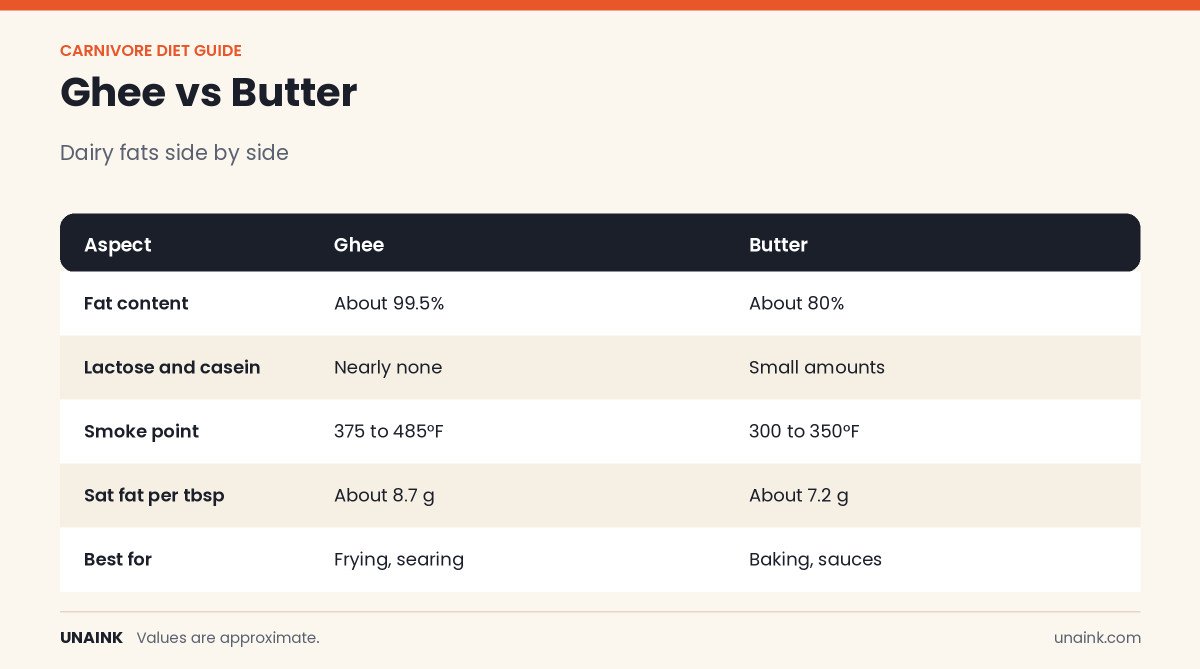
| Per tablespoon | Ghee | Butter |
|---|---|---|
| Calories | About 123 | About 102 |
| Total fat | About 13.9 g | About 11.5 g |
| Saturated fat | About 8.7 g | About 7.2 g |
| Lactose and casein | Nearly none | Small amounts |
| Smoke point | 375 to 485°F | 300 to 350°F |
| Best cooking use | Frying, searing, roasting | Baking, sauces, low heat |
Both supply some vitamins A, E, and K and a little butyrate, though ghee holds slightly more vitamin A per spoonful. Reviewers describe the nutritional differences as small. Claims that ghee is dramatically healthier are exaggerated, according to GoodRx’s summary of the research.
Which Is Easier to Digest?
Lactose is a sugar and casein is a protein, and both live in the milk solids and water. Butter has only small amounts, while ghee has even less. For many people with lactose intolerance, that tilts toward ghee.
Digestive comfort has other causes too. A big dose of any fat can cause loose stools, nausea, or reflux, especially when you are new to high-fat eating. If a small amount of ghee still causes symptoms, a dairy allergy, fat intolerance, or another condition may be involved, and a clinician can help sort that out.
Safety Notes for Dairy Allergy and Cholesterol
- Milk allergy: ghee is still dairy-derived, and traces of milk protein can remain. Avoid it unless an allergist approves.
- Cholesterol: ghee has more saturated fat per tablespoon, and an older analysis found oxidized cholesterol in ghee but not fresh butter.
- Quantity: people watching LDL may want to keep to a spoonful or two per day, and some should ask their clinician first.
- Quality: choose ghee made from grass-fed butter with no additives, and check that the label lists only butter.
Using Ghee and Butter on Carnivore
Dairy is optional on a carnivore plan. Some people include butter, some use only ghee, and others skip all dairy for an initial period. A common approach is to remove dairy for a few weeks, then reintroduce one item at a time and note symptoms. Our how to start the carnivore diet guide covers pacing.
For searing steaks and frying eggs, ghee is a good option. For fat without dairy at all, beef tallow is the classic choice, and beef tallow vs butter explains the tradeoffs.
Ghee vs Butter: The Short Version
In the ghee vs butter matchup, ghee wins for lactose sensitivity and high heat, while butter wins for flavor in baking and sauces. Whichever side of ghee vs butter you pick, keep portions moderate and watch how your body responds.
Frequently Asked Questions
Is ghee lactose free?
Ghee contains only trace amounts of lactose, so it is often well tolerated, but it is not guaranteed to be completely lactose free. Check with a clinician if your reaction is severe.
Can people with a milk allergy eat ghee?
Generally no, unless an allergist approves. Milk proteins can remain in small amounts, and reactions can be serious.
Is ghee better than butter for cholesterol?
No evidence says so. Ghee has more saturated fat per tablespoon, so people managing LDL should limit it just as they would butter.
Does ghee need refrigeration?
Often not, since it has almost no water. Follow the label, and refrigerate it if your kitchen is warm or if the product says to.
Can I make ghee at home?
Yes. Simmer unsalted butter gently until the foam clears and the solids turn golden, then strain through cheesecloth into a clean jar.
Conclusion
Ghee can be a gentler choice for lactose-sensitive eaters and a better pan fat, but it is still dairy and still high in saturated fat. Test it in small amounts and let your own response guide you.
Medical note
This article is for general education and is not medical advice. Talk with a doctor or registered dietitian before making major diet changes, especially if you have a health condition, take medication, or are pregnant or breastfeeding.
Keep Reading
- Beef Tallow vs Butter: Smoke point, flavor, and nutrition compared.
- What Is Beef Tallow?: A dairy-free animal fat for cooking.
- How to Start the Carnivore Diet: A gradual way to begin and test foods.
- Carnivore Diet Food List: Which foods fit and which to skip.
Sources
- GoodRx: Is Ghee Healthier Than Butter?: Nutrition per tablespoon, lactose and casein, smoke point.
- Healthline: Ghee: Evidence review of ghee health claims.
- American Heart Association: Saturated Fats: Saturated fat guidance.