Few questions about meat-only eating come up as often as how the carnivore diet and heart health fit together. Heart groups warn about saturated fat and red meat, while carnivore followers point to lower triglycerides, weight loss, and steady energy. Here is how the two sides line up, what the small studies show, and what to check with a clinician.
Quick Answer
The carnivore diet and heart health have not been studied long enough to know the outcome, but cholesterol is the main warning sign. LDL rose in several small studies, and mainstream groups link high LDL with heart disease and stroke. Because direct heart attack and stroke data are missing, anyone with heart risk factors should work with a clinician and track lab results.
Key Takeaways
- The American Heart Association suggests keeping saturated fat under about 6% of calories, roughly 13 grams on a 2,000-calorie diet.
- LDL cholesterol rose in several carnivore studies, and about 27% of one survey sample reported worse lipid profiles.
- Some people see lower triglycerides, but no study has measured heart attacks or strokes in carnivore eaters.
- None of the nine studies in a 2026 review reported blood pressure results.
- Never stop a statin or blood pressure medicine without your prescriber, even if you feel well.
How Diet and Heart Disease Connect
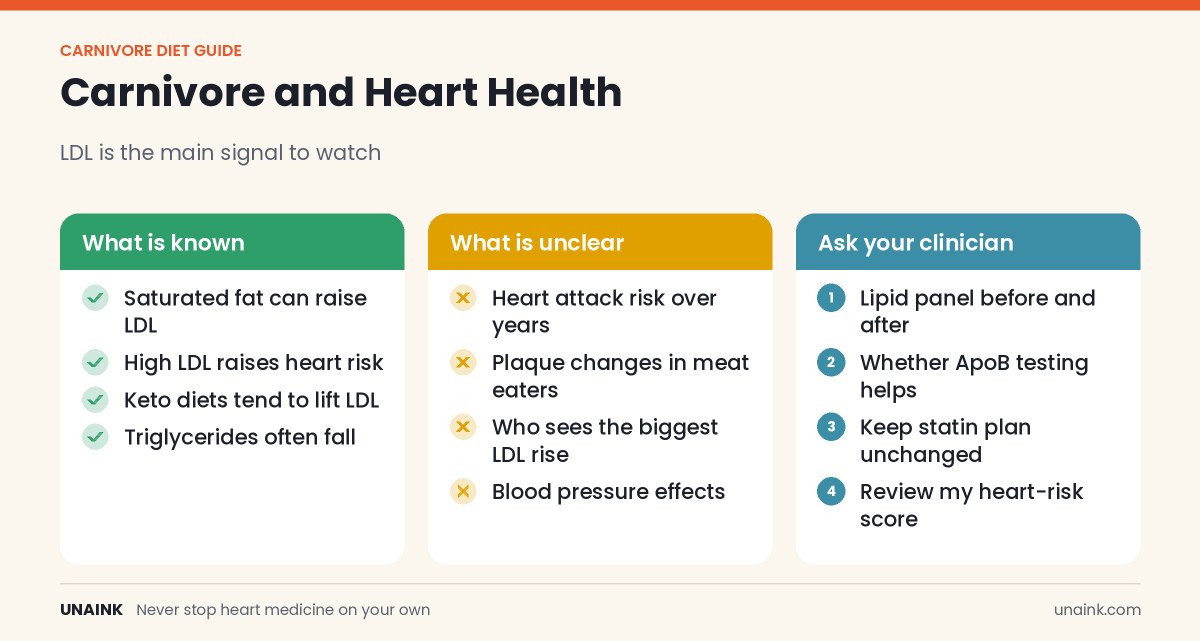
The American Heart Association explains that too much saturated fat can raise LDL, the so-called bad cholesterol, and that high LDL increases the risk of heart disease and stroke. Its saturated fat page recommends keeping saturated fat below about 6% of calories, roughly 13 grams on a 2,000-calorie plan, and swapping in unsaturated fats such as olive oil.
A ribeye, ground beef, butter, and tallow can add up past that limit quickly. If you eat that way, LDL is the number to watch, and it is worth reading is saturated fat bad for you for the broader debate.
What We Know About the Carnivore Diet and Heart Health
The 2026 scoping review gathered nine human studies. Here is what it found on heart-related measures.
| Measure | What reports show | Comment |
|---|---|---|
| LDL cholesterol | Rose in several studies; about 27% of one survey sample reported worse lipid profiles | The most consistent signal |
| Triglycerides | Improved in people with existing metabolic problems, but rose in metabolically healthy participants in one study | Mixed |
| Blood pressure | Not reported in any of the nine studies | Unknown |
| Heart attacks and strokes | Not measured in any study | Unknown |
| Body weight | Loss is commonly reported | Helpful for heart risk, but not unique to this diet |
The Case Supporters Make
Some followers argue that high LDL alongside low triglycerides and high HDL is a harmless pattern. That is a hypothesis, and nobody has tested it in carnivore eaters over decades. Cardiology groups still regard LDL as a driver of risk, and Harvard Health notes that keto-style diets tend to raise LDL in both the short and long term. The Cleveland Clinic dietitian also points out that the AHA advises limiting red meat.
Other Heart-Related Pieces
These pieces also shape carnivore diet and heart health beyond cholesterol alone:
- Electrolytes: low sodium, potassium, or magnesium can contribute to palpitations; see carnivore diet heart palpitations
- Fiber: a meat-only plan has almost none, which affects cholesterol handling and gut health
- Processed meats: bacon and sausages bring extra sodium and preservatives
- Weight: losing excess weight can lower heart risk, but that benefit is not exclusive to carnivore eating
Who Needs Extra Caution
A carnivore diet is not recommended without medical guidance for people with existing heart disease, a prior stroke, very high LDL, a family history of early heart disease, diabetes, high blood pressure, or kidney disease. It is also not recommended, and lacks safety evidence, in pregnancy, breastfeeding, or childhood. If you take a statin, blood pressure medicine, or a diuretic, do not change it yourself; diet changes can shift how much you need, and that call belongs to your prescriber.
If You Still Want to Try It
- Get a lipid panel and blood pressure reading before you start
- Repeat the panel after a few months and compare
- Ask whether additional tests, such as ApoB, make sense for you
- Discuss leaner cuts and fish as part of the mix, since the AHA suggests lean choices
- Have a plan for what you will do if LDL climbs sharply
Carnivore Diet and Heart Health: The Short Version
When it comes to the carnivore diet and heart health, the best-supported concern is rising LDL, and the gap is any evidence on real heart outcomes. Weigh the carnivore diet and heart health question with your own lab results and a clinician, not with testimonials alone.
Frequently Asked Questions
Does the carnivore diet raise cholesterol?
It often raises LDL. Several small studies reported increases, and about 27% of one survey sample reported worse lipid profiles. Individual responses vary, so measure rather than guess.
Is red meat bad for your heart?
Heart organizations advise limiting red meat and saturated fat, though research debates how much each contributes. See is red meat bad for you for the details.
Can I take a statin on the carnivore diet?
Statins are prescribed for a reason. Do not stop one because you changed your diet, and tell your prescriber about the change so they can follow your labs.
Does the carnivore diet lower triglycerides?
Many people report lower triglycerides, particularly those who had metabolic problems. One small study found triglycerides rose in metabolically healthy participants, so results are mixed.
Can the carnivore diet cause palpitations?
Electrolyte shifts can contribute in some people. Chest pain, fainting, or a racing heart that does not settle needs urgent medical care.
Conclusion
The carnivore diet may help weight and triglycerides for some, but rising LDL and missing outcome data leave the carnivore diet and heart health question unresolved. If you have heart risk, make it a clinician-guided decision and revisit it with new labs. For the wider picture, read carnivore diet high cholesterol.
Medical note
This article is for general education and is not medical advice. Talk with a doctor or registered dietitian before making major diet changes, especially if you have a health condition, take medication, or are pregnant or breastfeeding.
Keep Reading
- Carnivore Diet High Cholesterol: Why LDL can rise and what to do.
- Is Saturated Fat Bad for You?: The evidence on fat and heart risk.
- Carnivore Diet and Blood Pressure: Sodium, weight, and medicines.
- Carnivore Diet Heart Palpitations: Electrolytes and when to seek care.
Sources
- American Heart Association: Saturated fats: LDL, saturated fat limit, and heart disease risk
- Carnivore Diet: A Scoping Review of the Current Evidence: lipid findings and gaps
- Harvard Health: What is the carnivore diet?: keto diets and LDL
- Cleveland Clinic: The carnivore diet: saturated fat and AHA red meat advice
- Self-reported survey of 2,029 adults: self-reported lipid and health changes